
The One and the Ninety-Nine:
Forging Identity in the Age of Social Contagion
by luke burgis
st. martin’s press, 288 pages, $30
Whenever someone like Candace Owens or Nick Fuentes posts “ragebait,” it’s not difficult to predict how my friends will react. Public discourse, online and off, hews to scripts. Usually, the scripts we follow are determined more by our belonging to a particular social or ideological tribe than by convictions based on reasoning or the promptings of conscience. If the libs say X, then I, as a committed conservative, must say Y, and vice versa. But at the end of the day, what—concretely—does adopting one of the available scripts change? Is it even possible in the current climate to act with real agency?
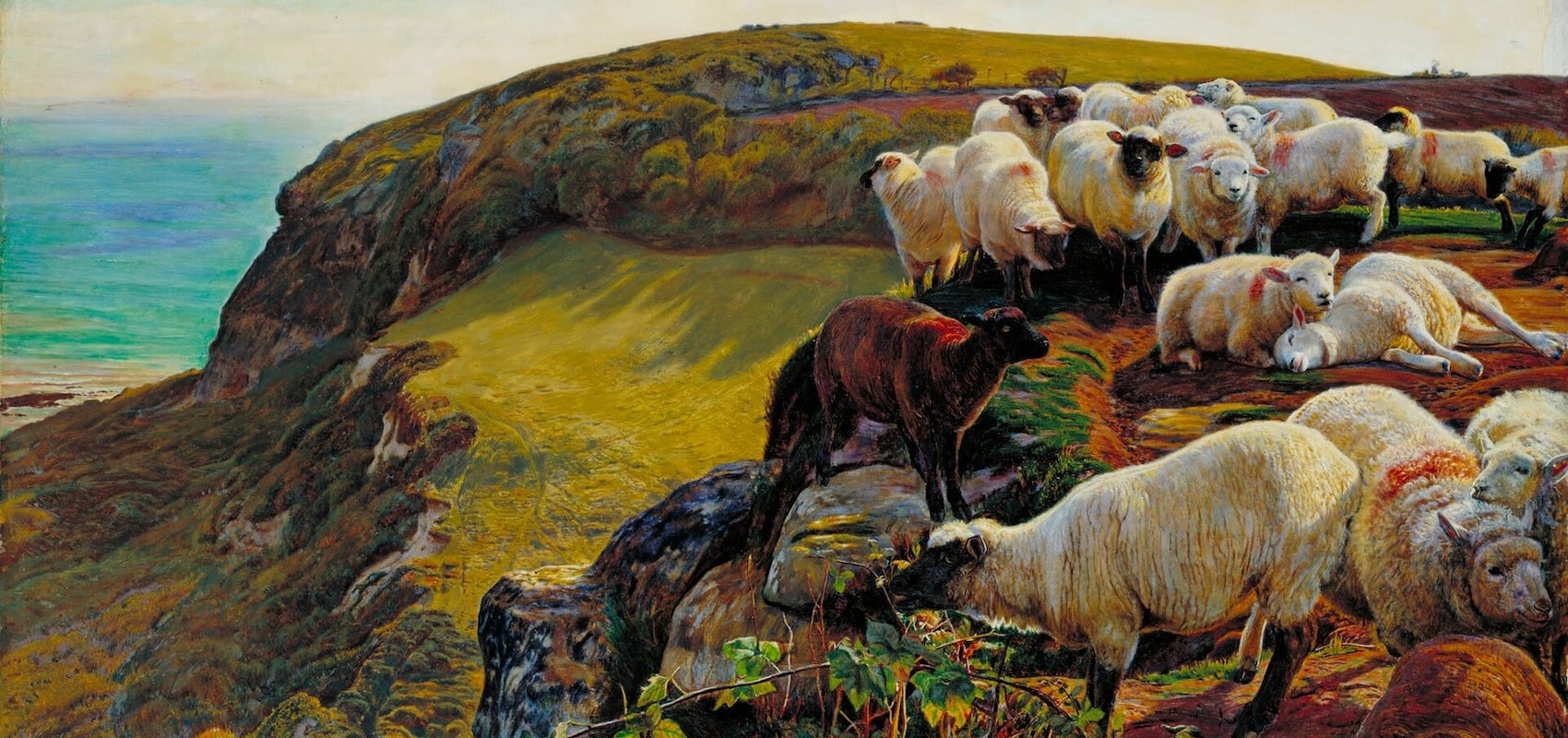
This dilemma is at the forefront of Luke Burgis’s latest book, The One and the Ninety-Nine: Forging Identity in the Age of Social Contagion. Building on his previous book Wanting, a primer on René Girard’s theory of mimetic desire, Burgis uncovers the hidden dynamics of the tribalism that pervades public discourse and offers a path toward recovering our individual agency, becoming a “solid self” in a sea of “pseudo-selves.” He uses the parable of the Good Shepherd, to which the book’s title alludes, as a lens to think through the complex relationship between the individual and the tribe.
Burgis applies the spiritual insights of the parable—about the paradoxical tension Christ maintains between communion and individuality, obedience and freedom, justice and mercy—to the realms of social psychology and public discourse. Accordingly, those who ignore the tension between the individual and the tribe, between “belonging and differentiation,” are bound to compromise their agency. Our dilemma is complicated because so much of our lives and relationships are dominated by the internet and mediated by ever-changing technologies. We are rendered vulnerable to the hidden forces of social contagion.
Burgis proposes that we maintain this tension by participating in communities that, while rooted in shared values, also allow individual members the freedom to challenge them. We must reinstitute rites of passage that both uphold an individual’s identity and solidify his belonging to the group, rites guided by elders who possess wisdom acquired through experience. In other words, we must revive cultures of mentorship. Ultimately, Burgis suggests that the best foundation on which to build a “solid self” is belief in the transcendent. Using the example of the historic “Using the example of the historic Benedictine monastery of Cluny (the namesake of the think tank Burgis founded and directs), he explains how the Christian faith is the ideal crucible for establishing one’s agency within the context of communal belonging.”? monastery of Cluny (the namesake of the think tank Burgis founded and directs), he explains how the Christian faith is the ideal crucible for establishing one’s agency within the context of communal belonging. What united the Cluniac monasteries “was not a top-down command structure or a charismatic leader,” but “a rule of life” written by St. Benedict. “If the monastery is a body, its rule is its nervous system—quietly coordinating, adapting, and transmitting signals about what matters most.”
Burgis has a knack for making complicated concepts accessible to a general audience and for proposing solutions that can be applied daily to one’s life. But above all, the book speaks to real problems plaguing our times, whose consequences I feel acutely in my own experience. As much as I may try to laugh off the ragebaiting of online influencers, I can’t deny the effect they have on people I know—namely, my students.
Their way of thinking through current events and broader questions about truth and human nature is dominated by simplistic, algorithm-driven scripts. When I asked one student how he arrived at his conclusion that the “real message” of The Apology of Socrates is that “men need to return to Bronze Age values,” he cited a popular TikToker. Indeed, few of my students are able to arrive at a conviction using their own reasoning. Beyond the classroom, social contagion drives much of their “activist” efforts. Take the “anti-racist” students who staged a sit-in demanding the administration establish an Africana studies minor, or the “Christian nationalist” students who had a rosary rally to “take back our America from the godless liberals.” This so-called “activism” looks more like the performance of a script inspired by TikTok reels than genuinely agentic acts intended to “make a difference” in the world.
Burgis’s work has challenged me personally to examine my commitment to going against the grain. I often justify my contrarian temperament as necessary to break through conventional narratives and provoke deeper thought in my readers and students. But Burgis has opened my eyes to how the very effort to distinguish oneself from the crowd is easily co-opted. Drawing on Girard’s concept of mimetic rivalry, Burgis insists that “when people try to stand out through rivalry, they usually end up more alike than different.” Reactionary ideas that result from contrarianism for its own sake, rather than from principle, tend to participate in and reinforce a zeitgeist defined by the interplay of rival scripts. Take the red-pilled “truther” who believes evolutionary psychology is a sure guide to understanding the female mind—the more rigid his script, the more it traps him in the romantic loneliness he believes the zeitgeist has determined as his lot. Rather than exercising true agency, he risks becoming what he dreads most: an NPC. While The One and the Ninety-Nine offers no easy solutions, it has certainly provided me with the conceptual framework necessary to seek them out. Rather than taking rivals as our points of reference, Burgis recommends looking to the Good Shepherd himself as our principal model for identity formation.
Above all, I applaud Burgis for bringing his faith to bear on debates about AI, social media, and other technologies, especially at a time when the public’s attitude toward religion is changing so rapidly. On the one hand, there’s an apparent uptick in Zoomer converts to Catholicism, and Silicon Valley increasingly endorses traditional monotheism (perhaps at the risk of diluting or distorting it); on the other, most of the political left preaches that religion is a regressive force best left in the past or treated as a mere museum piece. It is a risky time for those applying religious truths to major social questions.
But Burgis both avoids heavy-handed proselytizing and refuses to water down religious truths to make them more palatable. Driven by his earnest desire to live his faith in the realm of Big Tech, Burgis produces work marked by integrity and sincerity, making him a credible voice before an audience traditionally thought unlikely to listen. For this, he should be commended.
Dear Reader,
Can I be direct with you?
War abroad. Socialists on the rise. AI upending human life. Endless uproar online. The modern attention economy doesn’t want readers — it wants users enslaved to the tyranny of the present.
First Things is the antidote: literary excellence, timeless truths, and a fixed point of reference in a culture that has lost its bearings.
But we can’t do it without readers like you.
Our goal: Raise $150,000 by November 1 to sustain First Things in the year ahead.
Your gift anchors readers in the permanent things.
Make your Fall Campaign gift now using the button below.
If you have any questions or would like more information, please contact Giovanni Del Piero, Director of the Editor’s Circle, at gdelpiero@firstthings.com or 212-627-1985.

YOU MIGHT ALSO LIKE
A Culture of Parricide
I learned a new word the other day: déploration. It’s the French, directly from the Latin, for “lament.”…
Prime Rib of Unicorn
Of all the titles I’ve been tracking this year, the one I am most delighted to have…
Three TikToks in a Trench Coat
On today’s episode, Meagan O’Rourke joins Virginia and Germán. Reporting on Gen-Z trends has become trendy. It’s…
