
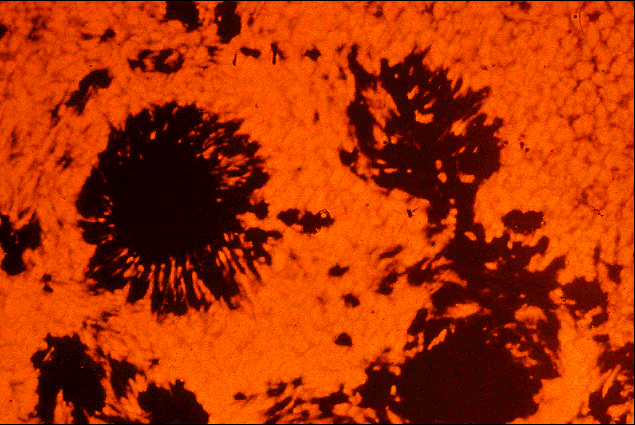
 Solar scientists are beginning to come out of the closet as skeptics about human-caused global warming. From “It’s the Sun, Stupid,” by Lawrence Solomon in Canada’s National Post:
Four years ago, when I first started profiling scientists who were global warming skeptics, I soon learned two things: Solar scientists were overwhelmingly skeptical that humans caused climate change and, overwhelmingly, they were reluctant to go public with their views. Often, they refused to be quoted at all, saying they feared for their funding, or they feared other recriminations from climate scientists in the doomsayer camp. When the skeptics agreed to be quoted at all, they often hedged their statements, to give themselves wiggle room if accused of being a global warming denier. Scant few were outspoken about their skepticism.
Yes, I have seen the same corruption of science first hand in the stem cell debates. That’s what happens when ideology pretends to be science. But back to the sun-cause meme:
Earlier this month, the link between solar activity and climate made headlines throughout Europe after space scientists from the U.K., Germany and South Korea linked the recent paucity of sunspots to the cold weather that Europe has been experiencing. This period of spotlessness, the scientists predicted in a study published in Environmental Research Letters, could augur a repeat of winters comparable to those of the Little Ice Age in the 1600s, during which the Sun was often free of sunspots. By comparing temperatures in Europe since 1659 to highs and lows in solar activity in the same years, the scientists discovered that low solar activity generally corresponded to cold winters. Could this centuries-long link between the Sun and Earth’s climate have been a matter of chance? “There is less than a 1% probability that the result was obtained by chance,” asserts Mike Lockwood of the University of Reading in the U.K., the study’s lead author.
Solar scientists widely consider the link between the Sun and Earth’s climate incontrovertible. When bodies such the IPCC dismiss solar science’s contribution to understanding Earth’s climate out of hand, solar scientists no longer sit on their hands. Danish scientist Henrik Svensmark of the Danish National Space Institute stated that the IPCC was “probably totally wrong” to dismiss the significance of the sun, which in 2009 would likely have the most spotless days in a century. As for claims from the IPCC and other global warming doomsayers who argue that periods of extreme heat or cold were regional in scope, not global, Svensmark cites the Medieval Warm Period, a prosperous period of very high solar activity around the year 1000: “It was a time when frosts in May were almost unknown — a matter of great importance for a good harvest. Vikings settled in Greenland and explored the coast of North America. On the whole it was a good time. For example, China’s population doubled in this period.”
So, does solar activity explain the warming trend of the last century, and does its reduction explain the unexpected pause in the projected warming trajectory? I don’t know, but it is consistent with evidence of warming on other planets. But this much is sure, man-caused global warming is not a fact. We need to take a step back and let all the scientists with relevant knowledge weigh in before giving into global warming hysteria.
Dear Reader,
Can I be direct with you?
War abroad. Socialists on the rise. AI upending human life. Endless uproar online. The modern attention economy doesn’t want readers — it wants users enslaved to the tyranny of the present.
First Things is the antidote: literary excellence, timeless truths, and a fixed point of reference in a culture that has lost its bearings.
But we can’t do it without readers like you.
Our goal: Raise $150,000 by November 1 to sustain First Things in the year ahead.
Your gift anchors readers in the permanent things.
Make your Fall Campaign gift now using the button below.
If you have any questions or would like more information, please contact Giovanni Del Piero, Director of the Editor’s Circle, at gdelpiero@firstthings.com or 212-627-1985.

YOU MIGHT ALSO LIKE
The Church in the Age of Therapy
In 1966, Philip Rieff wrote in The Triumph of the Therapeutic that “Religious man was born to…
Canada’s Deadliest Blind Spot
On September 20, the Daily Mail ran a story with the provocative headline, “Our 83-year-old Christian grandmother…
The Faithful Joy of Dolly Parton and Fulton Sheen
Dolly Parton and Fulton Sheen seem to have had little in common. She favored rhinestones; he wore…
