
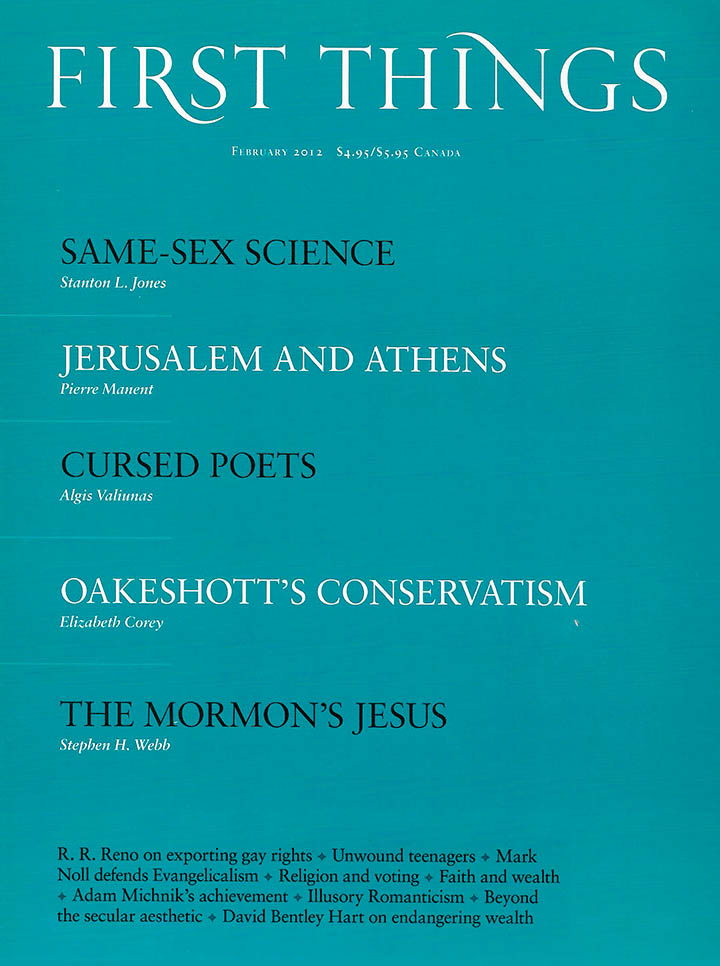
It was a telling speech, Hillary Clinton’s address to the United Nations Human Rights Council in recognition of International Human Rights Day. The secretary of state drew attention to the brutal treatment of homosexual people around the world: lesbians raped by groups of men, gay men murdered after public rallies denouncing homosexuality, and other instances in which homosexuals (or those simply suspected of homosexuality) are “arrested, beaten, terrorized, even executed.” There is indeed plenty to protest against, and Article 5 of the Universal Declaration of Human Rights provides an explicit reason to do so: “No one shall be subjected to torture or to cruel, inhuman or degrading treatment or punishment.”
Enforcing the existing standards of the Universal Declaration, however, was not the Obama administration’s goal. “Gay rights,” Clinton declared, “are human rights.” Being a homosexual is “like being a woman, like being a racial, religious, tribal minority,” and therefore deserves the same affirmative protection that other minorities should receive. As the speech, and a White House memorandum released the same day, made clear, the administration wants to enroll sexual liberation in the larger human-rights movement.
Clinton observed that the “obstacles standing in the way of protecting the human rights of LGBT people rest on deeply held personal, political, cultural, and religious beliefs.” And, “People cite religious or cultural values as a reason to violate or not to protect the human rights of LGBT citizens.” She is right to suggest that our convictions often become excuses for exercising our perverse love of violence. Moral judgments focus the fury of those who inflict gruesome public punishment, and they incite vigilante mobs that track down transgressors. Women are stoned for adultery or become victims of honor killings at least in part because their real or imagined transgressions evoke moral horror. The same is undoubtedly true of violence against homosexuals.
There are ways to humanize our moral horror and reduce its capacity to lead to violence and injustice. Christianity urges us to adopt the disposition of charity or love that allows us to see and affirm the intrinsic dignity of the human person, an inviolable dignity we should not deny, no matter how we feel about the person’s actions. Hate the sin; love the sinner. It’s a formulation much mocked by gay activists, but drawing a distinction between transgression and the essential humanity of the transgressor limits our moral horror, focusing it on actions rather than persons.
In the early modern period, a secular and pragmatic way of thinking largely superseded religious rationales as a way of moderating the blows of moral judgment. Liberals encouraged the virtue of tolerance, a disposition that involves enduring what one objects to. After all, perhaps there’s not a lot we can do about what we find morally repugnant, and therefore we have to live with it. Or maybe we see that punishing or denouncing would do more harm than good. Or we recognize that when it comes to objectionable behavior our own lives are not exactly spotless. So we repress our impulse to denounce and punish: Do unto others as you would have them do unto you.
The contemporary liberal solution is quite different, involving the typically modern desire to get at “root causes” and promote “systemic change.” We are often told that we must overcome the obstacles that Clinton identifies”“deeply held personal, political, cultural, and religious beliefs””not by rooting them in the humane and humanizing elements of these beliefs, as the Christian way of charity seeks to do, nor even by limiting or moderating them with pragmatic considerations that encourage tolerance, but by eliminating them.
Humanizing or moderating moral horror is not easy to do, and modern liberalism imagines it to be much simpler to deny the moral horror in the first place. This helps explains the long-term ambition of gay activists to get rid of the cultural and religious basis for thinking that homosexuality is immoral, a goal that requires vigorous censorship and reeducation, as we see in the major media, the universities, and the other institutions controlled by contemporary liberals.
Am I reading too much into the speech? I don’t think so. In promoting gay rights, Clinton turns to the usual analogies. “This is not unlike the justification offered for violent practices toward women like honor killings, widow burnings, or female genital mutilation.” And then for good measure she points out that people have given religious justifications for slavery as well.
The supposed forces of progress need not worry: “In each of these cases, we have come to learn that no practice or tradition trumps the human rights that belong to all of us.” Clinton is confident that those whom she suggests are barbaric, irrational bigots and the cultural and religious traditions they represent will be defeated by enlightened views about sex. “As it has happened so many times before, opinion will converge once again with the truth, the immutable truth, that all persons are created free and equal in dignity and rights.” Sexual liberation owns the future, and so Clinton concludes with one of the most chillingly cruel slogans of modern ideology: “Let us be on the right side of history.”
In recent decades international institutions have emerged, some of them official bodies of the United Nations and others part of a large network of nongovernmental agencies that are funded by Western governments. These institutions, along with significant portions of our own diplomatic bureaucracy, as well as those in other Western countries, have largely adopted human rights as their rationale and source of legitimacy. This complex, interlocking network is part of the “soft power” that many liberals believe should supersede the “hard power” of military force. The long-term hope is that legal adjudication will replace force and intimidation as the motor of global politics.
As Clinton’s speech and an accompanying memorandum make clear, the Obama White House wants to add gay rights to the exercise of America’s “soft power.” The State Department will use aid recipients’ treatment of homosexuals to evaluate their suitability for aid, and will be setting aside $3 million to fund NGOs that fight for gay rights.
The change is not surprising. Guaranteeing sexual liberation”unrestricted abortion, sex education, easily accessible and subsidized contraception, and gay rights”has become one of the major commitments of the Democratic party, and it is natural for a political party to shape policies in accord with its core commitments. Yet in this instance I’m struck by the arrogance.
In the first place, and unlike the main elements of the Universal Declaration of Human Rights, sexual liberation has no roots in the traditional cultures and religious traditions that shape the lives of the vast majority of people in the world. The world’s religious traditions are deeply complex, and it is true that they have endorsed many inhuman practices. Nonetheless, one can find plenty of Jewish, Christian, Buddhist, and other traditional sources for condemning widow burning or for that matter slavery, as Andrew Wilson’s recent essay on the early sixteenth-century Dominican friar Antonio de Montesinos reminded us (“With What Right and What Justice?” December 2011).
But sexual liberation, especially homosexual liberation? It’s an imperative that seems not to have occurred to anyone until the emergence of a secular culture in the West. For this reason”and again unlike most of the rest of the human rights project”making sexual liberation and gay rights part of the “global consensus” that Clinton views as the inevitable direction of history will require a very aggressive campaign of cultural imperialism against traditional cultures and religions.
Some Africans certainly think so. Last October, British Prime Minister David Cameron gave a speech not unlike Hillary Clinton’s, suggesting that his nation’s foreign aid would be cut to countries that did not recognize gay rights. The Nigerian response was to criminalize same-sex marriage and homosexual cohabitation. As Senator Ahmed Lawan put it: “This is to be pro-active so no one catches us unaware.”
In the second place, when Jimmy Carter made human rights an explicit priority in foreign policy, he was appealing to moral principles that the overwhelming majority of Americans have endorsed for a very long time. This is not the case with gay rights. The majority of Americans have many of the “deeply held personal, political, cultural, and religious beliefs” that are obstacles to the progressive goal of turning the sexual revolution of the 1960s into personal civil rights protected and advanced by the state. Under normal conditions, this fact would give our leaders pause. We have a long tradition of conducting American foreign policy on the basis of a broad national consensus that does not shift from party to party. Apparently the Obama White House does not think much of this long tradition, which it will not allow to stand in the way of gay rights.
As Urvashi Vaid, former executive director of the National Gay and Lesbian Task Force and now director of a gender and sexuality program at Columbia Law School, observed about Clinton’s speech and the new Obama White House policies: “This is a breakthrough moment, achieved by a small group of U.S. activists and allies who have been working quietly to get the government here.” Yes, that sounds about right: a self-appointed progressive vanguard “working quietly” to overcome what Richard Socarides, a former advisor to Bill Clinton, described in his own reaction to Hillary Clinton’s speech as “the right-wing craziness we have here.”
So there we have American liberalism in a nutshell. Vaid and Socarides are not marginal people. On the contrary, they are members of the liberal elite that imagines itself the enlightened governors of the morally benighted. Americans have largely adopted a live-and-let-live attitude to sexual morality, but there is no domestic consensus about gay rights, in large part because Americans have a great deal of experience with liberal arrogance and recognize the authoritarian implications of Hillary Clinton’s talk of “obstacles.” This lack of consensus gives no pause. The White House is turning one of the most divisive issues in our current domestic battle over culture into a principle guiding the American effort to influence and shape culture throughout the world. Senator Lawan and his Nigerian colleagues are wise to be wary, very wary.


YOU MIGHT ALSO LIKE
Who Killed the Clancy Children?
After a Massachusetts jury failed to convict Lindsay Clancy of strangling her three small children to death…
A Terrible Coarsening
The now-ubiquitous terms “reproductive health” and “reproductive freedom” have contributed mightily to a slaughter of the innocents…
The Stench of Corruption
The Trump family’s exploitation of every opportunity to enrich themselves demoralizes me, as I’m sure it does…
