
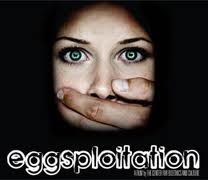
 I am a special consultant to the Center for Bioethics and Culture—but had nothing to do with the creation of the important documentary Eggsploitation (although I do have one line in it). The movie deals with the dangers of egg donation, and is now being shown at film festivals. Jennifer Lahl, the CBC’s head and driving force behind its production, has been promoting the movie. Some media are taking notice. From a column by Rebbecca Hagelin:
Jennifer Lahl is a kind, deeply caring woman. A health care worker for 25 years, she has seen medical care at its best — when it gives fresh hope and renewed health to suffering patients. These days, Ms. Lahl is a passionate advocate on behalf of young women who’ve experienced medical care at its worst. In the upside-down world of assisted reproduction, too many fertility specialists have dashed the hopes and compromised the health of previously healthy young women — egg donors.
All true. Jennifer rocks and rolls. But to the point of the movie:
Our young women need to know the truth. Egg donation exploits young women for the benefit of older women. The fertility business needs an increasing supply of “donor eggs” from healthy, fertile young women. The pitch? Money. Students and young women don’t have much, but many older infertile couples do. Donor agencies place ads in university newspapers or on craigslist.com, promising anywhere from $5,000 to $50,000 to women who donate eggs. Repeat donations (up to six) are encouraged. Economically vulnerable young women face an undue temptation to trade their eggs for money.
Egg donation itself carries significant risks because it requires fertility drugs, anesthesia, and invasive egg retrieval. Donors take drugs first to induce temporary menopause, then to hyperstimulate the ovaries so they’ll produce from 16 to 35 eggs in one cycle. Worse, doctors really don’t know the long-term risks to egg donors, because so few studies have been done. And fertility specialists are in no hurry to find out.
Fertility treatments are big business, generating layers of people who depend on its expansion: Doctors who retrieve, fertilize, and implant eggs; pathologists and lab technicians who grade, sort, store, and test eggs and embryos; agencies that match donors and parents; lawyers to write contracts; counselors to screen donors and parents. There’s money to be made — and the easiest, cheapest payoff goes to egg donors. Women’s bodies become mere commodities in a larger business.
Human eggs are probably—ounce for ounce—the most valuable commodity on the planet, grasped for by the infertile and bioscientists for use in cloning. Where great money can be made, industries easily follow. And that can threaten young women with being turned into commodities.
Eggsploitation is non partisan, by which I mean, it unites Left and Right in joint concern for the health of young women—and the destitute overseas—too easily targeted for harvesting. I am very pleased that Jennifer’s movie is making waves. It should.
Dear Reader,
Can I be direct with you?
War abroad. Socialists on the rise. AI upending human life. Endless uproar online. The modern attention economy doesn’t want readers — it wants users enslaved to the tyranny of the present.
First Things is the antidote: literary excellence, timeless truths, and a fixed point of reference in a culture that has lost its bearings.
But we can’t do it without readers like you.
Our goal: Raise $150,000 by November 1 to sustain First Things in the year ahead.
Your gift anchors readers in the permanent things.
Make your Fall Campaign gift now using the button below.
If you have any questions or would like more information, please contact Giovanni Del Piero, Director of the Editor’s Circle, at gdelpiero@firstthings.com or 212-627-1985.

YOU MIGHT ALSO LIKE
The Church in the Age of Therapy
In 1966, Philip Rieff wrote in The Triumph of the Therapeutic that “Religious man was born to…
Canada’s Deadliest Blind Spot
On September 20, the Daily Mail ran a story with the provocative headline, “Our 83-year-old Christian grandmother…
The Faithful Joy of Dolly Parton and Fulton Sheen
Dolly Parton and Fulton Sheen seem to have had little in common. She favored rhinestones; he wore…
