
Twenty-five years ago Allan Bloom proclaimed a heresy: The supposed idealism of the 1960s was in fact a veneer hiding a new barbarism. He saw that our elite liberal culture has a very definite vision, however much it talks about diversity, multiculturalism, and the like: the relativism of moral truth. This anti-dogmatic dogma, he thought, is leading to an intellectual crisis: We no longer think about the things we must think about to live truly human lives.
The Closing of the American Mind unsettled me when I first read it as a graduate student at Yale. My professors and fellow students were good people, and they believed some things are worthy and admirable. Academic excellence, obviously, but also loyal friendship, concern for the common good, and so forth. And they thought other things shameful and wrong, such as harming others, or coercing them.
But therein lay the problem. The therapeutic mentality that came to predominate in mid-twentieth-century America views confident assertions of moral truth as a kind of coercion. Therefore, postmodern liberalism seeks to build a culture of moral relativism, not because it seeks to promote immorality or amoral disregard for others, but because it wants a society where people aren’t harmed and coerced by morality. As Bloom wrote, “The relativity of truth is not a theoretical insight but a moral postulate.”
When I say that the Lord God of Israel is the one true God, or even that God exists, I’m putting a great deal of pressure on those who think otherwise. Moral truths are even more fraught. Today, “Homosexual acts are immoral” and “same-sex marriage debases the institution of marriage” are heard as fighting words, and in some circles denunciated as hate speech.
Bloom never put it quite so clearly, but twenty-five years ago he certainly recognized that relativism dominated elite education. The young person going to college in the last few decades is often quickly socialized into the moral mission of moral relativism. He learns to soften his views. “Well, just speaking personally,” he now says. And, “From my experience.” He begins to value “diversity.” Or he acquires a critical superiority that talks of “subtexts” and “power interests” and “heterosexism.” These are the phrases and concepts that neutralize the commanding power of moral truth: It is just an expression of preferences—or a mask for will to power.
In fairly short order the academic establishment closed ranks against The Closing of the American Mind . The presumption prevailed that Bloom’s full-throated attack on relativism was meant to prepare the way for a restoration of traditional modes of moral authority. A particularly agitated critic denounced Bloom as a “Hitlerite.”
In the Weekly Standard Andrew Ferguson offers his own analysis of the significance of Bloom’s surprise bestseller, and he makes it clear that there was something absurd in the critical responses. “Bloom was never a movement conservative. In electoral politics he was a moderately liberal Democrat, and more liberal still in personal and social matters.” An academic mandarin, “he was no fan of the free market or the heedless getting and striving it encourages.” A homosexual, he did not call for the restoration of family values. “I am not,” he wrote, “arguing here that the old family arrangements were good or that we should or could go back to them.”
But he saw that the dogma that has come to dominate elite culture in America, the dogma that there are no dogmas, involves a renunciation of the ageless desire of all cultures, which is to discipline our desires, to direct ourselves toward ideals and inculcate feelings of shame when we transgress. This requires authoritative truths, robust and demanding truths, truths that, like the angel of God at the ford of Jabbok, must be wrestled with.
In Plato’s dialogues, which Bloom loved and taught, Socrates challenges his interlocutors in order to loosen the bonds of prevailing beliefs. However, this was not in the service of the “critical freedom” so cherished today. Socratic reason attacks convention in order to make us vulnerable to the deeper and more intimate voice of timeless truth. He breaks with reason what can be broken so that we’re forced to confront—and live in accord with—what is unbreakable.
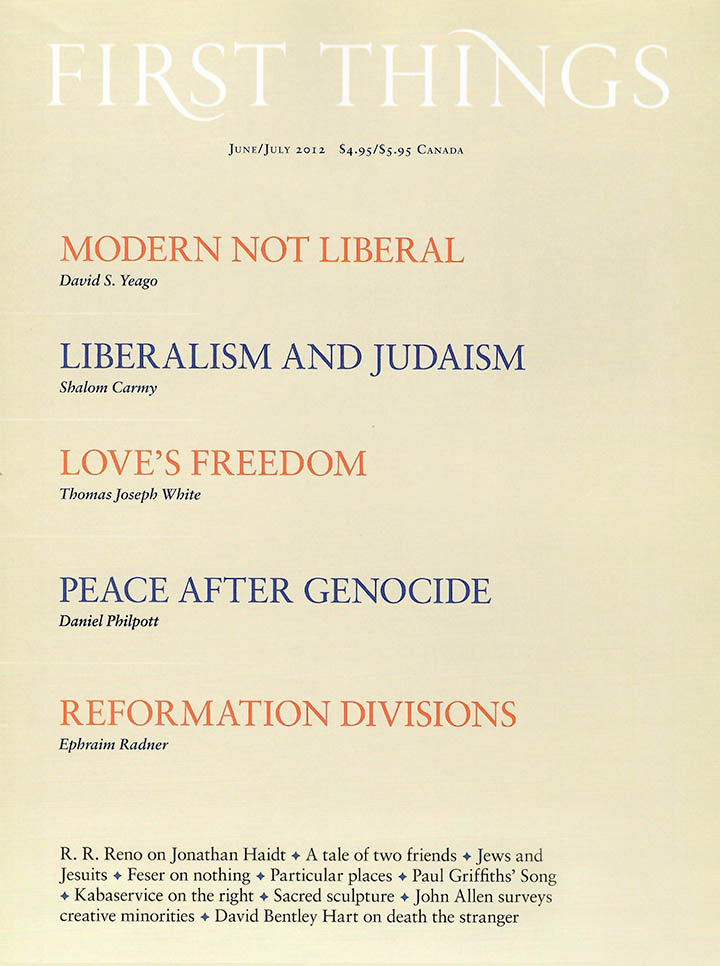
Our culture war in America isn’t only between the one-eyed liberals and conservatives with two eyes, as Jonathan Haidt suggests. It’s that, to be sure. But it’s also a struggle over whether or not we’re to sustain the age-old task of high culture, which involves using reason to pierce the complacent armor of convention in order to understand afresh the commanding truths that ought to shape our tastes, our loves, and our lives. High culture involves debate, to be sure, but that debate takes on its urgency because it involves what is true, good, and beautiful. It’s a debate that renews rather than relaxes the force of commanding truths.
Liberalism today allies itself with moral relativism: Commanding truths are “judgmental,” they harm and oppress. That’s why the contemporary university dominated by liberalism has largely abandoned the tasks of high culture, not the least of which is to stipulate a substantive core curriculum. We don’t have them today because they necessarily involve authoritative judgment: This is worth reading, this must be known, this is more important than that.
Any culture worth its salt must seek to be a high culture, making rather than avoiding authoritative judgments that people must wrestle with. Liberals are again one-eyed. Yes, the authoritative judgments of high culture wound our egos (it’s not fun to realize that one has Philistine tastes). Jacob limped. But to wrestle with ultimate questions—and to venture convictions—also ennobles our lives.
The Closing of the American Mind was written to warn us of the enervating, dehumanizing effect of moral relativism. If there are no commanding, authoritative truths to guide us, then we must live in accord with . . . well, with whatever. Bloom saw that there was nothing Socratic, nothing ennobling about “whatever.”


YOU MIGHT ALSO LIKE
Who Killed the Clancy Children?
After a Massachusetts jury failed to convict Lindsay Clancy of strangling her three small children to death…
A Terrible Coarsening
The now-ubiquitous terms “reproductive health” and “reproductive freedom” have contributed mightily to a slaughter of the innocents…
The Stench of Corruption
The Trump family’s exploitation of every opportunity to enrich themselves demoralizes me, as I’m sure it does…
