
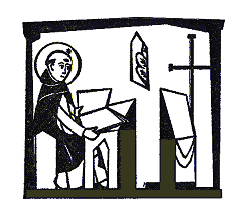
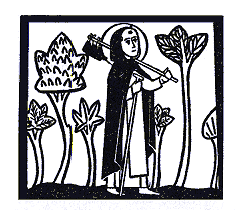
Picture a Franciscan praying, and the Poverello of Assisi comes to mind: a coarse-robed friar, alone in the woods, arms outstretched to heaven. Picture a Benedictine or Carthusian, and Into Great Silence resonates: a tonsured monk, reciting psalms in a darkened choir stall. Picture a Jesuit, a plain-clothed priest meditating imaginatively on the Gospels; or a Missionary of Charity, a sari-clad nun contemplating the cry of the Crucified. Each gives a glimpse into the diverse richness of life in Christ.
Picturing a Dominican in prayer is more difficult. Called to preach, the Dominican forms his minds through ongoing study—an intense quest for truth. But, as Fr. John Vidmar, OP, shows the lay reader in this newly published little volume  , Dominican spirituality is about more than the life of the mind. It is, in essence, about the life of the whole person—as relevant now as it was in the thirteenth century.
Dominic founded his order of mendicant preachers to counter the raging anti-worldly dualism of the Albigensian heresy. “It seems impossible to recall these men to the Faith by words alone,” he realized. “We must attack them rather by our example.” Thus, while living a life of apostolic poverty, he and his friars sought to affirm the goodness of the created world.
We should pray bowing, prostrating, kneeling, standing, reading, thinking, says an early manuscript on Dominic’s ways of prayer ; prayer uses the mind in unity with the body. As Conrad Pepler, twentieth-century Dominican theologian, reiterates: “It is not prayer when I merely weave theological pattern out of the truths of faith; but it is prayer when, contemplating God revealed to me, I find him to be so loveable that my heart longs for his company.”
In what has become a Dominican motto, Thomas Aquinas urged his fellow preachers to “contemplate and share the fruits of contemplation.” It’s a powerful merging of the vita contemplata and the vita activa : Giving birth to the divine Word, and presenting him to the world. Moreover, it is an ideal that all Christians can, and should, aspire to—the call of discipleship.
Dear Reader,
Can I be direct with you?
War abroad. Socialists on the rise. AI upending human life. Endless uproar online. The modern attention economy doesn’t want readers — it wants users enslaved to the tyranny of the present.
First Things is the antidote: literary excellence, timeless truths, and a fixed point of reference in a culture that has lost its bearings.
But we can’t do it without readers like you.
Our goal: Raise $150,000 by November 1 to sustain First Things in the year ahead.
Your gift anchors readers in the permanent things.
Make your Fall Campaign gift now using the button below.
If you have any questions or would like more information, please contact Giovanni Del Piero, Director of the Editor’s Circle, at gdelpiero@firstthings.com or 212-627-1985.

YOU MIGHT ALSO LIKE
The Church in the Age of Therapy
In 1966, Philip Rieff wrote in The Triumph of the Therapeutic that “Religious man was born to…
Canada’s Deadliest Blind Spot
On September 20, the Daily Mail ran a story with the provocative headline, “Our 83-year-old Christian grandmother…
The Faithful Joy of Dolly Parton and Fulton Sheen
Dolly Parton and Fulton Sheen seem to have had little in common. She favored rhinestones; he wore…
