
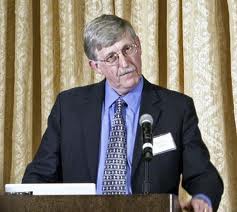
 What difference does it make if Francis Collins is a Christian and Christopher Hitchens is an atheist? Hitchens has cancer and Collins is working on individualized cancer treatments based on genetics. But that is the hook for this Telegraph story:
The author of God is Not Great: How Religion Poisons Everything said that he is a “guinea pig” for a new personalised medicine partly developed by Dr Frank Collins, a geneticist with very strong religious views. The two had often met in the past as adversaries in the debate about whether God exists. Against the odds they had become friends. Now Hitchens is one of the few people in the world who has had his entire genetic make up mapped and is receiving a new treatment that targets his own damaged DNA. “I’m an experiment,” Hitchens said. “These are early stages, but in theory it should attack the primary site of the tumour. “If that does happen, it won’t just be good news for me, it will be very exciting in the general treatment of cancer.”
Dr Collins is a former director of the National Human Genome Research Project and is now the director of America’s National Institutes of Health. He is the author of a bestselling book, The Language of God: A Scientist Presents Evidence for Belief.
I trust an atheist geneticist would just as readily help a Christian or a Muslim as Collins is helping an atheist. It. Should. Make. No. Difference.
The real and exciting story here is the advance of individualized medicine:
The prognosis looked very grave until a few weeks after his diagnosis he was asked if he would like to be a guinea pig in the new science of genome sequencing as a possible cure for cancer. Samples were taken from healthy tissue and from his tumour and on each of them six billion DNA matches were run, in order to catalogue any mutations found in the cancerous cells. He was warned to have no expectations. But in the New Year came the good news that there is a genetic mutation found in the tumour for which there already exists a drug. Having been on varying types and doses of chemotherapy, he is now on a regime of one pill a day.
Hitchens deserves our best wishes—and for those so inclined, prayers—although as we’ve discussed here at SHS, praying for him should not be used as a cudgel in the religion versus atheism disputes. Let’s hope this works, both for Hitchens and for the future betterment of cancer therapies.
Dear Reader,
Can I be direct with you?
War abroad. Socialists on the rise. AI upending human life. Endless uproar online. The modern attention economy doesn’t want readers — it wants users enslaved to the tyranny of the present.
First Things is the antidote: literary excellence, timeless truths, and a fixed point of reference in a culture that has lost its bearings.
But we can’t do it without readers like you.
Our goal: Raise $150,000 by November 1 to sustain First Things in the year ahead.
Your gift anchors readers in the permanent things.
Make your Fall Campaign gift now using the button below.
If you have any questions or would like more information, please contact Giovanni Del Piero, Director of the Editor’s Circle, at gdelpiero@firstthings.com or 212-627-1985.

YOU MIGHT ALSO LIKE
The Church in the Age of Therapy
In 1966, Philip Rieff wrote in The Triumph of the Therapeutic that “Religious man was born to…
Canada’s Deadliest Blind Spot
On September 20, the Daily Mail ran a story with the provocative headline, “Our 83-year-old Christian grandmother…
The Faithful Joy of Dolly Parton and Fulton Sheen
Dolly Parton and Fulton Sheen seem to have had little in common. She favored rhinestones; he wore…
