
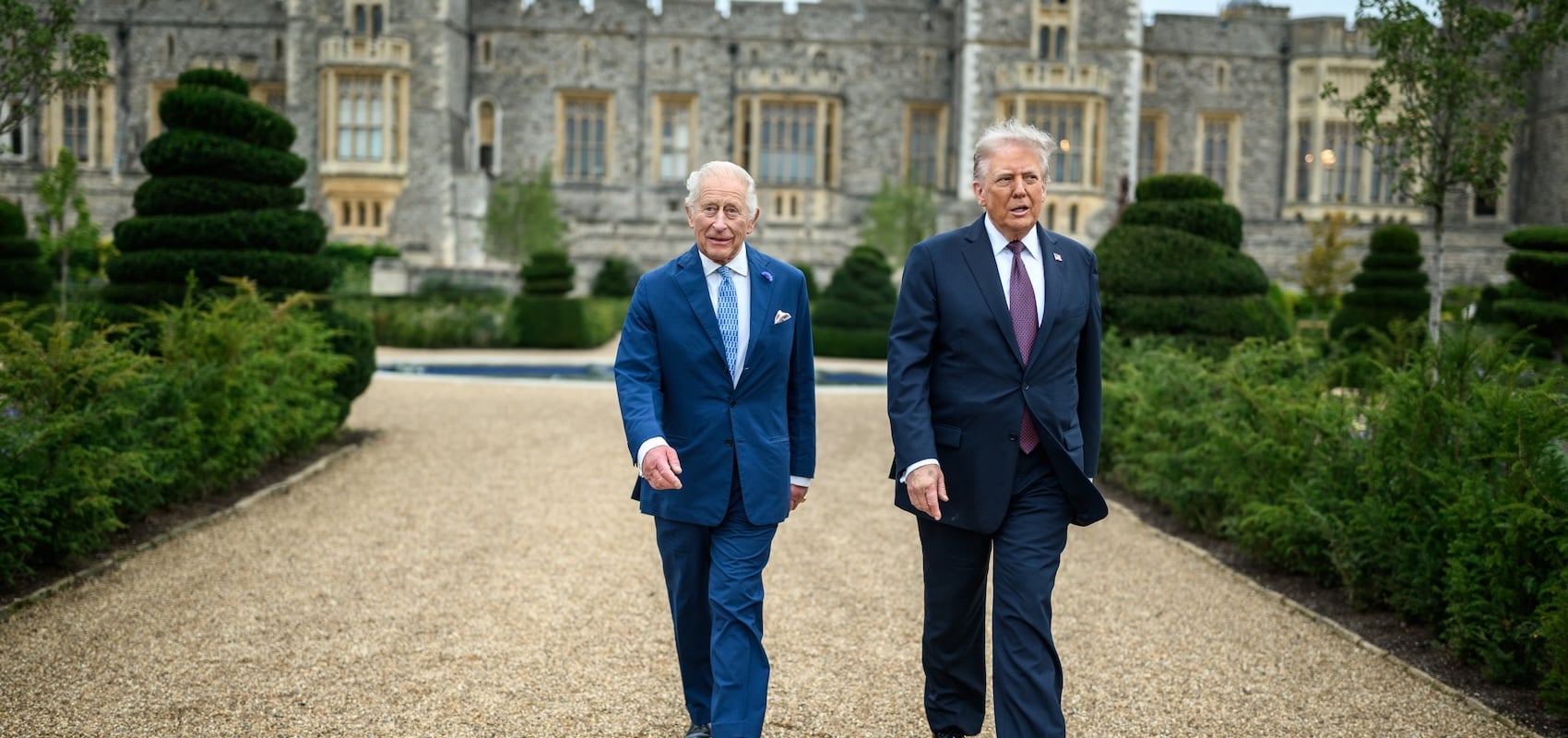
Amid rampant speculation about what King Charles would say and do on his state visit to the United States, and what outrages Donald Trump might cause, few commentators took much interest in the relationship that exists between the two men. The lazy shorthand is to describe the president as a brash vulgarian, tolerated by Charles out of his lifelong adherence to royal duty, and the monarch as a poet-king of sorts, reluctantly leaving his rural idyll in Gloucestershire to perform the tasks of state.
There is some truth in this, but what it ignores is the surprising amount of mutual warmth and even respect that has grown between the two. That warmth was in clear evidence on this trip, with Trump praising Charles as “a very elegant man” and revealing that his mother, Mary, had a crush on the young prince. His Anglophilia is hereditary: “I told the king that [Mary] loved the royal family and she loved the queen. And any time the queen was involved in a ceremony or anything, my mother would be glued to the television and she would say ‘look Donald, look how beautiful that is.’ She really did love the family.”
Trump’s great regard for the royal family has always been factored in—even exploited—by courtiers in Britain who have privately despaired of the colorless prime minister Keir Starmer forging a similar rapport. It helps that Charles is a good deal more charismatic and adept at both private and public speaking than Starmer, and that he ensures Trump feels that he is special and a winner. His gift to the president of a submarine’s bell marked “HMS Trump” during the state visit was a particularly welcome one from a public relations perspective.
If the meeting of these two alpha males, both of whom could undoubtedly have swapped some interesting tales about their earlier marriages in private, was never intended as an exercise in one-upmanship, they each still reverted to type. Trump’s cheerful revelation during the state banquet that “We are never going to let that opponent [Iran] ever—Charles agrees with me, even more than I do—we’re never going to let that opponent have a nuclear weapon,” may have been a regrettable indiscretion, but it might also have been Trump’s typical co-opting of whomever happens to be sat next to him at an occasion for bluster.
The king did not contradict him, but there were several pointed moments in his public addresses that suggest his feelings about the president, while fond, are not uncritical. His joke at the state banquet—“You recently commented, Mr. President, that if it were not for the United States, European countries would be speaking German . . . dare I say that, if it wasn’t for us, you’d be speaking French”—was a neat skewering of Trump’s blowhard tendencies. And when Charles addressed Congress, which responded rapturously with at least a dozen standing ovations, he alluded pointedly to “shared security” and how “unyielding resolve” was essential for the defense of Ukraine. Most would have seen this as a dig at the president, whose support for Ukraine has not always been as consistent as his European allies might prefer. Likewise, the king’s environmental concerns manifested themselves with a reference to “the diversity of nature,” and the suggestion that “nature’s own economy” was the basis for the world’s prosperity and security. This is worlds away from “drill, baby, drill.”
There have often been unexpected rapports between the president and the monarch. George VI and Franklin D. Roosevelt got on exceptionally well in their so-called “Hyde Park on Hudson” summit in 1939, which proved invaluable for American support in World War II pre–Pearl Harbor; Elizabeth II had a great relationship with Ronald Reagan, with whom she shared an interest in riding, and Eisenhower, to whom she sent a recipe for her drop scones.
Charles’s relationship with Trump is closer to the one between his grandfather and FDR than that of his mother and Reagan, because the two men meet with the world once again in a state of crisis. What makes matters more tense is that the United States is no longer, in many people’s eyes, the peacemaker but the aggressor. What Charles has done, ably and tactfully, is show Trump both friendship and international unity—while making it clear that he has reciprocal expectations of the White House. It remains to be seen whether this most mercurial of presidents keeps up his end of the bargain.
Dear Reader,
Can I be direct with you?
War abroad. Socialists on the rise. AI upending human life. Endless uproar online. The modern attention economy doesn’t want readers — it wants users enslaved to the tyranny of the present.
First Things is the antidote: literary excellence, timeless truths, and a fixed point of reference in a culture that has lost its bearings.
But we can’t do it without readers like you.
Our goal: Raise $150,000 by November 1 to sustain First Things in the year ahead.
Your gift anchors readers in the permanent things.
Make your Fall Campaign gift now using the button below.
If you have any questions or would like more information, please contact Giovanni Del Piero, Director of the Editor’s Circle, at gdelpiero@firstthings.com or 212-627-1985.

YOU MIGHT ALSO LIKE
Forget Odysseus. Aeneas Is the True American Hero.
Who is our Odysseus? Or more precisely, who is the most Odyssean hero of American film? Matt…
Meet the Post-Religious Right
There have been many books written about the online right and the Trump movement, most by people…
Candace Owens and the Sin of Anti-Semitism
According to the online Encyclopedia Britannica, Sir Moses Montefiore (1784–1885) was “an Italian-born businessman who was noted…
