
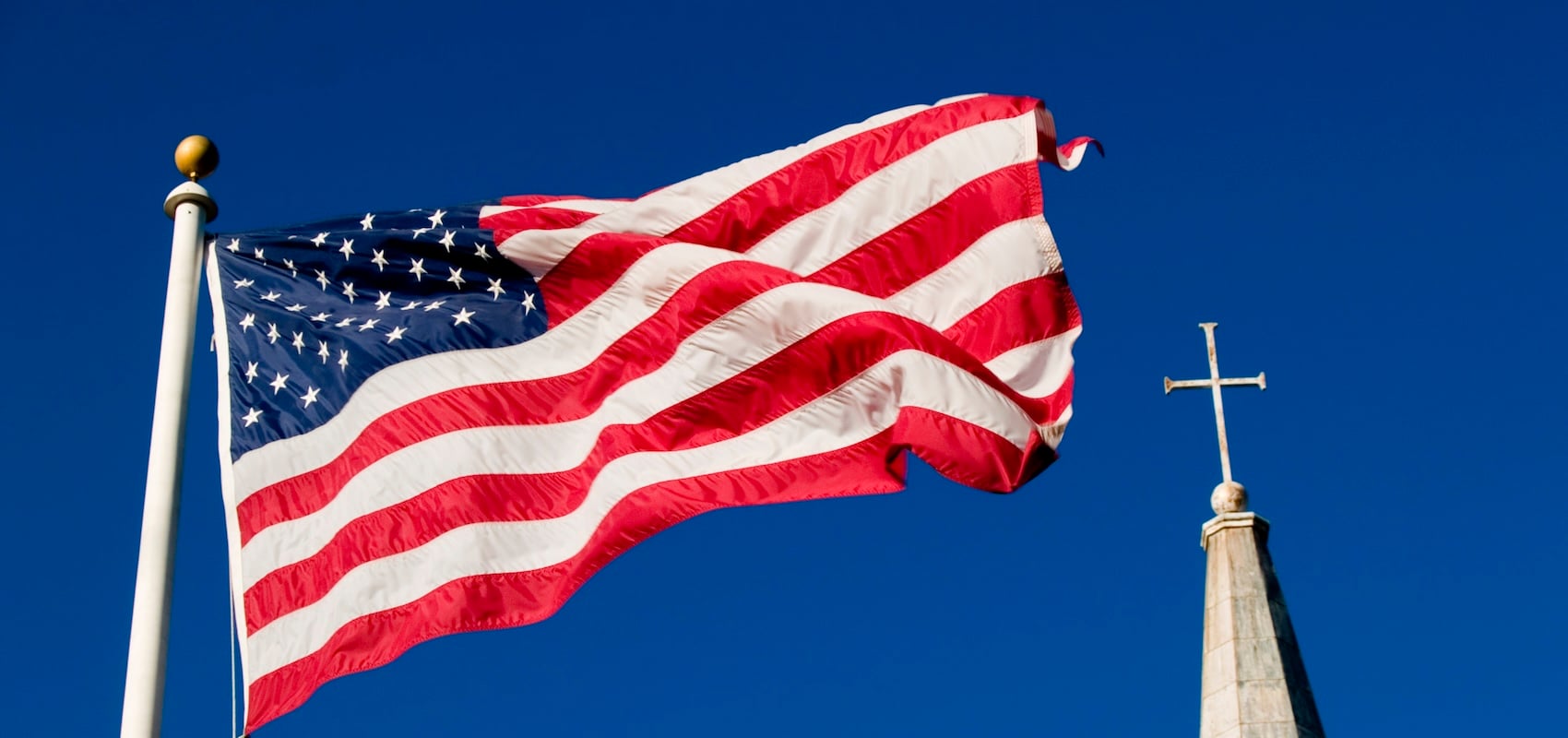
America is a Christian nation. It was at its birth, and despite increasing attacks on this reality, our Founding is unintelligible apart from the faith that animated it.
Today, we celebrate an anniversary that makes our Christian heritage especially clear. The Second Continental Congress approved the final text of the Declaration of Independence on July 4, 1776, but it wasn’t until August 2, 1776, that our Founders gathered in Independence Hall to sign the document and officially pledge “our lives, our fortunes, and our sacred honor” to the cause of American sovereignty.
This was not an Enlightenment undertaking. It was an undeniably Christian one. As our Founders approached the table one by one, they understood themselves to be making a covenant before God. The ceremony could be traced back to the Mayflower, when the men aboard that ship each signed his name and promised to “solemnly and mutually, in the presence of God and one another, covenant and combine ourselves together into a civil Body Politick.”
The same founding ritual was repeated in countless New England towns. Its roots can be traced to the Mosaic covenant of ancient Israel—a people delivered from oppression, carried through a sea, led into a wilderness, and destined for greatness if they remained faithful to God. That biblical tradition is how our Founders understood the nation to which they pledged themselves.
However, in recent years a chorus of voices has sought to convince Americans that our country was never a Christian nation.
This view draws support from across the political and religious spectrums. Progressives and atheists have filled entire books arguing that our Founding is not only devoid of Christian influence but is positively opposed to the Christian faith. More recently, a journalist at MS NOW used the occasion of America’s 250th to argue that our nation “was never dedicated to God.” Versions of this same argument appear on the right, too. Late last month on Firing Line, Justice Neil Gorsuch argued that America is a creedal nation, divorced from religion and based solely on ideas.
Both right and left reason that, because our Founders came from different Christian traditions and refused to establish a national church, America is properly understood as a pluralistic patchwork of various faiths inspired by Enlightenment rationalism. They hang their hat on the phrase “separation of church and state,” which never appears in the Declaration or the Constitution.
This, of course, is ridiculous. In writing about the “separation of church and state” in a private letter, Thomas Jefferson was arguing that the state should stay out of the affairs of the Church, not the other way around. The state could never have been free from the influence of the Church, because the men who stitched together the fabric of our nation and filled high public offices were steeped in a thoroughly Christian civilization. Any attempt to read our Founding documents as if they existed apart from that Christian heritage is not only wrong but fatal to our republic.
America isn’t an idea. It is a covenant, passed down from generation to generation and utterly dependent upon God’s grace. Passing that covenant down to future generations takes more than keeping the Declaration safe under a pane of glass at the National Archives. We must raise young men and women steeped in America’s Christian tradition and willing to pledge their own lives, fortunes, and sacred honor.
This means unapologetically teaching them about our Christian history.
Many people have forgotten that on the morning of September 7, 1774, the First Continental Congress opened with Rev. Jacob Duché reading Psalm 35 to the assembled delegates. Likewise, our schools no longer teach that, months later, the same Congress appointed a continental fast and envisioned, in the words of John Adams, millions of Americans “upon their Knees at once before their great Creator, imploring his Forgiveness and Blessing, his Smiles on American Councils and Arms.”
Christianity was so important to our Founders that the Continental Congress directed its Committee of Commerce to purchase 20,000 Bibles from “Scotland, Holland, or elsewhere” when war with Britain cut off the supply of the Holy Scriptures. Our seventh president, Andrew Jackson, called the Bible “the rock on which our Republic rests.”
Even most American Catholics aren’t aware that Charles Carroll—the only Catholic signer of the Declaration—was also the wealthiest signer and thus had the most to lose in pledging his “fortune.” Nonetheless, he was so proud to sign the Declaration that he included his estate in his signature so that King George III would know where to find him.
This Christian history matters because it has continued to influence our country, from the Founding Era right up to the present day.
For example, ever since Duché’s prayer before the First Continental Congress, every session of Congress—up to and including the 119th Congress in which I proudly serve—has also opened with prayer.
In 1982, Congress passed a resolution making 1983 the national “Year of the Bible.” The law, which President Reagan signed, quoted Andrew Jackson’s declaration that the Bible is “the rock on which our Republic rests” and went further, declaring that “Biblical teachings inspired concepts of civil government that are contained in our Declaration of Independence and the Constitution of the United States.”
And through the Knights of Columbus, Catholics played a pivotal role in convincing President Dwight Eisenhower to add the words “under God” to the U.S. Pledge of Allegiance on June 14, 1954. That day, Eisenhower declared:
From this day forward, the millions of our school children will daily proclaim in every city and town, every village and rural school house, the dedication of our nation and our people to the Almighty. . . . In this way we are reaffirming the transcendence of religious faith in America’s heritage and future; in this way we shall constantly strengthen those spiritual weapons which forever will be our country’s most powerful resource, in peace or in war.
More examples abound, and each points to the same conclusion: “Our Constitution,” as John Adams once famously declared, “was made only for a moral and religious people” and is “wholly inadequate to the government of any other.”
This is why we can’t let claims that America is not a Christian nation go unchallenged. This is why we must reject the notion that America is simply an idea. And it’s why we should remember and celebrate the 250th anniversary of the signing of the Declaration and the birth of the American covenant.
Keeping this covenant isn’t easy. Writing to John Adams just thirty-five years after the signing of the Declaration, Benjamin Rush lamented that many were already forgetting the “solicitude and labors, and fears, and sorrows and sleepless nights of the men who projected, proposed, defended, and Subscribed the declaration of independance [sic].”
Two hundred fifty years later, we must not make the same mistake. We must remember that America is, and must remain, a Christian nation.
Dear Reader,
Can I be direct with you?
War abroad. Socialists on the rise. AI upending human life. Endless uproar online. The modern attention economy doesn’t want readers — it wants users enslaved to the tyranny of the present.
First Things is the antidote: literary excellence, timeless truths, and a fixed point of reference in a culture that has lost its bearings.
But we can’t do it without readers like you.
Our goal: Raise $150,000 by November 1 to sustain First Things in the year ahead.
Your gift anchors readers in the permanent things.
Make your Fall Campaign gift now using the button below.
If you have any questions or would like more information, please contact Giovanni Del Piero, Director of the Editor’s Circle, at gdelpiero@firstthings.com or 212-627-1985.

YOU MIGHT ALSO LIKE
Forget Odysseus. Aeneas Is the True American Hero.
Who is our Odysseus? Or more precisely, who is the most Odyssean hero of American film? Matt…
Foucault’s Idol of Nothingness
Today marks the 100th anniversary of the birth of Michel Foucault. He was influential in his lifetime,…
Meet the Post-Religious Right
There have been many books written about the online right and the Trump movement, most by people…
