
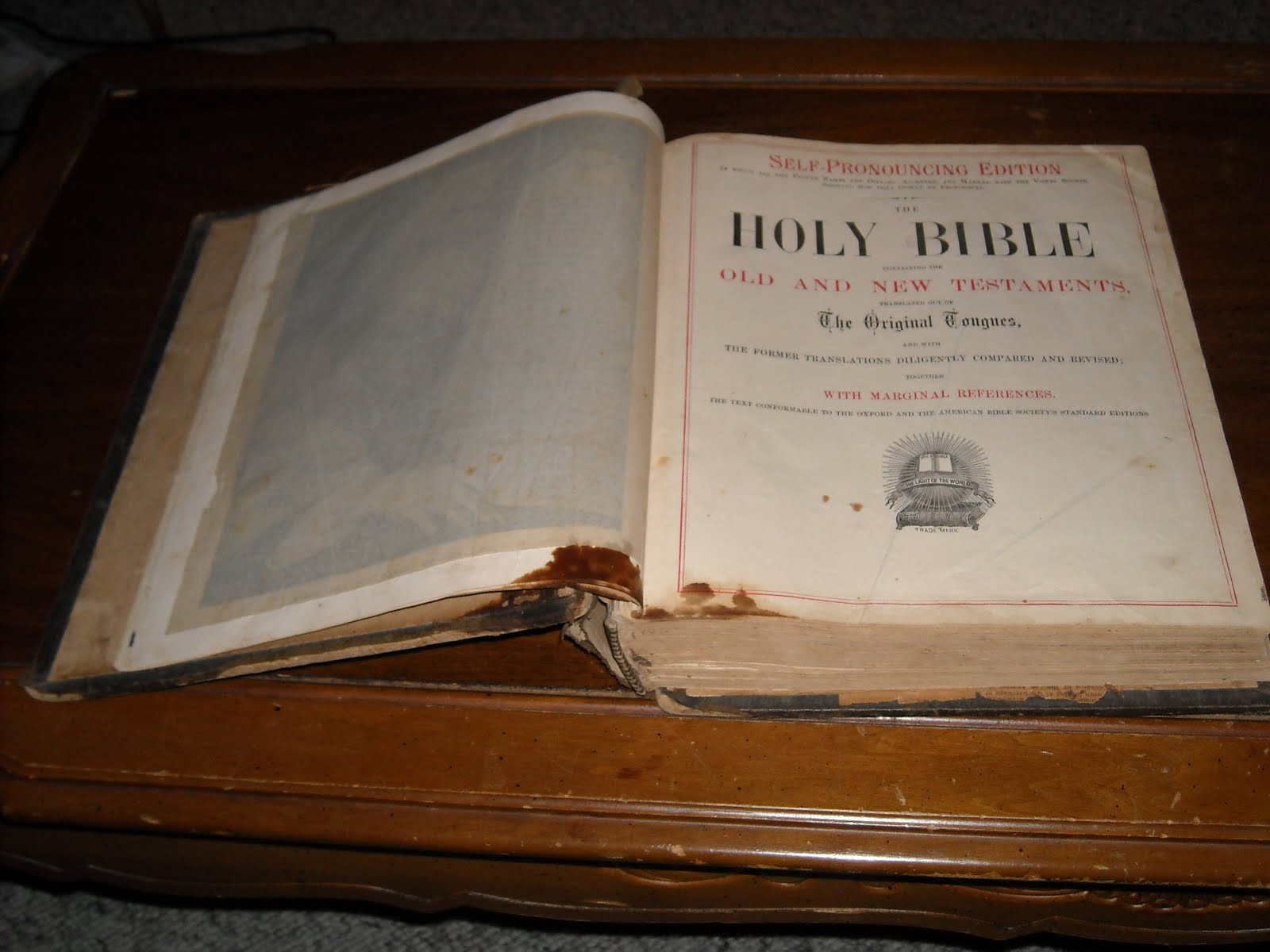
My great-grandmother, Lucy Jane Bentley Hyder, died several years before I was born, so I have no personal memories of her. However, I do have her family Bible, a hefty King James version printed in 1892 that has been passed down the generations and came into my possession not quite twenty years ago. I cannot say whether her family read from it regularly, but, like so many other bible owners, she recorded births and deaths in its pages – something giving it inestimable value to her descendants.
Lucy Jane and her husband Nelson were both born in 1875 and married in 1896. The first event she recorded was the birth of their eldest child, Mary E. Hyder, later that year. The most poignant record in her handwriting was the birth of twins Emmet and Emma in 1901, followed a day later by a record of their deaths. One suspects they were born — perhaps premature — at home before the days of hospital neonatal intensive care units. Apparently there was a page listing marriages as well, but at some point one of their sons seems to have torn it out to expunge evidence of an earlier matrimonial moment he preferred to forget.
Lucy Jane was a Virginian by birth, growing up and living in East Stone Gap, Virginia, until around 1914, when she and Nelson moved to a farm outside Adrian, Michigan. They were members of the local Friends Church, not because they were Quakers, but because it was nearest their home. A cousin assures me that Lucy Jane believed the world was flat until her dying day. My mother tells me she spoke with a distinctive southern accent, pronouncing the neuter third-person pronoun as hit, a holdover from Anglo-Saxon and Chaucer’s Middle English, with an obvious family resemblance to the Dutch het.
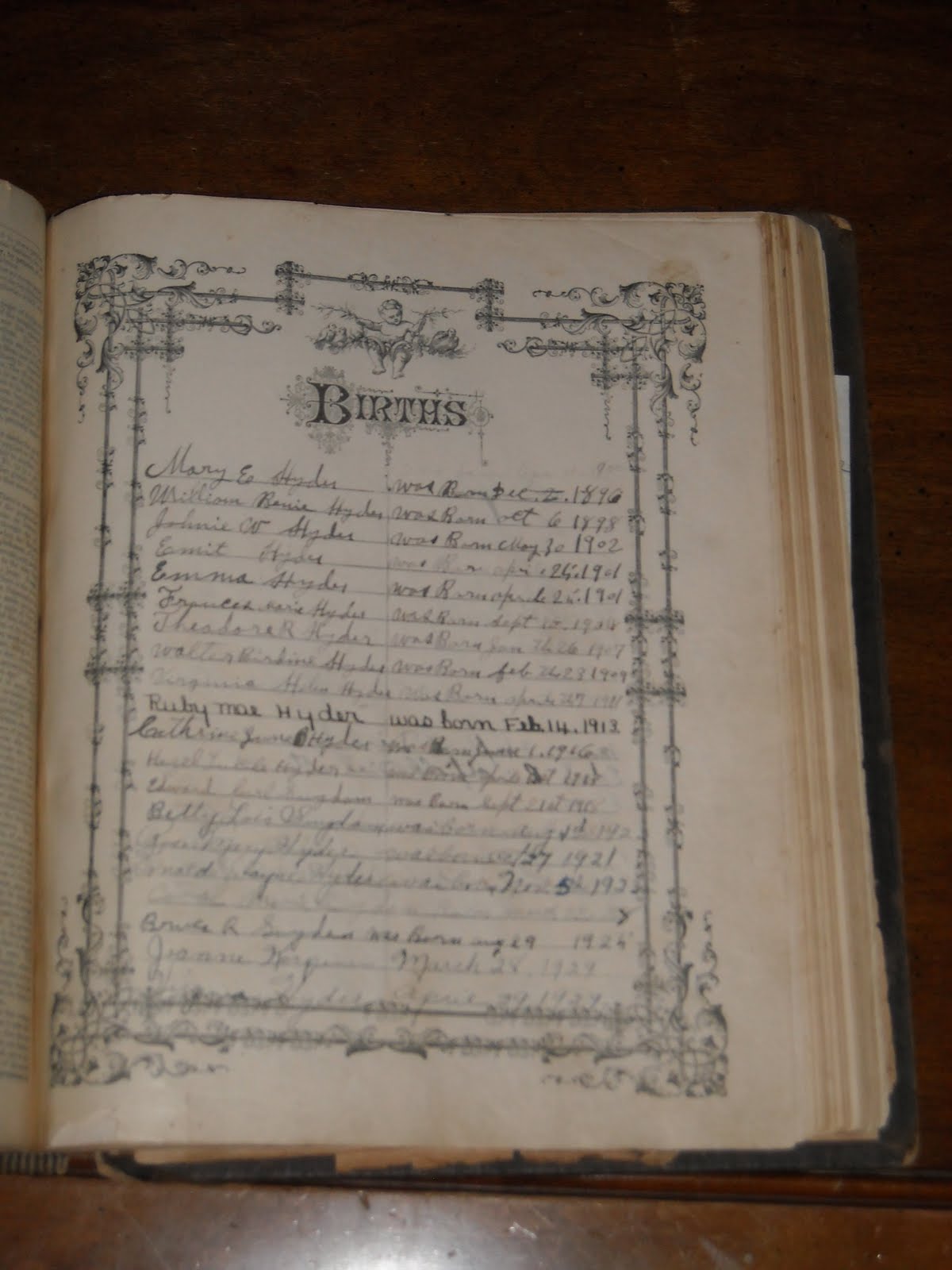
Though she had little formal education, Lucy Jane had the presence of mind to record two reminiscences of her own ancestry extending back to the end of the eighteenth century. One of these was dictated to my mother’s elder sister and is still found between the pages of the Bible in the book of Daniel. Armed with this information, I was easily able to find myriad connections with the so-called World Family Tree, containing the various European noble and royal figures from which virtually everyone we might chance to meet on the street is descended in some fashion. The results of my research I posted here nearly a decade ago: The Ancestry of Nelson Hyder and Lucy Jane Bentley Hyder, along with entries from the Bible itself.
There are no underscorings in the text of this Bible. Whether it was read in the course of daily family prayers I cannot say. I wish I had had thought to ask her daughter, my grandmother, while she was still alive. Yet it was obviously an important part of the family’s life together, collecting over the years newspaper clippings, personal letters and pressed leaves. The binding is intact, although the front cover is loose and some of the cloth has clearly worn away near the spine. I hope that my own daughter will treasure this volume, as have more than a century of her ancestors.
Incidentally, during a recent visit with relatives, I rediscovered a family bible dating to 1841 belonging to the first settlers in a region of Michigan where my cousins were born and raised. I can no longer recall how it came into my possession some thirty years ago. But when I found it again and recognized what it was, I typed the original owners’ names into the ubiquitous Google and quickly discovered that a descendant had posted their information on a popular genealogical website. I was able to contact her and return the volume to a family member who would value it more than I. This would not have been possible two or three decades ago.
My curiosity is piqued. In an age of mass printing and the easy availability of books, does anyone keep a family bible anymore? The people I know have scores of individually-owned bibles in their homes, but does any have the clear status of family bible? Responses are welcome.
Dear Reader,
Can I be direct with you?
War abroad. Socialists on the rise. AI upending human life. Endless uproar online. The modern attention economy doesn’t want readers — it wants users enslaved to the tyranny of the present.
First Things is the antidote: literary excellence, timeless truths, and a fixed point of reference in a culture that has lost its bearings.
But we can’t do it without readers like you.
Our goal: Raise $150,000 by November 1 to sustain First Things in the year ahead.
Your gift anchors readers in the permanent things.
Make your Fall Campaign gift now using the button below.
If you have any questions or would like more information, please contact Giovanni Del Piero, Director of the Editor’s Circle, at gdelpiero@firstthings.com or 212-627-1985.

YOU MIGHT ALSO LIKE
The Church in the Age of Therapy
In 1966, Philip Rieff wrote in The Triumph of the Therapeutic that “Religious man was born to…
Canada’s Deadliest Blind Spot
On September 20, the Daily Mail ran a story with the provocative headline, “Our 83-year-old Christian grandmother…
The Faithful Joy of Dolly Parton and Fulton Sheen
Dolly Parton and Fulton Sheen seem to have had little in common. She favored rhinestones; he wore…
