
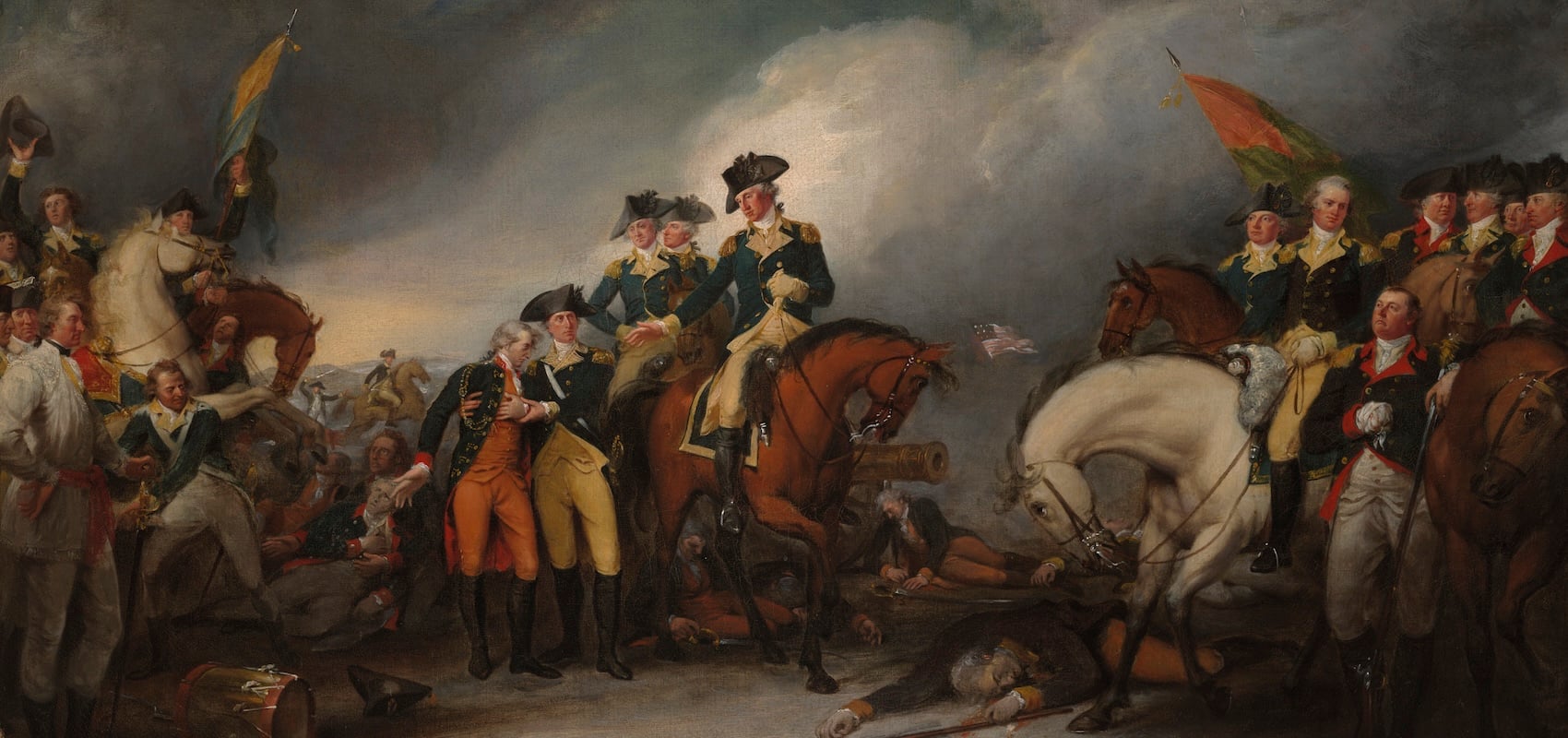
America has just celebrated its 250th birthday amid a quiet but consequential confusion: a growing tendency to treat the American Revolution and the French Revolution as siblings—two chapters in one story of liberty overthrowing tyranny. While they share a vocabulary, they do not share a foundation. As the United States marks a quarter-millennium, it is worth being precise about which revolution built the most exceptional country in history.
Skeptics will note, correctly, that both revolutions drew on Enlightenment ideas of natural rights and the social contract, that Lafayette fought at Yorktown and carried those lessons home, and that America’s own break with monarchy and establishment religion was itself radical. All true. But shared vocabulary is not the same as a shared foundation. The decisive question is not which words the revolutionaries used, but the source from which they believed rights originated.
America’s 1776 revolution was a revolution of covenant. The Declaration’s claim that all men are “endowed by their Creator” with unalienable rights is not decorative; it is the load-bearing pillar of the entire structure. Rights precede government because they come from God, not from the state. That is why the American experiment could limit government at all: if rights were the state’s gift, the state could just as easily be their author and their undertaker. Even the American Revolution’s radicalism—breaking with a king, disestablishing churches—was a revolt against a specific institutional arrangement, not against the idea of a transcendent moral order standing above human will. The Founders dismantled a throne; they did not dethrone God.
France’s 1789 revolution dismantled both. Lafayette’s constitutional-monarchist moment was real, but it did not hold the field. Within four years the revolution he helped launch had passed through the Declaration of the Rights of Man, the Cult of Reason enthroned in Notre Dame, and into the Reign of Terror. That trajectory is not a betrayal of 1789’s logic; it is its executor. When rights are re-grounded in the “general will” rather than a Creator who stands above the state, the general will becomes infinitely elastic—and, in Robespierre’s or any revolutionary’s hands, infinitely lethal. This is always the outcome of any mass political movement that dethrones God and the dignity of human life.
This is the distinction America’s next 250 years cannot afford to blur. The American order rests on a specific anthropology: human beings as both image-bearers and sinners, incapable of the perfect virtue utopian schemes require, yet possessed of a dignity and possibility for renewal no government or human actor may licitly cancel. That is why the Declaration of Independence is a call to renewal, and the Constitution builds in checks, balances, and federalism. The French revolutionary tradition, and the socialist and Marxist movements it fathered, rest on a different anthropology: human beings as infinitely malleable, sin—if it exists at all—as a structural defect of unjust systems rather than the human heart, and the state as the proper instrument for re-forging both.
That lineage is not a caricature; it is one the revolutionary left has claimed for itself. Marx and Engels wrote openly in 1789’s shadow, treating the French Revolution as the necessary but incomplete first draft of the classless society, and Lenin studied the Jacobins as a template for revolutionary discipline. To note that today’s vocabulary of “systems,” “structures,” and “equity” descends from that tradition is not to flatten every reformer into a Jacobin. It is to observe, accurately, that when American activists describe rights as whatever the collective currently wills, or treat institutions as illegitimate simply for predating the revolution’s verdict, they are reasoning in 1789’s destructive revolutionary tradition, not 1776’s—whatever their intentions.
None of this means America has perfectly lived up to 1776. It manifestly has not; chattel slavery was the Founding Era’s own gravest betrayal of its stated creed. But the corrective for this betrayal was found within the 1776 framework, not outside it. Abolitionists and, later, civil rights leaders did not need a new revolution to indict the old one; they appealed relentlessly to the Declaration’s own logic—to the Creator who made all men equal—to convict the nation of its sin and drive it toward repentance. That is what a Judeo-Christian founding makes possible: a standard fixed enough to judge even the Founders themselves. The premise of 1789 offers no such fixed standard, only the shifting verdict of whoever currently controls the revolutionary tribunal—which is precisely why the Revolution devoured Lafayette, then the Girondins, then Robespierre himself.
As America prepares for its next 250 years, the choice is not between progress and reaction. It is between two founding principles and realities. One grounds rights in the Creator and embeds them in his image-bearing creatures—self-evident, universal, and beyond the state’s reach. The other grounds rights in the collective’s evolving will—flexible, factional, and ultimately at the state’s mercy. The first gave us a republic that has endured, self-corrected, and still commands the allegiance of billions who are not its citizens. The second gave France a decade of terror, gave way to the authoritarianism of Napoleon, and seeded many destructive and lethal offspring.
America’s next 250 years must be built on the foundation that has endured and continues to uphold the promise of life, liberty, and the pursuit of happiness.
Dear Reader,
Can I be direct with you?
War abroad. Socialists on the rise. AI upending human life. Endless uproar online. The modern attention economy doesn’t want readers — it wants users enslaved to the tyranny of the present.
First Things is the antidote: literary excellence, timeless truths, and a fixed point of reference in a culture that has lost its bearings.
But we can’t do it without readers like you.
Our goal: Raise $150,000 by November 1 to sustain First Things in the year ahead.
Your gift anchors readers in the permanent things.
Make your Fall Campaign gift now using the button below.
If you have any questions or would like more information, please contact Giovanni Del Piero, Director of the Editor’s Circle, at gdelpiero@firstthings.com or 212-627-1985.

YOU MIGHT ALSO LIKE
Foucault’s Idol of Nothingness
Today marks the 100th anniversary of the birth of Michel Foucault. He was influential in his lifetime,…
Forget Odysseus. Aeneas Is the True American Hero.
Who is our Odysseus? Or more precisely, who is the most Odyssean hero of American film? Matt…
Meet the Post-Religious Right
There have been many books written about the online right and the Trump movement, most by people…
