
♦ Aldous Huxley: “The surest way to work up a crusade in favor of a good cause is to promise people they will have a chance of maltreating someone. To be able to destroy with a good conscience, to be able to behave badly and call your behavior ‘righteous indignation’—this is the height of psychological luxury, the most delicious of moral treats.”
♦ Something similar might be said of late-1960s hedonism. To smoke pot and sleep with your girlfriend and, in doing so, claim to be fighting the good fight against bourgeois conventionality and advancing the great cause of liberation—those were days of marvelous psychological luxury. Some still try to work the old magic. But transgression has become a cliché. It no longer carries the charge of sanctification.
♦ The progressive left has been for open borders and closed debate. The Trump administration flips these positions. Border enforcement was a day-one priority. A January 20th Executive Order signed by Trump includes this statement: “Government censorship of speech is intolerable in a free society.”
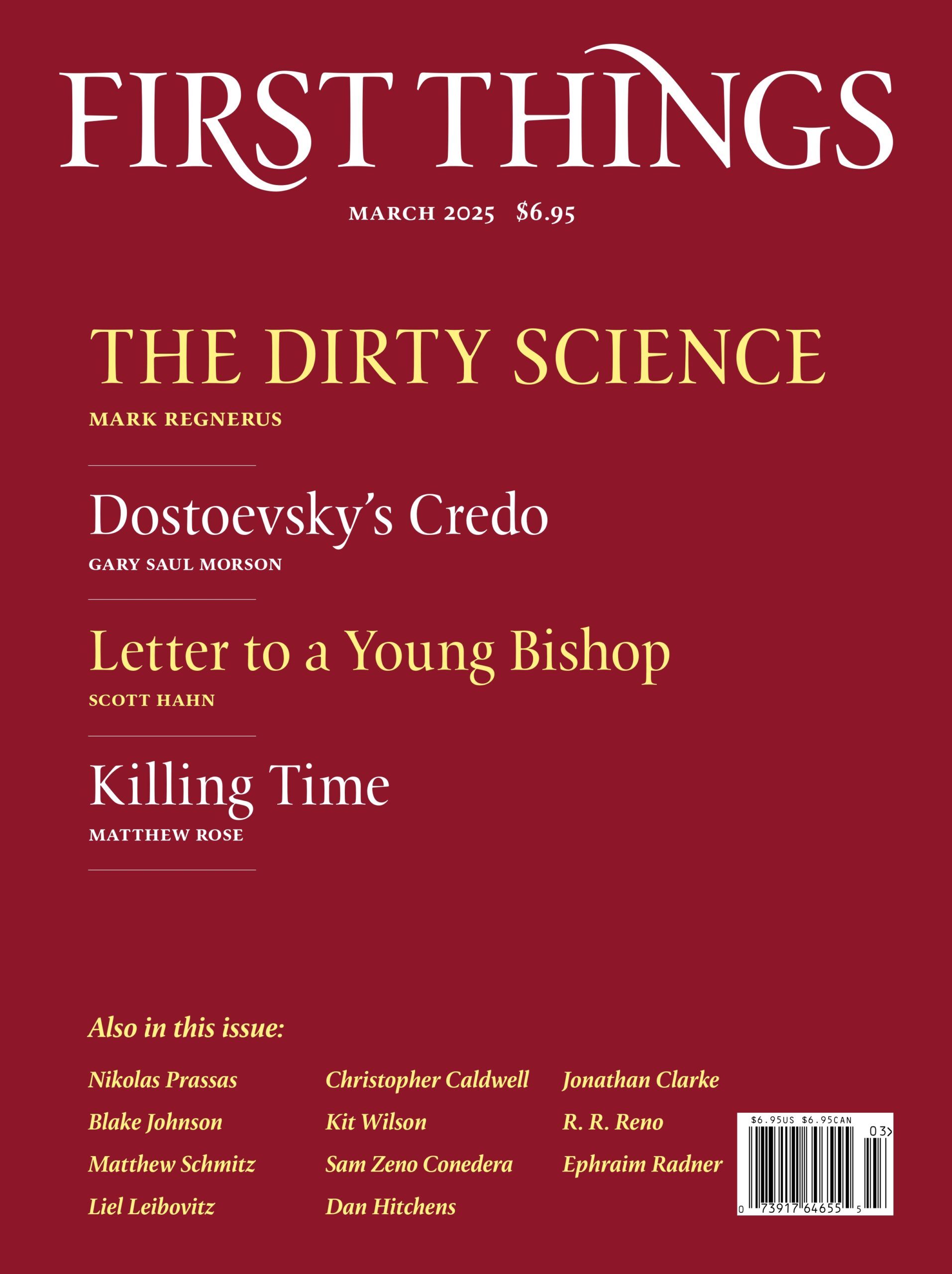
♦ In this issue, Matthew Rose analyzes Mircea Eliade’s religious project (“Killing Time”). The Romanian scholar’s star has fallen in recent decades. When I was a college student in 1980, the postwar “study of religion” project (in which Eliade played a foundational role) was still widely influential. In that year, I read Eliade’s most well-known book, The Sacred and the Profane, along with Carl Jung’s Psychology and Religion, Sigmund Freud’s Moses and Monotheism, and Rudolf Otto’s The Idea of the Holy. Freud didn’t grab me. He took a reductive approach, wherein religion is an outward manifestation of man’s inner psychological diseases. In their different ways, Otto, Jung, and Eliade fed my inchoate religious longings. They allowed that religion grapples with numinous realities and mysterious truths. These authors gave me confidence that my growing interest in spiritual matters concerned something real. I soon concluded that Eliade and the others maintained a scholarly distance that cooled and neutralized their subject matter. (Reading Kierkegaard can make one impatient with scholarly distance.) I turned toward theology: talking about God without interposing theories that purport to explain what people are saying and doing when they talk about God.
♦ In 2024, “Mohammed” was the most popular name given to newborn boys in London. In New York, the top name was Liam. Mohammed came in as the tenth most popular, tied with Michael.
♦ A friend recently observed that death is a natural phenomenon, part of the circle of life, as it were. The comment sent me back to the Catechism of the Catholic Church and its exposition of the significance of Christ’s descent into hell on Holy Saturday. Paragraph 635 includes a passage from an anonymous ancient sermon. It tells of Christ’s descent and his search for Adam and Eve. He finds them in their bondage. Rousing them from their slumber, Christ announces: “I am your God, who for your sake have become your son. . . . I order you, O Sleeper, to awake. I did not create you to be a prisoner in hell. Rise from the dead, for I am the life of the dead.” We acknowledge that death is real. It is the unavoidable final stage of our life in this world. But we know that we were not made for death.
♦ Writing at UnHerd, Mary Harrington provides compelling analysis of Joe Biden’s strange announcement that the failed Equal Rights Amendment is now part of the Constitution (“Donald Trump is the end of Hilarity”):
With hindsight, Covid was a high-water mark of elite idealism: an apparently widespread belief that you could simply decide what was real, then make it so via a combination of fiat declaration and media censorship. . . . Last week the Biden era’s devotion to reality-as-fiat climaxed not with a bang, but an internet whimper: an apparent effort to meme an amendment to the U.S. Constitution into force, by posting about it online. . . . It was the perfect finale for a regime characterized from its inception by eerie fakeness: what Nathan Pinkoski recently called “a simulacrum of a functioning progressive presidency.”
To some extent, democratic politics has always been about making images and selling them to voters. But there’s little doubt that social media has taken this trend to new heights, encouraged by a consensus in higher education that reality is “socially constructed.” I hope that we can find our way back to real reality.
♦ Joe Biden awarded Medals of Freedom to an eclectic group of worthies—and then, a few days later, to Pope Francis. I penned a semi-serious, semi-satirical column recommending to Donald Trump various candidates for that honor (“Medal of Freedom Recommendations for Trump”). In the spirit of back-seat driving, I’d like to offer unsolicited advice to Congress.
In 2024, Park MacDougald published a detailed account of how foundations such as the Rockefeller Brothers Fund, the Ford Foundation, and Peter Buffett’s NoVo Foundation funneled money to activist organizations that spearheaded pro-Hamas protests (“The People Setting America on Fire,” Tablet). Congressional staffers should revisit this important article and advise their bosses to hold congressional hearings to investigate this use of tax-exempt money to support radical political organizations.
Foundations are prohibited from participating in political campaigns. Have these foundations engaged in a pattern of funding that amounts to direct support of left-wing politicians in the Democratic Party? A congressional investigation should cast light on foundation spending during 2020 as well. Are internal communications at the Ford Foundation and other foundations explicit in their calculations that supporting BLM would harm Donald Trump’s electoral chances? I’d like to hear foundation heads and grant officers answer these and other questions under oath.
♦ Donald Trump’s election has forced some soul-searching among America’s elites. Writing for RealClearPolitics, Peter Berkowitz identifies a form of elite mea culpa that preserves elite amor propre (“David Brooks Misunderstands the Miseducation of Elites”). This approach, which he ascribes to David Brooks and Michael Sandel, holds that ordinary Americans envy elites for their wealth and privilege. Berkowitz rightly recognizes that this is not the case. Of ordinary people he writes,
They are seldom envious of high achievers like Brooks and Sandel. They do not often aspire to opine from the New York Times’ pages or hold forth in Harvard lecture halls. They don’t generally yearn to send their children to the Ivy League or see them chasing fame and fortune in Manhattan, Hollywood, or Silicon Valley. Most of the time, they prefer to be left alone by the people who think their fancy universities and success in waxing eloquent for a living equip them to manage other people’s lives.
I would go further: Ordinary people don’t like being talked down to, disdained, and told that they are “takers” or lack “diversity” or are in some other way unworthy of the exalted leadership of the Great and the Good.
♦ Consider a common encounter. A rich and powerful person checks in at JFK Airport. His baggage is taken by a woman wearing a tailored dress or a man wearing a coat and tie, signs of respect for the person whom they are serving. And what is that man heading for the first class lounge wearing? Sweatpants and a T-shirt. He can’t be bothered to reciprocate and acknowledge that he, too, should honor and respect those who serve him.
♦ Kathleen Carlson of Vero Beach, Florida would like to launch a ROFTers group. If you want to sit down once a month to discuss the latest issue of First Things, get in touch with her at katheliza@icloud.com.
♦ We rolled out our new website in late January. Our aim was to echo in our online publication the elegance of our print edition. I’m pleased to report that many readers have expressed their approbation. Many thanks to our designer, Cohere Studio, for so faithfully executing our vision. And kudos to Carter Skeel and Miguel Caranti, who oversaw this project from start to finish.
Dear Reader,
Can I be direct with you?
War abroad. Socialists on the rise. AI upending human life. Endless uproar online. The modern attention economy doesn’t want readers — it wants users enslaved to the tyranny of the present.
First Things is the antidote: literary excellence, timeless truths, and a fixed point of reference in a culture that has lost its bearings.
But we can’t do it without readers like you.
Our goal: Raise $150,000 by November 1 to sustain First Things in the year ahead.
Your gift anchors readers in the permanent things.
Make your Fall Campaign gift now using the button below.
If you have any questions or would like more information, please contact Giovanni Del Piero, Director of the Editor’s Circle, at gdelpiero@firstthings.com or 212-627-1985.


YOU MIGHT ALSO LIKE
The Church in the Age of Therapy
In 1966, Philip Rieff wrote in The Triumph of the Therapeutic that “Religious man was born to…
Canada’s Deadliest Blind Spot
On September 20, the Daily Mail ran a story with the provocative headline, “Our 83-year-old Christian grandmother…
The Faithful Joy of Dolly Parton and Fulton Sheen
Dolly Parton and Fulton Sheen seem to have had little in common. She favored rhinestones; he wore…
