
• Medical concerns have been raised about the “morning after pill,” but the Christian Century editorially opines that it’s worth the risks. “The possible downside is offset by some distinct benefits. It seems to us a good idea to give women who wish to terminate a pregnancy the option of doing so at the very earliest”and morally preferable”stage rather than later. It’s also a good idea to provide a method that reduces the total number of abortions.” Unless, of course, terminating a pregnancy is morally indistinguishable from abortion.
• Philip Hamburger’s Separation of Church and State , published two years ago, has received a great deal of deserved attention and, for the most part, high praise (see FT, December 2000). Douglas Laycock, another distinguished scholar of the First Amendment religion clause, offers a sharp dissent in the University of Chicago Law Review (Fall 2003). In “The Many Meanings of Separation,” Laycock contends that Hamburger’s book”while providing massive and useful documentation of the ways in which separationism has been driven by anti-religious and, more specifically, anti-Catholic passions “ deceptively limits “separation” to one meaning, namely, the “strict separationism” of, for instance, the 1948 McCollum decision with which the Hamburger book ends. Almost a half century later, Laycock argues, it is evident that the Supreme Court’s construal of the religion clause is much more nuanced than Hamburger suggests. Laycock concludes: “If to some people separation means protection of religious activity from government, and to other people it means suppression or subordination of religious activity by government, then the phrase has no agreed core of meaning that will enable anyone to communicate. The phrase is deeply entrenched in American society and people will not quit using it. But the apparent lesson of Hamburger’s book is that the phrase has no sufficiently agreed meaning to be of any use, and until we develop vocabulary that communicates distinct theories of separation, we should give up the phrase altogether. Thanks to Hamburger’s careful history of actual usage, we now know that from the phrase alone, without an analysis of context, we have no idea what people mean by it.” I’m not quite sure what to make of all this. I agree with Hamburger that, in the past and at present, the dominant use of “separation of church and state” in public discourse has aimed at limiting, muting, or excluding religious influence in our public life. I agree with Laycock that the most virulent forms of antireligious separationism, described in such detail by Hamburger, have not definitively triumphed. I also agree with Laycock that the “separation of church and state” also supports the freedom of religion from government interference. He is right to say that the phrase is deeply entrenched and will continue to be used until an alternative terminology gains currency. All of which leaves us with the observation that the phrase “the separation of church and state” is used in ways both hostile and friendly to religious freedom and, so long as it is with us, we must not tire of contending for its friendly use.
• Apparently it’s becoming the thing with rich kids who have lots of Jewish friends. They go to Bar Mitzvahs and Bat Mitzvahs and find the parties really cool. For example, Laura Jean of Dallas, whose parents are Methodist, had a really big bash, which the Wall Street Journal says “looked like a Bat Mitzvah, without the religion.” Said Laura Jean, “I wanted to be Jewish so I could have a Bat Mitzvah. Having the party fulfilled that.” More precisely, having the party fulfilled wanting to be Jewish in order to have a party. Don’t blame the kids, but what are the parents, if they are thinking, thinking?
• Robert Louis Wilken of the University of Virginia concludes his review of the book by saying that we are privileged to live in a time that can claim a historian of such distinction. That is a tribute offered by one master historian to another. The book is The Rise of Western Christendom and the historian is Peter Brown of Princeton (Blackwell, 625 pages,, $29.95). The book was first published in 1996 and this is called the second edition, but in fact it is so thoroughly updated and rewritten that it can be considered a new work. Brown is the author of many books on early Christianity and late antiquity, and is best known for his magnificent Augustine of Hippo , a biography. The Rise covers the period from 200 to 1000, the story of “the decline and fall” of the Roman Empire, the “invasion of the barbarians,” and the final triumph of “Western Christendom.” It is the story known to generations from Edward Gibbon’s Decline and Fall of the Roman Empire , a great book that was utterly wrongheaded in its time and is now impossibly outdated but is still much worth reading for the caustic elegance of its prose. Brown offers an alternative to two more recent historians: Christopher Dawson, who, in The Making of Europe , put Catholicism at the center of the constitution of a new civilization, and Henri Pirenne, who dismissed “the barbarian invasions” as a nonevent, contending that the empire did not fall but was sustained by the economic system of Mediterranean trade. In Brown’s telling, there was no dramatic “fall” and no real “invasion” from the north but a slower and more ambiguous process of amalgamation between what was originally Roman with what was “Romanized” in a long period of interaction with the Franks and others who gradually moved from marginality to dominance. The book is especially strong in its depiction of the Eastern Empire based in Constantinople and the vitality of pre-Islamic Christianity in the Levant, and it dwells with loving attention on the early Irish-Scot Christianization of Britain centered in the holy island of Iona. Of popular accounts such as Thomas Cahill’s How the Irish Saved Civilization , Brown flatly states that “this is a myth which has no scholarly support.” It is a myth that also obscures the true achievement of the Irish. “For what Irishmen and West Britons lacked in books, they more than made up for through the intensity and originality with which they read what books they had, and the zest with which they applied their reading to substantially new situations. The Irish did a lot more than ‘save’ the relics of classical civilization. They created something new.” On the rise of Islam in the seventh century, Brown makes the interesting point that the initial tolerance toward Christians, Jews, and others reflected the original Arab belief that Islam was for Arabs, who were a kind of new chosen people. Only later was it asserted that obedience to the new revelation required the conversion or subjugation of all. Then there is the big question: What was it that held Christianity and, later, Christendom together? Brown answers with the rather clunky term “inter-connectivity,” meaning that”from Syria to Constantinople to Iona to Armenia to Iceland”Christians shared the same sacred texts, essentially the same liturgy, and a form of episcopal governance harkening back to a shared memory, or imagined memory, of apostolic origins. Only with trepidation would I question Peter Brown but, if Christopher Dawson exaggerated the role of Rome, I suspect Brown is inclined to downplay it. There are other questions that might be raised, and Brown well knows that he has not written the last book on the subject, but the appropriate response to The Rise of Western Christendom is one of enormous gratitude. It is an astonishing story, told in a way that keeps general themes clearly in sight while lovingly attending to the particularities of people, practices, and beliefs. If the term multiculturalism is ever to be rescued from its current trivializations, it might be through engaging the intricacies of difference and sameness, of clashes and borrowings, of defeats and victories and new beginnings related by Peter Brown in The Rise of Western Christendom .
• Precisely six years after the tumultuous visit by John Paul II, the ecumenical patriarch of Constantinople, Bartholomew I, visited Cuba. There are about a thousand Orthodox Christians in Cuba, and the patriarch was there to dedicate a new church in downtown Havana. Fidel Castro pulled out all the stops and Bartholomew was, according to press reports, the perfect guest. Despite appeals from brave dissidents for a meeting, despite the hundreds, if not thousands, in Castro’s jails for challenging his tyranny, despite the regular protests of Jaime Cardinal Ortega y Alamino against the regime’s denial of freedom, Bartholomew said nothing that might upset his dictator host. By way of sharpest contrast, John Paul II in Cuba repeatedly called for religious freedom, respect for rights of parents and families, democratic accountability, and the release of prisoners. Yes, an Orthodox friend tells me, but we must remember that the two are in very different positions. John Paul commands the world stage as leader of more than a billion Catholics, while Bartholomew, for all the traditional dignity of his office, is holed up in the back streets of Istanbul and lives day by day at the sufferance of a hostile Turkish government and people. That is true enough. (The sorry plight of the Patriarchate of Constantinople is vividly depicted in William Dalrymple’s splendid book, From the Holy Mountain [1999]). But the fact remains that, for all of Bartholomew’s besieged circumstance, including also a frequently unfriendly and very powerful Moscow Patriarchate, he is the nominal leader of Orthodox Christianity. He came to a country where fellow Christians are persecuted, jailed, and summarily executed, and he said not a word. He diligently followed the script given him by his criminal host, and that”all mitigating circumstances notwithstanding”is both disappointing and scandalous.
• Twenty-three priests in the Chicago area sent out an open letter protesting what they said was the use of harsh and insensitive language in Vatican documents on homosexuality. Francis Cardinal George responded by saying that we must indeed be careful about the language we use, and then he added this: “Pastors have to mediate the tension between welcoming people and calling them to change, to repent and convert and live according to Christ’s teaching transmitted by the Church. That tension is often resolved in practice by a pastor’s love for his people. I thank you for loving your people. If, however, you cannot resolve that tension between welcoming people as they are and still calling them to leave their sinfulness and become saints, or if you yourself do not accept the Church’s moral teaching on the moral use of the gift of sexuality, it would be all the more important for us to talk.” There is no report on how many priests have called for an appointment.
• A conference on women’s rights in Saudi Arabia is a delicate business. But it happened recently in Jidda, and the Grand Mufti Sheik Abdulaziz bin Abdullah al-Sheik, considered to be Saudi Arabia ‘s highest religious authority, was not amused. “Allowing women to mix with men is the root of every evil and catastrophe,” he said. “It is highly punishable. Mixing of men and women is a reason for greater decadence and adultery.” Muhammad, he suggested, would be exceedingly displeased by the conference. At the meeting a different perspective on allowing women to mix with men was offered by former president Bill Clinton. According to the New York Times , he said that “ Saudi Arabia could not fight the ‘tide of change’ and that the Prophet Muhammad would have let his wife drive if cars had existed 1,400 years ago.” (Women are banned from driving in Saudi Arabia.) So the question is: What would Muhammad do? Sheik Abdulaziz’s views seem somewhat extreme, but one can readily imagine, and sympathize with, his opinion of Mr. Clinton as an authority on Islamic teaching”or, for that matter, Christian teaching”on how men and women should and should not mix.
• Letters to a Young Catholic is George Weigel’s latest. Just out from Basic (262 pages,, $22.50), it is in the publisher’s series of “Letters to . . . ””a young conservative, a young radical, a young this or that. Weigel’s The Courage to be Catholic has been a big hit, and I expect the new book will make a similar mark. Like Courage , it presents Catholic fidelity as a challenge and invitation to the high adventure of Christian discipleship. But this book is more autobiographical, even confessional, in character. It takes the reader on a tour of the places and people and practices that have formed the author’s understanding of what it means to be Catholic, in the hope of conveying to the young reader the “feel” of the particular and palpable “stuff” of Catholic faith and life. There is the Holy Land, and Chartres, and Newman’s oratory, and the Scavi in Rome where St. Peter is buried. There is also the youth ministry of the Dominicans in Krakow, Poland, and the cathedral in Weigel’s hometown of Baltimore, as well as a visit to a vibrantly Catholic parish in Greenville, South Carolina. Here is the Church, Weigel is saying, and in this Church is to be discovered, in its fullness and variousness, the presence of Christ and the maddeningly different ways of responding to Christ. It is a marvelous book, a great gift for young people of your acquaintance. But be sure to get a copy for yourself as well. Here is a taste: “That’s the truth shining through the ineffable blues of the Chartres windows. That’s the truth that makes every icon possible. That is grace at work”God’s outpouring of his superabundant life into the world and into our lives. Like Augustine, we, too, burn for the embrace of the Beauty that is ever ancient and ever new. That burning, which God himself has built into us, is the beginning of every prayer.” Letters to a Young Catholic . I warmly recommend it.
• “Sexual Abuse in Social Context” is a report issued by the Catholic League for Religious and Civil Rights. It was published in anticipation of the comprehensive report by the National Review Board which has not been issued as of this writing. The Catholic League document is aimed at countering the media “obsession” with sexual abuse by Catholic priests, suggesting that the incidence of abuse is somewhat higher for Protestant clergy, rabbis, and psychologists, and much higher for public school teachers. It underscores what is undoubtedly true, that most sexual abuse is perpetrated by family members or people known to the family. The Catholic League report is well intended but largely beside the point. Nobody doubts that “inappropriate sexual behavior” is widespread, but the Catholic scandal is about men engaging in sex with minors. Moreover, it is about Catholic priests doing so, and priests are rightly held to a higher standard. Finally, the reality would seem to be that the overwhelming majority of instances involve teenage boys, from which one may surmise that the problem is homosexual priests who act on their desire to have sex with teenage boys. Good intentions notwithstanding, no report on “social context” can mitigate that horror. This is not the time for Catholics to circle the wagons, shooting tu quoque arrows at their critics. The assault on the integrity of the Church comes from within. Conservatives focused on countering anti-Catholicism and liberals focused on countering gay-bashing join in suggesting that the crisis is not so grave as it has been made out to be. They are both wrong.
• Forget about the slander that it is anti-Semitic. It appears that the problem with Mel Gibson’s film on the passion is that it’s too pro-Christian. The Rev. Paul Rutger, director of the Council of Religious Leaders in Chicago, saw an advance screening and said, “Personally, I have mixed feelings about the movie. It’s clearly a message movie. And the message is ‘I believe in Jesus as the Son of God.’ It’s straight-out evangelical, Jesus-died-for-your-sins.” Aha. So that’s what Gibson’s up to. Clearly, the film should be accompanied by an advisory giving fair warning to the Christianly challenged.
• “The book doesn’t say much that we didn’t already know,” one reader wrote. Christopher Baglow of St. Joseph Seminary College in Louisiana also started out with the prejudice that the Evangelicals and Catholics Together (ECT) volume Your Word is Truth could hardly say anything about the relationship between Scripture and tradition that has not been said many times before. Reviewing the book for Nova et Vetera , he changed his mind: “Yet reading only a few pages of Your Word is Truth is enough to turn both disdain and discomfort into eager attention, and to stand ordinary theological prejudices on their heads. The depth of insight in the essays collected in this volume is distinguished by an all-too-rare pairing of virtues: theological astuteness and ecumenical charity. In regard to the first, the volume justifies the reputations of the distinguished Evangelical and Catholic theologians who dutifully and diligently entered the discussion. In regard to the second, every individual contribution justifies, from page to page, the frequent assertions of an earnest and common desire for unity in the truth which permeate the joint statement that begins it.” He concludes with the suggestion that the ECT participants should “compose a joint statement on the method and spirit of dialogue they employ, so that other ecumenical enterprises can benefit from the example of their excellent approach.” We’re thinking about it.
• Good news, according to the advertising magazine Brandweek . Focus-group studies show that products advertised on “edgy” television programs do not suffer significant damage to their image. “Edgy” is the new word for vulgar. Advertisers used to worry that the sleaze would rub off on their products. But now, Brandweek declares, “marketers can get a bang for their buck buying into edgy programs.” What matters morality, never mind good taste, when the alternative is a bang for the buck?
• In what sense is America an empire? Or should it be an empire in any sense of the term? To the second question, Andrew Bacevich of Boston University and a contributor to these pages, answers with a qualified No, but in the new book he has edited, The Imperial Tense (Ivan R. Dee), he gives ample space to those who answer with an outright, or variously qualified, Yes. Most of the essays are interesting, several are outstanding, but my attention was drawn particularly to “A Citizen’s Response” by Wendell Berry. Berry is a Kentucky farmer and prolific writer on How We Live Now, and how we should be living. From time to time, readers who admire Berry have wondered why we don’t pay more attention to his work, although there have been favorable mentions. I confess that what I have read of Berry strikes me as a too easy proposing of beguiling alternatives in a manner too often marred by wistful sentimentality and moral smugness. But people whose judgment I respect tell me I’m wrong, and so I”possessed of an irrepressible eagerness to be corrected”went immediately to his essay in The Imperial Tense . Berry takes as his text the statement on National Security Strategy (NSS) published in September 2002, which declares the U.S. intention to work with the international community, but then adds that “we will not hesitate to act alone, if necessary, to exercise our right of self-defense by acting preemptively against such terrorists.” Who is this “we,” asks Berry, and then answers his question: “This ‘we’ of the new strategy can refer only to the president. It is a royal ‘we.’ . . . By this new doctrine, the president alone may start a war against any nation at any time.” And just who are these “terrorists” (quotes in original)? The NSS document defines terrorism as “premeditated, politically motivated violence perpetrated against innocents.” To which Berry responds, “The ‘legitimate’ warfare of technologically advanced nations likewise is premeditated, politically motivated violence perpetrated against innocents.” Plus, there are many other forms of terrorism. “I mean such things as toxic pollution, land destruction, soil erosion, the destruction of biological diversity and of the ecological supports of agriculture,” writes Berry. In the NSS document there is “the contradiction of peace and war, or of war as the means of achieving and preserving peace. This document affirms peace; it also affirms peace as the justification of war and war as the means of peace, and thus perpetuates a hallowed absurdity.” The document notes that the U.S. has not accepted the jurisdiction of the new International Criminal Court. Berry comments: “The rule of law in the world, then, is to be upheld by a nation that has declared itself to be above the law. A childish hypocrisy here assumes the dignity of a nation’s foreign policy.” He acknowledges that September 11 was a “catastrophe,” but observes, “It is useless to try to adjudicate a long-standing animosity by asking who started it or who is the most wrong.” I am sorry, but this is moral recklessness of a drearily predictable and partisan nature. Berry ‘s unfortunate essay notwithstanding, The Imperial Tense is well worth reading for other and more bracing arguments, pro and con, on whether or in what sense America is an empire.
• The life of Francis Thompson was in many ways a shambles, but I am impressed by the number of people for whom “The Hound of Heaven” was instrumental in drawing them, or returning them, to the faith. Continuum has now brought out The Poems of Francis Thompson , and Neil Powell, writing in the Times Literary Supplement , wonders why. “The Hound of Heaven” he describes as “that pious dog’s dinner of a piece,” and he cites approvingly the judgment of Geoffrey Grigson that the poem is the “wild half-digested gush” of a drug addict dominated by “indolence and self-delusion.” Well, that is a bit over-the-top. In the late 1870s, Powell writes, Thompson became addicted to opium and his family life disintegrated around him. “His mother died in 1879, six years later”when one of his sisters entered a convent, the other became engaged to a Canadian, and his father was planning his own remarriage”Thompson fled to London,” where he became destitute and was provided refuge by a prostitute. I don’t know why having a sister getting engaged to a Canadian is a sign of disintegration. Powell rather grudgingly acknowledges that Thompson did get off some good lines. For instance, this: “Nothing begins, and nothing ends, / That is not paid with moan; / For we are born in others’ pain, / And perish in our own.” I don’t know Neil Powell, but one gets the distinct impression that what he most dislikes about Francis Thompson is that he knew himself to be a sinner who was finally compelled to surrender to the persistence of grace.
• Now here is something as welcome as it is unusual. I am not aware of any government publication quite like it. Being Human is a 628-page collection of readings put together by the President’s Council on Bioethics, under the leadership of the formidable Dr. Leon Kass. The selections from world literature, philosophy, ethics, and poetry are exquisitely judicious. Although from a multitude of different perspectives, each selection homes in on one or another aspect of what it means to be human, which of course is the fundamental question that the Council was established to address. It’s a very big book divided into ten chapters. The first, on human perfection, includes Hawthorne ‘s story about the birthmark, C. S. Lewis on “that hideous strength,” and Lewis Thomas on the importance of making mistakes. The second, on “scientific aspirations,” includes Descartes, a touching memoir by E. O. Wilson, and James Watson’s chilling account of the discovery of the structure of DNA. On the human life cycle we have Plato, St. Augustine, and Tolstoy (the last making several appearances in the volume). On suffering, there is Auden and Shakespeare and Francis Bacon, among others, while the meaning of human dignity is addressed by Willa Cather, Homer, and Isaac Bashevis Singer. And so it goes, on and on. (But where is Dostoevsky?) My worry about this big book is that some might use it as CliffsNotes, sampling the well-chosen excerpts and bypassing the original texts. Each excerpt comes with some well-formulated questions for further reflection, and the whole thing makes for several evenings of instructively pleasant reading. To obtain a copy of Being Human, visit the website of the President’s Council on Bioethics ( info@bioethics.gov ).
• The problem with Michael Novak is his “Marxian sentimentality.” That, according to Scott Richert, an editor at Chronicles , a magazine published in Rockford, Illinois. What is worth noting is that the Wanderer , a conservative Catholic paper, thinks Richert is right. The Wanderer quotes Richert quoting Novak: “At one time, the major form of wealth in most places was land . . . . In our time economists affirm that the chief cause of the wealth of nations is not material at all, but knowledge, skill, know-how, what economists call ‘human capital.’” That, writes Richert, is “denying the material nature of property” and is clear evidence of Novak’s succumbing to “gnostic notions” that are in manifest dissent from Catholic social doctrine. Novak is not alone in dissenting from church teaching. Consider this: “In our time another form of ownership . . . is becoming no less important than land: the possession of know-how, technology, and skill. The wealth of industrialized nations is based much more on this kind of ownership than on natural resources.” That’s John Paul II in the encyclical Centesimus Annus . That papal encyclicals are not read at Chronicles is perhaps not surprising, but at the Wanderer ?
• While a prisoner in the Tower of London awaiting his certain execution, Thomas More reflected on, among many other things, the perfidy of the English bishops who signed the oath accepting King Henry as the supreme head of the Church in England. Only one, John Fisher, refused, and he paid with his life. More’s words are hard, but he never for a moment doubted that the bishops are successors to the apostles, which only makes their perfidy all the greater. More was struck by the words of St. Paul in 2 Corinthians 7: “For the sorrow that is according to God produces repentance that surely tends to salvation, whereas the sorrow that is according to the world produces death.” The second kind of sorrow was evident in the bishops who buckled in the face of what they viewed as the inevitable. The following is from a fine little collection edited by Matthew Levering, On the Priesthood . Thomas More writes: “If sorrow so grips the mind that its strength is sapped and reason gives up the reins, if a bishop is so overcome by heavy-hearted sleep that he neglects to do what the duty of his office requires for the salvation of his flock”like a cowardly ship’s captain who is so disheartened by the furious din of a storm that he deserts the helm, hides away cowering in some cranny, and abandons the ship to the waves”if a bishop does this, I would certainly not hesitate to juxtapose and compare his sadness with the sadness that leads, as Paul says, to hell. Indeed, I would consider it far worse, since such sadness in religious matters seems to spring from a mind which despairs of God’s help.” As John Paul II may or may not have said in another connection (Mel Gibson’s The Passion ), “It is as it was.”
• Tom and Ann Belser Brown write in the Messenger , a magazine of the Church of the Brethren: “We have had an END WAR license plate on our car since 1985 in Mississippi. When we moved to Indiana in 2001, we transferred that phrase to our new plate. A few months later, we joyfully found out that some good friends in Jackson took the END WAR for their Mississippi car tag. Unfortunately, war continues.” Even after all that?
• A Wisconsin reader writes that his cable television now shows pay-per-view gay and lesbian films. “We subscribe to cable. It is our only source for television. Have we a moral duty to cancel now that it has embraced sodomy? This raises, of course, the much larger question about Christian responsibilities in a pagan culture. To what degree must we retreat?” First, we should be careful about being unfair to the pagans of antiquity, who were in some respects morally exemplary. Second, why is sodomy the line in the sand when television has long been promoting promiscuity, adultery, divorce, abortion, and egregious violence? I have considerable respect for people who have long since pitched out their television sets. I have one but often go days without looking at it. Not as a form of moral protest, but just because there is so little on offer that can compete with all the books to read, music to listen to, and friends to talk with. In any event, we should not retreat, except in the sense of making a retreat to be strengthened in doing battle, even if that takes the form of simply living a life attuned to things more worthy. There have been televised moments that I am glad I did not miss. But it is good to remember that television, like newspapers and most other media, are businesses aimed at making a profit by attracting paying crowds. They are marketing their products, which is to say they pander to the degree that it does not jeopardize their market. And they pitch themselves ever lower in a society that is, in the nice phrase of the late Senator Moynihan, defining deviancy down. Those in charge do their best to feel good, indeed righteous, about what they are doing, knowing that every deviancy indulged, every taboo defied, will be celebrated by their peers as daring creativity and a blow for liberty. The television of countries such as Germany and France shows how far this can go. We are not there yet, but we may be on our way. There is much to be said for pitching out the set, or putting it in the closet, only to be very occasionally retrieved for viewing things of great moment. Prime time should be reserved for the aforementioned books, music, friends, and, of course, this journal. As for not watching television, it is not so much a matter of moral principle as knowing how little you have missed.
• In time for the edification of another generation there may appear a new sacramentary with, at the insistence of the Congregation for Divine Worship, rites and prayers more accurately translated from the Latin. Adoremus Bulletin quotes Dorothy Sayers, author of the Lord Peter Wimsey detective novels and much else, on the difficulties in writing good prayers. “It isn’t so much liturgical or theological knowledge that is lacking as the ability to write good English, and I refuse to believe that God is well served, or a spirit of worship promoted, by knock-kneed, broken-backed phrases that sound as though they were written by a tired journalist in a hurry.” That is a depressingly fair description of the language with which Catholics have been burdened for several decades. In addition to liturgical and theological knowledge, along with accuracy of translation, one hopes the promised sacramentary will reflect a decent respect for felicity in the use of a language capable of honoring God and elevating souls, if we will but let it.
• “Secularism, Justice, and Jesuit Higher Education”Are They All the Same?” The article is in Review for Religious , and the answer to the question would seem to be in the affirmative. The particular issue addressed is globalization and the inequalities created by capitalism. Father Martin R. Tripole, S.J. writes, “The perception seems to be that Jesuit higher education is not adequately committing itself to the pursuit of justice and something must be done about it. The pressure has grown to make the promotion of justice the litmus test for qualifying as a Jesuit institution . . . . In short, if your institution is not promoting justice, it is not Jesuit.” Fr. Tripole is surely justified in being worried about Jesuit higher education. To borrow his fine phrase, something must be done about it.
• Mark Judge writes in Crisis that, having given away yet another copy of Thomas Merton’s The Seven Storey Mountain , he went out to buy a new one, to which has been added an introduction by William H. Shannon, president of the International Thomas Merton Society. Merton’s book is, of course, a conversion story, and some have gone so far as to compare it with Augustine’s Confessions . Shannon, however, seems downright embarrassed by Merton’s conversion, and perhaps by the very idea of conversion, as though one form of religion might be more “true” than others. Shannon writes: “The pre-Vatican II Church into which Merton was baptized was a Church still reacting”even three centuries later”to the Protestant Reformation. Characterized by a siege mentality, wagons circled around doctrinal and moral absolutes, it clung to its past with great tenacity . . . . The Church prided itself on the stability and unchangeable character of its teaching in the context of a world in flux. At the time Merton wrote his book, Roman Catholic theology had become a set of prepackaged responses to any and all questions. Polemical and apologetic in tone, its aim is to prove Catholics were right and all others were wrong.” Oh dear. Merton went so far as to think he was being received into the “one true Church” (in sneer quotes). Oh dear, dear. All is not lost, however. Shannon goes on: “Today, as we hover on the verge of a new millennium, we can identify with his searching, if not always with the specific direction it took. Merton’s personal magnetism, the enthusiasm of his convictions, the vivid narratives of this born writer, transcend the narrowness of his theology. His story contains perennial elements of our common human experience. This is what makes it profoundly universal.” But agree with Merton or not, the entire story of his book is about “the specific direction” of his searching and finding. For Merton, the “profoundly universal” was discovered in the Church. For Shannon, as for so many in an Oprahfied popular culture, the fatuously universal is the discovery of Me. Catholicism is a living tradition and much has changed since Merton’s book was published in 1948, but I expect Mark Judge is right when he writes, “I daresay that in a hundred years Shannon’s introduction will seem far more dated than the book it so ineptly introduces.”
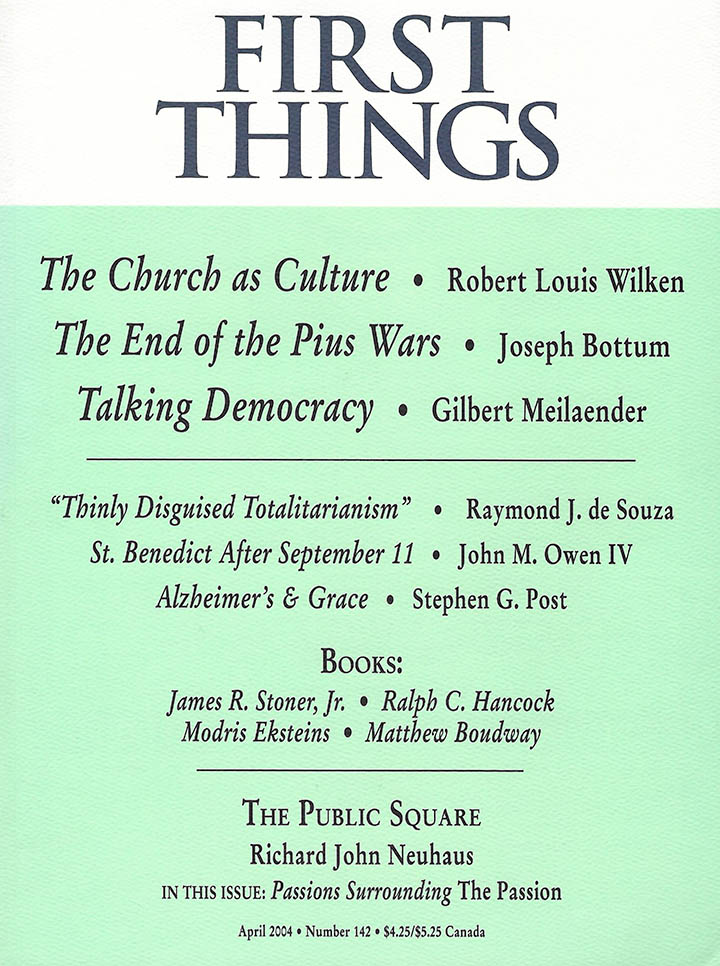
• Quite suddenly, it seems, there are four imminent developments of most particular interest to a magazine of religion, culture, and public life. Each has the potential of being a benchmark of historic change. Not necessarily in order of importance they are the response to Mel Gibson’s The Passion , the campaign for the marriage amendment, the report of the National Review Board on the Catholic scandals (and the responses to it), and the prospect of John Kerry being the Democratic nominee. Many churches and parachurch organizations are gearing up to make The Passion a box-office success. Some, such as the Catholic Diocese of Cleveland, appear to be putting the anxieties of Jewish organizations ahead of the proclamation of the gospel and are actually warning against the film. An important question is whether the film will generate in our public culture, for the first time in living memory, a serious discussion of the meaning of Christ and his crucifixion. The marriage amendment continues to gain steam and will likely play a significant part in the presidential campaign. A critical question is whether it can avoid being stigmatized as an anti-gay measure. That will depend in large part on whether the argument is successfully made that homosexual unions and other domestic arrangements fall into the category of friendships. Friendships can be healthy or not, but it is not the government’s business to certify or regulate friendships. By way of sharpest contrast, marriage has always and everywhere been recognized as a legitimate and necessary public concern. As for the National Review Board, there are two reports scheduled for February 27. The first is the report on the research done by the John Jay College of Criminal Justice on the pertinent data–how many offenses, how many victims, the circumstances of offenses, etc. At least six dioceses declined to participate in that study because they claim it was not mandatory, because it would risk violating confidentiality and impugning the innocent, and because it does not include the one-third of priests who are in religious orders. Much more important is the report of the National Review Board itself, and the episcopal responses to the report. Finally, if John Forbes Kerry is the nominee, be prepared for a historic rectification of what happened when the first JFK ran for the presidency. He dealt with the “Catholic question” by assuring the Baptist ministers of Houston that his faith was entirely a private matter and would have no bearing on his conduct in office. Catholic leaders didn’t like that but they bit their tongues, so eager were they to see Catholicism culturally legitimated by having one of their own in the White House. That was nearly half a century ago. Since then, many developments–most notably Roe v Wade and the related life questions–have dramatically changed the Church’s relationship to the elite culture. Some bishops are at last beginning to act like bishops in speaking out on the moral malfeasance of Catholic politicians who freely, knowingly, publicly, and persistently defy the Church’s teaching. Unlike the first JFK, Kerry will almost certainly not get a free pass from the Church. And history having many ironies in the fire, this time the Baptists and other Evangelicals will be cheering on the bishops in their effort to make clear that Christian faith has inescapably public implications. All very interesting, all of potentially historic significance, and on all four developments there will be much more in forthcoming issues.
• We continue to receive requests from Readers of first things (ROFTERS) who would like to convene independent discussion groups in their local communities. If you are a ROFTER living in one of the cities listed below and would like to join other readers to discuss articles and issues related to our magazine, contact the following individuals. Check the last page of each issue beginning with October 2003, or on our website (www.firstthings.com), for more ROFTER groups around the country. Finally, if you would like to start a group in your area, please send us your contact information.
Those living in Ridgewood, New Jersey can contact:
Walter W. Lynn
562 Fairway Road
Ridgewood, New Jersey 07450
(201) 445-5279
e-mail: w.w.lynn@att.net
In Ann Arbor, Michigan contact:
Thomas Fitzgerald
450 South Main Street
Ann Arbor, Michigan 48104
(734) 426-0047/ (734) 761-8440
e-mail: thfitz@umich.edu
In Hong Kong: len Cheng
c/o Financial Times
29th floor, 2 International Finance Centre
No 8 Finance Street, Central
Hong Kong
e-mail: ien.cheng@ft.com
In Cheyenne, Wyoming,:
Dan Swiatek
4911 East 7th Street
Cheyenne, Wyoming 82001
(307) 634-8247
e-mail: djswiatek@msn.com
In Berkeley, California:
John F. Maguire
Natural Law Jurisprudence Center
1442A Walnut Street, #404
Berkeley, California 94709
e-mail: drmaguire@hotmail.com
In Christiansburg, Virginia:
David M. Ruggio
949 Switchback Road
Christiansburg, Virginia 24073
(540) 731-1644
e-mail: dmr@vt.edu
In Plymouth, Minnesota
Gregory J. Pulles
4625 Xene Lane North
Plymouth, Minnesota 55446
(763) 577-0907
e-mail: Gpulles@tcfbanks.com
In McLean, Virginia:
Charles Molineaux
8321 Weller Avenue
McLean, Virginia 22102
(703) 448-8092
e-mail: CMInx@ldlaroccaaol-com
In Philadelphia, Pennsylvania:
Deborah Conley
220 West Gorgas Lane
Philadelphia, Pennsylvania 19119
(215) 843-2852
e-mail: dconleygorgas@msn.com
In Gainesville, Florida:
Mary Jane Ballou
530 NE 8th Avenue
Gainesville, Florida 32601
(352) 375-0858
e-mail: mjballou@bellsouth.net
In Ames, Iowa:
(The Rev.) Russell J. A. Melby
2106 Hunzikeve Drive
Ames, Iowa 50010
(515) 233-4830
e-mail: norskeboy@aol.com
• We will be happy to send a sample issue of this journal to people who you think are likely subscribers. Please send names and addresses to first things, 156 Fifth Avenue, Suite 400, New York, New York 10010 (or e-mail to subscriberservices@pma-inc.net). On the other hand, if they’re ready to subscribe, call toll free 1-877-905-9920, or visit www.firstthings.com.
Sources: The Bishop of Bray, Washington Times, January 31, 2004.
while we’re at it: Christian Century advocates “morning after pill,” February 10, 2004. Methodist woman wants a Jewish Bat Mitzvah, Wall Street Journal, January 14, 2004. Bartholomew I in Cuba, www.chiesa.com, January. Francis Cardinal George’s letter to spineless priests, Origins, January 22, 2004. Bill Clinton’s opinion on how Muslim men and women should mix, New York Times, January 22, 2004. Gibson’s pro-Christian passion, Chicago Sun-Times, January 21, 2004. Edgy, Brandweek, October 13, 2003. Neil Powell on Francis Thompson, Times Literary Supplement, July 26, 2003. Michael Novak’s “gnostic notions,” Wanderer, January 15, 2004. END WAR car tag, Messenger, January-February 2004. Secularism as Jesuit higher education, Review for Religious, Vol. 63.1. Mark Judge on William H. Shannon and Thomas Merton, Crisis, November 2003.

YOU MIGHT ALSO LIKE
How the State Failed Noelia Castillo
On March 26, Noelia Castillo, a twenty-five-year-old Spanish woman, was killed by her doctors at her own…
The Mind’s Profane and Sacred Loves
The teachers you have make all the difference in your life. That they happened to come into…
History’s Pro Tips on Iran
Nothing in human experience compares to the wars of the last 120 years. Their scope has grown…
