
• The Chicago Sun Times prompted something of an ecumenical kerfuffle with a long story under the headline, “Are Lutherans Pretending to be Catholic to Lure Hispanics?” Some Catholic priests think so. Pastor Keith Forni of a congregation that goes by the name of Iglesia Santa Cruz Church protests. Yes, he writes in a Lutheran publication, some Lutheran parishes reaching out to Latinos have holy water at the door, display pictures of Our Lady of Guadalupe, call the pastor “Father,” celebrate a liturgy very much like the Catholic Mass, and downplay the name “Lutheran.” But for Lutherans, or at least for Lutherans who understand themselves to be “evangelical catholics,” such practices can be justified by appeal to the original intention of the Lutheran Reformation. Pr. Forni notes that Luther himself did not intend a church called Lutheran. Yet, as he acknowledges, there is the question of “truth in packaging.” In response to the criticism that it is deceptive for Lutherans–and he mentions Episcopalians as well–working among Hispanics not to prominently display their denominational affiliation, he says, “My nearest Roman Catholic parish is commonly known as Mount Carmel Church'” —without any mention of Catholic or Roman Catholic. Well, yes, but for almost all Hispanics the default position is Catholic. That is to say, a church that does the aforementioned things is assumed by Hispanics to be Catholic. This is not a big deal, except for the people immediately involved. Lutheran and Episcopal outreach to Hispanics is minuscule compared with the work of Pentecostals, who make no secret of the fact that they are not Catholic and are, more often than not, overtly anti-Catholic. But there are interesting questions raised. “Lure” may not be the right word, but there is something sly about trading in mistaken identities. Of course, Lutheran and Episcopal parishes could put their denominational identity front and center, offering themselves as a way of being catholic without really being what almost everybody means by being Catholic. But it is somewhat demeaning to present oneself as a substitute for the Real Thing. I am sympathetic to the Catholic priests who are critical of non-Catholics presenting themselves as Catholics. At the same time, it is good for priests to know how much some Protestants do share with Catholics. The question posed in Chicago and elsewhere is but one of many vexing ambiguities in being a lower-case catholic.
• At least one Anglican bishop is prepared to clamp down on dissidents. Bishop Michael Ingham of Vancouver, British Columbia, says, “I am trying to be very patient. I am trying to keep the door open as long as I can. I am trying to say to [the dissidents], ‘We do respect your conscience, we are not forcing you into anything?” But he adds, “There is a limit to all human patience.” The dissident priests and parishes are opposed to the church’s blessing of same-sex unions. (Recall the maxim: “Where orthodoxy is optional it will, sooner rather than later, be proscribed.”)
• It is all too easy to dismiss the World Council of Churches as moribund and irrelevant. Yet one should not overlook the ways in which an institution on the ropes is capable of maintaining a “plausibility structure” (Peter L. Berger) that makes it possible for people to believe that they are not only engaged but are on the cutting edge. In the WCC publication the Ecumenical Review, there is a long article by Ulrich Duchrow, professor of systematic theology at Heidelberg University and author of Alternatives to Global Capitalism: Drawn from Biblical History, Designed for Political Action (soon to appear under that title in English). “Since the breakdown of historic socialism,” the article begins, “the category of private property has practically disappeared from the discussion on economic justice.” After the breakdown of “historic socialism,” what the world needs, he seems to be saying, is socialism. Typical of his proposals is linking private productive property to strict criteria of social usefulness” as determined by “democratic institutions in the framework of the UN, which needs to be reformed accordingly.” The churches need to find the “prophetic” nerve to “join the struggle of the social movements” that will bring them into “conflict with the forces of power and wealth.” Francis Fukuyama wrote with relative caution about the end of history. The WCC, as befits a prophetic institution, is after the end of history, although it looks pretty much like history repeating itself. In any event, it is perhaps worth bringing this to the attention of those who thought the WCC is history.
• I have on several occasions been somewhat critical of Leon Wieseltier of the New Republic, and now my irrepressible niceness compels me to compensate by bringing to your attention a thoughtful essay by Wieseltier, “Hitler is Dead.” It was written some months ago at the height of what he called “ethnic panic” about the newly assertive anti-Semitism, especially in Europe. He cites a 1948 essay by Simon Rawidowicz, ‘The Ever-Dying People.” Rawidowicz wrote, ‘The world has many images of Israel, but Israel has only one image of itself: that of an expiring people, forever on the verge of ceasing to be…. There was hardly a generation in the Diaspora period which did not consider itself the final link in Israel’s chain. Each always saw before it the abyss ready to swallow it up.” Wieseltier comments: “The fright of American Jewry is finally not very surprising, and not only because we are an ‘ever-dying people.’ To a degree that is unprecedented in the history of the Jewish people, our experience is unlike the experience of our ancestors: not only our ancient ancestors, but also our recent ones. It is also unlike the experience of our brethren in the Middle East. Their experience of adversity in particular is increasingly unrecognizable to us. We do not any longer possess a natural knowledge of such pains and such pressures. In order to acquire such a knowledge, we rely more and more upon commemorations–so much so that we are transforming the Jewish culture of the United States into a largely commemorative culture. But the identifications that seem to be required of us by our commemorations are harder and harder for us to make. In our hearts, the continuities feel somewhat spurious. For we are the luckiest Jews who ever lived. We are even the spoiled brats of Jewish history. And so the disparity between the picture of Jewish life that has been bequeathed to us and the picture of Jewish life that is before our eyes casts us into an uneasy sensation of dissonance. One method for relieving the dissonance is to imagine a loudspeaker summoning the Jews to Times Square. In the absence of apocalypse, we turn to hysteria. In America, moreover, ethnic panic has a certain plausibility and a certain prestige. It denotes a return to ‘realism’ and to roots. A minority that has agreed to believe that its life has been transformed for the better, that has accepted the truth of progress, that has revised its expectation of the world, that has taken yes for an answer, is a repudiation of the past. Yes feels a little like corruption, a little like treason, when you have been taught no. For this reason, every disappointment is a temptation to eschatological disappointment, to a loss of faith in the promise of what has actually been achieved. That is why wounded African Americans sometimes cry racism and wounded Jewish Americans sometimes cry anti-Semitism. Who are we kidding? Racism is still with us. Anti-Semitism is still with us. The disillusionment comes almost as a comfort. It is easier to believe that the world does not change than to believe that the world changes slowly. But this is a false lucidity. Racism is real and anti-Semitism is real, but racism is not the only cause of what happens to blacks and anti-Semitism is not the only cause of what happens to Jews. A normal existence is an existence with many causes. The bad is not always the worst. To prepare oneself for the bad without preparing oneself for the worst: this is the spiritual challenge of a liberal order:” In that 1948 essay, Rawidowicz had observed, “An ever-dying people is an ever-living people. A nation always on the verge of ceasing to be is a nation that never ceases to be.” Of course, that is a statement of hope, not of logic. History is littered with nations on the verge of ceasing to be that ceased to be. But, with respect to Israel, it is a hope that we should all share.
• Does Francis Cardinal George of Chicago exaggerate? I think not. There is a move in the American Medical Association to require all hospitals to provide all “reproductive health services.” The Cardinal says, “Catholic hospitals cannot comply. Effectively, the AMA is being asked to help abolish Catholic health care in this country.” Catholic hospitals treat eighty million patients each year and make up 11 percent of all community hospitals. These are often in rural areas, and the 637 Catholic hospitals take a loss of $2.8 billion per year in serving the poor. Catholic hospitals are not where the money is. Abortionists—of whom there are less than a thousand in America–are concentrated in the cities. Only seven percent of abortions are performed in hospitals, and they are performed in just 14 percent of all hospitals. Pro-abortionists know that if abortion is ever to gain the appearance of moral legitimacy and be considered a normal part of medical care, it is necessary for Catholic hospitals to do abortions. As the Cardinal says, Catholic hospitals cannot comply. If the present agitations in the AMA and state legislatures, along with litigation in several courts, are allowed to succeed, it spells the end of nearly two centuries of Catholic health care in America.
• Thank goodness David Blankenhorn is on the job. My eyebrows too were raised by a January 14 Wall Street Joumal story, “Divorce Makes a Comeback,” by Jeffrey Zaslow. Blankenhorn, who heads the Institute for American Values, an organization that does some of the best research on marriage and family questions, devastatingly dissects the story, showing that Zaslow’s claims are based on no evidence at all. Divorce rates peaked in 1979 and have since fallen substantially. Of course there are still too many divorces, but at present the tide has stopped and shows some signs of turning. Numerous studies demonstrating, among other things, the sorry consequences of divorce for the children involved have contributed to a growing popular understanding that divorce is not the solution that it was so widely thought to be several decades ago. I’m as puzzled as Blankenhorn as to why the Wall Street Joumal ran the story. Maybe they have an editor in charge of countering good news.
• Bishop William Weigand of Sacramento, California’s capital, announced at Mass on the thirtieth anniversary of Roe v. Wade that Gov. Gray Davis and other pro-abortion politicians should abstain from receiving Holy Communion. “As your bishop, I have to say clearly that anyone— politician or otherwise—who thinks it is acceptable for a Catholic to be pro-abortion is in very great error, puts his or her soul at risk, and is not in good standing with the Church…. Such a person should have the integrity to acknowledge this and choose of his own volition to abstain from receiving Holy Communion until he has a change of heart.” The Bishop says he was emboldened by a priest who runs a home for disadvantaged children and told the governor that he wasn’t welcome, and also by a recent note from the Congregation for the Doctrine of the Faith that set forth the responsibilities of Catholics in politics. The governor’s office said that Weigand’s statement was “sad” and that the governor “is proud of the legislation he has signed giving women the right to choose.” The governor’s statement also criticized Bishop Weigand for “telling the faithful how to practice their faith.” How dare he! It must be admitted that the example of many bishops over the years has no doubt given some the impression that bishops have no business instructing the faithful on the practice of the faith. The key phrase in the governor’s statement is, of course, “their faith.” Yes, they take their faith from the local Catholic franchise as distinct from, for instance, the local Buddhist temple, but, in exchange for patronizing the Church and making a generous contribution, it is “their faith” to do with as they wish. Imagine if you patronize WalMart by buying, say, a sound system and then WalMart presumes to stipulate what kind of music you play with it. It is not the business of WalMart to tell customers how to use their sound system. The governor has given perfect expression to the idea of religion as a consumer product. For putting the matter so starkly, we are in his debt.
• Also on the thirtieth anniversary of Roe v. Wade, Medical Students for Choice, an organization at Johns Hopkins, threw a party. The invitation read: “Come learn about what’s being done to train new providers and ensure that a woman’s right to choose is both safe and accessible! Come and eat birthday cake!” Birthday cake in honor of Roe v. Wade? Perhaps this is an instance of overdetermined postmodernist irony, but I doubt it. Here the rule applies: do not seek for further explanations when stupidity will do.
• Daniel Johnson of the (London) Daily Telegraph has a useful article in the February Commentary titled ‘The Catholic Crisis.” It includes a review of Garry Wills’ Why I Am a Catholic, Daniel Goldhagen’s A Moral Reckoning, and George Weigel’s The Courage To Be Catholic. No reader will be surprised that I think he is right in his high praise of Weigel’s analysis of what has gone wrong and what might be done about it, and in his sharp criticism of Wills’ position as the problem, not the solution. Johnson overstates, I think, the immediate impact of the crisis on matters such as Mass attendance, financial support, and vocations to the priesthood, but he is right in thinking that the media depiction of the scandals—a depiction supported by very real failures of Catholic leadership–has had a powerfully negative effect in terms of the Church’s public influence. The article concludes with a typically laconic piece of wisdom from Irving Kristol, the Jewish “godfather” of neoconservatism, in an address of 1979. Kristol spoke about the threat of “an upsurge of anti-biblical barbarism that will challenge Christianity, Judaism, and Western Civilization altogether.” He went on to say: “If I may speak bluntly about the Catholic Church, for which I have enormous respect, it is traumatic for someone who wishes that Church well to see it modernize itself at this moment…. The Church turned the wrong way [in the 1960s]. It went to modernity at the very moment when modernity was being challenged, when the secular gnostic impulse was already in the process of dissolution. Young people, especially, are looking for religion so desperately that they are inventing new ones. They should not have to invent new ones; the old religions are pretty good.”
• There is a certain attraction in the ingenuousness of a review of my book As I Lay Dying: Meditations Upon Retuming in a medical journal called The Pharos. The review is appreciative on some scores, but then Dr. Benson B. Roe writes, From the viewpoint of a physician and research scientist, I find it impossible to reconcile the conflicting forces that must have influenced Neuhaus’ perceptions. His severe illness suggests the likelihood of experiencing toxic delusions during his critical phase, which he may have recalled with various imaginative embellishments.” Fair enough. I said as much in the book. And then this, “It is difficult for me to understand how an educated society, surrounded by critical media and objective appraisals of everything from movies to automobiles, can so willingly accept assertions of metaphysical phenomena.” I do not find it difficult to understand that he really does find that difficult to understand One is put in mind of Rudolf Bultmann, the once influential New Testament scholar and proponent of “demythologizing,” who thought it evident that a modern man who creates light by flicking an electrical switch cannot really believe that Jesus rose from the dead. There are still many like Dr. Roe for whom “critical” and “objective” simply preclude reflection on dimensions of reality that can be neither considered nor understood without reference to ways of thinking that throw into question the meaning of “critical” and “objective.” Anything that cannot be known in the way that we know toxins and how automobiles work cannot be known. It is a dogma that simplifies life, but at a terrible price of intellectual impoverishment.
• Here’s an interesting fracas. Psychology Today ran a small ad for a book, A Parent’s Guide to Preventing Homasexuality by Joseph and Linda Nicolosi. Robert Epstein, the magazine’s editor in chief, received an angry call from a lesbian activist informing him that she and her allies were organizing a harassment campaign against him and the magazine. Mr. Epstein tells the story: “In all, I received about 120 letters, many of which exemplified a bad game of Telephone: Some people complained about an anti-gay ‘article’ PT had published; others referred to an anti-gay book I had published and people who weren’t subscribers said they were dropping their subscriptions. Several writers suggested I was a ‘Nazi’ and a ‘bigot,’ and one compared me with the Taliban. A surprising number of letters asserted that gays have a right to be rude or abusive because they themselves have been abused. Most echoed the same points that my caller had made. But my caller was way off base on key points. The [American Psychological Association] has never condemned sexual conversion therapy but has merely issued cautionary statements, one of which reminds psychologists of their obligation to ‘respect the rights of others to hold values, attitudes, and opinions that differ from [their] own’—an obligation from which my caller clearly feels exempt. Although homosexuality was removed from the DSM–the diagnostic manual used by therapists–as a mental disorder in 1973, all editions of the DSM have always listed a disorder characterized by ‘distress’ over one’s sexual orientation (DSM section 302.9). Both gays and straights have a right to seek treatment when they’re unhappy with their sexual orientation, and some choose to try to change that orientation. It would be absurd to assert that only heterosexuals should have that right. Can gays change? Some people who wrote to me insisted that ‘orientation’ is immutable, but behavior is certainly not, and it’s common for people to ask therapists to help them suppress a wide variety of tendencies with possible genetic bases: compulsive shopping and gambling, drinking, drug use, aggressiveness, urges to have too much sex or sex with children, and so on. A 2002 research review by Warren Throckmorton, Ph.D., published in an APA journal, suggests that sexual conversion therapy is at least sometimes successful. From this and other sources I’ve checked, I’d guess that such therapy is probably successful about a third of the time and that in perhaps another third of the cases, clients are unhappy or even angry about their failure to change. These figures might sound discouraging, but there are certainly many examples of clinical problems that resist change (e.g., agoraphobia and autism) or that produce angry outcomes after therapy (e.g., couples counseling or treatment for sexual abuse). Of greater importance is a new study by Robert Spitzer, M.D., of Columbia University, the man who headed the committee responsible for removing ‘homosexuality’ from the DSM in 1973. After surveying two hundred people who had remained ‘ex-gay’ for at least five years— and even though he has been under tremendous pressure by gay activists to repudiate his findings—Spitzer has concluded that sexual conversion therapy can produce significant, positive, and lasting changes.” Mr. Epstein goes on to say that the Nicolosi book is “surprisingly” tame and balanced, although he takes exceptions to parts of it and is more sympathetic to gays than he takes the Nicolosis to be. He also says it’s time for the magazine to revisit the “sexual conversion” question, and it will be doing that in the near future. One thing is for sure: the protest guaranteed that the Nicolosis got more than their money’s worth from that little ad.
• Many important things have been said in this year of the thirtieth anniversary of the infamous Roe v. Wade decision. Among them I count the counsel of Father Francis Canavan of Fordham University, writing in catholic eye: “The direct and intentional taking of human lives is of its nature a public issue (if the state does not exist to protect human lives, what is it there for?) and is not one to be dismissed with cries of imposing beliefs. All that is asked for is that the issue be taken for what it is and be admitted to the public forum to be decided by the democratic political process. It would also help if pro-lifers got over the habit of thinking of that process as an either-or, all-or-nothing contest. If we present the issue as abortion on demand or no abortion at all, there can be no doubt which of the two the American public will support. Politics, however, does not work that way. As Edmund Burke explained two centuries ago, The decisions of prudence [i.e., political judgment) … almost all are determined on the more or less, the earlier or the later, and on a balance of advantage and inconvenience, of good and evil.’ We are in for a long, hard fight, where the gains will be slow and at first few, but the only way to make any gains is to get into the fight and stay in it.”
• “Religious routine” can mean a pattern of good habits. Or it can be something quite grim. As with this reflection on Church of England habits plucked from Nigel Rees’ inimitable “Quote… Unquote” Newsletter. The poem, published in 1918, is by Geoffrey Herbert Crump:
A brilliant summer morning, still and hot;
A day for flannels and a pipe, and not
For stuffy Sunday clothes, a long, dull walk,
And duller sermon, and the vapid talk
Of fellow-Christians, with souls replete,
Hurrying to fill their bodies with roast meat.
Their worship’s over; God’s returned to Heaven,
And stays there till next Sunday at eleven.
• I have on occasion quoted Martin Luther King’s statement that law cannot make a man love me but it can keep him from lynching me. But I was at a loss when asked for the exact source. Once again the invaluable Nigel Rees to the rescue. It was in a sermon at St. Paul’s Church, Cleveland Heights, Ohio, on May 14, 1963. Here is the fuller statement: ‘There are always those who say legislation can’t solve the problem. There is a half-truth involved here. It is true that legislation cannot solve the whole problem. It can solve some of the problem. It may be true that morality can’t be legislated, but behavior can be regulated. It may be true that legislation cannot change the heart, but it can restrain the heartless. It may be true that the law cannot make a man love me, but it can keep him from lynching me, and I think that’s pretty important.”
• John L. Allen’s “The Word from Rome” offers possibly the best reporting on the Holy See published in this country. He shares some of the leftist bias of his paper, the National Catholic Reporter, but is attentive to the various and often conflicting currents to be expected at the institutional and spiritual center of a community that is universal, as in Catholic. Here are a few recent items of interest. Father Thomas Stransky, 72, was one of the original staff for what was then called the Secretariat for the Union of Christians, established by John XXIII in 1960. In a speech in Rome, Stransky revealed that the Second Vatican Council’s language about the “hierarchy of truths” was in part the work of the ecumenical observers at the Council. The Council said: “When comparing doctrines with one another, [theologians] should remember that in Catholic doctrine there exists an order or ‘hierarchy’ of truths, since they vary in their relation to the foundation of Christian faith” (Unitatis Redintegratio, 11). Renowned Protestant theologian Oscar Cullman said at the time that the passage was “the most revolutionary to be found not only in the ecumenism scheme but in any of the schemata.” Of course the Council did not intend anything revolutionary, but innumerable Catholic theologians have used the idea of a hierarchy of truths to claim that dissent from, or rejection of, some doctrines is licit, provided it does not affect their definition of what constitutes “the foundation of the Christian faith.” Frequently the line of necessary assent is drawn at those truths infallibly defined, followed by endless quibbling over which doctrines qualify by that rule, followed by more quibbling over the meaning of infallibility, and yet more over what is meant by assent. In sum, “hierarchy of truths” has turned out to be, at least in consequence, infelicitous. Cardinal Ratzinger says the Council’s intent is better caught by the phrase “the structure of faith,” in which all doctrines co-inhere and are therefore obligatory, although, as in a building, not all are as essential to the structure itself. The Congregation for the Doctrine of the Faith has at times tried to discriminate between the different kinds or levels of assent required of theologians. These are honorable and necessary labors, but they are not likely to end the quibbling or dissent on the part of theologians who are undoubtedly sincere in asserting that they intend to be faithful Catholics while rejecting some or much that the Church teaches. Jean-Paul Sartre’s idea of “bad faith” is perhaps his single contribution to philosophy and our understanding of the subtleties of the human capacity for self-deception. No formulation–hierarchy of truths, structure of faith, whatever–can secure fidelity in the absence of a theologian’s earnest desire to think with the Church (sentire cum ecclesia). Fr. Stransky’s information throws light on how the Council’s phrase was misunderstood from the start. It would seem that Protestants who thought unity possible on the basis of selective assent to Catholic teaching supplied cover for Catholics who think the same. The infallibility of a Council does not mean that its documents are immune to misconstrual.
• John Allen reports that some European Catholics “look upon the European Union with approximately the same affection they feel for the Freemasons and the Communist Party.” One reason is that in its “constitutional treaty” the EU is resisting, with the French in the lead, any explicit mention of Christianity as the spiritual and cultural foundation, at least historically, of European identity. At a conference at Regina Apostolorum, the Legionaries of Christ university in Rome, it was noted that, according to UN statistics, 560 million of 730 million Europeans are Christian. To judge by what most Europeans say they believe and by what they do or don’t do religiously, “Christian” in this connection would seem to require a weaker word than “nominal.” In a de-secularizing world, Europe, and especially Western Europe, appears to be the dismal exception. Christoph Cardinal Schönborn of Vienna recently compared the circumstance of Christians in Europe to that of the Jewish diaspora throughout most of history. “This hostile, rejecting attitude in our secularized countries is felt ever more frequently,” Schönborn said. “We are increasingly regarded as foreign bodies, disturbing the peace in a neo-pagan society.” In this sense, he said, the situation of Christians is not unlike that of both Jews and Christians in antiquity whose refusal to place God among the gods in the pantheon was thought “highly intolerant.” The big difference, of course, is that today’s European views Christianity as something that was tried and found wanting, whereas in the second or third century it was a fresh, if troubling, proposal. It may be that Christians in Europe need to talk less about Christianity in terms of the “roots” and “foundations” of European identity and more about the proposal of Christian truth for the European future. I don’t pretend to have the particulars of how that might be done, but I doubt that Europe is an exception to the rule that those who propose the most believable and promising vision of the future are on the way to carrying the day.
• This is written before any military action by the U.S. and the coalition of the willing to effect regime change in Iraq, but there are irritants in Rome that some would inflate into a crisis of Catholic fidelity. Some curial officials have been very vocal in their criticism of U.S. leadership. One very influential Cardinal is reported as saying to a group of Italian journalists, “I said to an old American friend: Didn’t the lesson of Vietnam teach you anything?” Of course His Eminence is right. We Americans really must get around to giving some serious thought to the lessons of Vietnam. The Holy See is against the war,” he said. “It’s a moral position.” It may be a moral position in the sense that it is held by moral people for what they deem to be moral reasons, but it is not a position to which Catholics are morally obliged to assent. The Cardinal continues: “There’s not much to discuss, whether it’s a preventive war or non-preventive, because this is an ambiguous term. It’s certainly not a defensive war.” With due deference, there is a great deal to discuss. On September 11 terrorists attacked and declared war (once again) on America and the civilized world. In response, the U.S. declared a defensive war on terrorism. One can debate whether attacking Iraq is the right way to prosecute that war, while being permitted to wonder whether, as a geopolitical strategist, the Cardinal’s judgment is to be credited more than that of George W. Bush, Tony Blair, and the heads of government in Australia and most of Europe. “We’re trying to provoke reflection not so much on whether it’s just or unjust, moral or immoral, but whether it’s worth it,” the Cardinal said. “Is it really a good idea to irritate a billion Muslims?” The policy is to neutralize terrorists–most of whom happen to be Muslim–who are intent upon killing millions of us, and irritating a lot of Muslims might be a price worth paying to achieve that goal. On the other hand, millions of Muslims might be grateful for being liberated from their oppression by tyrants who, among other things, support international terrorism. I don’t know what is going to happen, and I’m rather sure the Cardinal does not know, but he is inclined to expect the worst. “Not even in Afghanistan are things going well,” he says with apparent satisfaction but without specifying what he has in mind. “For this reason we have to insist on asking the question if it’s a good idea to go to war.” I cannot help but think that President Bush et al. have asked that question. Another highly placed curial party shares the Cardinal’s concerns about the dire consequences of military action. He says an Arab foreign minister told him that war would “open the gates of hell.” Let’s hope that he and the Arab minister are wrong. The prudential judgments of curial officials on military and strategic matters should be respectfully received for what they are worth as weighed in the balance of other such prudential judgments. They do not reach, they do not even credibly gesture toward, magisterial teaching on faith and morals. For Catholics, no question of fidelity is engaged. Hypothetically, that could be complicated by a definitive pronouncement from the Pope, but I do not expect that. In Europe and here, there are many prognosticators predicting the worst. The other day an Episcopal bishop announced that he knows an attack on Iraq will cause “millions of deaths.” He knows no such thing. It would be more seemly and more helpful if religious leaders refrained from pretending to a superior knowledge of what might go wrong and got down on their knees, praying that a just cause will prevail. In all these ponderings, one keeps in mind the teaching of the Church as set forth in the Catechism of the Catholic Church. After discussing the traditional conditions for “legitimate defense by military force,” the Catechism states, “The evaluation of these conditions for moral legitimacy belongs to the prudential judgment of those who have responsibility for the common good” (§2309). As for me, it is little to the point whether I support or oppose military action against Iraq. It appears almost certain that it will happen. I am not persuaded that there is a morally defensible alternative to such action. I am persuaded it is part of a just cause that I pray will prevail with minimal damage to all concerned–except for Saddam and those most immediately responsible for this unhappy circumstance. They must, in justice, be severely punished. Military action in Iraq will not be the end of the war that has been declared against us. This, too, is a time to test men’s souls. At future points of crisis, one hopes that religious leaders will contribute to the necessary public discussion something more than their fears.
• It’s not much of a story but it does have its whimsical side. Jim Nicholson, the U.S. ambassador to the Holy See, invited Michael Novak to give a lecture in a series sponsored by the embassy. His subject was just war, with specific reference to Iraq. Sixty American opponents of U.S. policy, including superiors of men’s and women’s religious orders and activists associated with the pacifist Pax Christi organization, signed a letter of outraged protest. They accused Novak of violating the “almost unanimous” Catholic opposition to military action against Iraq. The letter does not say how they determined the opinion of the sixty-five million Catholics in the U.S. And they could not have been referring to the U.S. bishops, whose formal statement on the matter carefully refrained from making the prudential judgments necessary to determining the rightness or wrongness of U.S. action. The protest complains that Nicholson “selected one theologian to represent the U.S. Catholic community’s position on the morality of this war without any consultation with the recognized Catholic leaders in the United States.” Unlike the protesters, neither Nicholson nor Novak presume to think they represent the Catholic community in the U.S. Since “recognized leaders” could not refer to the bishops, one wonders if the signers meant themselves. The letter also says, “In a country where we have a time-honored and legally protected right to the separation of church and state, the appointment of a theologian seems to us to violate that separation.” But Nicholson didn’t “appoint” Novak to anything. He invited him to give a lecture. In fact, Novak, like this writer, has been appointed to various government positions over the years. The claim that theologians must be excluded from government appointments or government-sponsored lecture series is a new wrinkle in Catholic social doctrine and an impressive expansion of the ideology of the naked public square. To be sure, the protesters’ scrupulosity about church-state separationism is somewhat confused by their complaint that Nicholson should have invited someone who represents the “almost unanimous” position of Catholic Americans. The most piquant complaint of the letter is that, because he thinks the U.S. is waging a just war, Novak is a “dissident theologian.” Since some of the signers publicly dissent from Church teaching on any number of questions, it is quickly added, ‘While dissent is always welcome, it should not be confused with the clear statements by Church leaders and theologians.” But of course, dissent from authoritative Church teaching is not and should not be welcome, and nothing so confuses both the Catholic faithful and the general public as activists who present their political preferences as the teaching of the Church. Michael Novak, U.S. citizen and a non-dissident Catholic lay theologian, presented his views on why military action against Iraq is morally justified, and by most reports he did so very ably. It is true that Ambassador Nicholson could have invited someone from Pax Christi to lecture, but I suppose he thought that viewpoint is more than amply represented in Rome. However, for the champions of dissent and open dialogue, “almost” unanimous is not unanimous enough.
• Some Democratic analysts, more or less accepting the proposition that the parties are increasingly defined by the secularist/ religious divide, have taken heart from the finding that 14.1 percent of the population say they have no religion or describe themselves as atheist or agnostic. That figure has doubled since 1990. It turns out, however, that some secularists are not so very secular. Only one-fifth of those in the “no religion” category disagree with the statement that God exists, and only 12 percent of them disagree strongly. It’s an old story: some people don’t like religion, preferring “spiritualities” that are unencumbered by obligations and other people. Christianity in particular is notorious for letting in the riffraff, and then there is that business about taking up one’s cross and following Him.
• “The Case for Invading Iraq” is the subtitle of The Threatening Storm by Kenneth M. Pollack (Random House). Pollack is convinced that Iraq is set upon the aggressive use of weapons of mass destruction. Peter Baehr’s review of the book in the Times Literary Supplement includes a grim observation that none of us, whatever our view of U.S. policy, can evade. “At the heart of The Threatening Storm is a pathos that cannot have escaped its author. If Pollack’s recommendation is followed, and Iraq is invaded, his central argument can never be proved, for then history will thankfully be unable to record Saddam’s nuclear aggression. Yet if Pollack’s argument is vindicated by events it will be because his prognosis was tragically ignored. We are still left, however, with a question that deserves an honest answer: What would prove invasion to be a mistaken strategy, and those of us who now support it to be guilty of a gross misjudgment? The most damaging single piece of evidence would be the revelation that Iraq had abandoned its weapons of mass destruction program after 1998 (the year that the International Atomic Energy Agency was last able to verify that ‘most’ of Iraq’s nuclear inventory had been eliminated). And a ‘victory’ that came through the use of American or Israeli nuclear weapons against Iraqis would be worse than any of Saddam’s crimes. The cruel dilemma is that, without an invasion, a nuclear confrontation later is more likely than it is now.” But, Baehr says, we are not bereft of reasons for gratitude: “Since her founding over two centuries ago, the United States has been blessed with Presidents who were willing to make difficult but vital decisions in hazardous times. No one is going to elevate George W. Bush to the pantheon of Washington, Lincoln, and FDR, but I for one am grateful that providence has seen fit to place him, and not a Jimmy Carter, in the Oval Office at this fateful moment. Iraq is sui generis. One can oppose Bush on many other issues–domestic and international–while believing that invasion is the correct course of action. Saddam Hussein is a sinister and menacing tyrant who has violated sixteen United Nations resolutions since 1990. American power is the only means by which he can finally be unseated.”
• The “morality gap” is becoming the most important variable in American politics. So says Thomas Byrne Edsall, writing in the Atlantic Monthly, and using data similar to that employed by a recent article in the Public Interest on which I commented here (“Voting What You Believe,” Public Square, January). The best indicator of how people will vote, says Edsall, is their attitude toward sex: homosexuality, pornography, adultery, and sex before marriage. Those with traditional views vote Republican, those with liberal views vote Democrat. Edsall recognizes that there is a strong connection with religion, but the good news for Democrats is that people are becoming less religiously observant and more liberal in their sexual behavior. Edsall’s bias is undisguised. The Republicans are “the party of sexual repression,” devoted to “reversing the sexual revolution” by “moving to restrict Americans’ sexual autonomy,” and so forth. Missing from his discussion are counter-data indicating, inter alia, a dramatic rise in teenage abstinence and in pro-life views among younger adults. He also seems to assume that, for instance, because more people watch pornography more people think watching pornography is a good thing to do. At least as probably, there are just more people feeling guilty about watching pornography. I don’t know whether religion and morality serve the short and long-term political purposes of the Republican Party as argued with considerable sophistication in the aforementioned Public Interest article. Mr. Edsall’s essay to the contrary is more punditry than social science, and one can understand his trying to make the data come out in favor of his political and moral preferences.
• Here’s an item that flew in over the Internet transom. The title is “Who Reads the Newspapers?” and it doesn’t say whether it is the result of methodologically scrupulous survey research or just somebody’s hunch. Whichever, it has the ring of truth.
1. The Wall Street Journal is read by the people who run the country.
2. The Washington Post is read by people who think they run the country.
3. The New York Times is read by people who think they should run the country.
4. USA Today is read by people who think they should run the country but don’t really understand the Washington Post. They do, however, like their statistics shown in pie charts.
5. The Los Angeles Times is read by people who wouldn’t mind running the country, if they could spare the time, and if they didn’t have to leave L.A. to do it.
6. The Boston Globe is read by people whose parents used to run the country and they did a far superior job of it, thank you very much.
7. The New York Daily News is read by people who aren’t too sure who’s running the country, and don’t really care as long as they can get a seat on the train.
8. The New York Post is read by people who don’t care who’s running the country, as long as they do something really scandalous, preferably while intoxicated.
9. The San Francisco Chronicle is read by people who aren’t sure there is a country or that anyone is running it; but whoever it is, they oppose all that they stand for. There are occasional exceptions if the leaders are handicapped minority feminist atheist dwarfs, who also happen to be illegal aliens from any country or galaxy as long as they are Democrats.
10. The Miami Herald is read by people who are running another country but need the baseball scores.
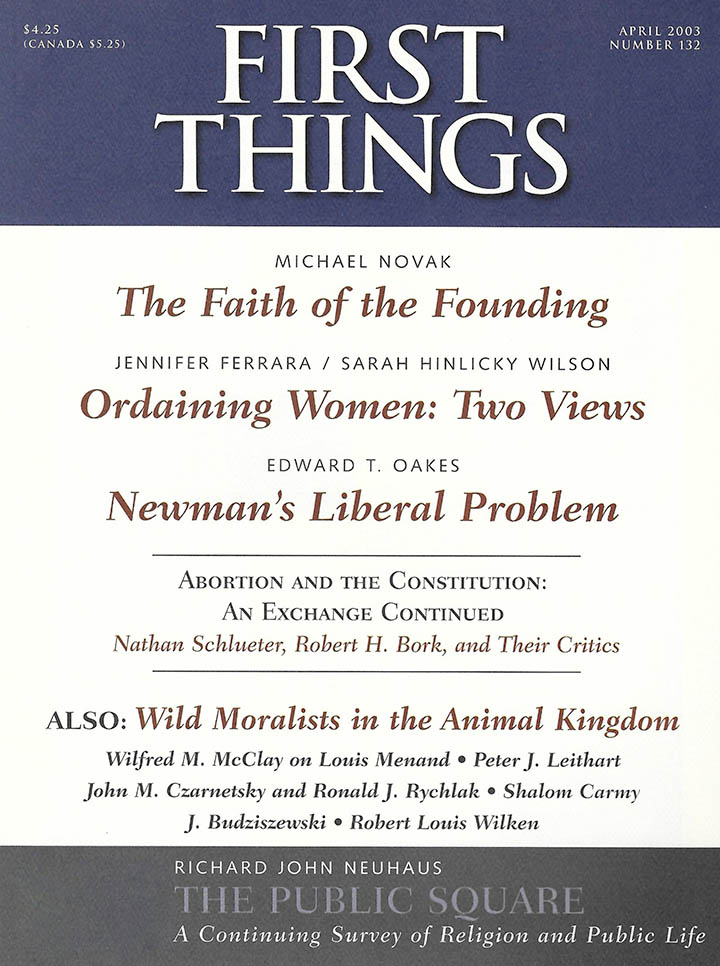
• We will be happy to send a sample issue of this journal to people who you think are likely subscribers. (first things is read by people who really like to read and think and discuss important ideas with their friends.) Please send names and addresses to first things, 156 Fifth Avenue, Suite 400, New York, New York 10010 (or e-mail to subscriberservices@pma-inc.net). On the other hand, if they’re ready to subscribe, call toll free 1-877-905-9920, or visit www.firstthings.com.
Sources: while we’re at it: Hispanic Lutherans, Let’s Talk, published by the Metropolitan Chicago Synod of the ELCA, Vol. 7, Issue 2. Anglican dissidents, National Post, January 20, 2003. On the World Council of Churches, Ecumenical Review, October 2002. Leon Wieseltier on the ever-dying people, New Republic, May 27, 2002. Catholic hospitals and the AMA, data from Bishops’ Secretariat for Pro-Life Activities. David Blankenhorn on divorce rates, American Values Reporter, January 15, 2003. Birthday cake for Roe v. Wade, personal correspondence. Daniel Johnson on the Catholic crisis, Commentary, February 2003. Dr. Benson B. Roe on As I Lay Dying, Pharos, Autumn 2002. Fr. Francis Canavan on abortion, catholic eye, December 31, 2002. Nigel Rees to the rescue, “Quote… Unquote” Newsletter, January 2003. John W. Allen on war and the Curia, Word from Rome, January 31, 2003. Protesting Michael Novak, Pilot, February 7, 2003. “No religionists,” Religion Watch, February 2003. Peter Baehr on war with Iraq, TL$, January 31, 2003. Thomas Byrne Edsall on the morality gap, Atlantic Monthly, January/February 2003.

YOU MIGHT ALSO LIKE
How the State Failed Noelia Castillo
On March 26, Noelia Castillo, a twenty-five-year-old Spanish woman, was killed by her doctors at her own…
The Mind’s Profane and Sacred Loves
The teachers you have make all the difference in your life. That they happened to come into…
History’s Pro Tips on Iran
Nothing in human experience compares to the wars of the last 120 years. Their scope has grown…
