
• Venom delivered with strained cleverness. That pretty much describes Maureen Dowd’s column in the Times. She’s hardly an equal opportunity hater; on almost every question of consequence she’s on the left. Yet she can be as spiteful about Bill Clinton as about George W. I stopped reading her regularly many months ago, although I do sometimes glance at the column to see what sparked today’s tantrum. Then I stumbled across this item in a review of Richard Blow’s book on the late John F. Kennedy, Jr. and his unfortunate magazine George. Dowd panned it after the first issue appeared, and then responded to a note of protest with this: “Don’t be mad at me. I’m paid to be a baby curmudgeon, and it’s no fun. I’d go back to reporting in a minute. I’ve subscribed and I promise only plugs from now on.” That would seem to explain what has gone so sour with her column. She believes the Times pays her to write infantile snits, so that is what she writes. So don’t write to the Times complaining about her silly nastiness. Write urging them to put her back on the beat. She’d be happier, and it’s not beyond possibility that the Times might replace her with a columnist who can be read with less pain, to herself (or himself) and others.
• “The National Council of Churches’ (NCC) devotion to its decades-long tradition of pandering to dictators while condemning democracies has been faithful and predictable. From Brezhnev and Castro, to Kim Il Sung, Daniel Ortega, and Yassir Arafat, the NCC never encountered an anti-American despot undeserving of its affections.” That’s Mark Tooley of the Institute on Religion and Democracy commenting on a recent NCC fact-finding mission to the Middle East. I’m not sure he’s entirely right. For instance, I do not recall any NCC defense of Zimbabwe despot Robert Mugabe in the last ten years or so. Of course, Mugabe may have been dropped from the most favored despots list because of his outspoken contempt for same-sex rutting. His threat to enforce a prohibition of such expressive behavior almost led to the canceling of a World Council of Churches confab in Zimbabwe a few years ago. Mugabe finally agreed not to interfere with the church leaders’ free exercise of libido and the meeting went ahead. I may be wrong, however, about why Mugabe is not on the NCC’s most favored despot list. After all, Castro and Kim Il Sung are also world-class homophobes. In any event, the NCC missionaries to the Middle East were received by the dictator of Syria, the king of Jordan, and by Palestinian leaders, all of whom explained why U.S.-supported Israeli aggression is the source of all the troubles in that part of the world. Of that the NCC delegation did not need to be persuaded. The report of the NCC mission reliably parroted the position of Israel’s neighboring enemies while omitting any mention of, inter alia, the anti-Semitic hatred daily spewed by the Arab media, official Arab support for Palestinian suicide bombers, Muslim prohibition of Christian (and, needless to say, Jewish) religious practice, and the conspicuous absence of democracy or freedom of expression in all the countries of the region except Israel. Nothing new in that. It is, as Mr. Tooley says, part of a “long tradition.” NCC general secretary Bob Edgar was particularly impressed by Syrian dictator Bashar Al Assad, calling him “articulate, clear, and thoughtful.” Edgar added, “He gave insights and a sense that Christians and Muslims and Jews can live together.” That happy prospect, it appears, awaits only Israel’s decision to acquiesce in its own destruction. While its public credibility passed on many years ago, the institutional shell of the NCC is sustained on life-support. One cannot help but wonder how an organization that is paying its overdue telephone bills on the installment plan manages again and again to find the money for pastoral visitations in support of the world’s misunderstood enemies of religious and political freedom. Of course, in a region where former President Bill Clinton can pick up $750,000 for a speaking engagement, as he recently did in Saudi Arabia, money is not an object. Whether or not they paid for this junket, if they are thinking of footing the bill for others in the future, even despots with unlimited slush funds might ask whether the NCC today has any influence worth buying.
• What I said is that I hope that nothing I write here is caustic or nasty. I didn’t say anything about appreciating the acrid talents of others. There is, for instance, James Woolcott’s review of Carol Gilligan’s The Birth of Pleasure. Ms. Gilligan, as you probably know, is the much-celebrated theorist of the male’s cold and calculated reasoning that stands in sharpest contrast to the female’s intuitive and nurturing “ethic of care.” Her 1982 book, In a Different Voice, is an academic version of men are from Mars, women from Venus. The present book, she announces, “was conceived in love.” Let Mr. Woolcott take it from there: “Like many a militant sentimentalist, Ms. Gilligan is serenely humorless, not realizing the absurdity of drawing parallels between herself and Anne Frank. True, Ms. Gilligan writes, I never suffered through poverty, anti-Semitism, war, or rape, ‘but I did experience a shocking break in my relationship with my mother.’ It came when the twelve-year-old Gilligan returned home from camp to find that her mother had asked her beloved grandfather, Popsy, to move out of the house and find his own apartment. Popsy, gone! Setting aside the grim irony that Anne Frank never got to come home from her camp (how I wish writers would quit appropriating Anne Frank for their own agendas), it’s worth noting too that this pushy narcissism isn’t an isolated instance. Elsewhere Ms. Gilligan has the gall to compare her professional quest to Charles Darwin’s (‘Adolescent girls became the Galapagos of my journey’). What’s astounding is that so many benefactors are willing to fund Ms. Gilligan’s fountain of soap bubbles. On each page banalities pop before your eyes. ‘Maybe love is like rain,’ she repeats on the last page, bringing the book full circle, like a bad folk song. There’s no dark, destructive side to love in Ms. Gilligan’s cosmology, no disruptive fury in her conception of nature. Her ‘radical geography of love’ never leaves the campus grounds. With this book Carol Gilligan crowns herself earth-goddess of the cognitive elite.”
• There is an “unlovely tendency” in certain kinds of liberalism, writes Peter Berkowitz in the Wilson Quarterly, to assume that people who disagree with you are simply unreasonable. The title of his essay is “John Rawls and the Liberal Faith,” and the occasion is the publication of Rawls’ Lectures on the History of Moral Philosophy. Rawls’ 1971 book, A Theory of Justice, is justly called the most influential work in political philosophy of the last century, at least among academic philosophers. Many of us who have written about Rawls’ argument have noted that the people behind his famous “veil of ignorance” are a peculiar kind of people (i.e., people very much like John Rawls) and therefore can hardly serve as the normative deliberators producing universal moral principles. Berkowitz also makes that point, but focuses on the thinly disguised “faith” assumptions in Rawls’ theory, such as human dignity, equality, and concern for the disadvantaged. Berkowitz ends his argument with this:
In trying to come to grips with the foundations of liberalism, Rawls offers conflicting ideas. On the one hand, he holds that the founding moral intuitions are self-evident. On the other, he holds that they rest on faith. Yet if good arguments can be made on behalf of both propositions, then by definition the moral intuitions cannot be self-evident. What is evident is the doubt about how precisely to understand liberalism’s moral foundations. So at minimum it is reasonable to pursue the fecund thought that Rawls’ freestanding liberalism actually stands on an act of faith. Perhaps Rawls’ conflicting accounts can be reconciled, as in the Declaration of Independence, through the idea that a certain faith impels us to hold as self-evident the truth that all people are by nature free and equal.
No one is saying that liberalism requires you to be religious or that religious people are more amply endowed with the liberal spirit. But for those who care about understanding liberalism, a more precise knowledge of its foundations should be welcome. And as a practical matter, for those who care about freedom and equality, knowledge of the foundations of the truths we have long held to be self-evident can contribute to our ability to cultivate the conditions under which we can keep our grip on them firm.
Berkowitz is on to something important when he says that, as in the Declaration, “a certain faith impels us to hold as self-evident the truth that all people are by nature free and equal.” One does not begin with the self-evident truths and then say that they are also endorsed by the Creator, presumably because the Creator is such a reasonable chap. One rather begins with the Creator and the order of creation (“Nature and Nature’s God”)-in the case of the Founders, the biblical God, even if for Jefferson and a few others attenuated by Enlightenment rationalism-from which understanding certain truths are established as self-evident. That is, such self-evident truths are not understood as the discovery of free-standing reason but as affirmations entailed and made morally obliging by a prior understanding of Nature and Nature’s God. Berkowitz’s critique of Rawlsian liberalism is incisive, and his conclusion is suggestive. Yet he, like Rawls, is still operating with a dichotomy between “reason” and “faith” that is a vestige of an earlier rationalism that refused to see how all reason necessarily entails faith. For this problem, it seems to me, the best antidote is still Michael Polanyi’s Personal Knowledge. But that is for another time. Suffice it to say that Peter Berkowitz’s essay on Rawlsian liberalism and its restrictive notion of what counts as “public reason”-a notion that has everything to do with maintaining the naked public square-is very much worth reading.
• Homosexual? Gay? Or a victim of Same Sex Attraction Disorder (SSAD)? The last terminology is favored by some proponents of therapy for homosexuals but, given the acronym, is not likely to catch on in wider circles. I continue to press for a clear distinction between homosexual orientation and same-sex attraction, on the one hand, and being gay, on the other. The former is something about a person, while someone who says he is gay has made a decision to define who he is by that something. John O’Sullivan discusses this intelligently in “Mistaken Identities,” an essay appearing in the New Criterion some while back: “To the old question, Is there a ghost in the machine? we can now answer: No, but there is a consumer.”
—The consumer selects his new identity from the vast range of moral possibilities that the modern world throws up. In its simplest form, the new identity is constructed by selecting one facet of someone’s real given identity, and elevating it to the whole, or at least to a dominant part, of the personality. George Orwell forecast this process of reification in a 1948 review of Sartre’s Portrait of an Anti-Semite.
—‘The’ anti-Semite, he seems to imply all through the book, is always the same kind of a person, recognizable at a glance, and, so to speak, in action the whole time. Actually one has only to use a little observation to see that anti-Semitism . . . in any but the worst cases is intermittent. But [this] would not square with Monsieur Sartre’s atomized view of society. There is, he comes near to saying, no such thing as a human being, there are only different categories of men, such as ‘the’ worker, and ‘the’ bourgeois, all classifiable in much the same way as insects.
—A recent example of this kind of identity-building is the gay identity. For a gay is not simply a homosexual; he is someone who has made homosexuality the basis of an entire personality and outlook-morals, politics, and social relations. This will tend to make him, or her, hostile to societies traditionally organized to favor heterosexuality and the family, and persuade him to advocate policies that seek not tolerance but the transformation of popular or traditional attitudes toward homosexuality.
—Needless to say, this kind of response is by no means universal among homosexuals. Even today when pressures such as ‘outing’ seek to enforce a gay identity on all homosexuals, many of them take the view that homosexuality is just one facet of their identity-whether an advantage, or a curse, or simply a slightly awkward fact about themselves-which has little bearing on the rest of their lives outside the bedroom. Their support for sexual reform will tend to go no further than social tolerance and the repeal of punitive laws. They may find the gay identity mysterious, alien, too narrow to express their entire personality, and even repellent.
—Here, in a passage from Noel Coward’s diary, is the response of one such homosexual (by no means a repressed one) to the gay milieu of Fire Island in New York:
I came back last night having spent Saturday and yesterday on Fire Island. I don’t think I shall ever go again. It is lovely from the point of view of beach and sun and wearing no clothes, but the atmosphere is sick-sick-sick. Never in my life have I seen such concentrated abandoned homosexuality. It is fantastic and difficult to believe. I wished really that I hadn’t gone. Thousands of queer men of all shapes and sizes camping about blatantly and carrying on-in my opinion-appallingly. Then there were all the lesbians glowering at each other. Among this welter of brazen perversion wander a few “straights,” with children and dogs. I have always been of the opinion that a large group of queer men was unattractive. On Fire Island it is more than unattractive, it’s macabre, sinister, irritating, and somehow tragic.
“Self-conscious identity-building is very different from the earlier argument of Bill and Shirley Letwin that traditional identity can be modified by reason’s deciding to emphasize some aspects of one’s environment at the expense of others. The difference is subtle but important and it has immense consequences. It is the difference between piecemeal self-improvement and the wholesale reconstruction of the personality. Someone attempting piecemeal reform will usually refer to what he is doing in modest terms-‘I’m trying to be more punctual.’ Someone engaged in ideological reconstruction of himself will, appropriately enough, see it in dramatic, even religious terms, as becoming a different sort of human being. He will be re-making himself in accordance with some revelation, either some new principle of reason outside himself, or some inner prompting of the personality, or even both-some impulse extracted from inside himself and expanded into a universal truth about human nature. Thus a lesbian, uncomfortable with femininity, will eventually be struck by the blinding revelation that all gender roles are socially constructed.”
• Everything is ship-shape. That was the reaction of America, the Jesuit magazine, to the highly critical book Passionate Uncertainty: Inside the American Jesuits by Peter McDonough and Eugene Bianchi. The book did not occasion the slightest smidgen of self-criticism. Commonweal, however, is not a Jesuit magazine. It is edited by fiercely independent, albeit liberal, lay Catholics. Commonweal‘s response to the book? Everything is ship-shape in the Society of Jesus. It is allowed that back in the 1960s and ‘70s, when some of those interviewed for the book were Jesuits, there may have been problems such as gays and straights sleeping around, rebellion against ecclesial authority, and flirting with Zen-inspired syncretisms. But no longer. Of course there is great diversity of talents and interests in the Society, “But what the authors of Passionate Uncertainty misunderstand is that this is the great strength of the Society, not its great weakness,” etc., etc. Again, not the slightest smidgen of self-criticism. Which is perhaps not surprising, since the reviewer is a Jesuit and, oh yes, an associate editor of America. In marked contrast to this circling of the wagons is the review of Passionate Uncertainty by the distinguished Jesuit, Avery Cardinal Dulles (FT, April).
• He was among the dearest of friends. We went way back, Jim Finn and I. We first met when he came to interview me at the rectory of my Brooklyn parish for his book, Protest, Pacifism, and Politics, a book still very much worth reading to get a sense of the mid-sixties and the protest against the war in Vietnam. We both opposed the war and also came to be critical of much opposition to the war. Jim loved a good argument, but he was not contentious. He was an irenic soul, and determined to be fair-minded above all. He was an editor of Commonweal for six years, and later wrote for this journal, as well as the New Republic, Commentary, and Crisis. From the beginning, he also served on our editorial advisory board. In the early seventies he and I launched and edited together a monthly called Worldview, published by the Council on Religion and International Affairs (now the Carnegie Council on Ethics and International Affairs).Worldview was in important ways the forerunner to First Things. I suppose we spent thousands of hours in discussion over drinks and good food, the latter often prepared by his wife Molly, an accomplished chef and author of cookbooks, whom to know is to love. Jim was learned, literary, and possessed a capacity for criticism that was incisive but never cruel. This I think I remember most: he lived gratefully. One might say eucharistically. After dinner of an evening, we were discussing his and Molly’s misadventure in Brooklyn real estate. They bought a house that required endless repairs and finally sold it at a considerable loss. “Some day we really should add up how much money we wasted on that house,” remarked Molly. To which Jim said, “Why?” And that was that, and that was Jim. May choirs of angels sing him to that place of gratitude vindicated, finally and forever.
• One imagines the organizers saying, “Oh, it’s Palm Sunday too?” A reader sends along a map published in the Washington Post, indicating the nineteen churches that would be affected by street closings for the first Washington, D.C., Marathon, which kicked off at 7 a.m. and ended at 1:14 p.m. You couldn’t get to church on Palm Sunday? Too bad, but first things first.
• People for the American Way (PFAW) is one of the most strident, and effective, left-liberal lobbying groups in the nation. It is regularly covered by the major news organizations, and almost always quite favorably. That is not entirely surprising, since it is also financially supported by those organizations. At its annual fundraising dinner here in April, the New York Times, Time, Inc., CBS, NBC, and Disney (owner of ABC) all bought tables at $500 to $600 per seat. I know that, at this late date in the game, media bias may hardly seem worth mentioning, but some readers tell me they keep clippings on the matter and they might want to add this to what are no doubt their overflowing files.
• I have a confession to make. I’ve never seen Oprah Winfrey on television. I do not make the confession reluctantly, since I expect the great majority of Americans have not watched her show. According to a long article in Christianity Today that tends toward heavy breathing, Ms. Winfrey has an “audience of more than twenty-two million mostly female viewers, and has become a postmodern priestess-an icon of church-free spirituality.” The article quotes without smirking a 1994 Vanity Fair claim that “Oprah Winfrey arguably has more influence on the culture than any university president, politician, or religious leader, except perhaps the Pope.” The “arguably” is a nice out. CT says that Oprah “could be viewed as a window into American spirituality at the beginning of the twenty-first century-and into the challenges it poses for the Church.” Well, yes, she could be if one were so inclined. The article notes that her program boosts a gang of New Ageish gurus and never includes an explicit altar call to make a decision for Jesus. One may agree with the article that what people are really looking for, if only they knew it, is “a personal relationship with Jesus Christ” without buying into the hype that Ms. Winfrey’s success is an “icon” or “window into” anything especially noteworthy about American culture. I imagine at any given moment there are at least twenty-two million women in America with nothing better to do with their time and looking for a little cheering up. The men probably get it watching the sports channels. Without researching the matter by, for instance, actually watching the program, I gather that Ms. Winfrey is a particularly successful entertainer specializing in self-affirmation with intimations of the religious. That’s as American as cherry pie. The combined wisdom of Chesterton and Barnum applies here. America is a nation with the soul of a church, and successful churches attract a paying crowd. You keep the crowd by sticking to generalities that require little thought and less commitment. “Spirituality,” for instance, is a sure winner. Oprah Winfrey is downmarket uplift for people who are “inspired” by the Hindu insights of Deepak Chopra and then go to church on Sunday to praise Jesus. I’m not sure about that, mind you. As Will Rogers might have said, I just know what I read in Christianity Today.
• Gibson Winter was a big name and big influence in oldline Protestantism. An Episcopal priest, his 1962 book The Suburban Captivity of the Churches inspired a generation of young clergy, including this writer, in their commitment to inner-city ministry. Gibson Winter died at age eighty-five in Chesterton, Maryland. Then there is another obituary. Most people knew him as Xavier Rynne, the pen-name he used for his reports in the New Yorker on the Second Vatican Council. Francis X. Murphy, a Redemptorist priest, perhaps did as much as any one person to popularize the liberal vs. conservative, “spirit” vs. “letter,” understanding (or misunderstanding) of the Council over the past decades. He was a very likable fellow who, in his charming innocence, really believed that one was either his kind of liberal or a pre-Vatican II right-winger. Francis X. Murphy died at age eighty-seven in Annapolis, Maryland. May choirs of angels welcome them, after due purgatorial corrections, to the eternal convivium where such disputes are no more than the stuff of amused remembrance.
• “I would have described an evangelical as a socially stunted wannabe-a fundamentalist with a better income, a slightly more open mind, and a less furrowed brow.” That, says popular writer Philip Yancey, is how he thought in college. But then he ran into G. K. Chesterton, and it made all the difference. Evangelical Protestants usually are not big on the cult of the saints. But then there are those shrines to the likes of C. S. Lewis, Malcolm Muggeridge, and J. R. R. Tolkien at Wheaton College. (None of those worthies, it has been noted, would have been permitted to teach at Wheaton.) Chesterton has not been canonized by evangelicals, however, and I’m glad to see that Yancey is bringing him to their attention. GKC, the prophet of mirth, represents a distinctive way of being Christian in the world. “The worst moment for the atheist,” he wrote, “is when he is really thankful and has no one to thank.” Yancey puts it nicely: “In addition to the problem of pain, G. K. Chesterton seemed equally fascinated by its opposite, the problem of pleasure. He found materialism too thin to account for the sense of wonder and delight that gives an almost magical dimension to such basic human acts as sex, childbirth, play, and artistic creation.” I know what he means when he speaks of going back to GKC again and again. “Whenever I feel my faith going dry again, I wander to a shelf and pick up a book by G. K. Chesterton. The adventure begins all over again.” This is from Yancey’s new book, Soul Survivor. I am not sure that GKC would have approved of the subtitle, however: How My Faith Survived the Church. A more Chestertonian subtitle might be How the Church Survived My Faith. But then, Yancey is talking about a different church.
• Said a friend of FT who is also a friend of Commentary, “I see Commentary has declared war on you. Or is it the other way around?” I sincerely hope that neither is the case. It is true that I have, ever so delicately, expressed regret that our friends at Commentary have published strident attacks on Pius XII for his “silence” about the Holocaust and what I believe is a very unfortunate attack on Dabru Emet, a statement by Jewish scholars on how Jews should understand Christianity. And I did question an assertion of Hillel Halkin in “The Return of Anti-Semitism.” He wrote in Commentary, “One cannot be against Israel or Zionism, as opposed to this or that Israeli policy or Zionist position, without being anti-Semitic. Israel is the state of the Jews. Zionism is the belief that Jews should have a state. To defame Israel is to defame the Jews. To wish it never existed, or would cease to exist, is to wish to destroy the Jews.” I pointed out in response that, however wrongheaded we may think them to be, there are people, including Jews, who think the establishment of the State of Israel was a mistake, and some people think it would be better for Jews if they emigrated elsewhere-to the United States, for instance-where they would not be under the constant threat of annihilation. In neither instance is it true that such people “wish to destroy the Jews.” After all, most Jews in the world, although supporting Israel, do not live there. To equate the Jewish people with the State of Israel, as Mr. Halkin at least implicitly does, is contrary to fact. To claim that the belief that the establishment of Israel was a mistake or that Israel is not sustainable is the same thing as “to wish to destroy the Jews” is a calumny. I concluded my reflection with this: “Hillel Halkin is certainly right in saying that, after September 11, the perceived risks in U.S. support for Israel are greatly increased. There needs to be a civil conversation about why we should be prepared to accept those risks. It is distinctly unhelpful to poison public discourse with the suggestion that those who disagree or have doubts are, in fact, simply anti-Semites.” Returning to the discussion, Gabriel Schoenfeld, senior editor of Commentary, describes me as among the “avowed friends of the Jewish state” but deplores my comments on Halkin’s article. “Such,” he writes, “are the tortuous rationalizations to which the swell of worldwide anti-Semitism has led.” (I note, but decline to entertain, the possibility that Mr. Schoenfeld is suggesting that anti-Semitism led me to write what I did.) My reflection, I am persuaded, was neither tortuous nor a rationalization. It was a straightforward clarification of a serious confusion in Mr. Halkin’s argument. There is a worldwide swell of anti-Semitism, except for, thank God, the United States. As American support for Israel becomes ever more crucial, those of us who advocate such support should not accuse everyone who disagrees of being anti-Semitic or of wishing to destroy the Jews. To divide Americans between those who support U.S. policy toward Israel and those who wish to destroy the Jews is, I believe, false, uncivil, and counterproductive. This may be a disagreement with Commentary. It is certainly not a war.
• Is there no end to the abuse? And this time by a cardinal! ABC News reports that its man Brian Ross accosted Joseph Cardinal Ratzinger on a street in Rome, demanding his comment on an alleged cover-up of a sex abuse case. Ratzinger told him to make an appointment to see him. The accompanying picture shows Ross sticking a mike into the Cardinal’s face. Then this: “Ratzinger became visibly upset and actually slapped this reporter’s hand.” Oh, dear. How could a cardinal be annoyed by an importunate reporter? As for what was probably a tap on the hand, poor Brian Ross is lucky that the Cardinal did not have with him the ruler with which he raps the knuckles of miscreants. The report does not say whether Mr. Ross was admitted to the hospital for treatment of his injured feelings.
• Following up on “Don’t Mention the Jews” (Public Square, May), I see that Vanderbilt and a host of other colleges and universities are becoming quite explicit about wanting more Jewish students. They are candidly operating by the stereotype, reinforced by the ample evidence, that Jews tend to be smart. The national average in SAT scores, which are crucial for admission to schools, is 1020. Students connected with the very small Unitarian Universalist Association average 1209, and Jews are second with 1161. (Religious affiliation in descending order, down to 1092: Quaker, Hindu, Mennonite, Reformed Church in America, Episcopal, ELCA Lutheran, and Presbyterian [USA].) Jews are two percent of the population but 23 percent of students in Ivy League schools. At the University of Pennsylvania, they’re over one-third. Vanderbilt and others are taking aggressive measures to recruit smarter students. The issue of stereotyping, Assistant Provost Greg Perfetto says, never crossed his mind. “It isn’t that we were targeting Jewish students,” says Mr. Perfetto. “If we were doing anything, we were targeting Vanderbilt. We were saying, ‘How does Vanderbilt need to change to be attractive to this population?’“ Being translated, they’re targeting Jews. Susquehanna University, a Lutheran school in Selinsgrove, Pennsylvania, a town without a synagogue, started a Jewish Studies program, offering a minor in the field, and runs a Jewish cuisine class that offers bagels, matzo, and gefilte fish. Jews are only two percent of the student body, but this year the number of Jewish applicants has doubled, thus, in the words of the admissions director, “increasing the quality of our applicant pool.” As might be expected, the liberally orthodox are made nervous by this kind of profiling and stereotyping. If it must be done, it should not be admitted. An administrator at Vanderbilt says he is not against recruiting Jews-as long as it’s “done with wires invisible.” The way it used to be done in the bad old days when quotas were designed to keep Jews out. In this instance the adage applies: the first time as tragedy, the second time as farce.
• The two best-selling books last year were The Prayer of Jabez by Bruce Wilkinson and Desecration, a title in the Left Behind series by Tim LaHaye and Jerry B. Jenkins, according to Publishers Weekly. The former sold eight million and the latter 2.9 million copies. Speaking recently at an evangelical college, I recalled a meeting we sponsored at which Tim LaHaye was a participant. On the evening of the first day he suggested we go running the next morning, and I agreed. I did a little jogging back then, but quickly discovered that Tim was a serious runner. I told the audience, “I was soon left behind, way behind.” Not everybody took that in good humor, one student pressing me on whether I was not worried about being left behind. The answer is that, when it comes to running and book sales, I’m resigned to being left behind Tim LaHaye. As for End Time scenarios, I pray I’ll be ready for whatever comes, which I expect will be a great deal more mysterious, and more interesting, than what is suggested in the little I’ve read of the Left Behind books. (Perhaps I missed the best parts.) Publishers Weekly also reports that LaHaye is signing a four-book contract with Bantam Dell for an estimated $45 million. The new series will, it is said, feature an archaeology theme similar to that of the Indiana Jones films. It will also be “a little lighter theologically.”
• The headline was accurate enough: “Homosexuality in Priesthood Is Under Increasing Scrutiny.” And I did say what the New York Times quotes me as saying. But I’m not surprised that the item puzzled some readers. The story ends this way: “Ultimately, many Catholics say, the idea that the Church will purge itself of gay priests is unlikely. There are too many homosexuals in the hierarchy, too many gifted gay men serving in a church that is starved for priests. Even a conservative like Father Neuhaus said he was not in favor of banning gay men from the priesthood. ‘I think we would probably discover we would be retroactively excluding a good many canonized saints over two thousand years,’ he said.” The problem here is that I was making a distinction between those whom we today describe as having a homosexual orientation and those who call themselves gay, meaning that they identify themselves by the desires on which they act. The confusion is caused by the Times‘ policy of using “homosexual” and “gay” interchangeably, the latter term being preferred to the former. So is it probable that, among the thousands whom Catholics recognize as saints, some or many had a homosexual orientation? Given the commonality of wayward human passions, it seems more than probable. Saints are not saints by virtue of not being tempted, but by virtue of grace in overcoming temptation.
• Justice Byron White has died. He was one of the two dissenters from the infamous Roe v. Wade decision of 1973, calling it “an exercise of raw judicial power.” He allowed that the Court “perhaps has authority to do what it does today,” but added that “in my view its judgment is an improvident and extravagant exercise of the power of judicial review that the Constitution extends to this Court.” He noted that the majority was not able to discover anything in “the language or history of the Constitution to support the Court’s judgment” and therefore had to discover a constitutional “penumbra” claimed to be somehow embedded in the “right to privacy.” Since Roe v. Wade, an estimated forty million unborn children have been denied the right to life. The Dred Scott decision of 1857, declaring slaves not to be persons under the meaning of the Constitution, was also 7-2. After the most tumultuous conflict in our history, the nation looks back on that decision with shame. One day, please God, Roe v. Wade will also be reversed or effectively nullified. Then Byron White, who we pray rests in peace, will have his posthumous vindication.
• You probably don’t read the masthead regularly and over the years there have been few changes, but if you did read it this time, you may have noticed the absence of Stanley Hauerwas from the Editorial Board. He believes that his well-known commitment to pacifism is incompatible with the position of the journal as expressed in our December editorial “In a Time of War,” and makes it necessary for him to discontinue his formal association. We agree on the incompatibility of positions regarding the war against terror, but disagree on the desirability of continuing our association. The decision to resign from the Editorial Board is entirely his; the disagreement is amiable; we are grateful for the assurance of his continuing friendship; and we will persist in holding many of his contributions to Christian moral thought in high regard. He may not appear on the masthead, but do not be surprised if his contributions continue to appear in these pages.
• I’ve mentioned before the bishop, a certified expert on matters liturgical, who followed a Mass with stopwatch in hand and reported that for more than half the time “the people were doing nothing.” To adore, to meditate, to wonder, to quietly pray is, presumably, to be doing nothing. In a 1998 address, John Paul II said: “Worshipers are not passive, for instance, when listening to the readings or the homily, or following the prayers of the celebrant, and the chants and the music of the liturgy. These are experiences of silence and stillness, but they are in their own way profoundly active. In a culture which neither favors nor fosters meditative quiet, the art of interior listening is learned only with difficulty.” It is commonly said today that a liturgical practice “works” or does not “work.” As someone who has presided at thousands upon thousands of liturgies, I think I know what can be meant by that expression, but too often it reveals a utilitarian or psychological mindset that is antithetical to the spirit of liturgy. Worship is the one thing in the world that is an end in itself. Thus the great Romano Guardini: “It is in this very aspect of the liturgy that its didactic aim is to be found, that of teaching the soul not to see purposes everywhere, not to be too conscious of the end it wishes to attain, not to be desirous of being over-clever and grown-up, but to understand simplicity in life. The soul must learn to waste time for the sake of God and to be prepared for the sacred game with sayings and thought and gestures, without always immediately asking ‘why?’ and ‘wherefore?’ It must learn not to be continually yearning to do something, to attack something, to accomplish something useful, but to play the divinely ordained game of the liturgy in liberty and beauty and holy joy before God.” Anne Husted Burleigh puts the matter very nicely: “If we are to foster the awe, reverence, and adoration through which we may know the Word of Christ, then we must love, and not fear silence and stillness in the Mass and in our life. From silence comes the Word. From silence God spoke and created the world. From silence He spoke to Mary and came to dwell in her womb. From silence He sent His Holy Spirit at Pentecost to lead the Church. Meditative quiet, as the Pope laments, is neither favored nor fostered in our culture. Yet there is no getting around the simple fact that only in stillness do we learn to listen with the interior ear. Only in stillness do we calm down enough to sense the Lord’s presence. Only in stillness do we find out that the Lord loves us and that we are made to love him. Silence, then, is not a den of terror; it is rather the place where we fall in love.”
• Okefenokee Swamp. I lived there a long time, at least in imagination. Now all eleven volumes of Walt Kelly’s Pogo have been reissued (Fantagraphics, $9.95 each, paper). I still have the original books, although I noticed the other day that they’re mildewed and falling apart. In addition to the irresistible Pogo, there were countless characters who filled my youthful mind and playfully muddled my vocabulary, especially Albert the Alligator. And the little rabbit who, in times of catastrophe, would show up in the lower corner of a strip with a fire hose. While others squabbled over what to do about the disaster at hand, he would say, in small letters, “I carry the hose.” “I carry the hose” has been my mantra over the years when I have occasion to be impressed, as I have frequent occasion to be impressed, by how small is one’s part in the larger picture. But Kelly gave Albert some of the best lines. Brad Leithauser has a whimsical review of the reissued books in the New York Review of Books. He writes, “Albert was certainly a cheering presence. Few things in the world have so dependably amused me, over the years, as images of Albert wearing a look of indomitable shrewdness as he prepares to plunge once more into bottomless folly.” Of the achievement that was Pogo, he says, “It had depth, a madcap unpredictability, and restive verbal playfulness; it was, in short, the only comic strip spun through the mind of a poet.” When I go back to Pogo today, as I infrequently do, the fun is spoiled just a bit by Kelly’s strident leftism. I didn’t mind that in the fifties and sixties, but then I shared his prejudices. Leithauser observes that the satirical novel belongs to a tradition of indignant conservatism-Swift, Waugh, Wodehouse, Kingsley Amis, et al.-while clever comic strips, except for the later Al Capp, creator of Li’l Abner, are almost always products of the left. I suppose he is right about that, and one wonders why that should be, since comics, more than novels, are presumably read by ordinary folk more given to conservatism of a populist kind. I don’t think he is right, however, about Kelly’s Swamp being such an innocent place. He writes, “Those twin mainstays of adult existence, work and sex, have no place in it. . . . Kelly’s creatures belong to the world before Adam’s curse has descended upon it.” Work and sex there may not be, but all the other ravages of the Fall-pride, ambition, greed, anger, covetousness, envy, and sloth-are ever on ludicrous display in Okefenokee Swamp. Only Pogo himself is prelapsarian. Except, perhaps, for sloth. I wouldn’t want to be fifteen again. But I would dearly love to discover Pogo for the first time.
• In the pecking order of influence, it is said that the Wall Street Journal is edited for the people who run the world, the New York Times is edited for the people who think they run the world, and the Washington Post is edited for the people who think they should run the world. “Bishops at the Crossroads,” an editorial in the Times a few days before the Dallas meeting, is suggestive of that paper’s understanding of its reach. “We do not favor defrocking one-time offenders who have rehabilitated themselves. . . . Like the bishops, we believe in recovery and redemption. We just don’t want abusers as ministers.” As Tonto said to the Lone Ranger, What do you mean “We”? Perhaps the item was written by one of the Catholics on the editorial board and just slipped through. I don’t think publisher Arthur Ochs Sulzberger wants what used to be called the newspaper of record to be on record as agreeing with Catholic teaching on the meaning of redemption, or that he really believes that the Times is part of the Catholic “we” and thus entitled to a say in who should or should not be a priest. On the other hand, if you think you’re running the world . . .
• A third or more of our subscribers teach in colleges or universities, and we’ve been thinking about how to turn that to the journal’s advantage, and to the advantage of younger thinkers who should be reading FT. So here is what we came up with. If you teach at a college or university and have two or three students who graduated this past spring who you think would benefit from reading FT and might become long-term subscribers, please send us their names and addresses and we will send them a one-year subscription absolutely free. In the hope, of course, that they will renew on their own. And, with your permission, we will tell them that the subscription is given on your recommendation. But please, no more than three or it will bust our budget. Send names and addresses to First Things, 156 Fifth Avenue, Suite 400, New York, New York 10010. Thank you.
Sources: Robert Bork on adversary jurisprudence, New Criterion, May 2002. Commencement bullfeathers, New York Times, June 2, 2002.
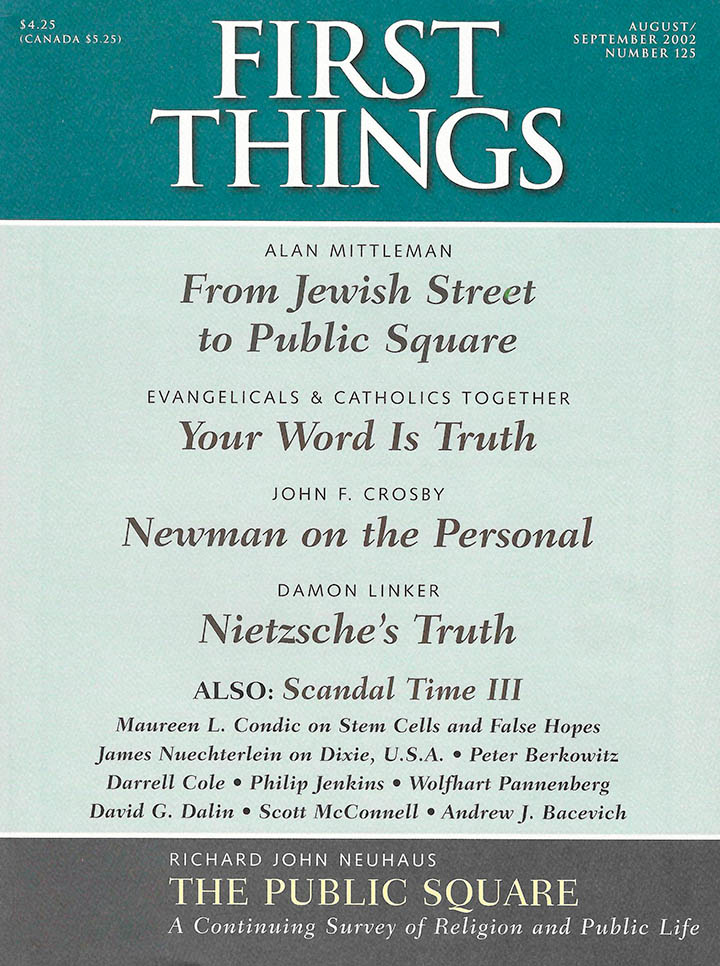
while we’re at it: The courts and kosher food, New York Sun, May 23, 2002. National Relationship Week, Tablet, March 16, 2002. On Dabru Emet, Commentary, April 2002. New profiles in courage, Publishers Weekly, April 8, 2002. Cousins having children, New York Times, April 4, 2002. Anthony Kenny on Kai Nielsen, Times Literary Supplement, January 18, 2002. Raymond Tallis on Jeremy Campbell, Times Literary Supplement, December 21, 2001. On “pre-Vatican II” priests, catholic trends, March 2, 2002. Catholics vs. Canadians, Catholic Civil Righs League of Canada, May 10, 2002. Maureen Dowd’s true vocation, New York Sun, May 6, 2002. Mark Tooley on the NCC, Institute on Religion and Democracy press release, May 9, 2002. James Woolcott on Carol Gilligan, Wall Street Journal, May 9, 2002. Peter Berkowitz on John Rawls, Wilson Quarterly, Spring 2002. John O’Sullivan on sexual identity, New Criterion, September 1996. On the Society of Jesus, Commonweal, May 3, 2002. On the People for the American Way fundraiser, Media Research Center, April 30, 2002. On Oprah Winfrey, Christianity Today, April 1, 2002. Philip Yancey on Chesterton, Christianity Today, September 3, 2001. Commentary on RJN on the Jews, June 2002. Ratzinger’s “slap,” ABC News, April 26, 2002. New quotas for Jews, Wall Street Journal, April 29, 2002. On Tim LaHaye, Christian Century, April 10-17, 2002. RJN on homosexuality in the priesthood, New York Times, April 19, 2002. John Paul II, Romano Guardini, and Anne Hustead Burleigh on silence in the liturgy, quoted in Priestly Identity by Thomas McGovern (Four Courts Press, 2001), pages, 294-95. Brad Leithauser on Pogo, New York Review of Books, April 25, 2002. The Catholic “we,” New York Times, June 9, 2002.

YOU MIGHT ALSO LIKE
How the State Failed Noelia Castillo
On March 26, Noelia Castillo, a twenty-five-year-old Spanish woman, was killed by her doctors at her own…
The Mind’s Profane and Sacred Loves
The teachers you have make all the difference in your life. That they happened to come into…
History’s Pro Tips on Iran
Nothing in human experience compares to the wars of the last 120 years. Their scope has grown…
