
• ‘Tis the season to once again complain about the season. There is something to be said for classy complaining such as Dell deChant of the University of South Florida provides in “The Economy as Religion: The Dynamics of Consumer Culture.” For instance, there is this: “Santa is not the embodiment of secular commercialism. He is the embodiment of our culture’s greatest religious myth: the myth of success and affluence, right engagement with the economy, and the acquisition and consumption of images and objects. Santa is the incarnation of this myth. For this very reason he functions as a profoundly religious figure in our postmodern cosmological culture. This reason may also account for his seeming immunity to criticism from a religion still following the cultural logic of a previous time. In short, Santa is not secular. He is sacred. To attack him as secular is to attack his shadow.” It is not only Christmas, says deChant. There is also Easter, Valentine’s Day, Halloween, the Fourth of July, the Super Bowl, and, if the designation catches on, September 11 as Patriot Day. All are intensely sacred events, we are told. “As such they reveal not only how thoroughly religious postmodern American culture has become but also just how difficult it may be for Americans to cease being the consumers the Economy demands that they be.” The postmodernist flourishes notwithstanding, deChant’s article is a pretty conventional jeremiad against “consumerism.” There is an important element of truth in such complaints, of course, but they always strike me as being a bit Scrooge-ish. And a bit condescending toward ordinary folk who, we are told, are dumb enough to believe every advertisement. Dr. Johnson observed that a man is seldom so innocently employed as when he is busy making money. And more or less the same obtains with the spending of money, at least when one is spending it on gifts for others. I rather doubt that Santa is the sacred figure deChant claims he is. His cult claims no martyrs. Not that lives are not ruined by excessive consumption, but nobody dies in its name. That being said, it is reassuring that every December the cry is heard in every corner of the land that we have lost the true meaning of Christmas, from which one may infer that the true meaning of Christmas is far from lost. It will be time to really worry when the cry is no longer heard.
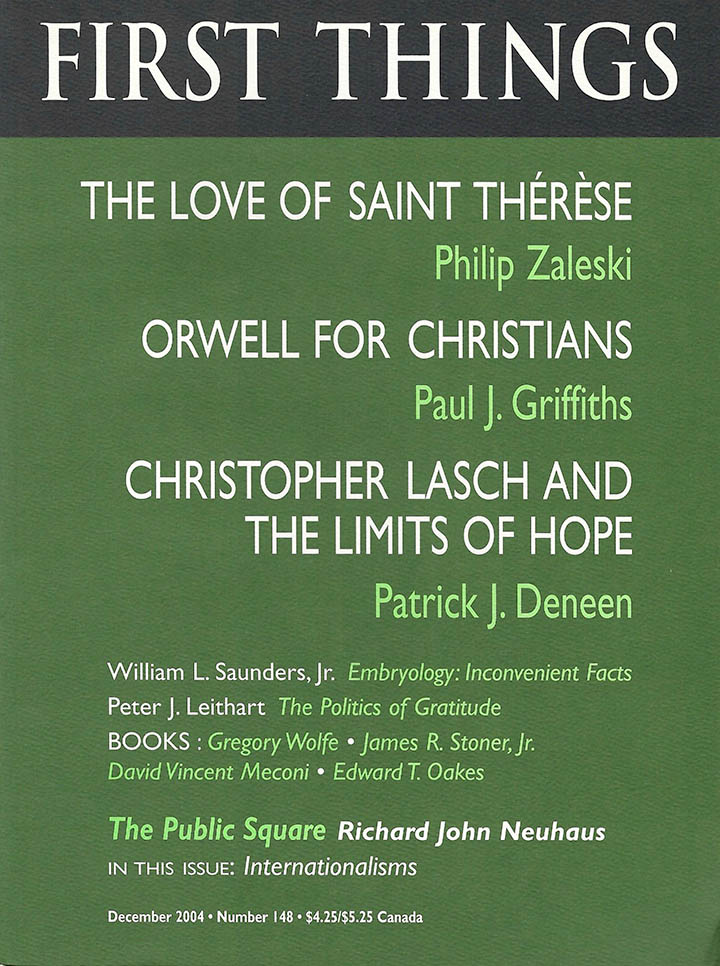
• Yes, yes, we know, although we thank you for bringing it our attention. The spine of the October issue read “Octobeer 2004.” As in Oktoberfest? The covers were all printed before the mistake was caught and to correct it would have cost thousands of dollars and a delay in getting the issue into the mail, so we let it be. Speculation that the misprint reflected the German extraction of persons associated with FT is entirely unfounded. There was, however, among copy editors desperate to make light of their egregious oversight, some discussion of making “Octobeer” an annual tradition. Be assured that the idea has been nipped in the Bud.
• A publication of the British Jesuits, Letters and Notices, quotes approvingly from the obituary of Cyril Barrett, S.J. that appeared in the London Times: “Like many Jesuits down the ages Barrett made no attempt to disguise his chafing at the Vatican’s hierarchical politics and social conservatism—going so far as to declare on the day of the attempted assassination of the Pope, in a bellow that filled a London restaurant, that ‘the only thing wrong with that bloody Turk was that he couldn’t shoot straight.’ Yet he could readily assume his priestly guise and, in that capacity, was a compassionate and subtle counselor and eminently practical moralist, ultimately convinced of the intelligence as well as the goodness of the Holy Spirit and able to instill that belief in others.” The use of “disguise” and “guise” is of interest, the latter now suggesting “semblance” or “pretext.” One has to wonder who is meant by those “many Jesuits down the ages.” Surely not the English martyrs of the Society of Jesus who were killed as “papists” and on the gallows prayed for their executioners. One expects they may be surprised at a Jesuit in a London restaurant bellowing his approval of killing the Pope. On the other hand, it was generous of Father Barrett to allow that the Holy Spirit is intelligent and good. The Jesuits are notorious for their high standards.
• He is by no means the first person to say it, but people pay most particular attention when Bernard Lewis speaks about Islam and the West. In an interview with Die Welt, he was asked whether the European Union (EU) could be a counterforce to the hegemony of the United States. He answered with a simple “No.” Pressed on the point, he observed that only three countries pose a potential challenge to the U.S.: China, India, and a restored Russia. By the end of the century, if not before, he said, “Europe will be part of the Arabic West, of the Maghreb.” Bat Y’eor, an Egyptian-French scholar of Islam, has been making this argument for years and has a new book coming out on what she calls “Eurabia.” But Lewis carries more weight in academic and diplomatic circles, and his saying it has given prominent European politicians a permission slip to speak more candidly about a subject previously addressed in public only by those dismissed as extremists. For instance, Frits Bolkestein of the Netherlands, a former EU commissioner, has said, “Current trends allow only one conclusion: the U.S. will remain the only superpower; China is becoming an economic giant; Europe is being Islamicized.” If Lewis is right, said Bokestein, “the liberation of Vienna in 1683 will have been in vain.” In 1683, it will be recalled, the West, led by Polish forces, turned back the Turks at the gates of Vienna. Absent that victory, Europe might very well have become an Islamic culture. In view of the birth dearth among Europeans and the swelling number of unassimilated and vigorously reproductive Muslim immigrants, the reconquest of Europe by Islam may be well underway. It is estimated that within a decade several major cities of Europe will be majority Muslim. All this gives new urgency to the question of Turkey’s admission to the EU. For reasons that I do not fully understand, the U.S. has been strongly supportive of Turkey’s application for membership, which EU officialdom has now agreed to negotiate over the next several years. The vestigial national parliaments in the EU have been vocally skeptical about admitting Turkey, and popular opinion is generally opposed. But national parliaments and popular opinion are increasingly trumped by EU administrators. Presently counting seventy million people, Turkey would become the largest country in the EU, and it is, of course, almost totally Muslim. If Turkey is admitted, one might ask, why not countries that are culturally more European, such as Ukraine and Belarus, or even Russia itself? An argument for admitting Turkey is that it represents, under its military guardians, a more moderate form of Islam and would serve as a buffer against or bridge to (take your choice) the larger Muslim world. The proponents of Turkey’s admission seem to have implicitly accepted the prospect of Eurabia, the only question being what kind of Islam will dominate Europe. Despite America’s unrivalled global power, it is too easy for Americans to think we live in splendid isolation, aloof from the momentous religious, cultural, and political reconfigurations of our time. But one cannot help but believe that the reversal, more than three hundred years later, of the victory of Vienna would be very bad for Europe, for America, and for the world.
• In my critical but sympathetic discussion of Samuel Huntington’s new book, Who Are We? The Challenges to America’s National Identity (“To Be American,” FT August/September), I suggested that his argument would be derided and dismissed by many as a revival of “nativism.” (A charge that Huntington should have more adroitly anticipated.) Sure enough, the New Republic has Paul Starr of Princeton do a long hatchet job under the title “The Return of the Nativist.” Starr is most particularly exercised by the claim that America is in any serious sense a Christian society, and he is totally unimpressed by the argument that the culture is falling apart. He writes, “And America’s cultural integrity is scarcely in jeopardy. From one end of the country to the other, Americans shop at the same stores, listen to the same music, follow the same sports, read about and watch the same celebrities—and largely honor the same ideals.” Well, that is a relief. E pluribus unum, thanks to Oprah, Wal-Mart, hip-hop, and Donald Trump. As to the same ideals, what Justice Scalia calls the “sweet mystery of life” passage in recent Supreme Court decisions, constitutionalizing the sovereignty of the unbridled individual will with respect to abortion and sodomy, is not what Huntington has in mind when he speaks of the “core culture” bequeathed us by the first settlers and the founders of the Republic. In the same issue of TNR there is, by way of contrast, a second discussion of Huntington’s book by Enrique Krauze, editor of Letras Libres, written “in defense of Mexican-Americans,” to whom, I agree, Huntington is less than fair. Krauze argues that, while there are also significant differences, Mexican immigration is more like than unlike great immigration flows of the past. “‘Mexico’ does not stand for a fundamentalist religion. ‘Mexicans’ are not a group of racialist or nationalist militants. California is not Bosnia. Mexican culture is not a threat to American culture. Mexicans will seek to become part of American culture (and American cultures: Korean, African, European, South American, Jewish, Anglo-Saxon), and to assimilate in the essential areas: language, business, politics, respect for the law, and, in the middle term, marriage. They will certainly maintain their differences in other areas: they will stick to their families, if they can bring them; they will opt for citizenship, if they are allowed; they will miss the land they came from for a generation or two; they will cling quite wisely to their cuisine; they will continue to be Catholics and to celebrate the holidays of the civic and religious calendar. They will be like and unlike their fellow citizens. They will show that one can live a richer life with multiple identities, and in this way they will contribute to new cultural models. So what’s the problem? France and Germany can only dream of such immigrants.” A neglected factor in this debate that was underscored by Philip Jenkins in these pages (“A New Religious America,” FT August/September 2002), and a factor that I suppose would only further disturb Paul Starr, is that immigration from Latin America, and Mexico in particular, will have the effect of reinforcing the social and cultural reality of “Christian America.” For all the scores on which it can be fairly faulted, Huntington’s book is helping to mainstream an argument that should be in the mainstream. For any society, asking “Who Are We?” can be an indication of cultural vitality. It is a question that should not be left to the xenophobic denizens of the intellectual fever swamps.
• I haven’t seen all the reviews but have the impression that Mario Cuomo’s book Why Lincoln Matters: Today More Than Ever is being almost unanimously panned, with criticism divided between the former New York governor’s risible ignorance of Lincoln scholarship and his forced recruitment of Lincoln to today’s Democratic Party. Not, however, in Commonweal, where Alan Wolfe of Boston College effusively praises the book and its author. It is really two books, he writes. “The one that appreciates Lincoln is as good as the one that lambasts Bush.” As for the author, Wolfe writes that we should be grateful for anything that comes “from a man as admirable and thoughtful as this one.” Then there is the final pitch: “Lincoln matters to us, among other reasons, because he matters to Mario Cuomo, and we should be indebted to the governor for bringing him once again to our attention.” Ah yes, Lincoln. We had almost forgotten him. Thank you, Governor, for bringing him once again to our attention. And, by the way, a nice job on Bush. But then, we expect nothing less from a man as admirable and thoughtful as you.
• “According to Webster’s,” some opponents of same-sex marriage like to say, “marriage is ‘the state of, or relation between, a man and a woman who have become husband wife.’” Not any more. The eleventh edition of Merriam-Webster’s Collegiate Dictionary, as well as the American Heritage Dictionary and the Oxford English Dictionary, all now include a union between two persons of the same sex under the definition of marriage. And, in a few years, there will likely be an allowance for “two or more.” Arthur Bicknell of Merriam-Webster says they don’t take sides on controverted questions. “Our primary job as lexicographers is to create a painstakingly accurate and comprehensive record of the English language.” In other words, their job is description, not prescription, and there is an argument to be made for that. The more important point is that defenders of marriage need to appeal to a higher authority than Webster’s, such as natural law, clear reason, the common good, and—dare one say it?—the Word of God.
• As Polonius said, “To thine own self be true, and it must follow, as the night the day, thou canst not then be false to any man.” It is commonly forgotten that Shakespeare portrays Polonius as the fool of Hamlet. The Bishop of Memphis, J. Terry Steib, addresses the abortion and Communion question and starts off on a fairly firm footing. “I believe that the Church is a hospital for sinners; it is not a museum of saints.” (Although I don’t know why we should think of the saints being in a museum.) He goes on to say that in receiving the Eucharist “none of us is worthy of so great a gift. This is why we pray: ‘Oh Lord, I am not worthy to receive you, but only say the word and I shall be healed.’” But finally, says the bishop, it is a matter of conscience. “When individuals try to make up their mind about a moral dilemma, they consult their own inner being, their families, their colleagues. If they are Christians, they will wisely look to see what theologians have said about the issue. They will consult the Scriptures. When the person is Catholic, she or he must also pay attention to the teachings of the Church.” “Consult” the Scriptures, “pay attention to” the Church. Nothing here about obedience to the truth, indeed nothing about truth. Nothing about the obligation to have a conscience rightly formed. Says the bishop, “The person chooses what is true to him or her self. And we are judged by God according to what is in our hearts.” Just as St. Polonius said. There is more: “The person asking for the Eucharist is following his/her conscience and that conscience tells each that he/she is worthy to receive the sign of our union with Christ.” So now it is “Oh Lord, I am worthy to receive you”? The bishop is to be commended for trying to address a difficult question, but the result is sadly muddled and would seem to directly contradict the statement of the bishops last June, “Catholics in Political Life.” Bishop Steib writes, “Our role as Catholics is to be as deeply involved in our society as possible so that we can be leaven to that society, so that we can add to the common good.” But what if the leaven has gone flat, and the hospital offers no remedy but only the lie that the desperately ill patient is just fine?
• “The Pledge of Allegiance and the Limited State” is a judicially, historically, and theologically informed essay by law professor Thomas Berg of St. Thomas University, Houston, in the Texas Review of Law & Politics. He writes, “‘Under God’ in the Pledge of Allegiance is a means for the state to declare that it is a limited institution that is subject to, and does not interfere with, higher commitments and norms. In a religiously pluralistic society, however, ‘under God’ is an imperfect way of making that declaration. But if ‘under God’ is removed from the Pledge, the state must . . . make other efforts to declare and respect its own limits.” The “other effort” that Berg chiefly discusses is school vouchers, which would permit parents to choose, with government financial support, the schools they want their children to attend. That is, of course, a very good idea and is, at least in principle, permissible under the Supreme Court’s Zelman decision of 2002. While it is true that the Pledge question, like most cases in church-state jurisprudence, is related to the government school monopoly on public funding, even if or when that monopoly is decisively broken the need for the state to declare its limited nature would remain. And it seems that one good, albeit imperfect, way of meeting that need in terms of symbolic public action is the simple saying of the words “one nation under God.” Another good way would be for all schools to teach that the truths of the Declaration of Independence are still in force.
• You can bank on it: when the party of change succeeds and becomes the establishment enforcing its rigorous rule, what had been the party of reaction to change will become the party of change, urging flexibility. A case in point: although the Second Vatican Council did not mandate it, the liturgical establishment, composed of certified academic liturgists who play hardball, was adamant in insisting that the rules required that priests celebrate Mass versus populum, facing the people. The old way, now scorned as the priest “turning his back on the people,” was traditionally called ad orientem, priest and people together facing East. Joseph Cardinal Ratzinger has been sympathetic to the old way and, in an introduction to a new book on liturgy, he comments on a clarification issued by the Congregation for Divine Worship which underscores that versus populum is not mandatory: “This is an important clarification. It sheds light on what is relative in the external symbolic forms of the liturgy and resists the fanaticisms that, unfortunately, have not been uncommon in the controversies of the last forty years. At the same time it highlights the internal direction of liturgical action, which can never be expressed in its totality by external forms. This internal direction is the same for priest and people, towards the Lord—towards the Father through Christ in the Holy Spirit. The Congregation’s response should thus make for a new, more relaxed discussion, in which we can search for the best ways of putting into practice the mystery of salvation. The quest is to be achieved not by condemning one another, but by carefully listening to each other and, even more importantly, listening to the internal guidance of the liturgy itself. The labeling of positions as ‘preconciliar,’ ‘reactionary,’ and ‘conservative,’ or as ‘progressive’ and ‘alien to the faith’ achieves nothing; what is needed is a new mutual openness in the search for the best realization of the memorial of Christ.” Against the rigorists, I am inclined to agree with Cardinal Ratzinger that a measure of flexibility and openness is in order.
• “None of this is by accident. For a couple of decades now, there has been a systematic attempt to dilute the sacred message of Christmas while elevating the prominence of Hanukkah and Kwanzaa (the latter a recent secular invention).” Conspiracy theory, anyone? The quote is from a Catholic League press release reporting on their careful counting of the seasonal cards produced by the major greeting card companies. There were 443 Christmas cards, with only nine featuring the religious significance of Christmas. That’s two percent. Of the thirty-three Hanukkah cards, twenty-six, or 79 percent, feature a Star of David or Menorah. The Kwanzaa cards are all areligiously ethnic. In the Christmas cards department, there is also a “Risqué” line and a “Rude” line on offer. These feature, inter alia, S&M gear and a near-naked female angel asking, “Ever make an angel in the snow?” You get the idea. There are no “Rude” or “Risqué” Hanukkah or Kwanzaa cards. It is not plausible that this circumstance reflects simply a business decision on the part of the card companies. In a country where nearly 90 percent of the people claim to be Christian and, curiously enough, even more say that Jesus was born of a virgin, the predominance of “Christmas” cards mocking or blaspheming the meaning of the day—or simply ignoring it—cannot be explained by market dynamics. I don’t know if conspiracy is the right word. Conspiracy implies a measure of collusion. Maybe the major greeting card companies, for some unknown reason, employ an inordinate number of people who are Christophobes, people who have hatred or contempt for Christ and Christianity. I am open to more convincing explanations.
• It is as it was. It had been years since I last read J. F. Powers’ Morte D’Urban. Published in 1956, it is critically acclaimed for its delicate evocation of the everyday “feel” of American Catholicism prior to Vatican II. On an impulse, I took the dog-eared paperback on a flight to New Orleans. More than I had expected, it is as it was. Father Urban, the traveling star of a fictional Order of St. Clement, finds himself in the unaccustomed position of running a parish in Minnesota.
Father Urban was familiar with the classic view of the parish as a natural unit of society, second in importance only to the family, but he had seldom found this view held by clergy and laity in the same parish. If the pastor tried to get his people to think of themselves not as Jaycees or trade unionists, not as Republicans or Democrats, but primarily as parishioners, the chances were they’d resist him, and Father Urban didn’t really blame them. Such a thesis made small appeal to anybody who’d arrived at a greater, or clearer, station in life than that commonly designated by the term parishioner—and who hadn’t? If, on the other hand, the people tried to raise the status of parishioners, the chances were their pastor would resist them—and wisely—for wherever you found people trying to make a lot of their parishionership, you’d find agitators at work. Invariably they were the products of higher Catholic education, or converts, whose real object was to assume unto themselves all but the strictly sacerdotal activity and to see that this was in accord with their understanding of it and the latest word from Rome. They’d had a field day under Pius XII.
After the Council, the field day became a permanent picnic of everybody getting in on the priestly action, with parishes declaring themselves to be “prophetic communities” and everyone designated a minister. Even the ushers are now “ministers of hospitality.” It is no longer sufficient to attend Mass. “You vill participate—fully, actively, and enthusiastically.” Pity the poor soul who shows up just to be quietly touched by grace. At a recent Mass in a fair-sized parish, the pastor proudly announced that the parish had 247 volunteers and to them he declared, “You are all ministers. You are what this parish is about. You make this community happen.” And here I thought it had something to do with the Real Presence of Jesus. Don’t get me wrong; parishes do need volunteers, and lots of them. But lending a hand does not require “trying to make a lot of their parishionership” by ratcheting up the status of helping out by turning it into a quasi-ordained junior “ministry.” J. F. Powers is right: that approach has little appeal for anybody who has “arrived at a greater, or clearer, station in life.” It is in that station in life that one is called to holiness. Parochial dignities and influence are no substitute for discipleship in the world. God bless all 247 parish volunteers. I don’t know what we would do without them, or at least a good many of them. But, with respect, they do not make the Church happen. Christ does that when, through the apostolic ministry he instituted, he gathers two or three in his name to “do this” in remembrance of him. Now, however, I may have given the impression that Morte D’Urban is a critique of Catholic foibles. It is also that, in passing. But mainly it is a poignantly funny story about the oddities and glories of The Catholic Thing in the 1950s and, for the most part, today. It is very much worth reading and, as I discovered on my way to New Orleans, very much worth rereading.
• As the Anglican communion appears to be on the verge of breaking up, wise men and women of the Church of England are unflagging in the cause of reform. The General Synod meeting in London has agreed to more prayer book revisions, including dropping any reference to the three wise men who visited the baby Jesus. They will now be referred to simply as Magi. The committee submitting the change said, “While it seems very unlikely that these Persian court officials were female, the possibility that one or more of the Magi were female cannot be excluded completely. . . . The visitors were not necessarily wise and not necessarily men.” This was presumably a pastoral response to people suffering a crisis of faith over the matter. On the grounds that the unlikely cannot be excluded completely, some years ago the Episcopal Cathedral of St. John the Divine here in New York put up “Christa,” a crucifix bearing an unbared woman. Despite rumored threats of its imminent dissolution, the progress of the Church of It Ain’t Necessarily So continues apace.
• As this goes to the printer, the report of the Eames Commission, called the Windsor Report, has been released. Addressing the crisis created in the Anglican communion by the consecration as bishop of a New Hampshire man who left his wife and children to live with his male partner, the Windsor Report, to judge by initial responses, seems unlikely to satisfy any of the several sides in this controversy. We hope to have a more detailed evaluation in the next issue.
• Holiday greetings or Christmas greetings? Every year about this time, the arguments begin anew. William Devlin, the founder of the Urban Family Council in Philadelphia, has come up with a notice that might be posted in public places in order to preempt the contentious and litigious: “Legal Disclaimer: ‘Merry Christmas’ (hereafter ‘The Greeting’) . . . this announcement is not intended to offend, alienate, foster hate, or be a precursor for any egregious acts (legal or illegal), thoughts, words, or deeds. ‘The Greeting’ is made only in the context in which it may be legally received, if in fact, it is received at all. It is not intended to be nor should it be, in any way, connected to any other type of greeting, real or imagined, past, present or future. No references to any persons, things, or substances, animate or inanimate, real, fictional, or otherwise should be assumed by the reader or receiver of the greeting (hereafter, ‘the greetee’). The greeting is not being made to (nor will tenders be accepted from or on behalf of) nonbelievers in ‘The Greeting’ in any jurisdiction in which making and/or accepting the greeting would violate that jurisdiction’s laws or feelings (also refer to local statutes and ordinances related to ‘The Greeting’). In any jurisdiction in which perceived ‘greeting’ is not welcomed nor agreed upon by all ‘greetees,’ then the ‘greetor’ of ‘The Greeting’ will be held harmless in this life and the next, including all issuing posterity both now and forever. ‘The Greeting’ may be made by a licensed ‘greetor’ and any liability assumed or created by the ‘greetee’ shall be the sole responsibility of said ‘greetor.’ If you have been aggrieved, offended, waylaid, parlayed, filleted, or delayed in any way, either real, imagined, or perceived by said ‘Greeting’ and/or by ‘greetor’ as the result of receiving said ‘greeting’ you can call toll free 1-800-CHRISTMAS to speak with legal counsel.”
• Although she once attended one and, later, would occasionally accept the hospitality of others, Flannery O’Connor took a distinctly dim view of creative writing schools. The problem, she said, is that they encouraged writing by people who should be strongly discouraged. The hundreds upon hundreds of books for review incessantly pouring into this office cannot help but create, at least at times, a measure of sympathy for O’Connor’s view of people who should not be encouraged to write. And yet, what we persist in thinking of as the intellectual conversation cannot continue without the making of books; and what the Preacher viewed with despondency—the making of books without end—may also be viewed as an inevitability not untouched by hopefulness. Be that as it may, I generally try to encourage aspiring writers, unless their manifest unsuitability for the task defeats my most strenuous efforts to be charitable. A great difficulty experienced by many in writing a book or article is simply getting on with it. This is not so much writer’s block as commonly understood; it is more a matter of the conscientious writer’s awareness that he does not command all the material pertinent to the subject he wishes to address. In this connection, I have come across nothing wiser than Dr. Johnson’s 1755 preface to volume one of his monumental dictionary. After discussing his original ambitions for the project, he writes:
But these were the dreams of a poet doomed at last to wake a lexicographer. I soon found that it is too late to look for instruments, when the work calls for execution, and that whatever abilities I had brought to my task, with those I must finally perform it. To deliberate whenever I doubted, to enquire whenever I was ignorant, would have protracted the undertaking without end, and, perhaps, without much improvement; for I did not find by my first experiments that what I had not of my own was easily to be obtained: I saw that one enquiry only gave occasion to another, that book referred to book, that to search was not always to find, and to find was not always to be informed; and that thus to pursue perfection, was, like the first inhabitants of Arcadia, to chase the sun, which, when they had reached the hill where he seemed to rest, was still beheld at the same distance from them. I then contracted my design, determining to confide in myself, and no longer to solicit auxiliaries, which produced more encumbrance than assistance; by this I obtained at least one advantage, that I set limits to my work, which would in time be ended, though not completed.
In sum, get on with it. Not all bad writers will become good writers by writing more. Many will only add to the already superabundant store of bad writing. But writers become writers by writing. And even the best, who will almost certainly fall short of the standard set by Dr. Johnson, can be emboldened by the certainty that their task will in time be ended, though not completed. In writing, as in every other human endeavor, completion is not our business.
• The phenomenon of the growing number of meetings of ROFTERS (Readers of First Things) is, well, phenomenal. Talking with people here and there, I gather that some meet in the evening and others on weekend afternoons, some at homes with potluck dinners or snacks and others at restaurants. In some meetings, the convener selects an article or two from the current issue for discussion, in others people volunteer to lead a discussion of particular articles, and in yet others it is a free-for-all left open to whatever in an issue people want to talk about. Wishy-washy latitudinarians that we are, the editors emphasize that each group is independent and works out whatever works best for participants. To see if there is a meeting near you that you might join, check out the website, old.firstthings.com. If you are interested in launching a group, write Erik Ross at er@firstthings.com.
• We will be happy to send a sample issue of this journal to people who you think are likely subscribers. Please send names and addresses to First Things, 156 Fifth Avenue, Suite 400, New York, New York 10010 (or e-mail to subscriberservices@pma-inc.net). On the other hand, if they’re ready to subscribe, call toll free 1-877-905-9920, or visit old.firstthings.com.
Sources:
Santa as Symbol, Civic Arts Review, Summer-Fall 2003. Anti-papal Jesuit, Letters and Notices, Spring 2004. Islamic Europe, drawn in part from a report by Christopher Caldwell, Weekly Standard, October 4, 2004. Paul Starr on Huntington, New Republic, June 21, 2004. The admirable Cuomo on Lincoln and Bush, Commonweal, September 10, 2004. Webster on marriage, Washington Times, May 24, 2004. Berg on the Pledge of Allegiance, Texas Review of Law & Politics, Fall 2003. Anti-Christmas cards, Catholic League press release, December 11, 2003. Anglican wise men, Reuters, February 10, 2004.

YOU MIGHT ALSO LIKE
Canada’s Offensive Secularism
On March 25, the Canadian House of Commons voted to repeal the good faith religious opinion defense…
A Win for Christian Counselors and Religious Liberty
In a resounding victory for religious liberty on Tuesday, the U.S. Supreme Court ruled 8–1 in Chiles…
What Drag Queens and Blackface Have in Common
My new book, The Desecration of Man, emerged from something I had noticed while researching questions of…
