
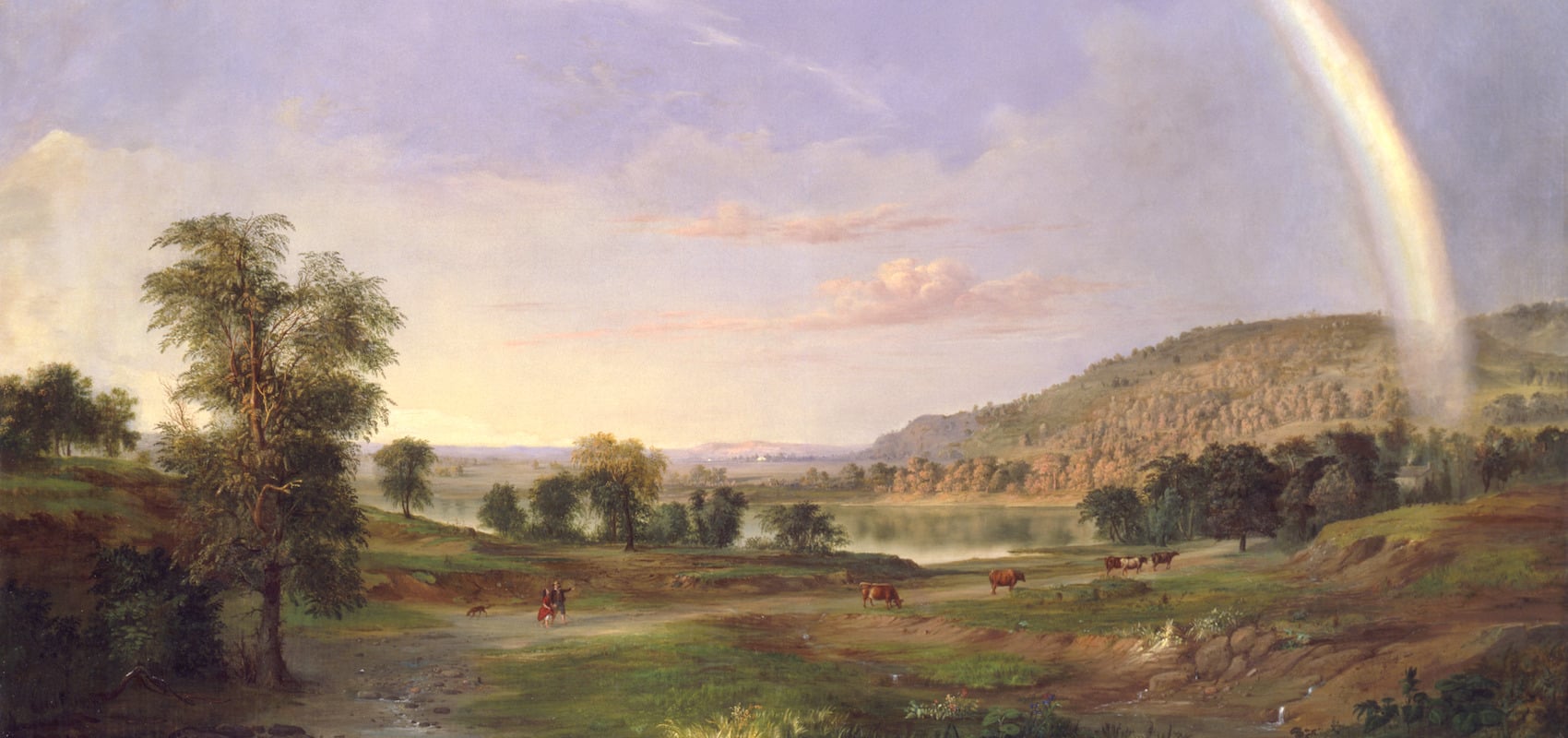
The United States of America dates her birth in accord with a foundational document, the Declaration of Independence. And Americans often champion a noble creed of liberty and equality. We are indeed a nation of ideals. Yet, in 1963, as he spoke from the steps of the Lincoln Memorial, Martin Luther King Jr. was not satisfied to challenge our minds and consciences with the plain sense of that creed and those ideals. He wished to drive them into the very marrow of our nation. So, he recited a litany of places, from New Hampshire to New York, from Colorado to California, to every hill and molehill of Mississippi. In that spirit, we asked a number of First Things writers and editors to meditate on a perennial question: In what place do you find America incarnate?
From June 2023 to October 2024 I lived in Wisconsin, at the center of the state, renting a house with a stream in back and an Amish farm across the road with cows grazing by the fence. The nearest town (pop. 447) was five miles away. It had one thoroughfare—yes, Main Street—with a community bank, post office, barbershop, library, bakery-café, and gift shop. When I stepped inside the bank, a teller would sing out, “Hey, Mark, what can we do for you?” Once I returned after a week away and stopped at the P.O. to pick up mail, but it was ten minutes past closing. I heard a voice inside and knocked on the door. It opened, and the mistress looked at me and said, “Oh, you want your mail—come on in.”
When food got low, I pulled into one of the Amish compounds, entered a room in back, grabbed eggs and vegetables, and added my dollars to those in a coffee can on the counter without seeing a soul. The nights were silent and pitch-black except when the brightest moon ever was out. The only airplane to be heard was the rare crop duster. Each afternoon I biked for twenty miles on straight and winding roads lined with cornfields and stands of pine and met but a car or two, more often a horse and buggy. Once a fly fisherman appeared, but only once.
Politics and media seemed very far away. The only campaign message in that heated fall of ’24 was a small yard sign, “DEPORT ALL LIBERALS,” which I took as humor, not policy. It was a year of nineteenth-century America—crops, animals, high-trust people—or at least a place with enough antiquated elements for me to imagine it as such.
Mark Bauerlein is contributing editor at First Things.
The ancestral heartland of twenty-first-century America is the ring of suburbs that grew up around major American cities starting three generations ago. Sicily, Ireland, and the Russian empire were the secret sources of the cultural and ethical and competitive intuitions that helped build the New Deal, the military–industrial complex, and the highway systems. In the same way, the suburbs those things made possible—with names like Annandale, Glendale, and Glen Cove—are the “Old World” lurking secretly behind the world we have today, for good and ill: espresso, cruise ships, prediction markets, woke.
For the folk singer Malvina Reynolds, suburbia was “little boxes made of ticky-tacky.” A dumb sentiment even then. Yes, there was something disreputable about the newer suburbs. They were built for people who weren’t quite established. But a credo united them: Education was important. The central institutions of every mushrooming suburb were the schools and the library. The ritual of getting your library card was taken as seriously as a First Communion. The volume of brilliance that suburbs with great school systems have injected into the world—Lexington, Massachusetts, say, or Scarsdale, New York—bears comparison with the Italian cities we travel to marvel at.
Ultimately, Americans admired them. Small towns tooled up to look more like suburbs, losing a lot of their character in the process. And the dynamic cities of today resemble suburbs. Whoever called Los Angeles a dozen suburbs in search of a city was describing an oversight. But Phoenix, Las Vegas, Austin? Those places are suburban by design, like the country they have come to typify.
Christopher Caldwell is a contributing editor of the Claremont Review of Books.
A street in Brooklyn in the late 1950s, bounded by Avenue I on one side, my apartment building on another, a warehouse and railroad tracks on the other two, and suitable for variations of baseball and other games. When this asphalt arena is unoccupied, I hone my throwing skills, hour after hour, pitching to the strike zone I have drawn in chalk on the warehouse wall, or hurling the “Spaldeen” against the wall to practice hitting the rebounding ball. I swing both righty and lefty. (Mickey Mantle is then at the acme of his prowess as a switch hitter. How can an aspirant to excellence not emulate him?)
Such are the unforgettable joys of my American (New York) childhood. American not just because of baseball’s grip on that culture, but because my prolonged efforts before the warehouse wall affirmed, in their way, my father’s immigrant creed of America: a creed predicated on the tacit conviction that you could accomplish anything within reason if you worked at it hard enough.
The father who encouraged my efforts as a ballplayer was infinitely more concerned to see me make my mark through Torah study, personal integrity, and a host of intellectual pursuits. The warehouse is long built over, but my dedication then may have expressed or heralded what I have tried to make of myself over the course of a lifetime. I hope that is part of what America, at its best, still stands for.
Shalom Carmy teaches Jewish studies and philosophy at Yeshiva University.
One of the most critical topographical features in American history is a small, flat stretch of land in rural central New York. Shrouded today in woods, marked at one end only by a modest stone monument, it varies from one to seven miles in length, depending on the season.
Yet because of this little spot, the Oneida tribe of the Iroquois Confederacy sided with the Americans, ultimately throwing critical momentum the colonists’ way. Because of it, the nearby Oriskany Battlefield became one of the bloodiest sites of the Revolutionary War. Because of it, savvy observers, George Washington among them, would realize that this place of portage was the key to joining the Atlantic to the continent’s interior—a connecting of watery dots that would go on to change not only America, but the world.
That slice of land is known in English as the Oneida Carry. History saturates this place, in every direction: from the Haudenosaunee peoples to the Jesuit martyrs; from the Second Great Awakening to the colorful boom years of the Erie Canal; from the rise and fall of manufacturing jobs in the twentieth century, to the opioid and fentanyl crises in the twenty-first.
Critical as it is to the nation’s story, the Carry symbolizes something else for me. It is the geographical center of the hamlets and villages in which I grew up—my own interior metaphor for a life that began around it, and, like the nation, expanded outward into the vast America that this deceptively humble place made possible.
Mary Eberstadt is a senior research fellow at the Faith and Reason Institute.
I have always rejected the notion that America is an “idea” or, even worse, an “experiment.” That kind of language leaves you with no way to love your country if you think the idea a bad one or the experiment a failure. It also deprives Americans of a sense of the tragic—a sense that the very thing that makes us great, the embrace of boundless possibility, contains the seeds of our disintegration. Doubtless, such notions help account for our wild fluctuations between jingoism and self-hatred. To think of America as home, by contrast, as a people and a portion of earth that are given rather than chosen, is already to adopt a tragic sensibility (especially if it is the case that they were also once taken).
When I think of “where America is” from this point of view, the first answer that springs to mind is . . . Walmart, though I recognize that every empire eventually comes to an end and even Walmart could soon yield to places more ethereal. But Walmart is about all that’s left of that anonymous little corner of America that generations of my family carved out of the Ozark forests, one log at a time.
It was a corner of America where people used to “come to town” on Saturdays, where the women would shop on the square and the men would slip into the bins at the lumber yard to tell the same old stories and steal a sip of whiskey. A corner bustling with mom-and-pop groceries, mercantile, hardware, and dry goods stores that passed from fathers to sons, and drug stores with soda fountains where old ladies with puffy ankles would gather in the morning for coffee and report your after-school shenanigans to your parents in the afternoon.
Walmart (and its satellites) stands at a point of intersection for the forces of “progress,” the force of time, and demographic forces the demos could not perceive. It stands in place of an America I was fortunate (briefly) to know and whose stories I had the privilege to hear, an America of characters and legends that has left its faint traces for those with eyes to see and ears to hear on dilapidated buildings, in the empty bottles one still finds buried deep in the lumber bins, in the empty lot that was home to the flooring mill where I ripped lumber with my grandfather, and in the stones that mark the graves of the old ladies with puffy ankles. An America that now resides mostly in my memory, where tragedy and a modest beauty mingle with gratitude.
Michael Hanby is associate professor of religion and philosophy of science at the Pontifical John Paul II Institute for Studies on Marriage and Family at the Catholic University of America.
Every American knows all too well the trauma of traveling abroad.
On the one hand, we wish to see the Doge’s Palace in Venice, say, or the pagodas of Beijing, walk the Kasbah of Marrakech or sip a chilled glass of Pouilly-Fuissé in a charming bistro in Paris. On the other hand, all these things involve dealing with people who are not American, which is to say people who can suddenly decide to shut down their bistro because it’s 2 p.m. and their culture demands a midday nap.
Fortunately, there’s a way for us proud patriots to have the world and eat it, too. It’s called EPCOT.
It was conceived in the mid-1960s by the great Walt Disney. Having built a successful theme park, Disneyland, Walt wanted something bigger. He wanted to build the city of the future, all concentric circles of culture and commerce and leisure, connected by monorails and people-movers. He called it the Experimental Prototype Community of Tomorrow, or EPCOT for short.
But Walt died shortly after envisioning EPCOT, and his company’s imagineers didn’t want to build something as ambitious as a city in his absence. They settled on a theme park, and they decided to fashion it into a permanent World’s Fair. The park was, at one time, the biggest construction project on earth, with a World Showcase walkway that features pavilions representing eleven nations across four continents.
Which means you can now very much enjoy that crisp French wine in a perfect replica of a Parisian side street, or drink some sweet tea in a building so perfectly arabesque you’d swear you were in Morocco. And you can do it all without once leaving the great state of Florida, where nothing ever shuts down for siesta and no one would ever scoff at you for not speaking the local language.
The cynics, alas, mock the park for being inauthentic, commercialized, and crass. They’re missing the point. Any empire can, if it puts its mind and its arms to it, take over the world. But it took the ingenuity of a real American dreamer like Walt Disney to bring the entire world stateside and condense it into one elegant walkway, complete with charming gift shops. It’s a testament to the ultimate American marriage, the union of imagination and commerce, and proof, as if any were needed, that America is the engine that thrusts the great world forward.
Liel Leibovitz is editor at large for Tablet magazine.
I was born in central Illinois, but we moved to Maryland when I was five, and I have only a few memories of that earlier time. But I never forgot the countryside, with its endless, arrow-straight roads crisscrossing the flat and featureless land, and the coal-black of its rich Drummer soil, nothing like the sandy soil I was used to in Maryland. It had its own kind of magnificence.
Every summer my family would pile into the car and drive west from Maryland to visit my grandmother in Charleston, Illinois. As the county seat of Coles County, Charleston enjoyed some regional prestige. It could boast a very fine courthouse, placed at the center of the town square, which was lined with the stores where my mother preferred to do her shopping, often with merchants she had known since she was a little girl. Charleston was also the site of the county fairgrounds and of the fourth Lincoln-Douglas debate, an event the locals seemed to remember as if it were yesterday.
It was a lively, healthy, and orderly place to live, with some amenities: a university (now Eastern Illinois University), a splendid Carnegie library, movie theaters, including two drive-ins, an A&W Root Beer stand and a Dog n Suds, and a nearby lake with swimming and boating and sunbathing. It was idyllic—and quintessentially American.
When years later I encountered writers like Sinclair Lewis who made their way by pouring contempt upon these very small towns, I was appalled. But yes, over a century ago the Midwest, once hailed as the homeland of Abraham Lincoln, the icon of American democracy, found itself the target of intense cultural disdain, the principal object of which was the small town. “The Revolt from the Village” was the name given this literary and cultural moment by Carl Van Doren in his 1921 study, The American Novel. Ernest Hemingway is said to have complained of his childhood home, Oak Park, Illinois—a very graceful suburb with Frank Lloyd Wright among its residents—that it was a place with “broad lawns and narrow minds.”
Our famous writers, too, are part of America. But no one will ever convince me that they were the ones with the broad minds. I know better.
And then it came to pass, five years ago, that my wife and I moved to a small town in southern Michigan. It is a lively, healthy, and orderly place to live, with a county courthouse, a town square lined with shops and offices, several nearby colleges, and a splendid lake. There are times I imagine I’m back in Charleston.
Wilfred M. McClay holds the Victor Davis Hanson Chair in Classical History and Western Civilization at Hillsdale College.
The Hawaiian Islands were almost the last territory to become a part of the United States, having been annexed by a joint resolution of Congress in 1898. The archipelago was inhabited by native Hawaiians, Asian sojourners (mostly Japanese), and haoles, that is, white Americans. The principal advocate of annexation was the U.S. Naval Department, which had long lusted after a magnificent inlet on Oahu, roughly six miles northwest of Honolulu. The Hawaiians called it wai momi (waters of pearl), and we know it as Pearl Harbor. By 1940, the harbor had become the home base of the Pacific Fleet.
For Americans celebrating their 250th anniversary in an era plagued by “forever wars,” it is difficult to imagine a time when the entire Eastern Hemisphere could wage total war without our being involved at all. That era ended when President Franklin D. Roosevelt’s administration imposed economic sanctions on Imperial Japan, whose army had invaded mainland China in 1937. Commanders in Tokyo, judging that their forces must seize control of Southeast Asia to compensate for the loss of imported oil and other commodities, chose to attack Pearl Harbor to prevent the U.S. Navy from spoiling their plans. Japanese dive bombers achieved total surprise on December 7, 1941. The American battleships were sunk or severely damaged; some 2,400 personnel perished.
Twenty years later, the U.S. government decided to construct a monument in Pearl Harbor to commemorate the day FDR said would “live in infamy.” It consists of a 184-foot-long memorial suspended over the sunken U.S.S. Arizona, and it is visited by two million people every year. The memorial’s most striking feature is an opening in the floor through which visitors can observe the deck of the martyred battleship. Oil that still leaks from the ship can be seen rising to the surface. Hawaiians call it “the black tears” of the Arizona’s sailors.
Every American should make a pilgrimage to Pearl Harbor and meditate on the fateful events of that Sunday morning. Whether the memorial will stir youth today is unknown. But old-timers invariably choke up when recalling the magnitude of what happened there, on the day when the American people lost their innocence. For Pearl Harbor is indeed a hallowed American place, no less than Bunker Hill or Gettysburg.
Walter A. McDougall is the Alloy-Ansin Professor of International Relations and professor of history at the University of Pennsylvania.
I grew up in northern California. More than once as a child, and several times since, I visited Fort Ross, on the Sonoma coast of the Pacific. “Ross” derives from “Russ,” for it was an old Russian trading post dating from 1812, when twenty-five Russians and eighty native Alaskans arrived. It operated until 1841, when it was sold to John Sutter of Gold Rush fame. You can walk through the reconstructed sleeping quarters, homes for officers and their families. A chapel (Orthodox). A cemetery filled with children and many Pomo natives. In 1836, John Veniaminov (later canonized as “Innocent of Alaska”) paid a pastoral visit to the fort. As a young missionary, John was a remarkable evangelist and catechist among the Aleuts. At Fort Ross, he met his first Catholics (Mexicans). A strange gathering of hopes!
Fort Ross sits, windswept, on a high bluff. Below are the dangerous waves of the Pacific. (The cemetery above is filled with the drowned.) The seals, after being hunted to near extinction, are back. It is a place, as the California poet Robinson Jeffers described, where human cries melt into the horizon.
I am one of those who see the mix of peoples in America as one of its compelling features. Not because diversity is itself a virtue. Rather, America is a place where that encounter’s vast, often violent collision, thrust against the towering edges of the world, is filled with a yearning that has as its source and end the Lord of all things. At our best, we recognize this.
Ephraim Radner is professor emeritus of historical theology at Wycliffe College.
Though no one place could fully represent America, the Indianapolis Motor Speedway is archetypally American. Its 2.5-mile oval is America-style gigantic, with more seating capacity than any other sporting venue in the world. It has more than 250,000 permanent seats, and reputedly can hold 400,000 people when the infield is included.
The car itself is an American icon, central to our military and industrial might. So it’s fitting that the Speedway is home to a legendary automobile race. The Indianapolis 500, held on Memorial Day weekend, is steeped in American patriotism. The national anthem, “America the Beautiful,” and “God Bless America” are sung. There’s a military jet flyover. And there’s the solemn playing of “Taps” in honor of those who gave their lives in service to their country. The Speedway is a place where people still love their country in the traditional way, without irony or cynicism.
Whereas Formula 1 has the glamor of the global jet set, the Indianapolis 500 has long appealed to the American everyman. Rather than spraying a bottle of expensive champagne, the winner drinks from a bottle of milk. These touches have not entirely served the event’s prominence and popularity. But that’s also why the Indianapolis Motor Speedway remains a quintessentially American place, a fundamentally democratic venue with middle-class appeal.
Aaron M. Renn writes at aaronrenn.com.
My wife and I recently visited Little Bighorn Battlefield National Monument in southeastern Montana. In late June of 1876, a detachment of U.S. Cavalry commanded by George A. Custer crested the hills overlooking the Little Bighorn River, where the combined forces of Great Plains Indians under the leadership of Sitting Bull and Crazy Horse were massed. Custer and his men were overwhelmed and retreated to a hilltop. They killed their horses to create a makeshift breastwork in the hope of surviving the onslaught. None did.
It’s a striking place, one of tragedy, cruelty, and violence. Although the battle is known as Custer’s Last Stand, it was also the Native Americans’ last stand. Never again would the continent-filling tide of new Americans meet effective resistance from the old Americans. And it’s a place of bravery, determination, dedication, nobility, and heroism.
One of humility, too, the kind Abraham Lincoln encouraged when he spoke of a superintending providence that we can never fathom. Small sun-bleached stone monuments mark the spots where the soldiers fell. There aren’t very many, nothing compared to the endless rows of Civil War dead in places like Antietam and Gettysburg. And the hilltop itself is dwarfed by the vast, empty landscape that extends in all directions, and by the sky that, on the day of our visit, was an adamantine blue, streaked by high cirrus clouds that seemed to reach the ends of the earth.
Perhaps it was the sharp wind that whipped across the treeless plains, so familiar from my years sojourning in the American West. Or maybe it was the fact that we visited in early December, a time when the interstates are not thronged with tourists, and we were alone among the monuments, as Thoreau was alone in his cabin by Walden Pond and John Muir in the high mountain fastness of the Sierra Nevada, as Walt Whitman was alone in his song to himself and Jay Gatsby in his self-invention. Whatever the cause, I felt in that moment that I was standing at the center of my nation, with its history and myths and dreams and nightmares, both collapsing right there on the remote Montana hilltop and radiating outward like mystic messengers to the inmost sacred place of every American heart.
R. R. Reno is editor of First Things.
On a backroad in Bessemer, Alabama, there was a tin-roofed shed where bands would play. Its owner, Henry Gipson, didn’t charge a cover. He also didn’t sell drinks or food. I drove there one night with a few friends, and we had to swerve around a mattress that was lying in the middle of the road. We were coming from a wedding, and we arrived at Gip’s Place (as it was called) vastly overdressed. But the unspoken policy was that no one should be made to feel out of place—not even if he was wearing a suit and tie. Before long we had drinks and were dancing to the blues.
The crowd was black, white, and all-American. The building was almost certainly not up to code. In the absence of rules, things operated on shared understandings: Pass the hat, show your love for the band. Here’s a cigarette, thanks for the beer. As ungoverned as the place seemed, four commandments were inscribed on the wall: “Love the Lord with all your heart. Live as if it were your last day. Always say you are sorry. Start & end each day in prayer.” We drove away early the next morning, past the mattress, back to an America where people receive official instruction on how to get along and the atmosphere is uneasy.
Matthew Schmitz is editor of Compact.
There’s a spot in lower Manhattan in front of Trinity Church, not far from the New York Stock Exchange, where you can see the sleepy village from which a great American metropolis grew. Trinity Church’s first building was constructed almost a century before the American Revolution, only to be rebuilt after its destruction during British occupation. It once dominated the skyline of a small but bustling five-thousand-person town.
The church is still there, having been upgraded in the 1840s to a splendid Gothic Revival building whose steeple was the tallest structure in New York until 1890. Now it rests in the shadows of the 1776-foot Freedom Tower and New York’s iconic Art Deco skyscrapers.
In St. Paul’s Chapel close by, George Washington prayed for guidance after assuming the responsibilities of the presidency in 1789. Walk in the other direction, and you can drink a whiskey in the Patriot-frequented Fraunces Tavern, in which he announced his consequential choice to step down as head of the Continental Army.
In two hundred feet, this stretch of America’s flagship city contains many of the seeming contradictions of America itself. Our deep national relationship with Christianity and the higher things coexists uneasily but productively with the busy, mercantile culture that has made us wealthy. Thick civic ties bind but strain against our rugged individualism. Permanence and progress seem superimposed on each other.
In Trinity Church’s graveyard, Alexander Hamilton is buried under a headstone with an inscription promising that posterity’s admiration for his contributions will continue “long after this marble shall have moldered into dust.” The claim is proved by the fact that those fading words had to be recut in 1935.
We often describe the Founders as “spinning in their graves” upon contact with what’s become of their project. But I think Hamilton, at least, would find this little stretch of modern America inspiring and comprehensible, rather than alienating.
All the tensions of the United States are palpable when you stand in front of Trinity Church. In them lie America’s genius, and probably our eventual undoing. This small piece of New York City, a city that now contains nearly four times the population of all the colonies in 1776, hardly represents the whole country on her 250th birthday. But it is without a doubt uniquely American.
Inez Stepman is a senior policy analyst at the Independent Women’s Forum.
When I was growing up in England in the 1970s and 1980s, America was the mythology of her Westerns. For me, the country will always be defined by the landscape John Ford’s movies returned to: Monument Valley, with its eerie sandstone buttes, sacred to the Navajo on whose land it stands.
Ford’s movies also witnessed to the deepening moral complexity of the genre in the 1950s. John Wayne was usually a very limited actor, but Ford could draw depths out of him—particularly in the dark and sinister Ethan Edwards, central character of the masterful fim The Searchers.
Twelve years later, in what to me is the greatest Western of them all, Once Upon a Time in the West, Sergio Leone paid homage to Ford by using Monument Valley as a background near the beginning of the film. The movie brings to a climax the moral ambiguity of the genre, to which The Searchers had contributed. But Leone also points to the ambiguities of America itself: the close relationship between western expansion and exploitation, the creativity and cruelty of the rising modern economy, the role of gun violence in its myths of redemption, and the fine line between heroes and villains. Casting the blue-eyed good guy Henry Fonda as the psychotic gunman Frank was a stroke of genius, raising obvious questions about the American tendency to identify good looks with moral virtue. And the opening credits sequence, perhaps the longest in Western history, is one that I never tire of watching.
Carl R. Trueman is a professor of biblical and religious studies at Grove City College and a fellow at the Ethics and Public Policy Center.
The proper ordering of our loves and loyalties tells us something about them and their relationship. Because my first loyalty is to Jesus Christ, his cause, and his Church, the place that is “most America” to me, as an American patriot, is what Baltimoreans of my generation know as the Old Cathedral: the Basilica of the National Shrine of the Assumption of the Blessed Virgin Mary.
It is a magnificent example of Federal-period architecture, designed by Benjamin Latrobe, one of the first architects of the U.S. Capitol. More U.S. Catholic history was made in the Old Cathedral than anywhere else. My personal ties to the basilica involve my son’s baptism, my daughter’s wedding, and my own first confession, First Holy Communion, and college graduation. More to the point of this symposium, however, the Baltimore Basilica links the U.S. Catholic story and the American story, into which my story and my family’s are woven, in a singular way.
Archbishop John Carroll, the first Catholic bishop of the new United States, wanted a cathedral church that expressed the fledgling republic’s commitment to religious freedom as the first of civil and political rights. He thus chose Latrobe’s classically inspired American design, featuring diffused light through a double-dome with skylights, rather than the Gothic design proposed by another architect. The light of faith and reason working in concert—faith expanding reason’s horizon and reason purifying faith—made the United States possible as a nation that staked its claim to independence on truths planted in the human condition by a Creator.
The Baltimore basilica reminds us at this semiquincentennial that faith and reason must continue to work together if the American experiment in ordered liberty is to endure and prosper.
George Weigel is Distinguished Senior Fellow of the Ethics and Public Policy Center, where he holds the William E. Simon Chair in Catholic Studies.
Equally inaccessible from all directions, as the joke goes, but a half-day’s drive from four major cities, the valley is approached through mountain ridges—hills, really. If they’re softer and less imposing than the Rockies, that’s because they’re a lot older. The town (pop. 40,000) is a blue dot in red America, with low costs and high professional attainment, and it takes its oddly descriptive name—State College—from the presence of the main campus of the flagship state university. Odd, but fitting for a pure crystallization of the American college town.
In this summer of the semiquincentennial and the World Cup, Europeans are discovering America all over again: her convenience stores, her barbecue, her free refills, her stadiums. College football claims the five largest-capacity stadiums in North America, and yet they are off the World Cup path. As a rule, they are just too far from major cities and airports. The second largest, capacity 106,304, is in this valley. Its steel-and-concrete bulk towers over cow pastures, a monument to the ability of college sports to draw Americans together.
On fall Saturdays at Beaver Stadium, expect tailgates and long lines, and don’t count on your cellular coverage. The team wins a lot but hasn’t won it all for decades, so if the action on the field disappoints, try the ice cream, pride of the ag school. It has higher fat content than can be legally sold in grocery stores. Remember that there’s always next time, and remember your college years.
The American college experience, as an initiation into meritocracy, is curiously, well, American. Its operations are mysterious—is it the diploma? the debt? the hangovers?—and sure to change as higher education enters its enrollment crisis. As universities fall on hard times, they lean on athletics to boost admissions and allegiance. Though widely deplored, this strategy is merely logical, if you’ve seen how fall Saturdays can enliven town and gown and encapsulate a golden period in the median American life.
This summer, we must not forget that the true football is American football, and the true American football is college football. Thanks to the remoteness of its stadiums, college football is the one glory of America the World Cup fans will not discover. I recommend making a pilgrimage to State College.
Julia Yost is senior editor of First Things.

YOU MIGHT ALSO LIKE
SlutCon’s Emotional Void
The tech-rationalist phenomenon “SlutCon” caused quite a stir online, perhaps predictably. SlutCon was a multi-day retreat and…
The Boys on the Brink
In the latest installment of the ongoing interview series with contributing editor Mark Bauerlein, Leonard Sax joins…
Who Killed the Clancy Children?
After a Massachusetts jury failed to convict Lindsay Clancy of strangling her three small children to death…
