
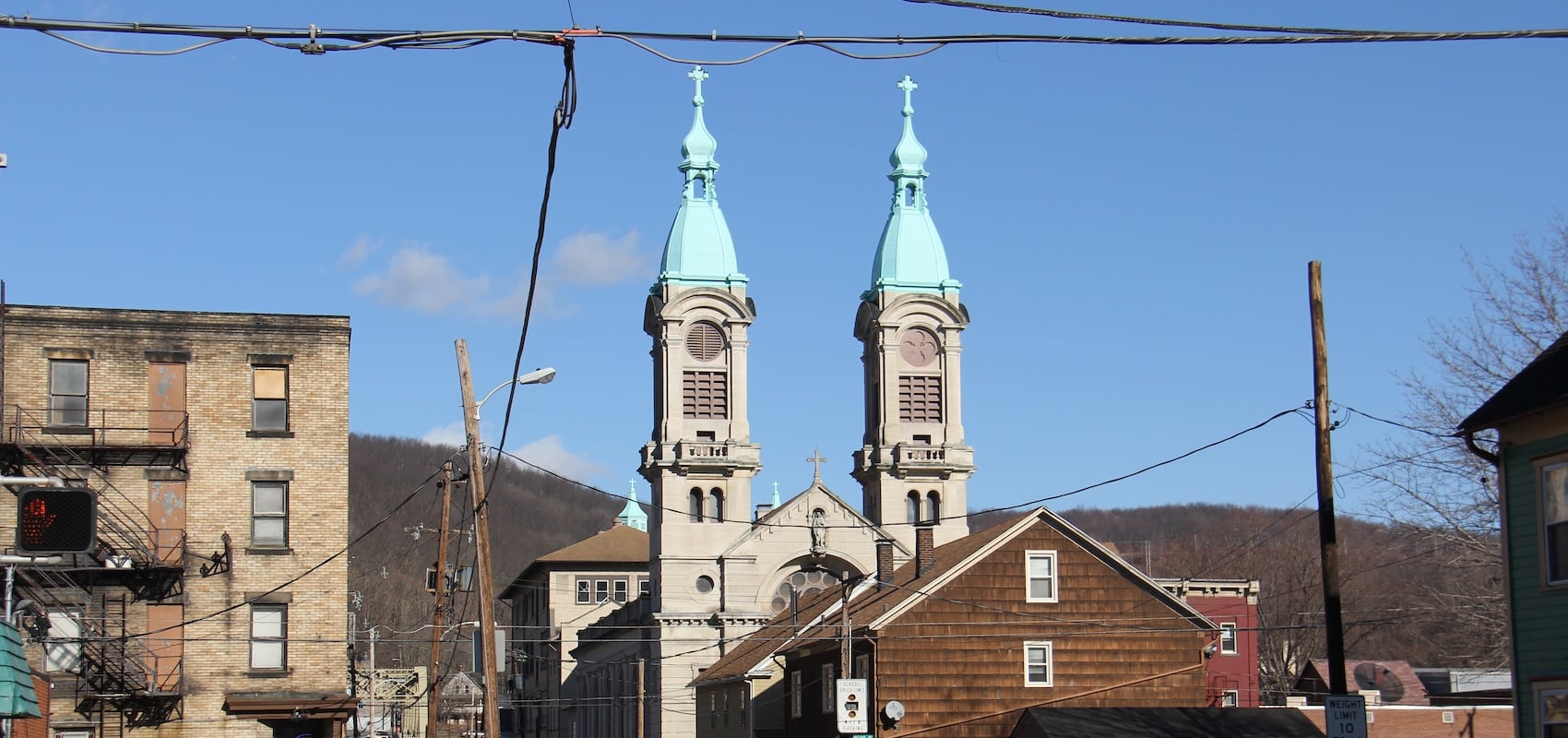
Some years ago, I was a resident at Conemaugh Memorial Medical Center in Johnstown, a small postindustrial town in the foothills of the Appalachian Mountains. In a free moment, I walked an old ethnic neighborhood on the west end, known as Cambria City. At its height it must have been a hub of ethnic color, the quintessential American immigrant neighborhood, here on the edge of Pennsylvania’s vast western forests. It still maintains a Sunday street market, where vendors trade in local produce and crafts beneath the great bells of the town’s church towers. The streets were populated by many unusual churches: the Hungarian Reformed Church, Holy Protection of St. Mary Byzantine Catholic Church, some small Polish and Irish parishes, German Catholic and Slovak Lutheran churches, and a lovely little brick building on the river, charmingly labeled “First Catholic Slovak Band.”
These structures were fossils of a multiethnic world, a world that was once expected to last forever. The debris is scattered across the few blocks of Cambria City: a copper spire etched with Polish script; a low, white clapboard church recalling the rolling pastures of Holstein; a Byzantine onion dome shimmering above a row of old mill homes, now largely abandoned. These structures stand today not as lively centers of ethnic civilization, but as melancholy reminders of what once was: a town thick with the communal worlds formed by poor immigrants who arrived with little more than a folk catechism and memories of a far-off place.
The decline of America’s ethnic churches is a familiar story, one that cuts across every region and every Christian denomination: the German and Danish Lutherans of the Midwest; the Moravians of Pennsylvania and North Carolina; the Dutch Reformed settlements of rural Michigan and Iowa; the Byzantine Ruthenians who built pockets of Constantinopolitan Christianity in the coal towns; and the mosaic of Eastern Orthodox churches, from Greeks and Antiochians to Serbs, Russians, and Ukrainians. Less examined is the cultural impact of the fading of these communities, the state of aesthetic, moral, and cultural impoverishment brought on by their decline.
To chart their demise is not an exercise in nostalgia. It is not the quaintness or simplicity of the past that is of value. To trace the disappearance of the very structures that once formed Americans to think with depth, pray with continuity, and inhabit time with reverence is to understand how the American psyche was formed, and perhaps to understand its destiny.
Walk through Milwaukee, Minneapolis, or rural Iowa, and you will still encounter the proud ghosts of nineteenth-century German Lutheran settlements: redbrick sanctuaries rising beside former parochial schools, built by congregations that expected their children and their children’s children to continue singing the same High German chorales in the same hand-hewn wooden pews. At their zenith, these churches were linguistic strongholds, maintaining the vitality of the German language under the direction of Herr Pastor. Until the First World War, sermons, catechesis, and hymnody were all conducted overwhelmingly in German, a language that would have been accessible to the congregation. The use of German did not bespeak a sentimental attachment to an ancestral homeland. It was the vessel of collective thought, the means of cultural continuity, in a world of alien theological and cultural precepts.
The forced Anglicization of such institutions due to wartime anti-German hysteria, the social mobility that sent the next generation off to suburbs and universities, and the growing dominance of American popular culture as an international force all contributed to the erosion of these enclaves. But the deeper loss came from the weakening of the communal habits that had long sustained these Lutheran parishes: the Wednesday suppers, the small devotional societies, the guilds, the seasonal festivals, the choral traditions stretching back to late-medieval Saxony and Hesse. These habits sustained a sense of identity that was independent of the outside world, that did not seek total assimilation into the broader culture.
Danish Lutherans faced similar pressures. Their enclaves, notably in Minnesota, Iowa, and Nebraska, once maintained a delicate balance of cultural retention and adaptation. But denominational reunions, such as the 1962 merger that formed the Lutheran Church in America (LCA), promoted administrative efficiency at the cost of regional identity. What vanished in these consolidations was not so much theological doctrine as ecclesiastical texture. The Danish hymnody, the folk pietism, the sense of a coherent microcivilization within the broader Protestant country were all swept away in the name of economy and political sensibility.
The Moravians are another example, the quiet and musical people who settled the city of Bethlehem in Pennsylvania with their calm devotion and disciplined communal life. Their lovefeasts, brass choirs, and precisely ordered liturgical year created parishes of almost monastic serenity. Yet the very gentleness that sustained their early cohesion left them vulnerable to the same homogenizing forces of American culture in the twentieth century. Like the Ruthenians, they struggled to define themselves within the American nationalist imagination. (Moravia has not held sovereignty since the tenth century.) The communal economic order that served them so well for most of their besieged history had dissolved by the mid-1800s. The Moravian schools became intellectually respected but culturally indistinguishable from other Protestant (and later secular) institutions. Today, the Moravian Church persists, sincere and pious, but its parishes no longer sustain the spiritual worldview that was once salient. They survive, admirable in their dedication and modest in their execution, but they no longer shape a communion. They serve the remnants of one.
Few ethnic groups produced so coherent an American subcivilization as the Dutch Reformed settlers of Michigan, Iowa, and New Jersey. Their churches anchored the entire cultural project of Dutch civilization: schools, colleges, newspapers, guilds, sabbath observances, and town governance. To visit Holland, Michigan in 1910 was to step into a pocket republic of the Netherlands. But the very success of this project sowed the seeds of its dissolution. High educational attainment brought mobility. The fractious nature of Dutch Calvinism produced schisms, counter-schisms, counter-counter-schisms, and a parade of theological disputes, all of which undermined institutional stability. By the late twentieth century, the broader American turn toward evangelical consumer-religion eroded Dutch liturgical rigor and communal discipline. What remains today is a proud but thinning remnant, a devout, serious, civically engaged church, yet one increasingly detached from the ethnic and theological system that birthed it.
Of all America’s ethnic churches, none were so unexpectedly luminous as the Byzantine Ruthenians and their Slavic Orthodox cousins. Arriving as miners and mill workers, they built small, onion-domed sanctuaries in the hills of Pennsylvania, Ohio, and the industrial Midwest. Those churches appear as flashes of Byzantium against the slag heaps and smokestacks of sundry mountain towns. The Ruthenian Greek Catholic Church, with its ancient chant and stunning iconography, blossomed in the early twentieth century as a living bridge between Eastern Christianity and American Catholicism. But as America’s coal industry collapsed, Ruthenian and Slavic Orthodox parishes emptied, hemorrhaging more than 75 percent in the last six decades. Intermarriage increased, vocations declined, and many communities found themselves unable to sustain the complex liturgical life their tradition demanded. The case of the Ruthenians is all the more tragic since the mother church in Ukraine was dissolved by the Soviets in 1949.
Other Orthodox churches—Greek, Russian, Serbian, Romanian, Antiochian—have fared better, bolstered by immigration in the later twentieth century, but still fear this fate. They confront the same forces of acculturation, assimilation, and decline. Among the effects are suburban dispersal, linguistic drift, and the slow weakening of the relation between ethnic identity and ecclesial commitment. The great onion domes still shine, and the festivals still draw crowds. But the communities, once robust enough to support choirs, brotherhoods, women’s societies, and language schools, struggle to pass on the fullness of Byzantine Christianity to children shaped by American modernity.
The standard explanations are unsatisfying. Urban flight, suburbanization, intermarriage, and declining birthrates are all relevant but nonspecific. Some other ethnoreligious groups, such as the Amish in Pennsylvania and Ohio, have doubled in size with every generation. Iraqi Christians and Copts, still relatively new to the American religious landscape, have thrived in recent decades. In all of this, the decisive factor appears to be more cultural than demographic.
Historically, ethnic churches were not solely religious institutions; they were incubators of social and personal identity. They demanded things from the individual that modern Americans find alien. These churches followed a fixed liturgical rhythm, usually derived from a long-observed agrarian calendar. They prescribed obligations to ancestors, moral and social, and were rooted in a parochialism that required regular association with the community. They demanded a disciplined catechesis: To be a member of the church was to be an informed member. It was necessary to know the boundaries of the community, and members felt social pressure not to deviate too far from its expectations and responsibilities. Finally, and most egregious to postmodernity, these churches required submission to something older and wiser, an act of humility that acknowledged a higher moral and intellectual authority than the self or American popular culture. The individual was understood in the interpersonal context of the church, not by self-expression.
The American cultural regime of the last sixty years has dissolved even the most deeply rooted communal traditions. Its trinity—therapeutic individualism, social mobility, and consumer choice—has eroded the coherence and social utility of ethnoreligious communities. Organic ethnic structures of belonging, binding individuals to inherited patterns of worship, discipline, and mutual aid, were gradually reconceived as optional hereditary accessories. The result is a fractured and diffuse religious landscape, increasingly detached from any cultural matrix that would be capable of sustaining it. The believer now stands alone, unmoored from ethnic memory or church discipline, encouraged to curate a spiritual profile rather than receive an ancestral tradition. When belief is reduced to preference and tradition repackaged as decor, the ethnic church becomes not a living organism but a museum piece.
America’s ethnic churches offered an apprenticeship in communal belonging and identity. In their fading, we glimpse the larger cultural predicament, what the sociologist George Ritzer called the “McDonaldization” of culture. The drive toward standardization, uniformity, and convenience, often at the expense of creativity, individuality, and quality, is here extended into the realm of religion. The decline of ethnic churches does not spell the end of Christianity in America, nor the end of any specific ethnic memory. But it marks the collapse of one of the few structures capable of moderating the deracinating energies of American liberalism and the flattening impulses of mass culture. When the bells stop ringing on Sunday—or rather, when fewer people care to hear them—there will ensue a spiritual quiet that cannot be filled by politics, entertainment, or digital navel-gazing. We are a country rich in roles but starved for social obligations, wealthy in information but poor in wisdom, diverse in heritage but unmoored from history. Even if the old church bells never ring again, the longing they answered will endure. Whether new communities can once again gather enough courage, discipline, and imagination to build something so lasting remains an open question.
Image by Ron Shawley, licensed by Creative Commons. Image cropped.

YOU MIGHT ALSO LIKE
Turned Away on Palm Sunday
In politics, diplomacy, war, or pretty much any field of human interaction, one must contend not only…
Via Crucis, 2026
The Way of the Cross—and the third, seventh, and ninth stations in particular—has been an especially appropriate…
A Medieval Pilgrimage in Modern Assisi
When you go to the hilltop town of Assisi, you’re immediately struck by how medieval it is:…
