
The term hypocrisy is much over-used and much misused. It comes from the Greek, of course, and means to act on the stage, to pretend to be what one is not or to believe what one does not believe. For all of us, and in various aspects of our lives, there is a gap between who we represent ourselves to be and who we really are; between what we say we believe and what we, at least at times, really think. That is not hypocrisy. That is the consequence of human frailty, confusion, cowardice, or, sometimes, a simple desire not to hurt the feelings of others.
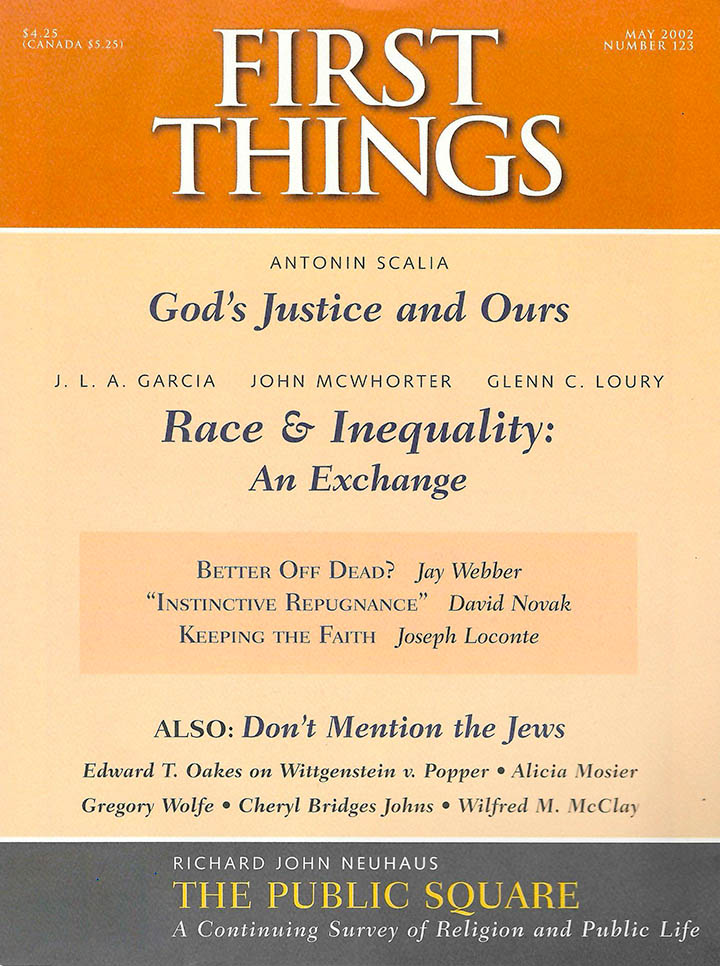
Hypocrisy is something much more deliberate and calculated. Hypocrisy aptly describes much discussion, or non-discussion, about the role of Jews in American life. It is commonly practiced among Christians, and my Jewish associates assure me it is as common among Jews. A significant difference is that there is a large literature produced by Jews on Jews in American life, whereas non-Jewish discussions of the subject tend to be confined to the shadowed world of bigotry and conspiracy-mongering. For non-Jews who understand how things are done, Jews in American life is a forbidden subject, at least in public.
Consider the recently released tapes from President Richard M. Nixon’s Oval Office when, in 1972, he and Billy Graham discussed what they obviously viewed as the Jewish problem. Referring to Jewish domination of the media, Graham says, “This stranglehold has got to be broken or this country’s going down the drain.” “You believe that?” responded Nixon. “Yes, sir,” said Graham. “Oh, boy. So do I,” said Nixon. “I can’t ever say that, but I believe it.” “No, but if you get elected a second time, then we might be able to do something,” Graham said. Mr. Nixon turned the conversation to Jewish influence in Hollywood, and Mr. Graham said, “A lot of Jews are great friends of mine. They swarm around me and are friendly to me because they know that I am friendly to Israel and so forth. But they don’t know how I really feel about what they’re doing to this country, and I have no power and no way to handle them.” Nixon replied, “You must not let them know.”
Graham’s office promptly issued a statement on behalf of the evangelist, now eighty-three and ailing, saying that he did not remember the conversation with Nixon and the reported remarks certainly do not reflect his thinking about Jews and Judaism. A source familiar with the Nixon White House and with Mr. Graham says he is sure that the conversation was very specifically about leftist Jews, which, as we shall see, does not quite fit the definition of anti-Semitism. But the press played it as an instance of anti-Semitism, and that does provide an occasion for trying to understand a phenomenon usually obscured by dissembling, evasion, fear, and, yes, hypocrisy.
No Dirty Little Secret
Anti-Semites—and there really are anti-Semites—think they have a corner on a dirty little secret. Their supposed secret is that Jews have a disproportionate influence in American society. But of course that is no secret at all; it is the obvious fact. About 2 percent of the population, a little over five million people, exercise an influence far out of proportion to their numbers. In certain sectors of American life—notably in media, entertainment, prestige research universities, and to a lesser extent in finance—people in that 2 percent hold 20, 40, or even more than 50 percent of the positions of greatest influence. It is quite astonishing. It is clearly disproportionate. Some say that it is not only disproportionate, which is obvious, but that it is inordinate, meaning that it is excessive and contrary to the right order of things. People who say that are also given to suggesting that the disproportionate influence of Jews is baneful. Certified anti-Semites say out loud, and many others say sotto voce, that America has a Jewish problem.
A recent survey, confirming many earlier surveys, indicates that Jews and Judaism have a very high approval rating. Asked about religious groups in America, 90 percent had a favorable view of United Methodists. What’s not to like about United Methodists? In second place were Jews, at 88 percent. “Only in America,” one might say, and there is truth in that. One might also add, “Only in opinion polls.” I have been critical in this space of Jewish defense groups that are forever sniffing about in paranoid fashion and detecting signs of imminent pogroms. But one need not be paranoid or even inordinately suspicious to be skeptical about such survey research findings. Who except a declared anti-Semite would tell a pollster that he has an unfavorable view of Jews, or even that he does not have a favorable view of Jews? The stigma of anti-Semitism has been so effectively employed that it makes most survey research on the question virtually useless.
What people say over the kitchen table, or even at the more formal dinner party when there are no Jews around, is something else. There is no way or proving it, but I expect that most non-Jewish Americans were not surprised, never mind shocked, by the 1972 discussion in the Oval Office. This does not mean they agree with what was said, only that they have heard it before. I also expect that few Jews were surprised, although many were shocked. It is the shock of being so frontally encountered by a reality that you hoped, but did not really believe, had disappeared.
America as “Host” Society
I had a small part in Charles Silberman’s very useful 1985 study, A Certain People: American Jews and Their Lives Today. Silberman’s conclusions about the Jewish circumstance in America lean toward the optimistic, and he has a kind word about my efforts to deal with our differences in a way that “will strengthen rather than weaken our pluralistic society.” He goes on to say, “Unfortunately, the approach Neuhaus himself proposes would have the opposite effect, for once again it would make Jews strangers in their own land.” The approach he has in mind is my argument that we must come to terms with the fact that America is—incorrigibly, confusedly, and conflictedly—a Christian society. Silberman agrees with the Reform rabbi who told me many years ago, “When I hear the phrase ‘Christian America,’ I see barbed wire.” The question of Jewish “at homeness” in America has run through numerous studies over the years by Jewish scholars such as Nathan Glazer, Milton Himmelfarb, Ludwig Lewisohn, and Oscar Janowsky, as well as by non-Jews such as E. Digby Baltzell and John Murray Cuddihy. The Jewish complaint is typically against the slightest suggestion that America is the “host society,” thereby implying that Jews are somehow guests or are here on probation.
In his strongly philo-Semitic book, A History of the Jews, the British writer Paul Johnson puts it this way: “For all these reasons it became perhaps misleading to see the American Jewish community as part of the diaspora at all. Jews in America felt themselves more
American than Jews in Israel felt themselves Israeli. It was necessary to coin a new word to define their condition, for American Jews came to form, along with the Jews of Israel and the Jews of the diaspora proper, the third leg of a new Jewish tripod, on which the safety and future of the whole people equally depended. There was the diaspora Jew, there was the ingathered Jew, and, in America, there was the possessing Jew.” Perhaps “possessing Jew” is not the best phrase, suggesting as it does the stereotype of the possessive, or even grasping, Jew. Better to speak of the Jew completely at home, or at least as completely at home as anyone can be short of the Messianic Age.
Sumptuary Fears
But is the American Jewish community completely at home? If one can speak of a community feeling, does it feel completely at home? There is reason to doubt it. Not long ago I was invited to a gala dinner at the Waldorf Astoria to honor the head of a major Jewish organization. It was a lavish affair, with about 1,200 of the rich and famous in formal attire in unabashed display of their having made it. There was a sprinkling of goyim (no disparagement intended), and I was the only Christian cleric. The book of tributes to the honoree, placed on each chair, was as thick as the Manhattan telephone directory. Politicians from the President and mayor on down, stars of stage and screen, and numerous other celebrities all paid tribute, either in person or by live video. The tributes went on and on for well over two hours before we got to dinner. Between the speeches were film clips of the skeletal survivors of Auschwitz and Dachau, along with heaps of corpses and scenes illustrating Hitler’s rise to power. Almost every tribute included at least one declaration of “Never again!”
Most Americans would, I am sure, have found the evening surreal. Here assembled in the Grand Ballroom of the Waldorf Astoria in New York were over a thousand of the richest, most powerful, and most influential people in America. It was, on the one hand, a community’s exuberant display of its unparalleled success. On the other, the unmistakable message of the evening was that this is a community perilously poised on the precipice of the abyss, of Auschwitz happening again, and this time in America. It was not a community that appeared to be securely at home, or at least did not appear to be for the purposes of that evening.
The last point is critical, I am told by a Jewish friend who was there. After all, he observes, the purpose of the occasion was to celebrate the leader of a Jewish defense organization, and a defense organization is only important if it can fuel the fear of the horrors against which it is defending the community. On such an evening, allowances must be made for hyperbole. Moreover, as many Jewish writers have argued in recent years, a community requires commonalities, and for most American Jews the religion of Judaism no longer provides that. The de facto religion is remembering the Holocaust, commitment to the State of Israel, and keeping alive a sense that, if the community lets down its guard for even a moment, they (whoever “they” may be) will do it again. Rabbi David Novak has famously said, “As a Jew, I do not get up in the morning cursing Hitler but praising the God of Israel.” That is no doubt true of the minority of American Jews who are in any way observant. But, as Elliott Abrams has written (FT, June/July 1997), it is Jewishness and not Judaism that holds together “the Jewish community” in its tribal identity. Praise of the God of Israel was not conspicuous at the Waldorf.
That evening does not tell the whole story by any means, but neither, on the basis of my own experience over the years, was it entirely atypical. It seems that the discordant notes of security and danger, of achievement and vulnerability, of belonging and otherness, are constantly contending in Jewish thinking about the American circumstance. The various notes wax or wane in response to discernments of what “the others” are thinking about Jews. There are those—Leon Wieseltier of the New Republic comes to mind—who make no secret of their contempt for Christianity, and are as offended when the “others” do not think about Jews as when they do think about Jews.
“We” and “Them,” and Vice Versa
Serving on a university panel discussing Jews, Christians, and the American experiment, I was confronted by a question from the audience. “Do you have any idea,” the woman asked, “how offensive it is to me as a Jew to hear you speak of Jews as ‘them’? In America, we are all ‘we.’“ Well, yes and no. Yes, we must affirm as much as possible what we have in common as Americans and, I would add, as children of the covenant. And no, the very fact of a panel on Jews, Christians, and the American experiment assumes differences of consequence. I am not a Jew. As with the Jewish participants in the discussion, there is a “we” and a “them.” The purpose is to understand what and how the other thinks. The alternative to doing that is to accept Richard Nixon’s counsel to Billy Graham: “You must not let them know.”
Until fairly recently, there were those who thought it was the better part of wisdom for Jews to maintain a low profile in public. It seems odd now, but in 1965 when Abraham Beame first ran for mayor of New York, there were prominent Jewish voices publicly fretting that a Jewish mayor might provoke a backlash. (He lost that year, but then ran successfully in 1973.) Since then we have had what seems like a lifetime of Ed Koch as mayor (he frequently appears to think he still is mayor) and now there is Michael Bloomberg, and nobody gives it a thought, at least not in public. In politics, both nationally and in the states, the low-profile days are long past. This is not true in the media, in entertainment, or in the prestige universities, where nobody is supposed to notice the disproportionate Jewish influence. Why does 2 percent of the population carry such weight? Anti-Semites, who think the disproportion is inordinate, and those who flirt with anti-Semitism, typically resort to conspiracy theories of one sort or another. Others refer to a prodigiously achievement-oriented subculture, and yet others (very quietly) to genetic superiority. Then there are those, Jews and Christians alike, who would not discount the importance of Jews being God’s chosen people.
Jewish influence was viewed as a “Jewish problem” when Jews were conspicuously prominent in attacking what was taken to be the American way of life. This was the case with the Old Left in the first part of the last century, when Jews were portrayed as predominant in the leadership of Communist and socialist movements, often because they were predominant. Irving Howe and, more recently, Ronald Radosh and David Horowitz have written compellingly about that Jewish world of the Old Left. The role of Jewish activists and ideologues in defining the newer leftisms of the sixties and onward is also notable. In what is aptly described as the culture wars, and especially in the central dispute over abortion, Jews are overwhelmingly on one side. In electoral politics, Jews tend to be Democrats, and on the left of the party. As Milton Himmelfarb has memorably written, Jews have incomes like Episcopalians and voting patterns like Puerto Ricans. One great Jewish dissent from the left is on affirmative action and quota systems. Jews are, understandably, not enthusiastic about a notion of equality that would limit them to no more than 2 percent of anything. The other great dissent from the left, for obvious reasons, is on support for Israel. (In such generalizations, important exceptions must be made for some of the Orthodox, but they are a small minority.)
On an array of questions that come under the rubric of “church-state relations,” Jews have in the last fifty years been at odds with most Americans. Generally speaking, they have thought the naked public square a very good thing. The more secular the society, the better it is for Jews. That was the rule advanced by the late Leo Pfeffer of the American Jewish Congress, for instance, and, beginning in the 1940s, he persuaded the Supreme Court to rule again and again against religious expressions and symbols Christian in nature—in our public life. Public secularism had not always been the position of Jewish leadership, as is admirably demonstrated by David Dalin and Jonathan Sarna in a study sponsored by the Institute on Religion and Public Life, Religion and State in the American Jewish Experience. The older Jewish position, and the position of the Orthodox today, is not in favor of a naked public square but of fair treatment of all religions in the public square. There are signs that that position may be in the ascendancy today, but a half century of what I have called “the Pfefferian inversion”—subordinating the “free exercise” provision of the First Amendment to the “no establishment” provision—is still taking its toll.
An Adversarial Subculture
Jews have been part of the American experiment since its constitutional beginnings. Until fifty years ago, they were very much viewed as guests in the host society of Christian America. Many older Americans well remember the days when clubs, societies, neighborhoods, and prestige law firms made no bones about being “exclusive,” and when universities such as Harvard and Columbia observed a “Jewish quota” in admissions. It is understandable that most Jews think the secularization of our public life has been good for Jews. Whether or not the connection is causal, over the last half century secularization and full social enfranchisement have proceeded apace. As with other ethnic and religious groups, the Jewish ways of negotiating a relationship with American society have changed over the years. Now it appears that a devotion to public secularism is no longer, if it ever was, a source of Jewish security and flourishing. It has become, rather, a liability that unnecessarily places American Jewry in an adversarial relationship to the culture, provoking the perception that Jews really are, in Silberman’s phrase, strangers in their own country.
We may well be entering a new chapter in the long story of the Jewish experience in America. The promise and complexities of this new period are addressed in a book of essays I have edited that is just out from Eerdmans, The Chosen People in an Almost Chosen Nation. I expect historians may designate people such as Will Herberg, Irving Kristol, Milton Himmelfarb, and Midge Decter as the prophets of this new era in the American Jewish experience. Over the years, they and a few others vigorously dissented from the proposition that it was good for the Jews to be a secularizing adversarial culture. They have proposed a more promising way toward unqualified “at homeness.” In this view, anti-Semitism is not the great threat. As Kristol has remarked, “The problem is not that other Americans hate us; the problem is that they want to marry us.” To the very real possibility of complete assimilation leading to the disappearance of the Jewish community, thinkers such as David Novak and Elliott Abrams have argued that the answer is for Jews to become more serious about the religion of Judaism, as distinct from the ethnic habits of Jewishness.
To Speak the Truth
In the fall of 2000, more than two hundred Jewish scholars issued Dabru Emet (To Speak the Truth), proposing a Jewish understanding of Christianity in response to the many statements of recent decades offering a Christian understanding of Judaism. The first purpose of Dabru Emet is to advance religious and theological understanding, but the premise is also that Christians and Jews will live together in greater security and mutual respect if they understand one another as participants in covenantal purpose seeking to be faithful to the God of Israel.
Some Jewish thinkers have reacted to Dabru Emet very negatively. Affirming religious commonalities, they contend, will obscure the differences between Christianity and Judaism, leading to more intermarriages and the loss of Jewish children to Christianity or to religious nothingness. The argument is that a degree of interreligious hostility—even, as one critic puts it, an “instinctive repugnance” toward Christianity—is necessary to preserve Jewish identity. This is what sociologists used to call an “out-group identity strategy.” It has been tried, and it has not produced a very healthy relationship between Christians and Jews. More important, and whatever its sociological merits or demerits, it is not true to how Jews and Christians should understand one another religiously. That at least is the position of the Jewish scholars who produced Dabru Emet, and I am convinced they are right.
Jews should not be viewed, and should not view themselves, as strangers in their own land. It should be obvious to all that this is their land as much as it is our land. Yet, if there is to be a distinct Jewish community, there will of necessity continue to be a “we” and a “them.” Silberman titled his book A Certain People. He could not quite bring himself to use the more biblical phrase, “a peculiar people.” Among the peculiarities of this people is that they will almost certainly continue to exercise an influence dramatically disproportionate to their numbers. Those who think that influence inordinate must just get used to it. It should be viewed as a permanent feature of American life.
As to what the future actually holds, very different scenarios are proposed. One can envision a religious awakening, with more Jews adhering to Judaism, having more babies, and rearing them in the tradition. That, combined with a growing awareness of the spiritual bond between Jew and Christian, and that bond being reinforced by the hostility of radical Islamism to both Jew and Christian, suggests one possible future. Many Jewish leaders see a more doleful prospect: secularizing forces further loosening adherence to Judaism, continued or increasing levels of intermarriage with most of the children and almost all of the grandchildren lost to the community, resulting in a dispirited remnant headed for virtual oblivion. Another prospect little discussed in public but on the minds of many is that, God forbid, the State of Israel could finally fail, with the great majority of Israelis coming here and almost doubling overnight the size of American Jewry.
Then there are the discussions such as that in the Oval Office of 1972, which are by no means a thing of the past. Such ugliness feeds on the secretive presumption of Nixon that “You must not let them know.” The story of The Chosen People in an Almost Chosen Nation has matured to the point where both Jew and Christian can and must let one another know what we think. It is necessary that we do so if we are not to be strangers to one another in our own land.

YOU MIGHT ALSO LIKE
Via Crucis, 2026
The Way of the Cross—and the third, seventh, and ninth stations in particular—has been an especially appropriate…
Trump’s Civilizational Project
Secretary of State Marco Rubio spoke at the recent Munich Security Conference. Last year, Vice President JD…
How to Bring Back School Prayer
Though it was overshadowed by the reversal of Roe v. Wade the Friday before, the Supreme Court’s…
