
Communion:
Finding My Way Back to Faith
by jd vance
harpercollins, 304 pages, $35
In the sixth book of his Confessions, St. Augustine relates a story about an encounter he had on the streets of Milan with a seriously intoxicated man. Augustine was being carried on a litter to witness a speech by the emperor, which he himself had composed. Mindful that his own career ambitions had brought him to this high point, he looked with disdain on the pathetic drunk. Then it hit him: Tomorrow morning that man will be sober, but I will still be drunk on worldly ambition. The episode proved to be a turning point on Augustine’s spiritual itinerary. I thought of this scene often as I read through JD Vance’s spiritual autobiography, for the story he is telling has a fundamentally Augustinian arc.
Like the great African Church Father, JD Vance is a man from the backwoods, far from the centers of power. Anyone who has read the first installment of his autobiography Hillbilly Elegy knows how his early years were marked by economic instability, lots of family dysfunction, and little prospect of rising in the world. But also like Augustine, this kid from the provinces possessed a fierce ambition to find success. And so, he made his way out of hillbilly country to the military, then to great achievement at Ohio State University, and finally to triumph at Yale Law School. And then came the moment of Augustinian perception: Though his lust for success had brought him to the heights, he realized he didn’t particularly like the law and certainly didn’t want to practice it. He was a success addict, or rather, an approval addict, and his heart was still utterly restless.
It was this emptiness that opened him to a reconsideration of the Christianity of his youth, which he had largely abandoned, at the prompting of the intelligentsia among whom he moved at Yale. Readings (or re-readings) of many of the masters—Tolkien, Lewis, Chesterton, Aquinas—followed, and a key breakthrough also had a very Augustinian flavor. Just as Augustine overcame his hesitations regarding Christianity when the preaching of St. Ambrose taught him how to read the Bible in a sophisticated manner, so JD Vance managed to move beyond a fundamentalist construal of Scripture with the help of teachers both ancient and modern. But Vance, though obviously a very bright man, is influenced more by the existential than the intellectual, which helps to explain why René Girard played such a significant role in his reversion to Christianity.
The great Franco-American theorist came to Vance’s attention through the ministrations of Peter Thiel, whom the vice president describes as “possibly the smartest person I’d ever met.” Girard’s account of “mimetic desire”—the way in which we tend to want things, not because of their intrinsic value, but because other people want them—resonated deeply with Vance, who desperately wanted success in the legal world, precisely because so many other people wanted the same thing. On Girard’s reading, mimetic desire conduces to mimetic rivalry, and Vance saw this clearly in the cutthroat competitive worlds in which he moved. And the scapegoating instinct, which Girard took to be the dysfunctional way that fallen human beings deal with rivalrous violence, Vance saw in the brutal mobs that form so easily on social media. However, the most important insight he garnered from Girard was that Christianity represents the unmasking and undoing of these dangerous impulses, which he found so readily in himself and in so many of his peers.
I suppose it shouldn’t be surprising, since this is the autobiography of a politician, but I was indeed struck by the important role that Catholic social teaching played in the vice president’s journey to Catholicism—confirming St. John Paul II’s insight, by the way, that the social doctrine of the Church is crucial to evangelization. Like many others, Vance was impressed by the breadth and balance of this teaching, which cannot be characterized in the customary fashion: “It is neither conservative nor progressive; neither liberal nor authoritarian.” He especially appreciated how the social doctrine as articulated by Pope Leo XIII refused to see economic classes as antagonistic to one another, “mutual agreement” resulting in the “beauty of good order.” In this regard, Catholic social thought represented, for Vance, a welcome departure from the antagonistic social theorizing so prominent in wokeist circles.
A chapter entitled “Another Munich” is particularly illuminating in this context. Vance recounts a congressional junket he embarked on as a new senator to the annual Munich Security Conference, a gathering of the best and brightest politicos from Europe and America. What struck the young senator was how lacking the conversations were in spiritual and moral substance. Whereas the founders of the postwar European alliance spoke easily of the ethical and religious character of European democracy, their successors seemed oblivious to this dimension: “We saw a new creed take form,” says Vance, “a secular global liberalism that maintained the vocabulary of rights while shedding the religious foundation that gave them meaning.” Closely echoing Pope Benedict XVI and more recently Pope Leo XIV, the vice president argues that an earlier generation of European leaders knew what they were defending: “It was Western Christian civilization and the values particular to it—the concept of natural rights, including freedom of speech; a sense of duty to one’s neighbors; an obligation of the strong to protect the weak.”
An even more acute analysis of the overlap between the social order and the faith occurs in the chapter “A Dismal Science.” Throughout this section of the book, I was reminded of a year-long seminar on political philosophy I took with Msgr. Robert Sokolowski at Catholic University many years ago. Sokolowski argued that what we identify as the central concern of politics today is a complete reversal of the classical perspective. Whereas contemporary politics is largely preoccupied with economic matters, ancient politics was focused above all on the cultivation of virtue. For the classical thinkers, economics (literally the law of the household) was the preserve of those in the private order. Vance observes that in the New York Times, economists are the most “discussed of all social scientists,” and in the Congressional Record, they are the academics most frequently mentioned. The simple truth is that we tend to read our shared life through an economic lens, using productivity as the most salient measure of success. But Vance comments, “this is such a thin and unsatisfying way to think about your life and the society you share with other people.” Far more important, he says, are family, friendship, education, play, and religion—and this prioritization is the result of his embrace of Catholic social teaching. To be sure, Leo XIII and his successors praise the market and its essential dynamics, but they don’t idolize; instead, they place it within a moral and legal framework meant to humanize it.
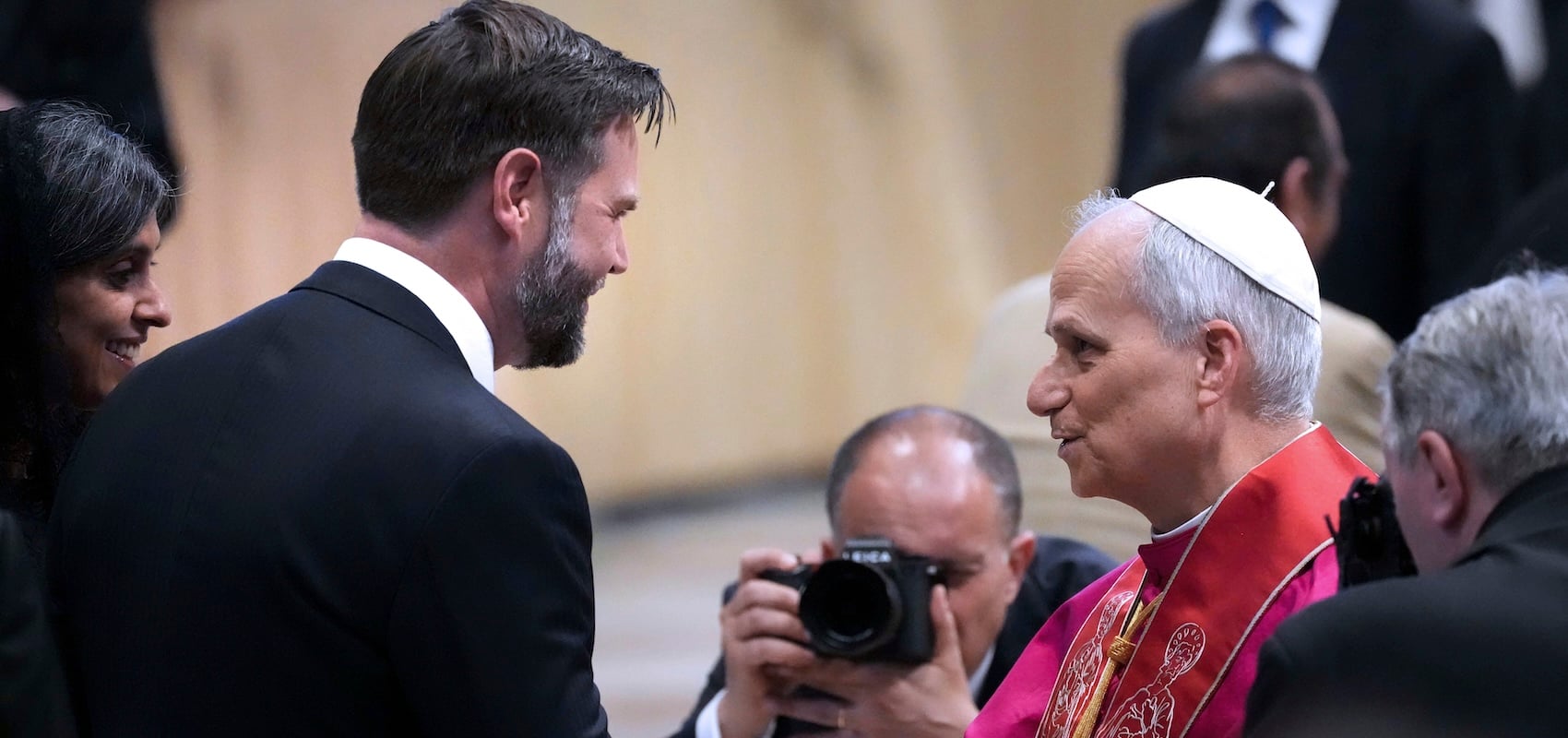
Famously, JD Vance was one of the very last persons to meet with Pope Francis. The vice president had great respect for the frail pope and was extremely grateful that the pontiff had granted him an audience literally the day before his death. Vance’s meeting with Vatican diplomats was less satisfying. Cardinal Parolin, the secretary of state, raised serious concerns about the Trump administration’s policy regarding immigration. Though he acknowledged that the U.S. had a right to control its borders, he encouraged Vance to treat migrants humanely. But what did the Vatican object to exactly? Deportations in general? Deportations of criminals? The pace of deportations? Vance claims he got no answers and remained flabbergasted that “the Vatican seemed unwilling to move its moral guidance past the point of trite platitudes.” It’s a damning observation, but I confess to sympathizing with it, for I have found the same tendency too often when the Church addresses complex political matters.
JD Vance’s ambition has led him to the vice presidency, and his Augustinian restless heart has led him to the Catholic Church. This book, in the final analysis, is an account of how he is endeavoring to bring the spiritual substance of his Catholicism to bear on his work as a statesman. As such, it is a challenge to both a secularism that disdains religion and a religiosity that aspires to hover above the political.
Image by Vatican pool/ Spaziani/picture-alliance/dpa/AP Images
Dear Reader,
Can I be direct with you?
War abroad. Socialists on the rise. AI upending human life. Endless uproar online. The modern attention economy doesn’t want readers — it wants users enslaved to the tyranny of the present.
First Things is the antidote: literary excellence, timeless truths, and a fixed point of reference in a culture that has lost its bearings.
But we can’t do it without readers like you.
Our goal: Raise $150,000 by November 1 to sustain First Things in the year ahead.
Your gift anchors readers in the permanent things.
Make your Fall Campaign gift now using the button below.
If you have any questions or would like more information, please contact Giovanni Del Piero, Director of the Editor’s Circle, at gdelpiero@firstthings.com or 212-627-1985.

YOU MIGHT ALSO LIKE
Why the Death Penalty Is a Sore Point for Papal Authority
Pope Leo XIV marked World Day Against the Death Penalty, observed on October 10, with the following…
Foucault’s Idol of Nothingness
Today marks the 100th anniversary of the birth of Michel Foucault. He was influential in his lifetime,…
Candace Owens and the Sin of Anti-Semitism
According to the online Encyclopedia Britannica, Sir Moses Montefiore (1784–1885) was “an Italian-born businessman who was noted…
