
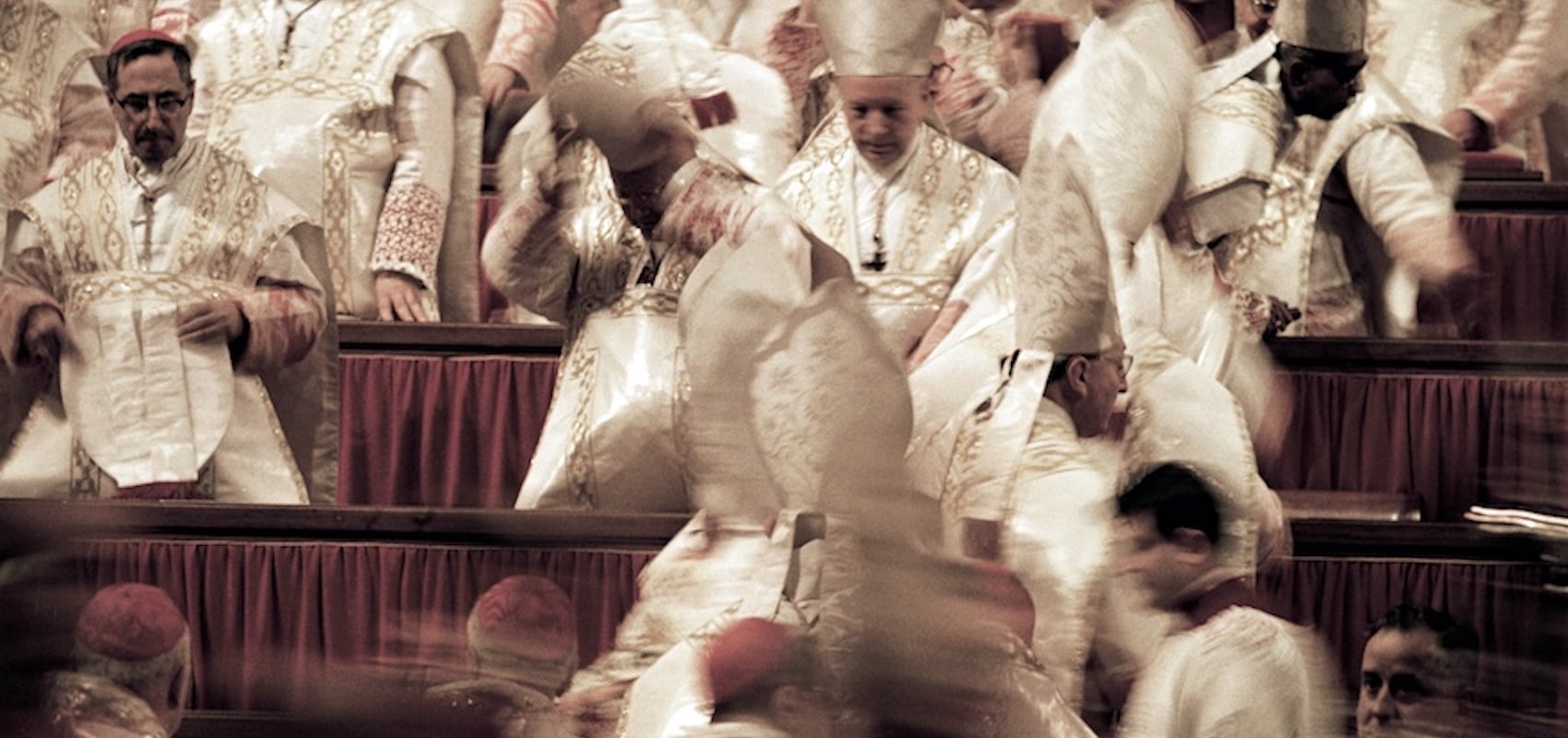
In his weekly catecheses on Vatican II, Pope Leo is now discussing Gaudium et Spes, one of the more controversial conciliar documents. Critics charged that, by revising its earlier condemnations of modernity, the Catholic Church bent its knee to the world. Indeed, Gaudium et Spes does alter certain nineteenth-century teachings. This is so much the case that Joseph Ratzinger famously stated that the document is nothing less than “a revision of the Syllabus of Pius IX, a kind of counter-syllabus.”
The Syllabus of Errors, attached to the 1864 encyclical Quanta Cura, sought to distance the Church from liberal modernity. But to some, the document was an embarrassment. John Henry Newman stated that the Syllabus was “nothing more than a digest of certain errors made by an anonymous writer.” Newman wished to make clear that the Syllabus did not preclude Catholics from being loyal citizens of modern democratic states.
Describing Gaudium et Spes as a “counter-syllabus” offers a clear example of discontinuity between Vatican II and elements of the prior tradition. It also serves as an example of the kind of “masking” that took place at the council, wherein occasional discontinuities between the great synod and earlier ordinary teaching were not mentioned. In this case, however, the discontinuity had little theological depth. As Newman clearly saw, the Syllabus was a hodgepodge of statements drawn from various documents—and cited entirely out of context. It certainly did not rise to the level of serious doctrinal teaching.
While the Syllabus sought to distance the Church from the pomps of liberal modernity, Gaudium et Spes wished to accent the similarity between the Church and the quest for truth and justice found in contemporary society. Abjuring the rhetoric of adamantine hostility, the document is marked by a vocabulary of cooperation and dialogue. Its language of fraternity is undergirded by the council’s emphasis on analogical reasoning and by its tacit distinction between the prime analogue, Catholicism, and secondary analogates. In this understanding, the Catholic Church possesses the fullness of divine revelation. Others “participate” in this fullness with varying degrees of intensity.
Utilizing this approach, the council could accent the similarity of Catholicism to other Christian churches, to other religions (principally Judaism), and to society at large. Even those seeking truth with a sincere heart are formally and intrinsically related to the Christian faith. By displaying a desire for truth and justice, they participate in the “perfections” found fully in Catholicism. As Yves Congar, a prominent conciliar expert, pointed out, although references to Aquinas are not numerous at Vatican II, his thought suffuses the documents. I am convinced Congar was referring to the analogical and participatory spirit that pervades conciliar teaching.
World War II, the Holocaust, and the simmering Cold War between the Soviet Union and the United States led the council fathers to conclude that the conciliar accent should be placed on what unites human beings, not what divides them. As Gaudium et Spes says, “Everything we have said about the dignity of the human person, and about the human community and the profound meaning of human activity, lays the foundation for the relationship between the Church and the world, and provides the basis for dialogue between them.” Building a better world was the goal of many institutions and individuals—and the Catholic Church could dialogue with all of them.
An example of this is the way that communism was handled by Vatican II. Some four hundred bishops asked the Theological Commission to condemn atheism and communism. This proposal was discussed with Paul VI, who stated, “This [condemnation] would be anti-pastoral and bad politics. . . . People, whether atheists or communists, ought to know that the Church loves them and is concerned with them.” As Congar would write in his journal, “The Pope and the Council opted for a pastoral attitude directed towards caring for people and trying to heal them.”
In his recent catecheses, Leo does not advert to any discontinuity between Gaudium et Spes and the Syllabus. He accents, rather, our common humanity, which is shared by Christ himself. This shared humanity is famously imprinted on the opening lines of the document: “The joys and the hopes, the griefs and the anxieties of the men of this age, especially those who are poor or in any way afflicted, these are the joys and hopes, the griefs and anxieties of the followers of Christ.”
Gaudium et Spes sought to reimage the relationship between the Church and the surrounding culture. It was not a matter of fortifying the borders of Catholicism by condemning everything outside as riddled with error. It was a matter of exploring the significant links that bind men and women together, even those of very different backgrounds and beliefs. Understandably, then, Leo’s recent encyclical, Magnifica Humanitas, which highlights the foundational importance of human dignity, takes Gaudium et Spes as a significant precursor.
From the very start, Leo disarms one of the chief criticisms lodged against Gaudium et Spes: that it is naively optimistic about both human nature and the culture at large. The young Joseph Ratzinger thought the document was overly optimistic about human progress, and at one point labeled aspects of it “downright Pelagian.” Ratzinger always harbored mixed feelings about Gaudium et Spes, although two weeks before his retirement from the papacy in 2013, he twice called the document “great.” Over the years, Benedict had likely been influenced by John Paul II, who remained firmly convinced of the paramount significance of the document’s teaching. In his catecheses, Leo repeats one of John Paul II’s favorite passages: Jesus Christ “fully reveals man to man himself and makes his supreme calling clear.” Aware of the traditional criticism, Leo insists that Gaudium et Spes counsels not “naive optimism, but rather a renewed fidelity to the Mystery of Christ.”
Leo also cites another controversial passage, which insists that the Church has “the duty of scrutinizing the signs of the times and of interpreting them in the light of the Gospel.” In the immediate postconciliar period, the phrase “signs of the times” was often adduced to argue that Christians must be sensitive toward shifts in the culture—and respond with apposite changes. In some interpretations, the ambient culture was presented as the guiding norm for Church teaching.
But the history behind the phrase reveals this to be a significant misinterpretation. Throughout the course of Vatican II, drafts of the documents were distributed to the distinguished Protestant and Orthodox observers in attendance. Their comments were solicited and then forwarded to the composers of the various texts. Among the observers was Lukas Vischer, a Swiss Reformed theologian who was the designated delegate from the World Council of Churches. Vischer criticized the phrase “signs of the times,” found multiple times in early drafts of Gaudium et Spes. Was it truly the task of the Church to respond to the signs of the times? On the contrary, Vischer argued, what was needed was a critique of the times by the gospel.
Taking account of Vischer’s comments, the council used the term signa temporum only once in the document. And even then, the word perscrutandi (scrutinize) was added, indicating the Church’s need to examine the claims of the world in light of the gospel. This change must have pleased the esteemed theologian Henri de Lubac, whose conciliar notebooks express fear that a Catholic “opening to the world,” and the desire for common action with unbelievers, might lead to a devaluation of Christian liturgy and doctrine.
Pope Leo’s talks, however, allow for no such marginalization of the Christian tradition. On the contrary, he focuses on the foundational message of Gaudium et Spes: The Church is called to engage the contemporary world by witnessing to Jesus Christ, by defending human dignity, by contributing to authentic human flourishing, and by attending to the poor and the marginalized.
With Gaudium et Spes, Leo firmly emphasizes the inherent dignity of each human being as made in God’s image. He expresses none of the reservations about the document found in some conciliar bishops and theologians—and at times still asserted today. On the contrary, Leo appears to be in the school of John Paul II. For Leo, Gaudium et Spes harbors rich theological thinking and, as such, still has much to teach both the Church and the world.
Image by Lothar Wolleh via Creative Commons. Image cropped.
Dear Reader,
Can I be direct with you?
War abroad. Socialists on the rise. AI upending human life. Endless uproar online. The modern attention economy doesn’t want readers — it wants users enslaved to the tyranny of the present.
First Things is the antidote: literary excellence, timeless truths, and a fixed point of reference in a culture that has lost its bearings.
But we can’t do it without readers like you.
Our goal: Raise $150,000 by November 1 to sustain First Things in the year ahead.
Your gift anchors readers in the permanent things.
Make your Fall Campaign gift now using the button below.
If you have any questions or would like more information, please contact Giovanni Del Piero, Director of the Editor’s Circle, at gdelpiero@firstthings.com or 212-627-1985.

YOU MIGHT ALSO LIKE
Why the Death Penalty Is a Sore Point for Papal Authority
Pope Leo XIV marked World Day Against the Death Penalty, observed on October 10, with the following…
Candace Owens and the Sin of Anti-Semitism
According to the online Encyclopedia Britannica, Sir Moses Montefiore (1784–1885) was “an Italian-born businessman who was noted…
The Myth of St. Francis
At the beginning of his 2020 encyclical, Fratelli Tutti, Pope Francis speaks of “an episode in the…
