
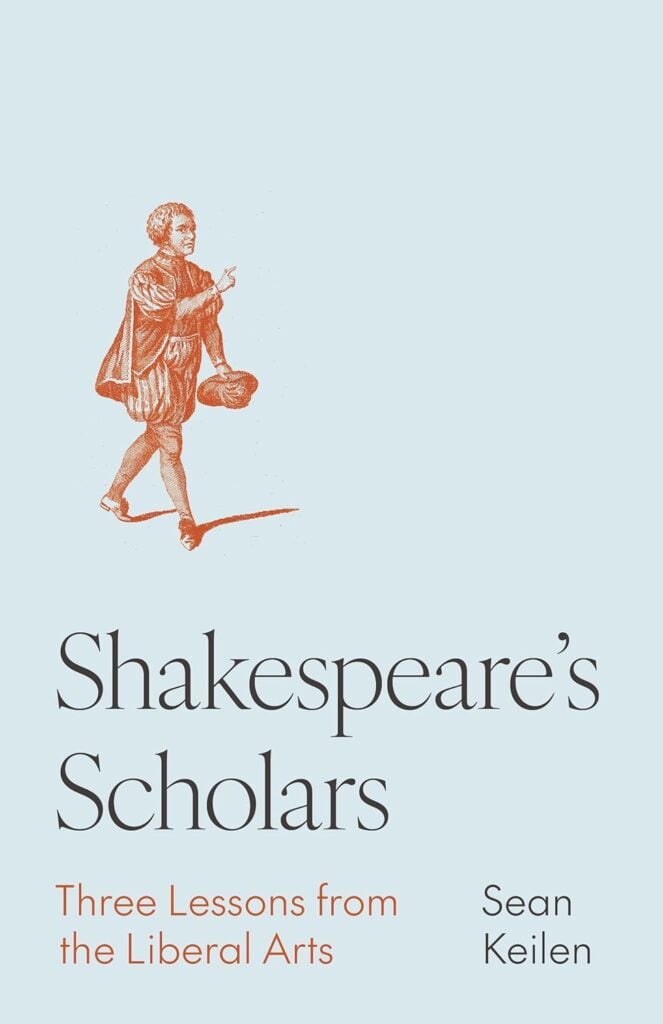
Shakespeareʼs Scholars:
Three Lessons from the Liberal Arts
by sean keilen
princeton university, 184 pages, $24.95
Why do the humanities face such a hostile climate? In part it’s because academics have excluded ordinary, intelligent readers from their work. Professors in the contemporary academy tend to write esoterically, technically, and primarily for professional advancement. Their audience is a tiny group of highly trained peers.
But Sean Keilen, a professor of literature at the University of California, Santa Cruz, thinks that literature is too important to remain cloistered in university departments. “I would like to do for the study of Shakespeare’s plays,” he writes, “what Joseph Addison proposed to do for ‘philosophy’ (that is to say, learning) in the pages of The Spectator, namely to bring it ‘out of the Closets and Libraries, Schools and Colleges,’ to people who cherish Shakespeare’s works in other places.” A bold aspiration, but not at all impossible if we pursue it.
This volume is at once a serious critical work about Shakespeare and a reflection on what it means to be a scholar. Keilen interweaves these two threads, like voices in a musical fugue, to produce an essai that is accessible to scholars and laypeople alike. He wears his learning lightly, and his tone is companionable and erudite at once. But the twenty pages of notes at the end of the book—which offer a tour through the history of liberal education and Shakespeare studies—show that this isn’t the work of a moment. It is the product of Keilen’s decades of reading, diverse kinds of teaching, and immersion in the world of Shakespearean theater in Santa Cruz.
Keilen focuses on three plays featuring characters who are scholars. He traces their development over the course of the plays, chronicling their various outcomes: in Love’s Labor’s Lost, a recognition that love is more important than fame; tragedy and death in Hamlet; and Prospero’s reconciliation with the world in The Tempest. Certain themes and questions recur. What temptations and pathologies accompany the scholarly life? How should scholars—and everyone else—think about passion, disinterested inquiry, and self-knowledge? And are friends and acquaintances distractions, or might they help us to live good and fulfilling lives?
Keilen himself was initially drawn to the intellectual life by a hope that literature and philosophy could offer insight into the human condition and lessons in how to live well. But as the journey went on, he grew less sanguine about its prospects. In graduate school he learned, as all graduate students do, that prestige is of great importance and that an academic career can easily turn into “a competition for status and position in an academic hierarchy.”
This desire for prominence and reputation is one way that academics—in Shakespeare’s time and ours—abandon their love of learning as an intrinsic good. In Love’s Labor’s Lost, a young King Ferdinand corrals three courtiers into a scheme of study and asceticism in an epic attempt to grasp at permanence. He offers the following exhortation:
Let fame, that all hunt after in their lives,
Live register’d upon our brazen tombs
And then grace us in the disgrace of death,
When, spite of cormorant devouring Time,
The endeavor of this present breath may buy
That honor which shall bate his scythe’s keen edge
And make us heirs of all eternity.
It’s the age-old attempt to escape mortality.
In our day, the pursuit of academic fame—negligible as that certainly is—pushes scholars to become more cynical, less open and pliable, less ready to read and converse with any willing teacher or friend. Colleagues are competitors and rivals in a race for prestige and honor.
Or, lacking a sense of the intrinsic worth of our work, we turn to social justice and activism. To quote the infamous classicist Dan-el Padilla Peralta, university professors should “face up to the incandescent urgency of the moment; to ask and then act on the question, ‘What then must we do?’” This approach aims at concrete, worldly outcomes: “I did that, see?”
Still other scholars find their identities in proudly distinguishing and separating themselves from others. They are “knowers” of arcane and esoteric ideas and languages—things that nonacademics don’t understand and (certainly) don’t value. “Our isolation in academic specialisms,” Keilen observes, “can beget the idea that we are special, along with a specious conviction that our gifts make us superior to other people—wittier, more discerning, more deserving, better.” More professional, more elitist—and often more discontented. Where are the insight and fulfillment the scholarly life promised? They have disappeared, perhaps not to be found again.
Nowhere are scholarly self-isolation and discontent more poignantly conveyed than in the character of Hamlet. Part of the brilliance of the play is that it initially draws a reader into naive sympathy with its main character. Upon a first reading, who hasn’t thought that Hamlet’s interpretation of events is beyond question? Obviously what the ghost tells him is true: His usurping uncle has killed his father and seized the throne. Hamlet must seek revenge and set the kingdom right, instanter.
Keilen shows his reader, however, that Hamlet is the very last person who ought to be trusted at this juncture. His passion has blinded him to commonplace wisdom and to the aid that could come from friends and family, not to mention from the wise sayings that he himself has copied down in his personal commonplace book. Keilen reminds us that there was an indissoluble unity in Shakespeare’s time between “the custom of writing in commonplace books and the comprehension of life itself.” Such a book is like a personal diary, but with heavy reliance on the received wisdom of the past. The assumption here is that each person need not remake the world afresh but would benefit from collecting the wisdom of the ages—in our own book, in our own hand.
Hamlet flatly rejects this idea. “I’ll wipe away all trivial fond records,” he declares to the ghost of his father,
All saws of books, all forms, all pressures past
That youth and observation copied there,
And thy commandment all alone shall live
Within the book and volume of my brain,
Unmixed with baser matter.
In this famous wiping clean of his mind, he renounces a lifetime of hard-earned knowledge for the moral certainty that has come to him in an instant. “By the time that Hamlet forsakes his commonplace book for the Ghost’s command,” writes Keilen, “he has already chosen passion over wisdom, in that he cannot or will not discern how the Ghost’s revelation replicates suspicions originating in his own bereavement, anger, and confusion.” He has thrown away “the fruits of his own past studies” in a fit of violent emotion.
Passionate renunciation isn’t a problem just for characters in fiction. In ordinary life, too, we’re often tempted to think that deep or intense feelings serve as indicators of what we should do. The more certain our convictions, the more justified we feel in a course of action. As cultural commentators have noted, the contemporary age is one of feeling, not reason or faith, and emotions come easily. Circumspection and restraint can seem inauthentic, detached, not vital enough, too cerebral. People who get things done, it’s said, are activists, not contemplatives.
That is how Hamlet understands his situation. Yet most adults will recognize that moderation and disinterested inquiry are invaluable in decision-making, and crucial for living a godly, righteous, and sober life. As Montaigne observes in his essay “On Solitude,” quoting Lucretius, “unless the mind is purified, what internal combats and dangers must we incur in spite of all our efforts! How many bitter anxieties, how many terrors, follow upon unregulated passion!” Other characters in the play understand this sentiment even if Hamlet doesn’t.
Horatio, for instance, is an apt foil, even though Hamlet doesn’t listen to him or take his advice. Unlike Hamlet, Horatio “engages his wide reading to bring the present into critical perspective, yet defers judgment about [its] final meaning.” Whereas Hamlet is passionate, Horatio is dispassionate. In his suggestion that ancient Rome might be an analogue for Denmark, Horatio’s “broad historical perspective” and “postponement of judgment about what cannot yet be determined” provide evidence of his circumspection and prudence. Horatio expands “our range of ways to understand ambiguous events and their claims on us.”
Even old Polonius, often laughed at for his delivery of conventional sayings to his departing son, Laertes, has extensive moral and practical experience. Keilen makes the argument, counterintuitive to contemporary audiences, that Polonius’s sayings really are wise, not worthy of mockery. Prior to about the middle of the twentieth century, most critics appreciated that a son’s taking leave of his father was a momentous occasion, which Shakespeare would not have trivialized. Thus there is intrinsic value in his final words of admonition, which offer a vision of flourishing social life and friendship. “Those friends thou hast, and their adoption tried,” counsels Polonius, “Grapple them unto thy soul with hoops of steel.” Readers shouldn’t dismiss him as a buffoon, argues Keilen, but would do well to distinguish “between the folly of Polonius’s behavior and the wisdom of his sayings.”
For both Polonius and Horatio see what Hamlet does not: that people who “shelter the present and themselves from the scrutiny of the past do so at their own peril.” Hamlet’s predicament is thus not just his own private problem. It is also ours, if we are people who—tempted by intense feeling and urgency—cast off ancient wisdom to pursue our causes with abandon. This is one of the most important lessons of Shakespeare’s Scholars: that liberal education, if pursued rightly, can temper passion and bring integrity and balance to life.
Keilen’s treatment of The Tempest highlights similar themes of passion and its governance. Resisting the contemporary trend toward reading this play solely as a meditation on oppression and colonialism, Keilen considers the relationship of liberal education to self-knowledge. Prospero, the play’s protagonist and exiled duke of Milan, is a supremely unhappy scholar. He is without his kingdom and estranged from his brother, and he keeps his daughter, Miranda, and slave, Caliban, in states of ignorance.
Yet Prospero considers himself superior because of his learning. Like many contemporary literature professors, Keilen notes, Prospero has sequestered himself “from quotidian life” and takes “refuge in artificial worlds of strange ideas, difficult texts, and ways of using language that are alienating” to other people. Prospero admits this forthrightly when he tells his daughter that in Milan he had been
the prime duke, being so reputed
In dignity, and for the liberal arts
Without parallel; those being all my study,
The government I cast upon my brother
And to my state grew stranger, being transported
And rapt in secret studies.
His education, then, is not a deliverance from ignorance. It is the cause of his illusions about himself and his alienation from others—the very opposite of self-knowledge.
The question of self-knowledge is fraught with difficulty, as much in our time as it was in Shakespeare’s. Is it merely knowledge about human beings—about our general moral, biological, and psychological makeup—or is it deeply personal insight into our own unique personalities, with all our anxieties, obsessions, talents, and gifts? The latter is the knowledge Aristotle offers in the Nicomachean Ethics to young people, who must grasp not only abstract philosophical principles of good conduct but also precisely where they stand, between deficiency and excess, in every moral virtue.
Shakespeare’s understanding of self-knowledge, Keilen argues, exists squarely within the Western tradition, which runs from Plato and Aristotle through Cicero and Seneca, into the Renaissance humanism of Erasmus, Juan Luis Vives, Montaigne, and Sir Philip Sidney. It isn’t so much Wissenschaft—“the pursuit of knowledge through scholarship”—as Bildung, “the formation of character through the contemplation of wisdom in the company of friends.” Friends see us as we truly are; self-love and pride tend to blind us to our own faults.
The aim of self-knowledge, in this account, is to learn how to live well. John Henry Newman famously argued that liberal education doesn’t necessarily yield good moral character, and of course he’s right. Nevertheless, I think it can and frequently does. At the very least, it encourages us to cultivate certain “minimal” virtues like temperance, moderation, and equanimity. A habit of attention in reading, thinking, and conversing encourages reflection on various ways of living well and badly, of governing or not governing our passions—especially those of pride and anger, which we’re quick to embrace in self-righteousness when we’re hurt.
Montaigne observes that our “most great and glorious achievement is to live our life fittingly.” In Sidney’s words, self-knowledge has “the end of well-doing, and not of well-knowing only.” The purpose of reading is to learn a lesson, which may at times be “merely” academic but is often much more. As Keilen observes, when we read from a text with moral authority, the outcome may well be “a change of heart and a new life.” Erasmus agrees. In the biblical humanism he called “philosophia Christi,” he argued that “transformation is a more important matter than intellectual comprehension.” The shared vision of these authors underlies the transformation that takes place in The Tempest, as Prospero follows a moral arc from selfish obsession to awareness of himself and others, and ultimately to charity and care for those around him.
To read these three plays the way Sean Keilen does is to practice, by turns, the exercise of sympathy and judgment, censure and pity. If done well, this approach to the intellectual life offers escape from the narrow self-concern that leads us to seek satisfaction in honor and reputation, projects of social justice, or elite separation from others. At its core it is practice in being human, entering into the minds and hearts of complex characters who can teach us vital lessons about ourselves.
So many contemporary scholarly books are bloated, pretentious, so full of esotericism and jargon that it can seem almost a defect to write beautifully. But Shakespeare’s Scholars is a book of literary criticism written in the classic style. Sean Keilen offers insight to all lovers of Shakespeare, essentially reclaiming Shakespeare for the “common reader.” The book, which contains evocative illustrations from artist Miriam Hitchcock, is a deftly cut gem of a work. It is a much-needed reminder of the way liberal education can still leaven our culture, leaving it a bit less barbaric and a little more beautiful.
Dear Reader,
Can I be direct with you?
War abroad. Socialists on the rise. AI upending human life. Endless uproar online. The modern attention economy doesn’t want readers — it wants users enslaved to the tyranny of the present.
First Things is the antidote: literary excellence, timeless truths, and a fixed point of reference in a culture that has lost its bearings.
But we can’t do it without readers like you.
Our goal: Raise $150,000 by November 1 to sustain First Things in the year ahead.
Your gift anchors readers in the permanent things.
Make your Fall Campaign gift now using the button below.
If you have any questions or would like more information, please contact Giovanni Del Piero, Director of the Editor’s Circle, at gdelpiero@firstthings.com or 212-627-1985.

YOU MIGHT ALSO LIKE
Foucault’s Idol of Nothingness
Today marks the 100th anniversary of the birth of Michel Foucault. He was influential in his lifetime,…
A Culture of Parricide
I learned a new word the other day: déploration. It’s the French, directly from the Latin, for “lament.”…
The Chariot Burials
Wheeling through the clotted earth, / Bronze, bone, and leather clumped in clay...
