
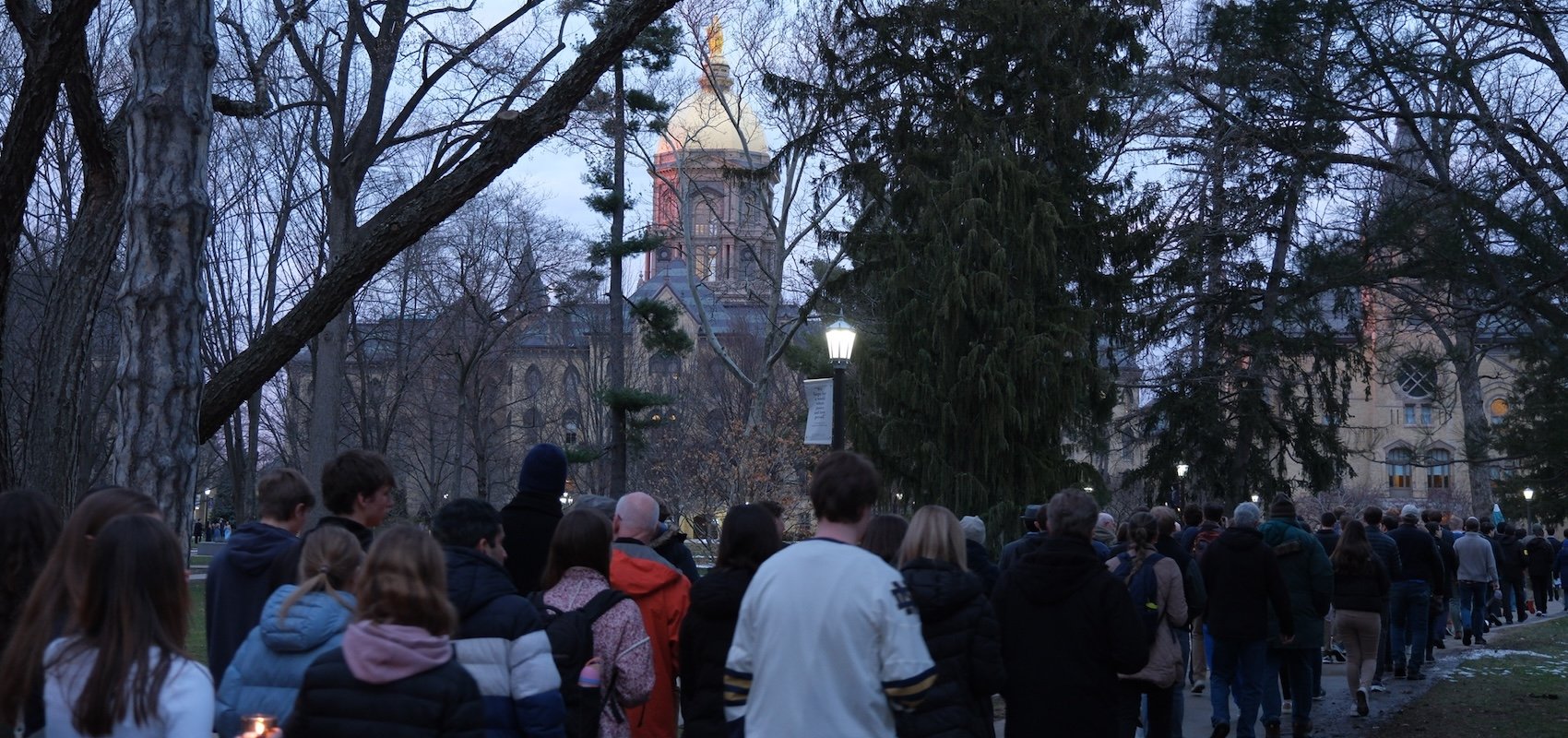
As I walked out of class Thursday morning, the day before the planned student-led “March on the Dome,” I received a text from one of my friends. It was a tweet from The Observer, one of Notre Dame’s campus newspapers, announcing that Susan Ostermann had declined her appointment as director of the Liu Institute. After weeks of outrage, the scandal had reached its conclusion. In light of this, students changed their plans from protest to prayer.
Ostermann, an associate professor at Notre Dame’s Keough School of Global Affairs, was appointed to lead the Liu Institute for Asia and Asian Studies on January 8 by Dean Mary Gallagher. Her history of fierce abortion-rights advocacy—which includes confusing claims like abortion being consistent with the Catholic social teaching of “integral human development” and pro-life movements being rooted in white supremacy—caused weeks of uproar from students, faculty, and clergy nationwide. The controversy only ended with her withdrawal from the position on February 26.
By February 6, two professors had cut ties with the institute. Five days later, Bishop Kevin C. Rhoades of the diocese of Fort Wayne-South Bend called for the university to rescind its appointment. He cited her outspoken abortion advocacy, misrepresentations of Catholic social teaching, and her work with the Population Council—a group that promotes abortion globally—as disqualifying for leadership. Bishop Rhoades’ statement was quickly echoed by numerous bishops, archbishops, and cardinals.
Despite nationwide pushback, however, Notre Dame continued to back the appointment publicly. The university issued a statement to EWTN News, saying that Ostermann was “well prepared” to “advance our dedication to serving as the preeminent global Catholic research institution.”
This claim would be absolutely true, had the word “Catholic” not been there. She is an esteemed professor, by many accounts. This scandal is not her fault. Rather, this was a case of poor administrative judgment with no remedy in sight.
So students began to take action. Gabriel Ortner, a junior, is one of the students who led the charge. According to Ortner, he was inspired by Bishop Rhoades’ letter to Notre Dame calling on students to light candles at the university’s Grotto of Our Lady. Ortner reached out to sophomore Luke Woodyard, and the planning of a prayerful protest, the “March on the Dome,” commenced. It was set to include speeches urging the administration to defend the university’s Catholic identity. A handful of student clubs joined as co-sponsors, with Notre Dame’s Right to Life club serving as the primary host.
Then, one day before the March on the Dome, Ostermann declined her own appointment, explaining that the controversy surrounding her appointment “risks overshadowing the vital work the Institute performs.” Further, she claimed that the “full realization of human dignity” demands that Notre Dame becomes a place where “a variety of voices can flourish.” Ironic, no?
Her decision left students scrambling to reorganize the protest to reflect the sudden change. After much discussion, students decided that they wanted the last word: “Amen.” The protest became a prayer vigil where around 150 students, faculty, priests, nuns, and community members came together to celebrate and give thanks.
Woodyard began the vigil by thanking the crowd and all who helped in the planning, noting the shift in the event’s focus toward a positive vision for the university. Ortner then spoke briefly, giving praise to God, and invited Fr. Bill Miscamble, C.S.C., to pray for the university: “May she never waver in defending the dignity of every human life, nor grow timid in witnessing to the splendor of [God’s] truth. . . . Guard this university; strengthen her to be a light upon a hill.” Asking everyone to extend their candles, Fr. Miscamble concluded, “Bless these candles, that their light may be a reminder of Notre Dame’s mission to be a place where Christ is honored, where the gospel is proclaimed boldly, and where future generations are formed in wisdom and in holiness.”
The whole way to the grotto, the crowd sang hymns as their candles flickered. The vigil ended by praying the rosary, led by students.
There has been much said lately about the fidelity—or lack thereof—of Notre Dame to its Catholic mission. With the appointment of Susan Ostermann, one can see why. The school’s institutional identity seems to be a perennial concern, which can be exacerbated by the university’s attempts to avoid necessary conflict.
Yet, we make a mistake if we assume that the administration is the heart of a university. Rather, it is the students. Surely, the administration affects the students. But the students affect the administration, too. That much is clear from Ostermann’s withdrawal. The pressure exerted by students means something. They were able to create an event to garner media coverage. Crowds marching on the Golden Dome would be a bad—and memorable—look. Students knew that, and used it.
Notre Dame’s greatest forgotten strength is her student body. The university is a hub for many faithful Catholic, as well as Protestant, students. It has the largest undergraduate pro-life club in the nation; OCIA numbers are booming; and institutions like the de Nicola Center for Ethics and Culture, along with the McGrath Institute for Church Life, thrive. The students play no small part in this.
And for those students who want to seriously engage with Catholicism and its intellectual tradition at Notre Dame, opportunities are plentiful. Even though they must at times be sought out, such opportunities are a sign of good bones. The institutions, faculty members, fellowships, classes, and clubs are all proof of that. Many students are hungry for deeper engagement with the faith. In this hunger, it is the student body that animates and invigorates this great university. We are its trustees for these few years; we help hold it to its mission. We give life to this university, and we are called to renew it. Renew it we will.
Image by Abby Strelow.

YOU MIGHT ALSO LIKE
Turned Away on Palm Sunday
In politics, diplomacy, war, or pretty much any field of human interaction, one must contend not only…
A Medieval Pilgrimage in Modern Assisi
When you go to the hilltop town of Assisi, you’re immediately struck by how medieval it is:…
Via Crucis, 2026
The Way of the Cross—and the third, seventh, and ninth stations in particular—has been an especially appropriate…
