

Against the Machine:
On the Unmaking of Humanity
by paul kingsnorth
penguin, 368 pages, $32
When I was a first-year doctoral student in England, a venerable Cambridge don whom I will not name called me into his office to offer his opinion on a dissertation topic I had previously mentioned to him, a grand “crisis of modernity” thesis. I had assumed he would love it, since virtually everyone in my cohort had gone to Cambridge to write the next Theology and Social Theory (John Milbank’s frontal assault on secular modernity). Suffice it to say, he was not impressed. “Americans,” he said—to the best of my recollection—“are like electricians. They like to twist the ends of wires together until they’ve created a whole web of connections. But in England, at Cambridge, scholars are like dentists. They drill down deep to the roots.” He advised me to forget about taking on the world. “Find one dead bloke,” he said. “Look into his head and start drilling.”
Now a dentist is fine, I thought, if you have a toothache. But if you’re living in darkness and you want to see, an electrician is exactly what you need. So, though the lesson must have made an impression on me—I remember it all these years later—I did what any young American with more bravado than brains would do. I got another director (and eventually another school) and set out to try to write an “electric” dissertation, though to this day I cannot say whether I ever really found the spark.
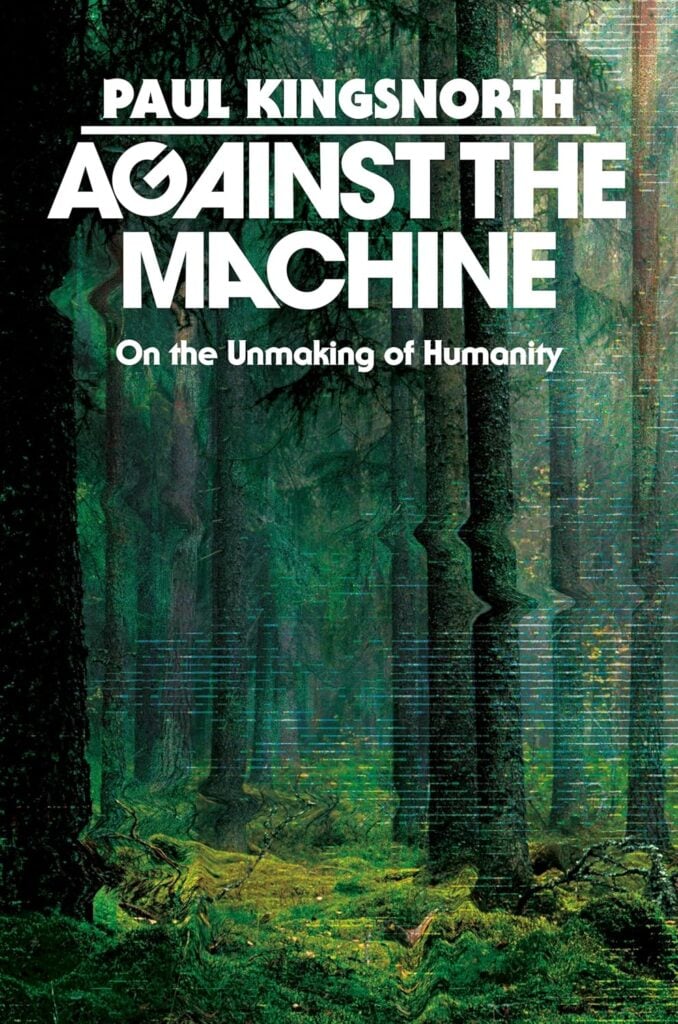
Paul Kingsnorth has found it. He has written an electric book, though I am aware of the irony of using such imagery to characterize an author so determined to defend nature from ravagement by a totalitarian regime of artificiality. His concern is nature in the older “humane” sense, which gave us a world, a home, and a hearth and human artifice produced in a human way and to a human scale—not the debased reductive nature of mere biology or the “environment” untouched by human hands that ultimately imagines human beings as parasites.
Kingsnorth might not have made much of a dentist, but he is an Englishman, a poet, a novelist, an essayist, a former environmental activist, and seemingly something of a “savage”—in the Huxleyan sense—encamped on the west coast of Ireland. But he is above all a seer, and he has drawn on a dizzying array of thinkers—philosophers, poets, historians, and tech bros—to wire together technocratic social and political order, global capitalism, and the industrial, sexual, and digital revolutions. He casts light on the half-visible circuitry of a “Machine”: his term for the perpetual and automatic revolution which, like other historical revolutions, is engineered by elites in the name of “the people” they disdain and continually police.
Kingsnorth takes the image of the Machine from the poet R. S. Thomas as a summary description of modernity’s defining pathology. He could just as easily have taken it from Hobbes, as a prospective expression of the modern ambition to replace both man and God with artificial facsimiles—an ambition now realized on a technological rather than political plane. The Machine is a rich, multi-faceted image. It refers to the mentality of almost everyone living under the brave new world of technological modernity—the neural circuitry, so to speak, of a technocratic age. It refers to the historical process, now centuries old, by which techno-capitalism systematically uproots and destroys all natural human attachments, in what Kingsnorth calls “The Great Unsettling.” This unsettling replaces the “Four P’s” essential to our humanity (“people, place, prayer and the past”) with the “Four S’s” (“sex, science, the self and the screen”). The image of the Machine refers to the material reality of the “Grid”—“a physical manifestation of the values of the Machine, appearing as a pattern across the global landscape”—which is replacing the nation with a “digitally enabled globoculture.” And it refers to the “global digital infrastructure” built on the grid, which “looks unnervingly like the ‘body’ of some manifesting intelligence that we neither understand nor control.” In brief, the Machine refers to the “Total System” under which we have come to live, whose totality and necessity increase with every swipe and click and whose exigencies determine the conditions for our thought and action, leaving the best of us existentially and intellectually incoherent and the worst of us alienated and sociopathic.
As one might already have gathered, Kingsnorth finds the modern political landscape full of irony and superficial self-contradiction. He has little patience for “conservatives” who defend a system of “oligarchic capitalism” that “strips the world of all the things which they claim to hold dear.” Yet he is perhaps even more critical of progressives, especially those “ecomodernists” or “Machine Greens” who, having sold their souls to technocracy, fetishize “climate change” at the price of “mass extinction, soil erosion, the collapse of human cultures, ocean pollution,” and other byproducts of industrial society. Climate change is compelling to Machine Greens because it is “a problem amenable to numerical questions and technocratic answers which go with the grain of Machine culture.” (He could have included in this number those left-Catholics who hailed the arrival of Laudato Si’ while demurring over the Church’s anthropological and sexual teaching, as if a fully human and humane existence were not the object of both.)
In an age when transnational capital “parrot[s] slogans from a leftist framework,” the left is dominated by the middle classes, and the cultural elite seek technocratic means to police populist movements, it is clear that that the technocratic left and global capitalism amount to the same thing: “engines for destroying customary ways of living and replacing them with the new world of the Machine.” Had Kingsnorth written his book a few months later than he did, he might have seen more clearly that the Machine’s war on reality and its destruction of “customary ways of living” is transforming America into a nation of sociopaths—angry, murderous spirits “liberated” from their bodies and from human attachments and affections.
The great strength of Against the Machine is also its weakness. At times the dentist in me wanted to say, “Hang on a minute, Paul. Maybe you should slow down and drill a little deeper.” Can you really leap from Augustine and Aquinas to the “disenchanting” and “dehumanizing” world of Descartes and Francis Bacon in the space of a single sentence? There are some differences to observe and distinctions to be drawn. How can you say, “Forget, then, about ‘defending the West’” and “We need a counter-revolution: a restoration” in the same paragraph? Some kind of middle term is missing. How can you call for a renewal of wisdom while saying “Reason, in and of itself, has always been little more than a fiction”? Speeding past neuroscientist Antonio Damasio’s Descartes’ Error in support of this conclusion, while ignoring the historical novelty of Cartesian rationalism and the older conceptions of reason that integrated soul and body, intellect and will, makes it appear as if modern rationalism were the high point of reason. In fact, that rationalism is the expression of a critical project that sought to maximize reason’s power by minimizing its scope, and authorized science, philosophy, and humanistic thought to go their separate ways.
Likewise, one might conclude from Kingsnorth’s hasty invocation of Iain McGilchrist’s subtle “hemisphere thesis” that irreducibly philosophical and historical questions can be resolved by neuroscience and that the Machine can therefore be comprehended by machine intelligence. Science, in such an interpretation, would once again be the final authority over the truth about nature, contradicting McGilchrist’s thesis—and Kingsnorth’s own insistence that there are whole dimensions of reality that a rationalist, materialist culture will not allow itself to see.
These “short-circuits,” though only episodic, make Kingsnorth’s proposals for resisting the Machine less compelling than they might otherwise be, and less complete than they need to be if the Machine and its reign of quantity are genuinely to be resisted. Kingsnorth understands that a culture is “above all a spiritual creation.” He therefore understands that a pervasive and omnivorous anti-culture is above all a spiritual crisis. He repeats Voegelin’s forceful assertion that “no one is obliged to take part in the spiritual crisis of a society”; one is obliged instead “to avoid the folly and live his life in order.” If the spiritual crisis of our age is an increasingly spiritless world, then the “order” one must seek is an order that treasures and cultivates the things of the spirit: memory; the ability to hold past, present, and future in a unity and thus to have and inhabit a history; and gratitude, the profound recognition that we do not cause our own existence and that a history is therefore not an obstacle to be surpassed but a gift and an unrepayable debt. All of these things are ingredients in the act of love and in the supreme act of love that is prayer.
Kingsnorth recognizes that no proposal to rehumanize ourselves can be fully satisfying in a Machine culture that is already a regime beyond our control—and, I would add still more emphatically than he does, beyond the reach of politics. Political order is permanently reactive to the machinations of technological order, whose deeds are scarcely imaginable, often to those responsible for producing them, until they are accomplished fact. (Kingsnorth’s own reflections on AI amply illustrate this.) Law cannot legislate what it cannot anticipate. Of course, it must be said that if the Christian vision were ever true and actual, it must also be possible, even if the times compel us to experience the presence of the real in the guise of its apparent absence. Kingsnorth could actually do with a little more nostalgia, which longs not for an impossible return to the past but for that glimpse of eternity shared by previous ages. He voices a widespread frustration when he says:
The reality is that most of us are stuck. . . . I can’t feed my family without writing, I can’t write without using the laptop I am tapping away on now, and I can’t get the words to an audience without the digital platform upon which I first published this series of widely read essays critiquing the Machine. I know that many people would love to leave all of this behind, because I often receive letters from them—letters mostly sent via email. But the world is driving them—us—daily deeper into the maw of the technium.
“There is no getting away from any of this,” he says. All one can really hope to do is “give [the machine] the slip” and loosen its grip by creating “shatter zones” in our homes and in our souls, and perhaps in a “Savage Reservation” benignly neglected by the Machine as the forward march of progress renders the savages themselves obsolete. He counsels what he calls “cooked” and “raw” askesis, and through myth, work, story, ritual, and a redoubled commitment to the four P’s, he aspires to “older ways of seeing” in a new historical key.
We Western people: we have to learn to inhabit again. We have to learn how to live sanely in our lands. How to write poems and walk in the woods and love our neighbors. How to have the time to even notice them. How to take an interest in the parts without detaching them from the whole. How to remember that the Earth is alive and always was, and that no ‘culture’ which forgets that can last, or deserves to.
Beyond ‘the West’ there might just be another way of seeing. An older way. Beyond the West, we might find Europe. We might find Albion. We might find Cockayne, or Doggerland. We might find the mind that painted the cave walls. We might find hunters and clear rivers and countries and saints and spirits and painted churches. We might find shrines and pilgrim routes and folk music and fear of the sea. We might find ourselves again.
I concur in all of this. But mythos and logos need each other. And those who would resist the Machine need to be able to contest the truth of the Machine account of the world, even if the Machine is uninterested in truth or measures truth only by success. The rediscovery of “older ways of seeing” also surely entails the rediscovery and renewal of older ways of thinking, and indeed of an older conception of intelligence, that have become largely unintelligible to us. “The name intellect,” Aquinas says in his De Veritate, “arises from the intellect’s ability to know the most profound elements of a thing; for to understand (intelligere) means to read what is inside a thing (intus legere). Sense and imagination know only external accidents, but the intellect alone penetrates to the interior and to the essence of a thing.” But where quantity reigns, where there is neither interior essence nor depth of existence, there is nothing to penetrate or read. Intellect, in the traditional sense, ceases to be intelligible or necessary when what is technically possible is the measure of what is true. The world cannot be spared from the “reign of quantity” unless reason is rescued from pragmatic and technical reductions and those “dimensions of reality” we are prohibited from seeing are rediscovered and restored.
This note of caution applies not just to Kingsnorth but to all who seek a re-enchantment of the world, or rather deliverance from the demonic “enchantments of mammon,” technology, and the Antichrist. True reason and mysticism—intellectual communion with that which is infinite, immutable, and eternal—are not opposites. In traditional philosophy and in the beatific vision, the perfect coincidence of reason and love and the paradigm of reason as such are one and the same. To the degree that we concede reason to rationalism, or hint that we should dismiss it altogether, we reveal that we do not yet understand what it is that we are seeking.
This misstep, however, takes nothing away from Kingsnorth’s vision, which has the great virtue of being true, both in its broad strokes and in the particulars. Neither does it diminish that vision’s scope. Which is to say that the weakness of Against the Machine is also its great strength. The depth of Kingsnorth’s vision is a function of its breadth, which is breathtakingly vast and which one really cannot summarize without omitting something essential or defiling its beauty. Against the Machine is like a poem in this respect; its meaning cannot be separated from its execution. Somehow Kingsnorth manages to wire together the Luddites, the Fen Tigers of East Anglia, the Black Ships of Commodore Perry (which compelled the Japanese to enter the modern world), the internet of things, and the writings of Oswald Spengler, Jacques Ellul, Lewis Mumford, René Guénon, Patrick Deneen, Eugene McCarraher, Augusto Del Noce, Ivan Illich, Carl Trueman, Rudolf Steiner, Klaus Schwab, Ray Kurzweil, Kevin Kelly, and innumerable others into a vast circuitry that casts light on the thing that is happening to us. In a world that often feels like it’s falling apart, Kingsnorth paints an ominous but compelling and finally hopeful picture of how it all hangs together.
What is still more amazing, given his dexterity with such a vast range of thinkers and events, is how clear this picture is—indeed not just clear, but generally wise, often beautiful, and always deeply human. One need not be an academic or any kind of specialist to grasp Kingsnorth’s vision, just a reasonably intelligent human being still in possession of his soul. It is difficult to imagine any such person reading Against the Machine and not being deeply moved by it.
As I proceeded through the book, and as Kingsnorth unfolded his thesis, wiring more and more unexpected circuits together, the “dental” reservations that came to me in the early chapters gave way, as ever, to the electricity. Almost the highest compliment that I can pay this book is that I approached it with wariness and put it down wishing I had written it—though of course I couldn’t have, since it is very much the “spiritual creation” of the singular man who wrote it. (Nor could I have called the final chapter “The Raindance.”) Yet higher still is my hope for the people I care most about—family, friends, and even intellectual adversaries and ideologists fumbling about in the dark, trying to find their way—that they too will read this beautiful, extraordinary book and see the light.

YOU MIGHT ALSO LIKE
Introducing The Jew From Nowhere
Longtime readers of First Things will probably be able to guess the third in this sequence: Catholic,…
Beware the “Orthobro”
On a late September morning, I approached the registration table outside the entrance to a small Greek…
John Allen, Nonpareil Vaticanista
Early Sunday morning, July 28, 2002, things were looking grim for the closing papal Mass of World…
