
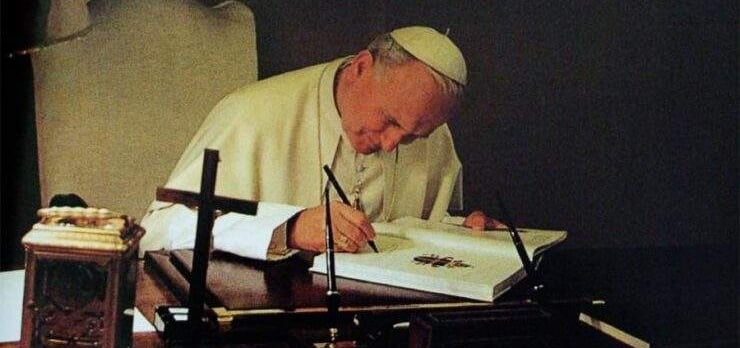
Forty-seven years ago, Pope John Paul II issued his first encyclical, Redemptor Hominis (The Redeemer of Man). The first letter in the centuries-old encyclical tradition devoted to the Christian idea of the human person, Redemptor Hominis was also what James Cardinal Hickey once called the “program notes” for John Paul’s entire pontificate: a preview of the great themes he would stress over the next twenty-six years, especially the inalienable dignity and infinite value of every human life. By linking that theme to the redemption wrought by Jesus Christ, the Polish pope located himself firmly within Vatican II’s call to restore Christocentricity—Christ-centeredness—to the Church’s self-understanding and the Church’s proposal to the world.
Perhaps the most lyrical section of Redemptor Hominis best summarizes what John Paul II wanted the world to know, and what he wanted the Church to be:
Man cannot live without love. He remains a being that is incomprehensible for himself, his life is senseless, if love is not revealed to him, if he does not encounter love, if he does not experience it and make it his own, if he does not participate intimately in it. This . . . is why Christ the Redeemer “fully reveals man to himself.” . . .
The Church’s fundamental function in every age and particularly in ours is to direct man’s gaze, to point the awareness and experience of the whole of humanity towards the mystery of God, to help all men to be familiar with the profundity of the Redemption taking place in Christ Jesus.
Karol Wojtyła, distinguished philosophy professor and experienced pastor before he became pope, knew all about the modern quest for “authenticity” and the modern passion for self-discovery. He also knew that the quest for the self could end up in the prison of narcissism. That is why, in Redemptor Hominis, he taught that a truly authentic “journey of self-discovery ends not in oneself, but in Christ” (as Archbishop J. Michael Miller neatly put it).
To begin the encyclical with the bold, unambiguous affirmation that “The Redeemer of man, Jesus Christ, is the center of the universe and of history” was thus a clarion confession of Christian faith and a declaration of human liberation from the shackles of self-referentiality and solipsism. John Paul II knew in his bones that the multiple disasters of the twentieth century reflected disordered ideas of human nature, human origins, human community, and human destiny. And he was determined that the Church lift up Jesus Christ as the One who reveals the truth about God and about us—the truths about self-giving love, reflective of the divine love, that liberate in the deepest meaning of human freedom, which is freedom unto eternal life.
A January 10 notice on the website of the Diocese of Regensburg, Germany, confirms that the message of Redemptor Hominis remains as relevant today as it was almost a half-century ago:
Bishop Dr. Rudolf Voderholzer met with Pope Leo XIV in a private audience at the Vatican . . . the two discussed, among other things, the current challenges in theology, which are concentrated in the question of the image of humanity in light of Christian revelation. Just as Christology was in the 4th century, anthropology is now the arena where the fate of faith and the Church is decided.
In the fourth century, the great question on which the future of Christian mission and Christian service to the world depended was, “Who is Jesus Christ? The Incarnate Son of God, or some kind of lower-order, created demigod?” Today, in a global culture dominated by the notion that everything in the human condition is plastic, malleable, and changeable by acts of human will—the insistence that nothing is given—the question on which the future of Christian mission and service to the world depends is, “Who are we?” Are we simply congealed stardust, the happy but accidental byproduct of billions of years of random cosmic biochemical forces? Do our desires—whatever they may be—define who we are? Is the satisfaction of those desires the full meaning of happiness? Or are we something else, something more, something infinitely grander and nobler?
The answer given by Redemptor Hominis remains the true and life-giving response to those questions, and defines the mission of the Church in our time:
The Church wishes to serve this single end: that each person may be able to find Christ, in order that Christ may walk with each person the path of life, with the power of the truth about man and the world that is contained in the mystery of the Incarnation and the Redemption and with the power of the love that is radiated by that truth.
George Weigel’s column “The Catholic Difference” is syndicated by the Denver Catholic, the official publication of the Archdiocese of Denver.


YOU MIGHT ALSO LIKE
Turned Away on Palm Sunday
In politics, diplomacy, war, or pretty much any field of human interaction, one must contend not only…
Via Crucis, 2026
The Way of the Cross—and the third, seventh, and ninth stations in particular—has been an especially appropriate…
A Medieval Pilgrimage in Modern Assisi
When you go to the hilltop town of Assisi, you’re immediately struck by how medieval it is:…
