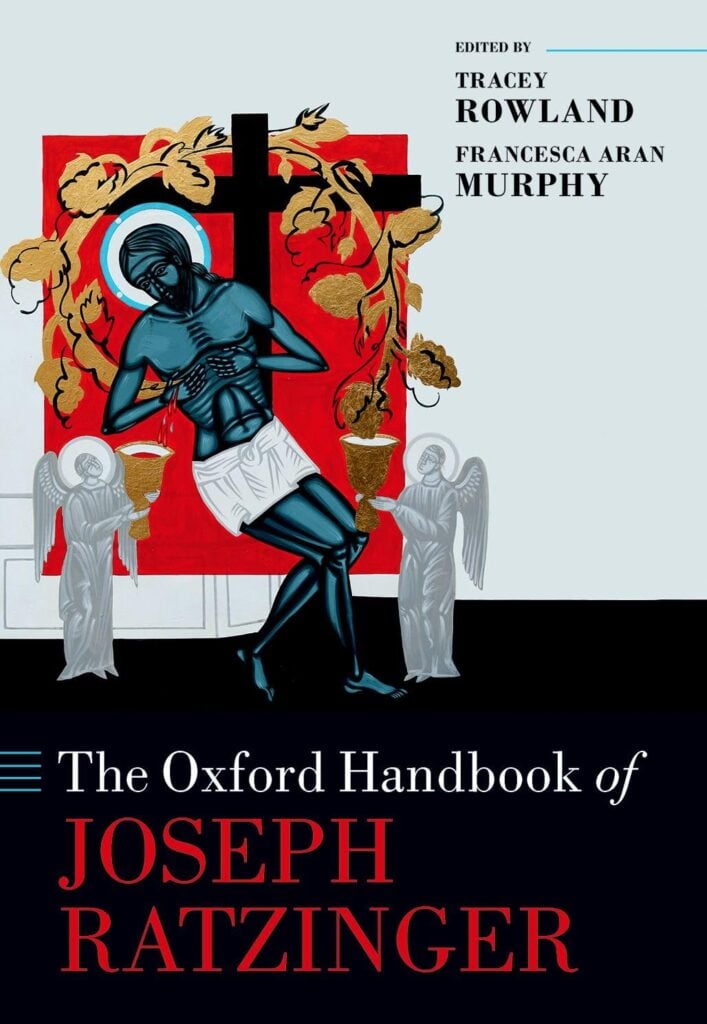
The Oxford Handbook of Joseph Ratzinger
edited by tracey rowland and francesca aran murphy
oxford university, 416 pages, $195
Joseph Ratzinger did not fade into obscurity when he retired to a life of prayer inside the Vatican walls in 2013. On the contrary, his work remains as influential as ever—as demonstrated by this new Oxford Handbook, which brings together leading scholars to provide a comprehensive view of his legacy. The book is also a milestone for Communio theology, of which Ratzinger (one of the founders of the original Communio journal) was arguably the greatest representative.
Communio is less a school than a sensibility. At the risk of oversimplification, one might say that its practitioners stand for thoroughgoing Christocentrism; Church-as-communion ecclesiology; concern about the dangers of extrinsicism and pure nature in the relationship between nature and grace; a desire to incorporate the positive insights of modern philosophy, literature, and art; and belief in the Church’s need for dramatic renewal in the modern era—which includes a basically positive assessment of Vatican II. The fact that this volume is edited by two other Communio scholars, Tracey Rowland and Francesca Aran Murphy, suggests that the future of Communio theology will be closely tied to the ongoing reception of Ratzinger.
Murphy provides a helpful primer on the life and times of this remarkable man. After his childhood in Bavaria and service in World War II, Ratzinger began studies for the priesthood and academic life that put him in touch with some of the great theological minds of the mid-twentieth century, including Wilhelm Maier, Gottlieb Söhngen, Romano Guardini, and Josef Pieper. Despite setbacks with his doctoral and habilitation theses, he advanced to academic posts in Freising and Bonn before serving as a peritus at Vatican II under Cardinal Frings of Cologne. There he helped organize opposition to the preparatory schema prepared by the Roman Curia, which he and his allies deemed too abstract, too defensive, and insufficiently informed by recent theological scholarship. Ratzinger took a special interest in the Council’s work on the topics of revelation, ecclesiology, and ecumenical and interreligious dialogue.
After the council, Ratzinger held additional professorships at Munich and Tübingen before settling at Regensburg. During this time, he helped found Communio and established a circle of brilliant and influential students. He was appointed archbishop of Munich in 1977 and then prefect of the Congregation for the Doctrine of the Faith (CDF) in 1981. In the latter role, he earned a reputation as a world-class scholar while taking a leading role in important initiatives such as the drafting of the Catechism of the Catholic Church, and in controversies over matters such as liberation theology. He was elected to the Chair of Peter in 2005 and took full advantage of the world’s greatest teaching position. Both the Church at large, and the Holy See in particular, were rocked by a series of crises during the latter years of his pontificate, which ended unexpectedly with his resignation in 2013. He would live on as “pope emeritus” until December 31, 2022.
The message that reverberates throughout this volume is “Catholic orthodoxy, yes; neoscholasticism, no.” Ratzinger was always drawn to Augustine and Bonaventure, to biblical studies, history, subjectivity, and the great challenges of modernity, rather than to the regnant neo-Thomism of his youth. He found neo-Thomism dry, constraining, and insufficiently grounded in Scripture and the Fathers. In his view, it was capable perhaps of safeguarding orthodoxy in a narrow sense, but generally unable to address the profound crisis of faith that afflicted even many Catholics by the mid-twentieth century. Ratzinger’s criticism of post-Tridentine theology—a frequent target of the Communio school—comes through strongly in this book, and his contributions to the understanding of divine revelation that was enshrined at Vatican II in Dei Verbum are explored at length.
Although an apologetic tone may be detected in some chapters, the truth is that Ratzinger and other Communio thinkers have indeed exercised a major influence outside of their own circles, most notably on the Thomistic revival of the past quarter-century. Many of today’s Thomists have absorbed certain Communio priorities and criticisms, and reconceived their theology accordingly. The result is “Ressourcement Thomism,” which portrays Aquinas as the great biblical theologian, one who transformed and integrated not only Aristotle but also the participatory metaphysics and mysticism of Pseudo-Dionysius. This Thomism is less a defensive response to the errors of post-Cartesian thought expressed in those same post-Cartesian categories than an exposition of the fullness of Christian life and doctrine in conceptually precise terms. In other words, it is something close to the vision of Ratzinger and other early Communio figures.
Ratzinger is no exception to the rule that great thinkers are complex and subject to diverse evaluations, even among their supporters. He is characterized by turns as “Mozartian” (Rowland), a “Dorothy Day Catholic” (Murphy), and, most unconvincingly, a “Kantian modernist” (Katherine Sonderegger). Was he Catholicism’s chief doctrinal watchdog, or the sensitive ecumenist who found words of praise for Martin Luther? Did he see the Enlightenment as part of the authentic European tradition and a boon for the Church, or did he hold it responsible for the crisis of faith and civilization that he consistently decried? Was he one of the main protagonists and defenders of Vatican II, or did he try to roll it back? If he supported the need for liturgical reform and the general direction the council took, why did he seem so disappointed in the outcome, or so supportive of the preconciliar rites? The volume moves beyond caricatures without trying to whitewash Ratzinger’s complexity. As Aaron Pidel puts it, he had a gift for holding many things in tension.
Ratzinger’s numerous critics, some of whom overlooked this complexity, receive due attention. The volume goes beyond the familiar critiques by secular thinkers and the Concilium school (the more progressive rival to Communio) to discuss criticisms advanced by traditionalists and biblical scholars. Gregory Yuri Glazov offers a reappraisal of Ratzinger’s theology of the Old and New Testaments from a Jewish perspective, and though no traditionalist or Concilium figures contribute chapters, their objections are noted. Ratzinger’s courage in the face of criticism and obstacles, despite his personal shyness, comes across quite clearly, though his reported sensitivity to negative media attention goes unmentioned.
Ratzinger’s critics often suggested an inconsistency in his thought, by portraying him as a young radical of the 1950s and 1960s who later joined the establishment. The usual rejoinder is that he remained the same while the world around him changed. Although there are a few instances in which Ratzinger clearly changed his mind (see, for example, Vincent L. Strand’s treatment of his theology of the priesthood), on balance the authors highlight the stability of his thought across the decades. The criticism of Ratzinger’s “establishment” turn overlooks how much the establishment itself changed during his lifetime. As Mary Frances McKenna observes, he spent the postconciliar period “reaping the whirlwind of success.” The removal of neoscholasticism, she says, meant that the faith could breathe again, yet the new air also contained convictions and assumptions that distorted the faith. By the time he became prefect of the CDF, his theological vision no longer represented an insurgency against the old guard, but rather a competitor with more progressive interpretations of Vatican II.
Perhaps the most challenging aspect of Ratzinger’s legacy is one that the authors mention but do not explore in detail: his resignation from the See of Peter. Not only did the most traditional of postconciliar popes do this most untraditional thing, but he did so in a way that raised all manner of questions and difficulties. George Weigel praises the pope’s faith and humility in making the decision, while criticizing its modalities: the title “pope emeritus,” the wearing of the white cassock, the living on Vatican grounds, and so forth. Even if this is a suitable way of parsing the issue, the modalities will no doubt be a continuing source of perplexity, especially in the event of future papal resignations. Try as one might to avoid the conclusion, the resignation forms an important, if discordant, part of Ratzinger’s theological legacy.
The Oxford Handbook goes a long way toward defending Ratzinger’s thought, and the Communio tradition he represented, as a vigorous option on the contemporary landscape. That is no minor accomplishment, but perhaps the more interesting (and more pressing) question is how various Catholic schools and styles should engage with one another going forward. Numerous obiter dicta indicate that Rowland and Murphy see the major challenge to Communio thought as coming not from Ressourcement Thomism (which is generally friendly to Communio) but from Catholic traditionalism.
Less a theological school than a mini-world within the contemporary Church, traditionalism often embraces a stricter, “Leonine” Thomism, which includes authors of whom Communio has been most critical, particularly Réginald Garrigou-Lagrange. It remains generally suspicious of Vatican II and the “new theology” behind it. Traditionalists are wont to view Communio thought as leaning toward modernism, at least on issues such as eschatology and the relationship between nature and grace. Communio writers, meanwhile, criticize putative traditionalist immobilism (the idea that everything after 1958 should be jettisoned). They also see the baroque and Leonine Thomists beloved of traditionalists as seriously flawed—and flawed in characteristically modern ways. Authors such as Thomas Cajetan and Francisco Suárez allegedly pulled apart Aquinas’s close integration of philosophy and theology, and conceived of Christian revelation as disclosing not so much God as pieces of information about God.
At the risk of being too sanguine, I would suggest that there is an opportunity for mutual enrichment between these theological trends. Ressourcement Thomism already has obvious affinities with the theological approach one finds in Ratzinger, so there is more need to find common cause between Communio and the traditionalists. The first thing to note is that they often share a number of priorities: a love of Christ and his Church, a sense of urgency regarding the widespread crisis of faith, an openness to postliberal conceptions of political and social order, a desire to overcome neoscholastic reductionism regarding liturgy and sacraments, a reassessment of hyper-papalism and excessively juridical approaches to ecclesiology, and an inclination to overcome fragmentation and false binaries by approaching divine and human things holistically. These features may be found in the work of traditionalist authors such as Peter Kwasniewski, Joseph Shaw, Sebastian Morello, and Robert Lazu Kmita, to name a few.
Moreover, the two groups may have their respective insights to share. Traditionalists often view Communio as modernism by another name, offering fruit from a poisoned tree. Hans Urs von Balthasar’s much-disputed teaching on Holy Saturday is a particular bête noire. Yet Rowland and Murphy’s work has shown that there is much more to Communio: a revival of the metaphysics of participation, a renewed reading of Scripture from within the horizon of faith, a more Christocentric moral theology, and contributions to hot-button issues such as feminism, to name a few. Surely there is room here for traditionalists to engage with Communio—however critically—as a legitimate and serious school of thought.
At the same time, Communio theologians sometimes treat the liturgical question as a secondary matter. Engagement with traditionalists might help them see the recovery of the ancient rites as a major priority for the Church’s reconciliation with her own past and for a coherent understanding of tradition. Here Ratzinger the Communio theologian can serve as a bridge, thanks to his leadership of liturgical renewal on numerous fronts: his book The Spirit of the Liturgy, the revision of the English translation of the Roman Missal, the founding of the Anglican Ordinariates, and, of course, his motu proprio Summorum Pontificum.
Undoubtedly the most difficult topic here is the Second Vatican Council. Both as an event and as a corpus of documents, it was fundamental to Ratzinger’s life and thought, and Communio authors largely share his positive assessment of it—in diametric opposition, of course, to the traditionalist consensus. Some commentators have proposed a way of bypassing the issue by claiming that the debates over the most recent council belong to the past and are no longer of concern to younger Catholics. The patterns and disputes of contemporary ecclesial life, however, are downriver of Vatican II and its implementation: how doctrine develops or changes (or both), the relationship between dialogue and mission, the ecclesiological issues of collegiality and now synodality, the vocation and role of the laity, and of course, the “liturgy wars.” I suggest that rather than being forgotten, the council and its interpretation are entering a new phase, one in which more sober and nuanced assessments become possible.
If one reads carefully the debates and ambiguities around Ratzinger and Vatican II that the Oxford Handbook explores, the council emerges as a mixed legacy. Beautiful, resonant passages in the conciliar documents coexist with observations whose historical moment has clearly passed; genuine advances in the articulation of doctrine stand alongside theological forays whose meaning remains contested. Documents passed by overwhelming consensus have been interpreted and implemented amid bitter division. Certain pastoral and rhetorical strategies have been confirmed, whereas others invite re-examination. On one hand, there seems to be at least some correlation between the implementation of Vatican II and the indices of decline that began in 1965; on the other hand, it is neither right nor just to lay all problems at the council’s doorstep. A sense of balance and proportion is needed.
Other issues require deeper thought and harder labors. The discursive literary style of the conciliar documents, and the decision to use John XXIII’s “medicine of mercy” in place of clear definitions and anathemas, have made it more difficult to put the teachings of Vatican II into propositional form. This is one reason for the protracted problems with the Society of St. Pius X and their implications for the larger Church. Above all, as this volume shows, there is a persistent dispute over continuity and discontinuity: To what extent is the teaching of Vatican II harmonious with previous teaching, and to what extent does it provide revisions or corrections, or introduce new teachings of its own?
There is little evidence that these issues will be resolved anytime soon, whether through ongoing theological dialogue or interventions by the Holy See. In itself, the contention is neither surprising nor catastrophic. Church history shows that the teaching of one council may raise issues that must be addressed by a later one, as happened with Ephesus and Chalcedon (with a latrocinium in between). Is it possible for both defenders and critics of Vatican II to agree that the outstanding issues will need to be taken up by a future ecumenical council? Given that one is not visible on the horizon, it may behoove Catholic theologians in the meantime both to attend to the projects of their respective schools and styles, and to find common ground with people who hold perspectives different from their own. In this regard, as in so many others, Ratzinger provides an example to follow.
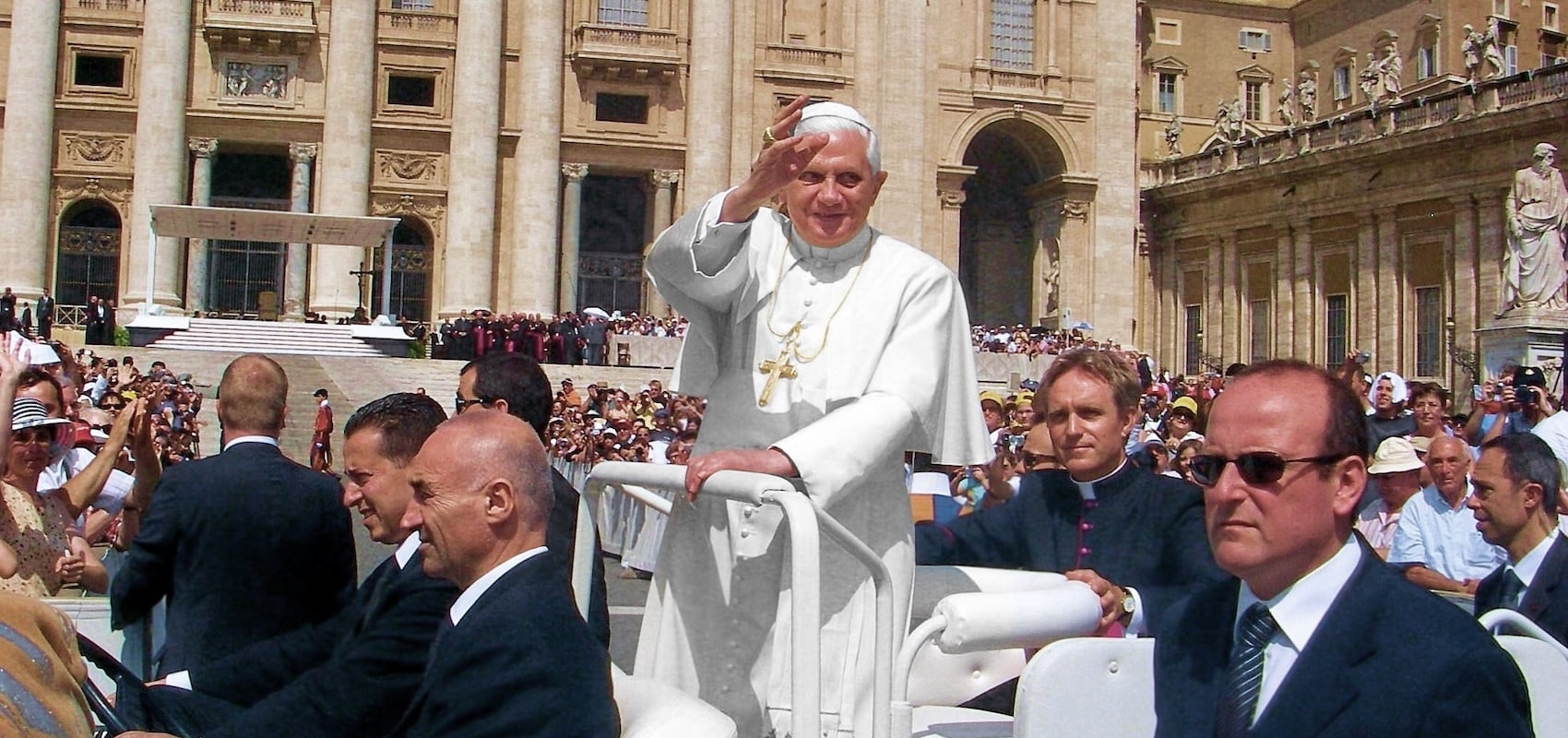
Image by Marek.69 (original) / Rundvald (retouches), licensed via Creative Commons. Image cropped.