
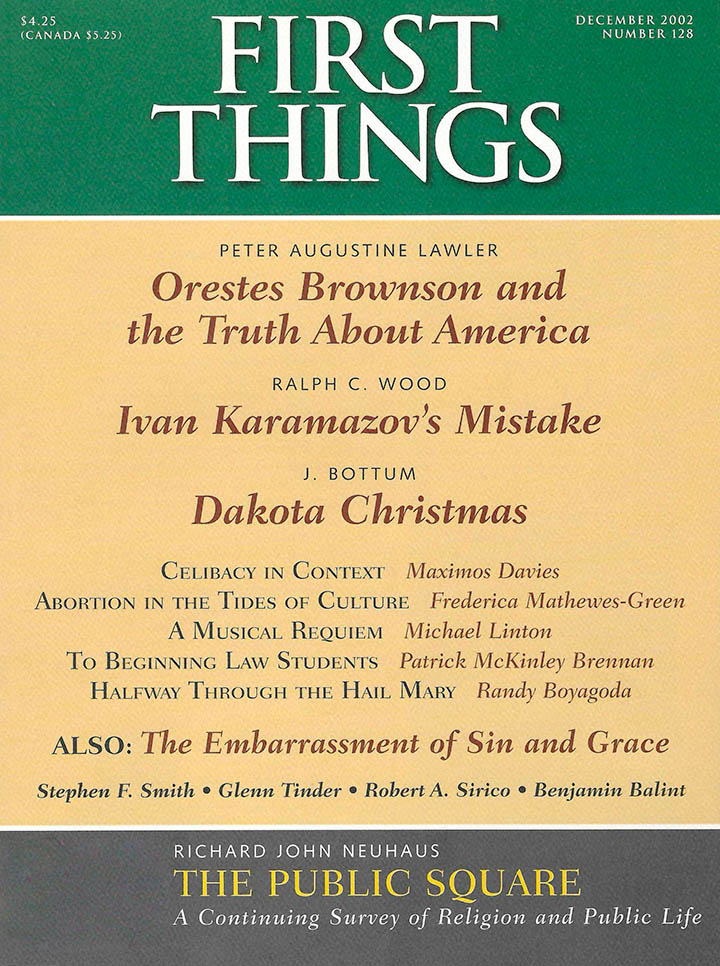
Our Jody Bottum—I say “our” because I’ve never quite accepted his defection to the Weekly Standard—gets into deep pondering, occasioned by the deep pondering of Francis Fukuyama’s Our Posthuman Future. He applauds the book’s warnings about the biotechnological threats confronting us, but suggests that these developments are only the logical next thing in the project of modernity and liberalism, the two being pretty much the same thing. Conservatives of different stripes, he says, are disillusioned with the liberalism/modernity train ride, and get off at different points. “Thus the economic libertarians wish to hold their position in the 1890s, the evangelicals in the 1920s, the Southern agrarians in the 1940s, and the National Review conservatives in the 1950s. For a century and a half after the French Revolution, Catholicism stood as the only major force opposed to modernity, and even after the great rush of Vatican II aggiornamento, Catholics essentially froze the modernity they were willing to accept at 1964. A variety of factors drew off the neoconservatives around 1972.”
The conservatives and neocons who rallied around Reagan tended to share a yearning for something like a religious renewal, but theirs was, for the most part, a pretty thin and instrumental view of religion. “And yet, lacking a coherent unmodern philosophy, we can offer no compelling reasons for modernity to stop where we wish it to. The economic and political battles against communism, by returning liberalism to its original course, certainly changed the direction of modernity. But they did nothing to slow modernity down. Over the last few decades, for example, political scientists, sociologists, and scholars of the American Founding have all pointed out that a smidgen of religious belief seems necessary to prevent modern liberalism from devouring its own political and economic gains. But this insight hasn’t brought us much, for a culture’s religious belief doesn’t derive from the desire that the culture have a religious belief. Meanwhile, since its Enlightenment beginning, modernity has conceived of religion as its great enemy, and the antireligious impulse of the modern world is still steaming on and on”unchecked by our recognition that it ought not to, that it ought to have stopped somewhere before this.”
I am pleased to count myself as one of the “liberal writers” of the time who hoped the train could be stopped at another point described by Bottum. He writes, “Or, for another example, consider the question of whether we could have had a liberalism that was against abortion. We did manage to find an anti-Communist liberalism, after all—however much the Communists insisted that the future was theirs and that they were merely liberals in a hurry. And, hard as it is to remember, there was a moment around 1969 when several liberal writers were insisting that care for the poor and the weak demanded the rejection of abortion. But the liberationist impulse was simply too strong, and the sexual revolution too much fun. And so abortion came, despite opposition from those who wanted a modernity without it. Having bought a ticket this far, what means—what right, for that matter—did they have to stop the [train] from going further?”
He appreciates Fukuyama’s respectful references to religious and philosophical arguments, including those offered by John Paul II, but: “Fukuyama, however, mistrusts thick accounts. He is too modern to think he can persuade us with the Pope’s religious claim, too current to imagine he can restore us to Aristotle’s philosophical view, and too scientific to rely on Aldous Huxley’s literary understanding. But without some such support present generally in the culture, the government regulations for which he calls are doomed. The political pressure from activist groups will be too great. The moral confusion of politicians will be too massive. And, most of all, the internal motor of science will be too powerful.” That’s a pretty grim outlook, and he may be right. What we need, Bottum says, is someone who can “gather up the premodern elements necessary to maintain the political advances of modernity—and to build them into a new and coherent philosophical vehicle” that will prevent the threatening biotechnological train wreck. I am very sympathetic to Bottum’s forebodings, especially about the dynamics propelling what presents itself as, and often is, scientific progress. At the same time, it seems highly improbable that we will be rescued by a “philosophical vehicle,” no matter how new or coherent. Unless philosophy is stretched to mean the Word that was in the beginning, and will see us through to the promised end. On days when I am tempted to resign myself to the inexorable triumph of the modernism/liberalism nexus that Bottum describes, I wonder if it might not take a catastrophic wreck, after which, with heroic labor, a chastened world repairs the damage and lays tracks in a different direction. On better days, I hold to the promise of the ever ancient, ever new, and only coherent truth that the human project cannot fail, not finally. And that because the Word became us, and by his victory we already participate in the life of the One who, by definition, cannot fail. Our circumstance is too hopeless for any lesser hope.
Sources: J. Bottum on Francis Fukuyama, Weekly Standard, April 29, 2002.

YOU MIGHT ALSO LIKE
Canada’s Offensive Secularism
On March 25, the Canadian House of Commons voted to repeal the good faith religious opinion defense…
A Win for Christian Counselors and Religious Liberty
In a resounding victory for religious liberty on Tuesday, the U.S. Supreme Court ruled 8–1 in Chiles…
What Drag Queens and Blackface Have in Common
My new book, The Desecration of Man, emerged from something I had noticed while researching questions of…
