
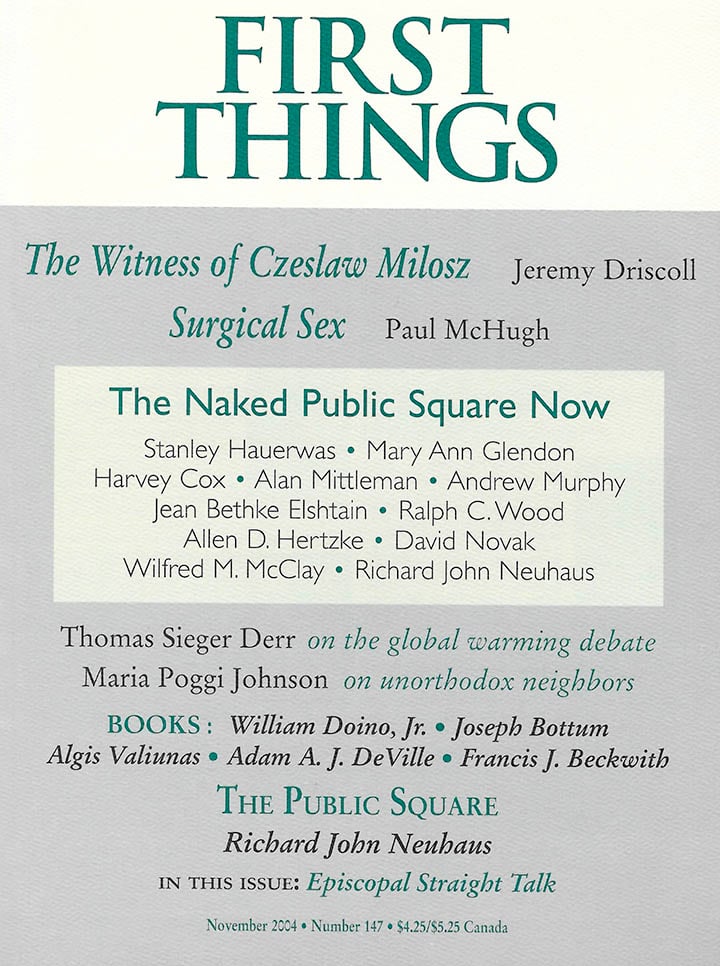
Father Jeremy Driscoll’s moving and instructive reflection on Czeslaw Milosz in this issue was written shortly before Milosz’s death on August 14 at age ninety-three. In discussions with the great poet before his death, Driscoll had the opportunity of exploring with him his own understanding of his life’s work, and especially the religious character of his controlling vision. Since the death of Milosz, others have weighed in with their interpretations, not least being the irrepressible British commentator Christopher Hitchens. Writing for Slate, Hitchens would have us believe that the key to understanding Milosz was his opposition to “the oldest form of oppression known to the mind: that of religion.” Possibly because he can find no support for that judgment in the work of Milosz, Hitchens invokes Leo Strauss on the importance of indirection and “writing between the lines.” It turns out that Milosz, like Strauss, was practicing the subversion of “religious tyranny—in this case Christianity.” “The long-term achievement of Milosz,” Hitchens declares, was to surreptitiously undermine “the party ‘lines’ that claim for themselves exclusive truth.” Hitchens’ unsurprising effort to recruit Milosz to his weary campaign against the baleful influence of religion is severely embarrassed by what the poet wrote and what he said about what he wrote.
It is not as though Milosz “got religion” in his declining years. Upon the occasion of his death, the New Republic reissued online Leon Wieseltier’s review of Milosz’s 1983 book, The Witness of Poetry, based on his Charles Eliot Norton Lectures at Harvard. I have in this space been critical from time to time of Mr. Wieseltier’s strident attacks on Christianity. It is the more gratifying, therefore, to discover that twenty-plus years ago he wrote so sympathetically of Milosz’s faith. At Harvard, Milosz asked, “Is non-eschatological poetry possible?” Critics at the time attributed such unfashionable musings to Milosz’s being “so very Slavic.” Wieseltier protested: “Milosz’s stark spirituality cannot be easily evaded. The poet’s Polishness is finally beside the point. Terror is not the only condition for transcendence, though it helps.”
The Witness of Poetry, Wieseltier wrote, “is the credo of a great poet. It reveals that Milosz is really a religious thinker.” Unlike Hitchens, Wieseltier can cite Milosz in support of his claim. Milosz wrote of his devotion to “Latin as the language of the Church and of literature, the theological quarrels of the Middle Ages, Latin poetry as a model for Renaissance poets, white churches in the baroque style.” Wieseltier observes, “His reverence for human custom is based upon the personal participation in it. The same is true of his religiousness. He does not shill for the spiritual life, or for its civil utility; he lives spiritually.” The critical reaction to Milosz by secularists leads Wieseltier to write, “Perhaps the most paradoxical feature of this century is that it is the century for which the spiritual should be most obvious. How could the slaughters of Hitler and Stalin, and the Communist captivity of half of Europe and most of Asia, not shake the soul?”
Wieseltier writes that, like another great Polish thinker, Leszek Kolakowski, Milosz “long ago exchanged the scholastics of the Party for the scholastics of the Church.” “There are sufferings that put the purely secular to shame, that create a need for meanings that neither reason nor society can satisfy. The secularization of modern life was anyway an exaggeration; a lot of religion remained. But there is no way that some of the traditional themes of religion can be dodged after the scale and style of contemporary carnage.” As for Milosz, he said that he and his poetry and prose are to be understood as “the passionate pursuit of the Real.” To which Wieseltier adds, “The capital R refers to something more than ordinary cognition but not quite to mysticism.” Driscoll’s essay suggests that Milosz was not quite so chary about the mystical. Wieseltier recognizes, however, that, in rejecting the secular utopianism of Marxism, Milosz represented “a necessary exchange of new lies for old truths.” Intellectually, spiritually, and aesthetically, Milosz’s ambition was not modest. “His solution,” wrote Wieseltier, “is the resacralization of the world.”
After the death of Milosz, Wieseltier wrote again about the greatness of the man, this time in the New York Times Book Review. Their friendship was cemented, he says, by a long conversation in 1982 in which they discovered that “we shared an envy of mystics.” Milosz, he notes, “was not embarrassed by the crudities of religion: they were the imagination’s answers to the mind’s questions. They created the ‘second space’ without which he saw no possibility of human flourishing.” He continues: “For Milosz, the journey was not the goal, the goal was the goal. Irony, for which he had a wicked appetite, was not adequate as a meaning for life. He was a man without illusions, holding steadfastly to a confidence in what he could not see.” Wieseltier concludes his tribute with these words by Milosz:
You gave me gifts, God-Enchanter.
I give you thanks for good and ill.
Eternal light in everything on earth.
As now, so on the day after my death.
Hitchens on Milosz, reprinted in New York Sun, September 1, 2004.

YOU MIGHT ALSO LIKE
Pitch for a Catholic Novel
Imagine a middle-aged white man in good clothes waiting for a morning train at a station of…
Disclosure in Modern Poetry (ft. Glenn Arbery)
In this episode, Glenn C. Arbery joins R. R. Reno on The Editor’s Desk to talk about…
Timothée Chalamet Is Right About Art (ft. Suzy Weiss)
In this episode, co-founder and reporter for the Free Press, Suzy Weiss, joins Virginia and Germán to…
