
The Vanishing Church:
How the Hollowing Out of Moderate Congregations Is Hurting Democracy, Faith, and Us
by ryan p. burge
brazos, 232 pages, $26.99
Ryan Burge is unignorable. A political scientist known for his “graphs about religion,” Burge is required reading for anyone who writes about Christianity in America today. He has a special knack for pairing the right questions with the right instruments, then packaging the results in a form that is accessible to the data-illiterate (among whom this reader is chief). His work is devoured on the right and on the left, by Catholics, evangelicals, and skeptics, by journalists, scholars, and humble theologians. At its best, Burge’s data-driven sociology of religion provides a limited but accurate snapshot of American faith—an infamously moving target. And Burge himself is at his best when he emphasizes those limits, avoids punditry, and accompanies the data with a range of plausible interpretations.
This is the approach taken by Burge in his previous three books, all of which are excellent: The American Religious Landscape: Facts, Trends, and the Future (2025); The Nones: Where They Came From, Who They Are, and Where They Are Going (2023); and The Great Dechurching: Who’s Leaving, Why Are They Going, and What Will It Take to Bring Them Back? (2023, coauthored with Jim Davis and Michael Graham). And, for the most part, it is the same approach one finds in his online writing, whether that be on his Substack, the online magazine Arc (for which he is a regular columnist), or the many other places where he publishes.
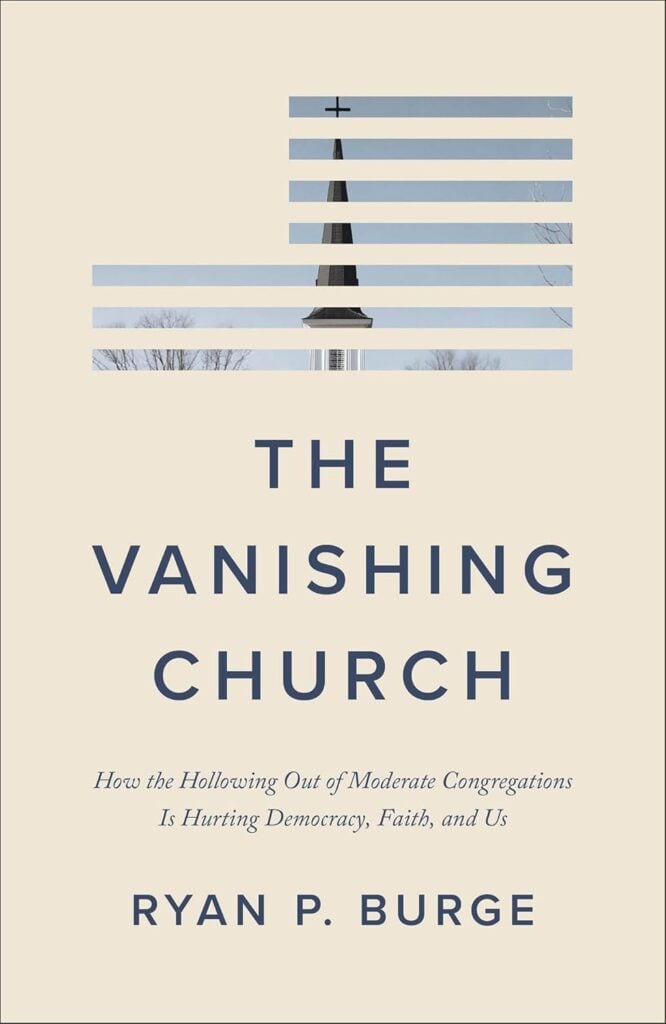
Unfortunately, his new book marks a significant departure. In The Vanishing Church: How the Hollowing Out of Moderate Congregations Is Hurting Democracy, Faith, and Us, Burge assumes the mantle of pundit, cultural commentator, and earnest pastor concerned for the state of Our Democracy. He has a declension story to tell, a story with winners and losers, heroes and villains. It’s one you’ve heard before. It’s a tired tale, incomplete, ungenerous, and moralizing. It goes something like this.
Once upon a time, half of all Americans belonged to the Protestant mainline. In the postwar glow of democracy’s triumph over fascism, Americans were Episcopalian, Presbyterian, Lutheran, and Methodist. Even some Baptists, notoriously déclassé, counted among this cohort. “These kinds of moderate churches,” Burge notes, “could be found in communities big and small, in the Midwest, New England, and the Bible Belt.” They were diverse generationally, economically, and politically. They were a mixed bunch. Managers rubbed elbows with guys from the factory, and Republicans prayed next to Democrats. These were modest spaces with big Overton windows: “a place to feel welcomed and embraced no matter how much or how little one believed in Jesus Christ that particular Sunday—or how one cast their ballot on Election Day.” Zealotry was uncommon; doubt was welcome.
Then the fall. Mainline pews emptied of people so fast it was as if someone had vomited them out. At the same time, evangelical churches started growing, even as they began to make their voice heard in Washington. White evangelicals in particular began to vote Republican more and more; conversely, white Democrats were less and less likely to be Christian or even religious.
These trends culminated in the two presidencies of Donald Trump, who consolidated the white evangelical vote, capitalized on a polarized electorate, and exacerbated the nation’s tribalism. This tribalism, Burge argues, has not merely colonized evangelical churches; it now also uses them as staging grounds for fomenting division, ideology, and partisan extremism.
In the face of such division, when “religion itself is increasingly coded as right-wing,” where can millions of Americans go who are looking for “churches where pastors [don’t] yell about eternal damnation every Sunday but instead [are] focused on encouraging congregants to love their neighbors and make the world a bit better for those around them”? What we need, Burge contends, is a resurrection of mainline faith. We need to “return American religion to what it looked like just a few decades ago”: moderate churches that welcome people of all kinds, especially those turned off by evangelical dogmatism, either in the pulpit or in the voting booth. Only then might some of the Nones—Americans who identify as having no religion but who, for the most part, are open to God—return to worship. Only then might the nation be healed.
In terms of mere numbers, this story is true as far as it goes. The Cold War era saw mainline Protestantism rise to unprecedented numbers, power, and influence before plummeting into political irrelevance and demographic death. During this time white evangelicals (and, later, Roman Catholics) shifted right, at least politically. (Actual theological conservatism is harder to quantify; there is no national plebiscite on religious questions.) And so there really was a great “hollowing out.” The Christian landscape of the 1950s would be unrecognizable to most Americans living today.
The trouble, as I say, is not with the story’s numbers. The trouble is with the story’s moral, as Burge sees it.
On one hand, he indicts white evangelicals for their theological conservatism, their persistence in holding “fringe” positions, and their voting en bloc for the GOP. On the other, he holds up the postwar white mainline as a model for believers to imitate today. He calls the mainline approach the way “religion used to be—moderate, sensible, pragmatic, and unifying.” Above all, he writes, the mainline approach aspires to be “reasonable.” And reasonable congregations are likelier to serve as “engines of social capital generation and catalysts for building trust and tolerance” among Americans who come to church “to find community” and “to work collectively to solve societal problems.”
This is the voice of a political scientist: Churches are here to make the country work. But Burge is also a Christian, and he is writing wounded. Having pastored dying mainline congregations for more than two decades, he preached the final sermon for a church that closed its doors just before the book went to press. The pain is still fresh. If it clouds his judgment, we can understand why.
Because the book is polemical, criticizing it might appear to be little more than an act of self-defense—one more skirmish in the perpetual culture war. It’s not quite true in my case, however. Burge’s bête noire, besides being a white evangelical, ticks the boxes you’d expect: Republican, Trump voter, gun owner, immigration hawk, young earth creationist, biblical “literalist” (a term, by the way, that desperately needs to be put to pasture). These terms may describe my neighbors in West Texas, but they don’t describe me. If I’m defensive, it’s on behalf of them, not myself. Bonnie Kristian has written that evangelicals “are people you can have a country with.” She’s right, and to the degree that this book implies otherwise, it is both uncharitable and wrong.
Fortunately, it’s not all wrong. As in his previous work, Burge illuminates trends worthy of attention. For example, his data show that the great challenge facing all churches today—black and white, Catholic and Protestant, evangelical and mainline—is class. Compared to midcentury, those Americans most likely to have dropped out of religion are not the college-educated middle class, the proverbial married couple with two-point-five kids. They are the unwed mother, the blue-collar worker, anybody lacking a high school diploma. The people avoiding church, in short, are those who failed the “success sequence.” They didn’t finish school; they didn’t find a spouse; they didn’t get a dependable, well-paying job before starting a family.
For Christians, this is the crisis of our time, and Burge is absolutely right to turn a spotlight on it. Whether his prescription is adequate to the problem is another question.
From beginning to end, the book presumes a continuum with two poles. The left pole is liberal unbelief, inhabited by Nones, the overwhelmingly majority of whom are Democrats. The right pole is conservative faith, filled with white evangelicals and Roman Catholics who vote Republican. Right in the middle is where Burge places mainline Protestantism, which he believes is where moderates would be if the mainline still existed.
It’s a neat trick. Burge begs the question by rigging the game. In doing so he has given us Protestant liberalism without the liberalism. But “liberalism” is not a term of abuse. Protestant liberalism is a long-standing intellectual project with roots in eighteenth- and nineteenth-century Europe. Its adherents were serious and often quite pious pastors and theologians. Even as implacable a foe of Protestant liberalism as Karl Barth could not help but venerate their writings and appreciate their accomplishments, much as he wanted to go beyond them.
In brief, “liberal” was mainline Protestants’ identification from within, not a slander from without. Why then propose a mainline of moderates, devoid of liberals?
The answer, in part, is that liberalism is said many ways. What you might call classical liberalism (individual liberty, inalienable rights), political liberalism (New Deal programs, voting left of center), sexual liberalism (the Pill, same-sex marriage), and theological liberalism (a merely human Jesus, no miracles or resurrection) all overlap but are not identical. As we behold the sweep of American Protestantism in the twentieth century, it can be difficult to disentangle any of these liberalisms from the others.
Another part of the answer, though, is that a merely moderate mainline serves Burge’s narrative. If the mainline was never actually liberal, then criticisms of its liberalism are moot. Burge defines the mainline by the self-reported voting practices of its members. And it is true that mainline pews always have been split down the middle between Republicans and Democrats.
But the pews are not the whole picture. Burge ignores mainline pastors and thereby the shape of the institutions they have led over the last seventy-five years. The personal beliefs and voting practices of the laity are relatively insignificant if the actual denominations they attend, or rather used to attend, are politically and theologically progressive from the top down.
Finally, Burge conflates political moderation with theological moderation. They are not the same thing. Although political moderation is not and cannot be a first principle, reflecting as it does merely the balance of people’s views on a subject at a given time, Americans generally prize the practice of moderation as a democratic virtue. It bespeaks a spirit of compromise, a refusal to let the perfect be the enemy of the good. This kind of moderation accepts that you win some, you lose some, and you live to fight another day. Civic patience makes self-governance possible.
Theological moderation is another story. There is not, in the Church, a balance to be struck between those who affirm and those who deny the resurrection. Christians don’t give airtime to other gods in worship. Trinitarians don’t divvy up Sunday mornings with Arians. Orthodoxy isn’t up for negotiation, and it isn’t subject to member surveys. Nor is it cleanly detachable from moral and social questions. The one clear case of excommunication we have from Paul’s letters involves a man who was sleeping with his stepmother. Sexual ethics, like other moral matters, is part of the Church’s witness and has been from the beginning.
Burge writes as if mainline departures from orthodoxy simply never happened. When he does allude to them, we are made to understand that they are instances of the kind of moderation worth applauding, the kind that ordinary believers want to see in their churches. Burge puts me in mind of a friend who, like so many others, left California for Texas in 2020. He was happy to leave, but he made it clear that he wasn’t shifting from blue to red; he still preferred California’s politics to Texas’s. The irony was lost on him. Like Texas’s politics, evangelicalism may be nuts, but Americans and Protestants alike seem to prefer their brand of crazy to the alternative.
This is the strangest aspect of the book: On Burge’s telling, the mainline’s downfall is a kind of inexplicable natural event (perhaps an act of God?). In appears so undermotivated that the reader is left wondering how it could have happened at all—a question made all the more pressing by Burge’s subsequent claim that what evangelical churches need most is an infusion of the same spirit animating the mainline church down the road that is struggling to keep its doors open. It led the one to death, but somehow it will lead the other to life.
Burge writes, “Mainline churches used to be ideal places to tamp down tensions, not inflame divisions.” After all, “mainline churches tend to elevate concepts like openness, toleration, and diversity as opposed to narrow dogmas and uniformity.” But, more in sorrow than in anger: “The mainline’s commitment to ideological diversity has left its denominations on the verge of collapse.”
Ideological diversity? For anyone who has spent time in mainline churches, seminaries, and institutions, that last line is sure to land as little more than a bad joke. Words like “openness” and “toleration” can themselves be wielded as dogmas. Any concept, no matter how seemingly good, can be deployed as a weapon. The uniformity that results is only stronger for it.
No one was forced to leave the mainline, and the mass exodus over the last half century was not the fault of white evangelicals or the religious right. Members of the mainline were not conquered and exiled. They self-deported. They voted with their feet. In a word, the death of the mainline was not a homicide. It was suicide.
The agents and causes of this particular self-slaughter are many and much studied. The list of authors who have analyzed it include Joseph Bottum, Ross Douthat, Mary Eberstadt, Tara Isabella Burton, and Christian Smith, among many others. What unites them, to borrow a phrase from the late Albert Murray, is their disregard for “social science fiction.” During and after the Civil Rights Movement, Murray wanted black Americans to be studied as the emotionally and psychologically complex human beings they were and are, not as so many lines on a graph reducible to pseudoscientific categories lifted from the latest academic jargon.
In The Vanishing Church, Burge’s brand of social science fiction does not so much reduce believers to simple categories, though it does do some of that, as reduce theology to civics. According to Burge, “the American church can (and should) be one of the primary drivers of depolarization in the United States.” Indeed, “the fate and future of American democracy may be at stake.”
This is pure, uncut civil religion. In Burge’s hands, the Church is not a biblical or theological entity; it is a voluntary association that exists to improve society, care for the disadvantaged, and forge bonds across differences. It is a spiritual NGO. It leavens democratic life with prayer and song and moral uplift. It offers a place for people to seek edification, whatever doubts may fester in their hearts.
In the words of Freddie deBoer, this is not worship of God. It is “worship of the God-shaped hole.” It lauds faith because it is “prosocial” and “builds capital.” DeBoer, to his credit as an atheist, calls it what it is: “Idolatry.”
The Church does not exist to grease the wheels of democracy. Paul did not found churches in Corinth and Ephesus to build up the civic health of the Roman Empire. The faithfulness of the Coptic Church is not measured by Egypt’s ranking in the social progress index. The Church is the body of Christ, called forth by the gospel into fellowship with the living God and sent by his Spirit to witness in the world to the good news of salvation. If, in the fulfillment of this mission, the measurable effects are hailed by social and political scientists, that is a happy by-product. If they are not, believers shouldn’t lose any sleep. With apologies to E. M. Forster: If I had to choose between betraying my democracy and betraying my church, I hope I should have the guts to betray my democracy.
There is a name for Burge’s preferred cocktail of religion and civics, Church and state. It’s Christendom. Burge’s book is one long lament for the passing of mainline Christendom in America. You might even say it is both a paean and a dirge for a certain style of Christian nationalism—liberal Christian nationalism. Make the mainline great again!
Somehow it is all white evangelicals’ fault, and young Catholic priests’, too. (It turns out they’re more conservative than Boomer priests. The mind reels.) As long as evangelicals and Catholics remain conservative, and no moderate mainline exists to welcome political liberals, those liberals may feel they have nowhere to go. “Thus, many find the most sensible option when it comes to religion is to leave it behind.”
I don’t doubt that this is happening. And I don’t disagree that churches ought to be hospitable to people across the political spectrum. It’s no less a problem for one church to be the GOP at prayer than for another to be the Democratic Party at prayer. I would leave any church that preached a candidate or party from the pulpit. I think Burge overstates the extent to which this practice is rampant, but he’s not wrong to worry about it.
Nevertheless, the proposal is an exercise in nostalgia. And it fails to explain either how we got here or why we would be wise to go back.
The reasons he does provide are consequentialist, not principled. Burge wants evangelicals and Catholics to tack to the middle because, he believes, it would aid both Americans’ faltering politics and Christians’ efforts at evangelism. Two birds with one stone! But if, as Burge admits, evangelicals are the only Christian tradition in this country not actively hemorrhaging members, then at a purely pragmatic level, why shouldn’t others be learning from their success? More to the point, if the issue is not tactics but principle, then it doesn’t matter whether a position in doctrine or ethics is “fringe” or “mainstream,” “conservative” or “moderate,” “right-coded” or “left-coded.” Christians should hold it, pastors should teach it, irrespective of these labels—much less the ever-shifting winds of public approval.
Burge faults evangelicals for letting the political tail wag the ecclesial dog, but before he notes the speck in his brother’s eye, he needs first to remove the plank from his own. When he writes that “religion now exists downstream of politics,” he means it as an indictment of others. What the book amounts to, though, is an unwitting self-indictment on the same charge.
The book’s low point comes in a chapter about the 1990s. This was the time when, Burge argues, the “Religious Right divided American religion and society.” The primary evidence Burge adduces is—I am not making this up—Newt Gingrich’s invention of dirty politics. Gingrich, Burge tells us, was responsible for “trampling on the unspoken rule that it was better to look the other way when a political opponent was engaging in ethically murky behavior.” From there, I believe we are meant to understand, it is only a short walk over to the golden escalator.
By this point it is clear that Burge is in over his head. Nowhere does he discuss what legitimate reasons “moderate” believers might have had for exiting the mainline or growing more conservative. Nowhere do we read about secularization in the wider Western world, about the effects of global industrial capitalism on labor and family formation, about rates of American church attendance prior to the heyday of the 1960s. Nowhere do we find the phrase “sexual revolution.” Nowhere are we told why it is a problem that so many white evangelicals vote Republican but not that so many black evangelicals vote Democrat. Nowhere do we learn that the pulpits most likely to preach partisan politics are found not in evangelical churches, but in the mainline.
The problem is not that Burge did not swell his book to a thousand pages, touching on each and every one of these variables. The problem is that his narrative is so reductive as to be irresponsible to the very data he presents. He takes one of the most complicated, overdetermined phenomena of the last three centuries—the secularization of the West—and condenses it into a just-so story about white Christians shifting right and giving in to hot political rhetoric. Surely we can do better than that. I know that Burge can, because he already has elsewhere.
To be sure, Burge pays lip service to other factors, like the threat of the Soviet Union and the rise of the internet. But for the most part, besides the graphs about religion, the book consists of potted cultural histories, political non sequiturs, caricatures of evangelicals, and platitudes. I don’t know what is more offensive, the lack of charity or the pablum. I suppose there is something almost charming about a political scientist solemnly chiding “a fringe belief holder” not “to force their opinion on the American public through the passage of unpopular legislation.” To do this, in Burge’s eyes, is not merely undemocratic but also ineffective.
His example is the anti-slavery movement, which he says “changed the law by winning the hearts and minds of the average American.” No, what changed the law was winning a war. The losers didn’t welcome the change, but at the point of a gun they had no choice. In this respect, the end of slavery is not an outlier. One could write a whole history of durable political transformations in America effected primarily through unpopular changes in the law (sometimes by Congress, sometimes by the other two branches). Burge’s advice is at once bad history, bad politics, and bad religion. So much for the Church saving democracy.
In a recent article for Harper’s about data journalism and the rise of Trump, Jason Blakely asks the following: “How did political scientists—specifically, those specializing in the American political system—end up with such a wrongheaded consensus about the country they not only studied but also inhabited?” He might have been writing about The Vanishing Church. As Blakely goes on to say, “The ‘sciences’ that elite technocrats and policy wonks have marshaled to adjudicate past [political] trials are manifestly unequal to the task of today’s politics.”
So here: Burge’s book and the method underlying it are manifestly unequal to the task of understanding Christian faith and American politics. Not because evangelicals are blameless—they are not—but because Burge’s argument cuts too many corners. And in any case, whatever our politics or religion, the one thing we should agree on is that the Cold War mainline is not the solution to our problems. For better or for worse, there’s no going back.

YOU MIGHT ALSO LIKE
Timothée Chalamet Is Right About Art (ft. Suzy Weiss)
In this episode, co-founder and reporter for the Free Press, Suzy Weiss, joins Virginia and Germán to…
Via Crucis, 2026
The Way of the Cross—and the third, seventh, and ninth stations in particular—has been an especially appropriate…
Canterbury and the Collapse of Anglican Unity
For more than a century, the archbishop of Canterbury has been regarded as primus inter pares, the “first…
