
I don’t know what to call this. It is certainly not, in any ordinary sense of the word, a review of Robert Louis Wilken’s new book The Spirit of Early Christian Thought: Seeking the Face of God (Yale University Press, 368 pages,, $29.95). A reviewer is supposed to have a measure of critical distance from the author and book under discussion, and I am anything but distanced from Wilken. Apart from my family, he is my friend of longest standing. We go back to college days in Austin, Texas, we went through seminary together in St. Louis, and we have been in unbroken conversation ever since. To complicate matters further, the book is dedicated to our friendship. So don’t expect from me what is usually meant by objectivity in the reviewing business. This is in part the discharging of a debt, or, better, call it an appreciation. And I take it as an occasion to reflect on the indispensable part that friendship plays in one’s personal and intellectual formation. As it happens, that theme is also close to the argument of The Spirit of Early Christian Thought.
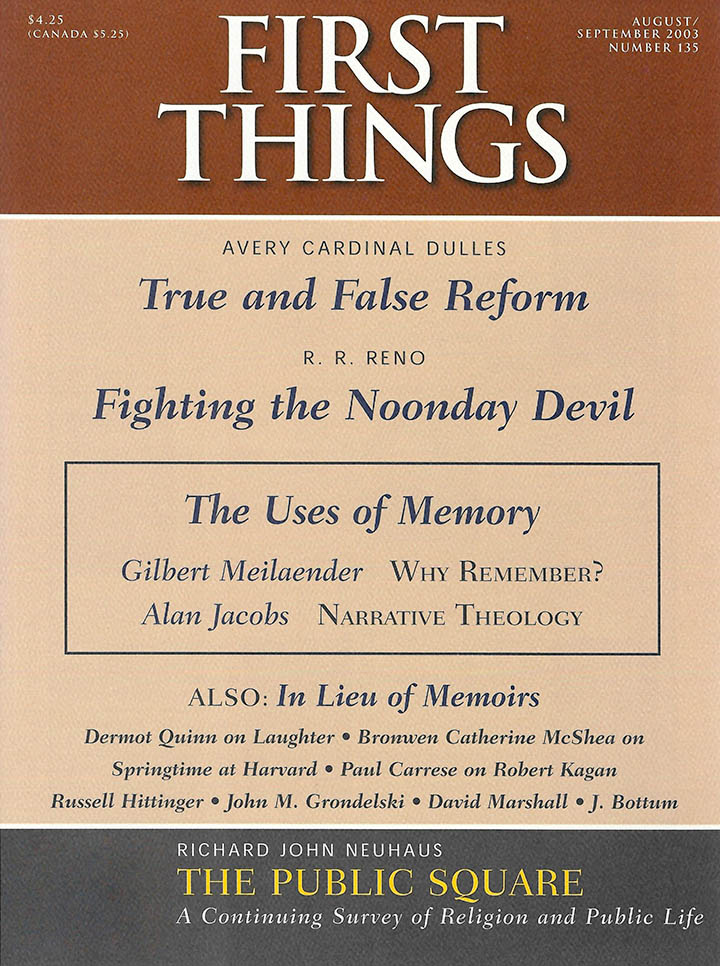
From time to time it is suggested to me—and not always, I think, in the way of flattery—that I should write my memoirs or even a full-scale autobiography. Perhaps some day I will, although I rather doubt it. Were I ever to do so, it would be in very large part the story of my gratitude for the people who have shaped my mind and way of being in the world. So herewith, before I return to Robert Louis Wilken, some rough notes in lieu of the memoirs that will likely never be written. I limit myself to intellectuals and writers, recognizing that the influence of innumerable other friends, also intellectually, would require a large book. Those mentioned are people without whose influence I would not think the way I think or live the way I live. They are my teachers, people to whom I intellectually surrendered myself, which is the only way to learn. Each left an indelible mark. With some I am now in decided disagreement. To others I regularly return to learn more, or to relearn what I had forgotten.
In compiling this list, I soon realized it was getting impossibly long. Rigorously, and reluctantly, I pruned and then pruned again. The final criterion was this: these are the thinkers who are essential to the telling of my life’s story. The omission of any would result in missing an influence without which I could not understand myself. Others might have been included; those included could not have been excluded. And a final caveat: we will not know the whole of the who and what in the formation of what we think we know until we know even as we are known, which is not yet.
I am not entirely satisfied with my list. After all, one could go through one’s personalized version of the Great Books or of Matthew Arnold’s “the best that has been thought and said” and be compelled to acknowledge that, in ways not always obvious, one would be a different person if he had never read, for instance, Plato, Descartes, or Alasdair MacIntyre. But I mean to limit myself to powerfully felt influences, to intensely personal engagements (whether or not I knew the thinker personally), to encounters that were “aha experiences” of an acutely conscious and continuing nature. I mention first thinkers whom I did not know personally, and then those whom I did, some of whom are still alive and still dear friends. I leave off the list biblical writers, only noting for the record that the four evangelists, along with Paul, the prophets, and the writers of the psalms—probably in that order, and as is probably the case for most Christians—are formative beyond any possible comparison.
So here we go. The names are not necessarily in order of importance. Each deserves an essay or more, but I offer only a sentence or two, which does no more than gesture at the nature of the influence. My list and what I say about each is, I readily acknowledge, not always terribly original, but it is mine. And then I will get back to Robert Louis Wilken.
St. Augustine: The master teacher of thinking faith and faithful thinking. St. Thomas Aquinas: Uncompromising champion of bringing all knowledge into obedience to Christ. Almost, from time to time, I am disposed to call myself a Thomist. Martin Luther: Possessed prophet of the utter gratuitousness of salvation. John Henry Newman: How we know what we know that we dare to trust. Josef Pieper: The wisdom of Thomas distilled and illuminated by life as lived. Samuel Johnson: The courage to see and say the obvious. Friedrich Schleiermacher: The brilliant but finally wrongheaded freedom of thought disengaged from authority. Émile Durkheim: Society as the bearer of mystery. William James: The futility of denying transcendence. Michael Polanyi: The impossibility of the autonomous and systematically skeptical mind. Hans Urs von Balthasar: Intellectual and spiritual genius at play in the fields of the Lord. Feodor Dostoevsky: The prophet of the fiery word pitted against the fiery sword that blocks the way to Eden. Søren Kierkegaard: The contriver of introspective knots from which we are freed by truth not our own. John Courtney Murray: The Catholic Thing made critically at home in America. Louis Bouyer: Faith lived as liturgy. Dietrich Bonhoeffer: Relentlessly probing what it means to follow Him. Flannery O’Connor: Vocation discovered in the grace of being limited. G. K. Chesterton: Unbounded gratitude in the wonder of what is.
Then there are those whom I have been blessed to know personally, in some cases casually but in most over years and in the conversation of friendship. Arthur Carl Piepkorn: There is no gospel apart from the Church. More pointedly, the Church is integral to the gospel. Wolfhart Pannenberg: Christian knight of Enlightenment rationality besting Enlightenment rationality at its own game. Abraham Joshua Heschel: He opened the Torah to reveal to me, but not to him, the Christ. Peter L. Berger: The sociology of thinking. Martin Luther King, Jr.: Pressing politics as the art of what might be possible. Reinhold Niebuhr: Uncompromising analyst of a grim world qualified by grace. Paul Ramsey: Happy contrarian captive to thinking clearly about doing the right thing. Karol Wojtyla: All truth is personal, and in the Truth, the person of Christ, we are revealed to ourselves. Avery Dulles: A magisterial command of the tradition making him a contemporary touchstone of reflective orthodoxy.
So there you have it, the short list; rough notes for the intellectual memoirs that will likely never be written. The list is eclectic, no doubt, and the less charitable might call it a hodgepodge. But then, life is eclectic and something of a hodgepodge. There are other thinkers, and especially individual books, that have turned around my thinking on this or that subject of consequence. Other contemporaries might have been included, but neither they nor I think of themselves as my teachers, and there are simply too many of them. I am also conscious of short-changing literary figures—novelists, dramatists, poets. Composers, too. The above canon of influentials is heavy on theology and philosophy, also on moral philosophy. But then, so am I. So I let the list, with its no doubt too allusive explanatory tags, stand as it is for the time being. Everything is for the time being.
The Strange New World of the Fathers
It goes without saying that Robert Louis Wilken—he started using the “Louis” after he became a Catholic, in honor of the thirteenth-century king of France, patron of his native city of New Orleans—would be on the list were it expanded only slightly. Wilken is not my teacher in the usual meaning of the word, but he is a friend who has taught me much. It is said of the Swiss theologian Karl Barth that he opened for many “the strange new world of the Bible.” Wilken has opened for many the strange new world of the Church Fathers. He taught patristics for years at Catholic institutions, notably at the University of Notre Dame, and since 1985 has been William R. Kenan Professor of the History of Christianity at the University of Virginia.
There is a discernible trajectory of development over the years in his many books and articles (some of the latter appearing in these pages). The new book prompted me to go back and look at The Myth of Christian Beginnings (1971). The thesis there is that there was for the Christian movement no biblical Golden Age from which subsequent history is a declension or by which subsequent history is to be judged. With specific reference to the patristic era, the argument is that the movement, also doctrinally, is one of development pointing toward an eschatological denouement. The eschatological accent was attributable in significant part to the influence of Wolfhart Pannenberg. Thirty years later, Wilken has not retracted that thesis, nor does he suggest that the biblical or patristic era was a Golden Age after all, but he is inclined to contend that the early Fathers got “the Christian intellectual tradition” (a favored phrase) right, and that that tradition is inseparably tied to the interpretation of the Bible. The Spirit of Early Christian Thought does not suggest that the patristic era represents the whole of the tradition. Not by a long shot. But it is a notably energetic, imaginative, and faithful part of the tradition to which Wilken has devoted a life of study. The conclusion of the book puts it nicely:
The intellectual tradition that began in the early Church was enriched by the philosophical breadth and exactitude of medieval thought. Each period in Christian history makes its own unique contribution to Christian life. The Church Fathers, however, set in place a foundation that has proven to be irreplaceable. Their writings are more than a stage in the development of Christian thought or an interesting chapter in the history of the interpretation of the Bible. Like an inexhaustible spring, faithful and true, they irrigate the Christian imagination with life-giving water flowing from the biblical and spiritual sources of the faith. They are still our teachers today.
The book fully vindicates that judgment. Although, truth to tell, I expect an essay by Wilken on the “unique contribution” of the modern era to the Christian intellectual tradition would be short and marked by deep ambivalence. An argument at the heart of The Spirit and Wilken’s other writings of recent years is that the thought we call modern is—unlike the Fathers and the classical world of philosophy of which they were part—marked by systematic skepticism and a posture of critical distance in the interpretation of sacred texts. Like the Greeks, the Fathers understood that commitment—as in faith and love—is essential to discerning the truth. Indeed, love is a way of knowing. In this connection and others, Wilken decisively rejects the powerfully influential complaint of Adolf Harnack (1851-1930) that the Fathers were guilty of “Hellenizing” Christian thought. The Fathers’ appropriation of Greek philosophy, and their success in bringing it into obedience to the history of Israel and its Christ is, according to Wilken, precisely their genius and their glory.
Whether in understanding the Greeks or in interpreting the Bible, the serious interpreter must give himself to the author. On this Wilken effectively cites T. S. Eliot: “You don’t really criticize any author to whom you have never surrendered yourself. . . . You have to give yourself up, and then recover yourself, and the third moment is having something to say, before you have wholly forgotten both surrender and recovery.” But is it possible for a modern to so surrender himself, to entrust himself to love as a way of knowing? Does that not inevitably end up in a form of fideism? Although the above-mentioned Michael Polanyi is not named in the book, Wilken’s answer, at least implicitly, is very much like Polanyi’s proposal for a “post-critical philosophy.” Also unmentioned, but very much between the lines, is Paul Ricoeur’s understanding of the “second naiveté” that is on the far side of systematic skepticism.
Wilken does invoke in his opening pages the words of Augustine: “No one believes anything unless one first thought it believable. Everything that is believed is believed after being preceded by thought. Not everyone who thinks believes, since many think in order not to believe; but everyone who believes thinks, thinks in believing and believes in thinking.” Wilken, however, does not understand himself to be writing a systematic treatise on the relationship between faith and reason. “Although I deal with ideas and arguments, I am convinced that the study of early Christian thought has been too preoccupied with ideas.” And, he might have added, not only early Christian thought. Christianity is about history, about what happened and is happening, about a way of life constructed by such events remembered, related, and reenacted. Christianity is a Church, a community, indeed a culture, created by truth discerned through commitment, which is to say by faith. Christianity is, as Wilken repeatedly says, the res, the things—especially the sacramental, devotional, moral, and intellectual things—that constitute The Christian Thing. We must give ourselves to the res. Critical distancing, and especially irony, are, in relation to the things of God, blasphemy.
The distinguished church historian Jaroslav Pelikan says of the book: “By turns scholarly, contemplative, and argumentative, this is an exposition in which the early Christian writers speak for themselves—and to us.” I don’t want to overinterpret a book blurb, but Pelikan’s use of the word “argumentative” is insightful. Although Wilken has been heaped with academic honors over the years, I have long thought he is not sufficiently appreciated by contemporary Christian thinkers. One reason for that, I expect, is that readers do not see the arguments he is making in the stories that he tells. Wilken is a stranger to polemic or pointed attack. His style is understated; absent are the fireworks of intellectual showmanship. He writes in a manner that is disarmingly, and sometimes deceptively, simple. The tone is invitational, as though he is saying, “Come and see. Let me show you a way of being Christian and thinking Christianly that is richer, more imaginative, more convincing, more faithful than the way in which most of us are Christian today.”
And so it is that, if anybody ever bothers to write about my life and thought, he will have to write about the people named above, and he will have to write about Robert Louis Wilken. Get The Spirit of Early Christian Thought and read it. Read it slowly, letting Wilken take you by the hand to enter into conversation with Augustine, Cyprian, Irenaeus, Gregory of Nyssa, Maximus the Confessor, and others; all of whom got The Christian Thing right. That doesn’t mean that nobody except the early Fathers got it right, and it certainly doesn’t mean that they exhausted the ways of getting it right. It is still and always the case that the truth is discerned and lived against an eschatological horizon. But Wilken loves the Fathers and their way of loving Christ. In asking the reader to come and see, he is, like St. Paul, introducing the great hymn of love that is the thirteenth chapter of 1 Corinthians. Paul says, and Robert Louis Wilken says, “Let me show you a more excellent way.” Let him show you a more excellent way.

YOU MIGHT ALSO LIKE
Canada’s Offensive Secularism
On March 25, the Canadian House of Commons voted to repeal the good faith religious opinion defense…
Against “God Alone”
A few years ago, I had some routine surgery. Something went wrong in recovery. The nurses on the…
The Politics of Judas
In this Easter season, we naturally reflect on the passion of Christ, his resurrection, and all that…
