
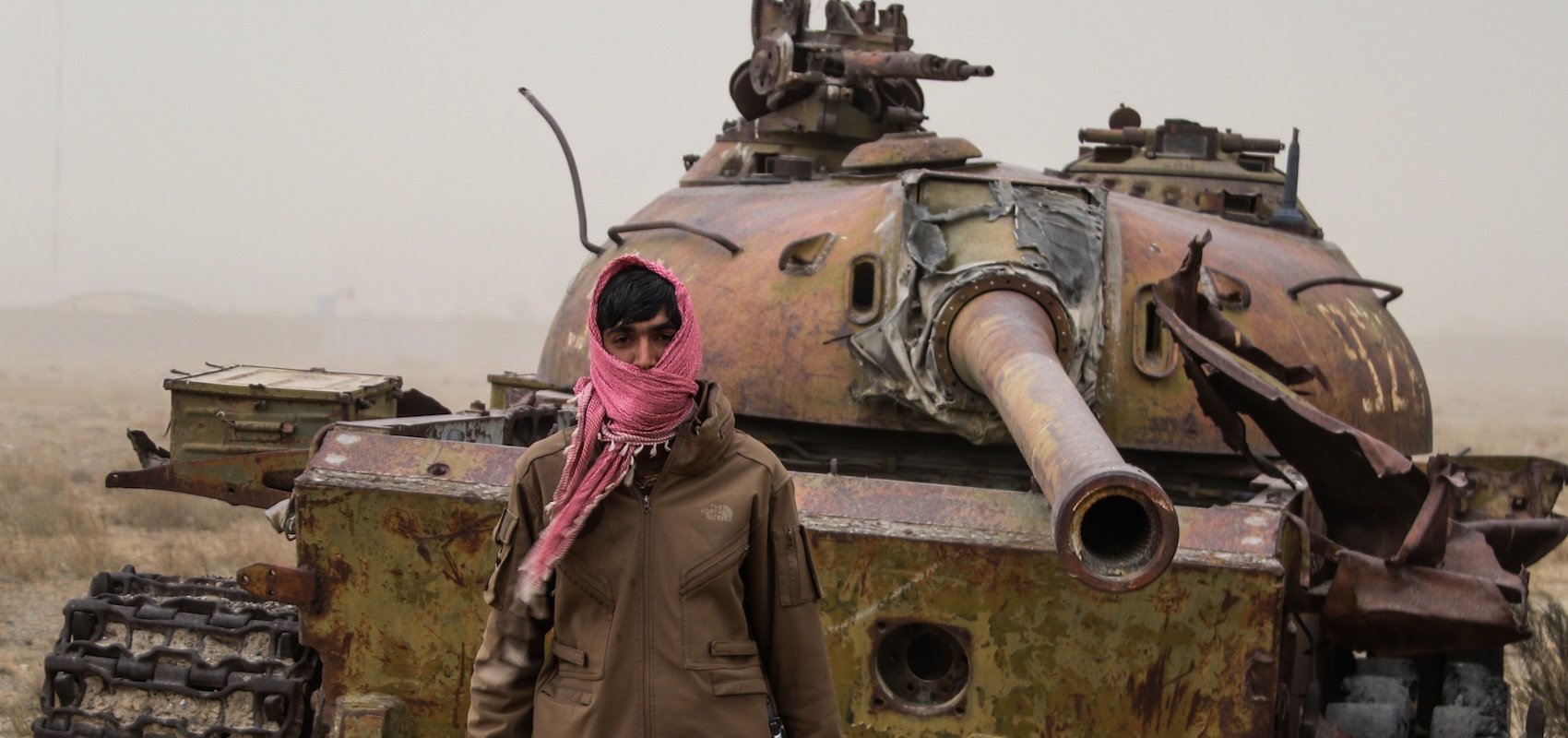
The recent attack by an Afghan national on two National Guardsmen in Washington, D.C., was not an outlier. Since coming to the United States, Afghans have murdered, attempted to murder, and conspired to murder other Americans. The tragedy of Afghan resettlement was predictable. Like virtue, it’s an open question whether Westernization is teachable. And in any case, why would anyone assume that months of living on U.S. soil would accomplish what two decades of the military-industrial might of the American state could not? This belated realization of the implausibility of cultural integration should bring about more than another much-needed course correction on loose immigration policy. The results of Afghan resettlement help us understand the true fruits of the era of globalization: tribalism.
Globalization was a drama in four acts. In the first act, which took place in the decades after 1945, the West was afraid of ethnic and tribal hatreds. It reinvented itself as a new kind of post-ethnic, post-tribal, universal civilization. Consigning kingdoms and empires to the world of yesterday, we redesigned the nation-state to adopt a more inclusive, egalitarian understanding of the nation. The second act, launched in the 1990s, was characterized by Western confidence that technological advances would make this post-ethnic political form our universal export. We believed that globalization meant homogenization around this same system. The third act revealed that most of the world did not want to buy this export. This culminated in the debacles of Iraq and Afghanistan. We’re now in the fourth act. The thing we’ve feared most, ethnic tribalism, is upon us. And our political form, designed in a more optimistic time wherein we assumed our substantial differences would pass away, is inadequate for the trials that lie ahead.
Marshall McLuhan predicted that globalization could end in a dark tribal night. The era of instantaneous communication—the electric age begun by the telegraph and accelerated by the radio and TV—created a global village. It would thrust us all closer together. But this doesn’t mean, McLuhan argued, progress toward tolerance, cooperation, and homogeneity. There’s no reason to assume that living next to someone makes us more tolerant of them or prevents us from noticing substantial differences. It’s also a mistake to believe that noticing differences reinforces equality or supports other assumptions underwriting the late-twentieth-century Western political form. As Grant Havers points out in his study of McLuhan, from the tribal perspective, “Equality is an alien value. Media that involve the peoples of the world all at once only serve to remind them of how different they actually are. They also provide a reminder of how powerless nation-states are in the face of this involvement.” The onset of the global village turns history backward, reviving the tribal consciousness.
In our political climate, it’s not hard to grasp what McLuhan means. A video goes viral. There’s a debate about what happened and what should be done. Battle lines are drawn. People sort themselves accordingly. Social fractures deepen. The cycle repeats. Digital technology, we discern, accelerates this hyperpolarized, hyperpartisan environment.
But this is only one part of the phenomenon that McLuhan describes. It sets aside the global character of digitization. That’s where the war in Afghanistan helps us grasp the deeper, disturbing character of McLuhan’s prediction. “War,” McLuhan argued, is “the little red schoolhouse of the global village,” and “it’s a gory little schoolhouse at that.” When we wage war in the global village, when we try to use our technology to impose our values upon others, we take on the features of our enemy. “We become what we fight in the very act of fighting,” wrote McLuhan.
How could that have happened in Afghanistan? The typical story of failure is that the West went to war against primitive forces: Exposing the Taliban to “modernity” failed, according to one foreign policy think tank, and their “medieval thinking remained just as rigid.” Yet the Taliban won because they understood the underlying dynamics of globalization better than the Americans. The Taliban were great modernizers. They rose to prominence in the 1990s through a late-twentieth-century phenomenon, an information-technology-fueled religious revival. Their influence spread through the network of Mullahs, who could move between villages to preach the more radical form of Sunni Islam that they learned from the broadcasts coming out of the Arab world. Moreover, the Taliban’s modernization did not abolish tribal identity. They reconstituted it, shaping a stronger Pashtun ethnic identity around Islam that displaced weaker tribal alternatives. And as they took over Afghanistan, they invited another cutting-edge organization to join them, which had likewise mastered global information and electronic financial exchanges: al-Qaeda. In Afghanistan at the turn of year 2000, it was the Taliban’s opponents who were the reactionaries, clinging to attenuated tribal identities, secular aspirations, and power-sharing arrangements that had characterized the country before the Taliban’s rise. That’s who the Americans sided with after the invasion.
To defeat the growing insurgency, the United States pioneered aggressive strategies of information warfare and psychological manipulation. They weren’t bad at it; the Taliban were just better, particularly during the last years of the war. For students of the digital era, 2015 was a watershed year, the year that mass migration became a digital phenomenon. As photos and videos of migrants arriving in Europe went viral, Westerners sorted themselves into the pro- and anti-immigration camps. Their leaders and social media platforms scrambled to control the narrative. This further intensified partisan tribalism, as Westerners also sorted themselves into the pro- and anti-censorship camps. Something similar happened in Afghanistan that year. Just like Western youth in the megacities, Afghan youth in the urban areas were mesmerized by their own set of viral videos. Except theirs were of ISIS suicide bombers.
Traditional Afghan warrior culture disapproved of the suicide bomber, valorizing the marksman instead. But digital technology changed the landscape. Young Afghans were enticed by visions of martyrdom and looked to ISIS as an alternative to the Taliban. So the Taliban adapted their identity, remolding Afghan honor culture away from valorizing snipers to suicide bombers. In the late 2010s, Afghanistan became the scene of a perverse mimetic rivalry as ISIS and the Taliban competed to win the support of the most fanatical. Eventually, after the Taliban won some battles against ISIS and launched a wave of suicide bombings across the country to demonstrate their resolve, they gained the upper hand. International elites could bemoan the end of education for girls or describe the Taliban’s tactics as ethnic cleansing. But in this digitizing, radicalizing environment, American tactics to control the flow of information failed to make any real impact.
What was the war in Afghanistan? It was a microcosm of the global village at work. The proliferation of information technology intensified religious zeal. Techniques of industrial warfare enabled it to expand rapidly. Digitization accelerated competitive practices and conflicts, launching a race to adopt more extreme positions. Modernization reshaped the civil war in Afghanistan into an ethnic conflict where the side that leaned into tribalism won. And all the participants therein were permanently changed.
In the very act of fighting the global war on terror, the West became what it fought, in two ways. First, we applied the techniques used to wage information warfare abroad to govern ourselves. This changed our state. Second, we imported the people shaped by the global war on terror, shaped by the electric age. From 2015 onward, thanks to those viral videos, we brought those from a digitized, tribalized environment into our postwar, post-tribal nation-states. This wasn’t the same as importing primitive medievals, as the rhetoric often went. Nor was it the same as importing sleeper agents from the East, as if it were still the 1950s. We were importing hypermodern bands who were still in the process of being transformed by digitization. That’s what made them so dangerous. The same struggles of the long Afghan civil war were transplanted into the U.S. For instance, the Afghan refugee Nasir Ahmad Tawhedi, married with a wife and child and residing in the U.S., planned an Election Day suicide attack last year. If he ever was a Taliban sleeper agent, they had lost him, like many others in 2015, to ISIS videos. He planned to do the attack in the U.S. on behalf of ISIS.
With this global village in our own countries, what’s the next phase in the transformation of the state? The Trump administration is often accused of heightening tribalism, but we should see its policies as a belated, almost desperate effort to contain tribalists at the border. To ensure public order, it deports and bans more visas from parts of the world affected by the Global War on Terror. The logic of this position looks back toward how the country’s immigration policy was arranged prior to the 1965 Immigration Act. The United States discriminates on a regional basis at the point of entry into the country—but only at the point of entry. Inside the U.S., the hope is to restore a color-blind constitutional and democratic order and rebuild a homogeneous national ethnos around support for that. It’s a gamble. It would take decades of consistent policy to achieve, and in a tribalized world, it’s not clear such a model can succeed.
Other countries—or administrations—might decide it’s easier to embrace the global village. But we should be clear-eyed about what that entails. It requires assigning the state with the task of managing quotidian violence between different tribes and ethnic groups; and because the majority is the most numerically powerful and therefore most potentially dangerous tribe, it requires taking extra measures and adopting double standards to ensure that that tribe is sufficiently subdued. That’s what most Western countries now have. The postwar, post-tribal nation-state may still excite our imagination and ideals, but it is vanishing into memory, of one with the kingdoms and empires it replaced.
