
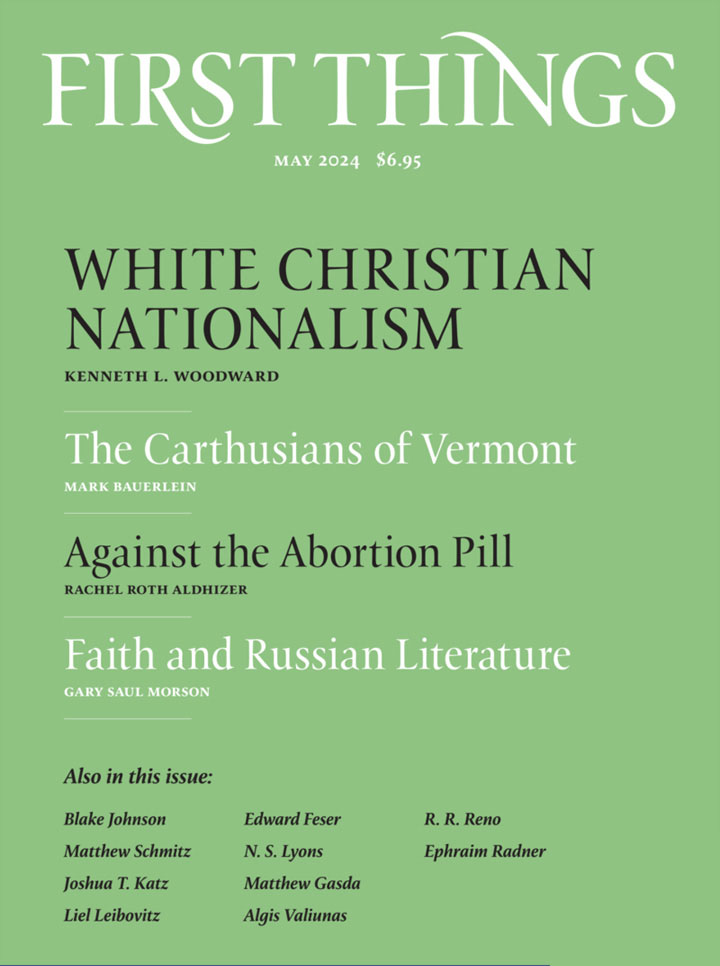
It was surreal. President Biden began his State of the Union speech by invoking the Nazi threat. More than eighty years ago, Biden reminded us, Franklin Roosevelt rallied the nation, as “Hitler was on the march,” and “freedom and democracy were under assault.” Today, the president warned, the fascist enemy rampages anew, not only on the world stage, but in America herself. This time the tyrant is Putin, while the dagger at the “throat of American democracy” is insurrection. “What makes our moment rare,” Biden intoned, “is that freedom and democracy are under attack—both at home and overseas at the very same time.”
On their face, Biden’s claims are wildly irresponsible. He implies that Donald Trump and his supporters are not mere political opponents, but Hitlerian foes and traitors. With rhetoric like that coming from a sitting president as he speaks to the nation, it’s no wonder that our politics is bitterly divisive and our society polarized. What is the greater threat to democracy: a ragtag mob in the Capitol, or a major political party that defines political opposition as treason?
The allure of this way of talking seems irresistible to liberal elites, even as it damages the body politic. Hitler, fascism, Nazism: There’s rarely an issue of The Atlantic or a week of editorials in the New York Times that doesn’t mine the 1930s for analogies. It’s as if we were living a collective version of the film Groundhog Day. It’s always 1939.
At this late date, the resort to Hitler suggests a decadent political culture, a case of arrested development. The Civil War had concluded less than seventy years before Herbert Hoover ran for reelection in 1932. Yet neither he nor his opponent, Franklin Roosevelt, regularly used that conflict to frame the choice that faced the nation. Jefferson Davis was not deemed the specter haunting the American people. Hitler’s body was consumed by flames in his bunker in Berlin nearly eighty years ago, and yet he still lives in our political imaginations as an ever-present threat. Biden was a toddler in 1945, unconscious of world events when Hitler died. Yet he and his speechwriters make ready appeal, confident that listeners will find Hitler and his misdoings salient to our times.
Renaud Camus is a mauvais garçon in the French literary scene. He’s not afraid to speak inconvenient truths and expose the self-deceptions of the establishment. He has meditated on the phrase “the second career of Adolf Hitler.” The dictator’s first career, which played out in Germany during the years of the Third Reich, ended in death and defeat. In the 1960s, Hitler attained a second life, this time as the incarnation of evil. His name was deployed “as an absolute weapon of language, as its supreme fulmination, the atomic bomb of maledictions.” Dread of Hitler’s return exercised an almost totalitarian power, “a dread,” Camus notes, “that proved a tremendously effective mode of presence for this consummate dictator.” The West threw itself into anti-racism and anti-colonialism as sacred projects. Longstanding authorities and traditional forms of life were held in suspicion, interrogated for signs of latent fascism. Patriarchy, homophobia, and the rest became further forms of Hitlerian abomination. The work is ongoing. “Europe is like a patient who has suffered from a terrible cancer—Hitlerism—and who is endlessly operated on and reoperated on by terrifically thorough, if perhaps not always very professional, surgeons.” The mildest symptoms trigger the most extreme procedures.
Pierre Manent has dubbed this establishment extremism the “fanaticism of the center.” We see it in action today. The populace manifests discontent. Polling shows hostility toward mass migration. Populist politicians enjoy support. Against this threat, the establishment turns to Hitler, the peril with which to bludgeon those who object to elite governance. Vladimir Putin invades Ukraine, and the second coming of Hitler plays a role here as well. He ensures that anyone who urges negotiation and compromise will be denounced as a naive appeaser or treacherous quisling. One must not sup with the devil!
I lack Camus’s literary élan. In Return of the Strong Gods, I offer a more pedestrian explanation for Hitler’s continuing relevance to contemporary political and cultural affairs. The bloody years from 1914 to 1945 were a civilizational catastrophe for the West. As the victors, American liberals blamed the war on the “closed society,” the social form that prized solidarity and obeyed authority. The designated remedy was an “open society” that encouraged “open minds.” The title of Karl Popper’s influential book framed the agenda: The Open Society and Its Enemies. The tacit violence of Popper’s title (elaborated at length in his relentless attack on Plato, which amounts to a denunciation of nearly the entire philosophical tradition of the West) indicates the imperial, indeed paradoxically totalitarian, ambitions of the open-society consensus. Its Manichean logic recapitulates National Socialism, simply inverting the latter’s ambitions. The future of the West requires defeating internal enemies, excising cancerous growths—otherwise, Hitler might return.
The men and women who promoted the open-society consensus after World War II were generally moderate. But from the outset, the consensus had a utopian character: to create a world in which another Hitler would be impossible. And like all utopian projects, this one lost touch with reality over time. We cannot in fact organize our lives around the ideal of the “open mind.” And we certainly cannot sustain an actually existing society if we treat “openness” as the highest good. Political correctness and cancel culture grew out of open-society liberalism. They are punitive strategies and disciplinary regimes that protect the open-society consensus from reality-based criticism. Concerned about social cohesion in our era of mass migration? You’re a racist. Sympathetic to populist politicians? You’re a fascist.
Biden’s uses of these maledictions are ham-handed. He never does with a scalpel what he can do with a machete. The opening of his State of the Union is more than tiresome, though—it’s troubling. The year is 2024, not 1939. We face very significant challenges—rampant mental illness, declines in marriage and fertility, mass migration, runaway environmental ideologies, deindustrialization, global instability, and more—and we can’t address them until we let go of Adolf Hitler. Indeed, some of those problems fester because of our fixation on him. A culture that puts the memory of Nazism at the center of its self-understanding is almost certain to slide toward nihilism. It’s time to bring Hitler’s second career to an end.
Dear Reader,
Can I be direct with you?
War abroad. Socialists on the rise. AI upending human life. Endless uproar online. The modern attention economy doesn’t want readers — it wants users enslaved to the tyranny of the present.
First Things is the antidote: literary excellence, timeless truths, and a fixed point of reference in a culture that has lost its bearings.
But we can’t do it without readers like you.
Our goal: Raise $150,000 by November 1 to sustain First Things in the year ahead.
Your gift anchors readers in the permanent things.
Make your Fall Campaign gift now using the button below.
If you have any questions or would like more information, please contact Giovanni Del Piero, Director of the Editor’s Circle, at gdelpiero@firstthings.com or 212-627-1985.


YOU MIGHT ALSO LIKE
Why the Death Penalty Is a Sore Point for Papal Authority
Pope Leo XIV marked World Day Against the Death Penalty, observed on October 10, with the following…
The Myth of St. Francis
At the beginning of his 2020 encyclical, Fratelli Tutti, Pope Francis speaks of “an episode in the…
Job and Her
It is said that Job lost everything, but she has lost more. All her possessions—the money, the…
