
America’s Fatal Leap:
1991–2016
by paul w. schroeder
verso, 336 pages, $34.95
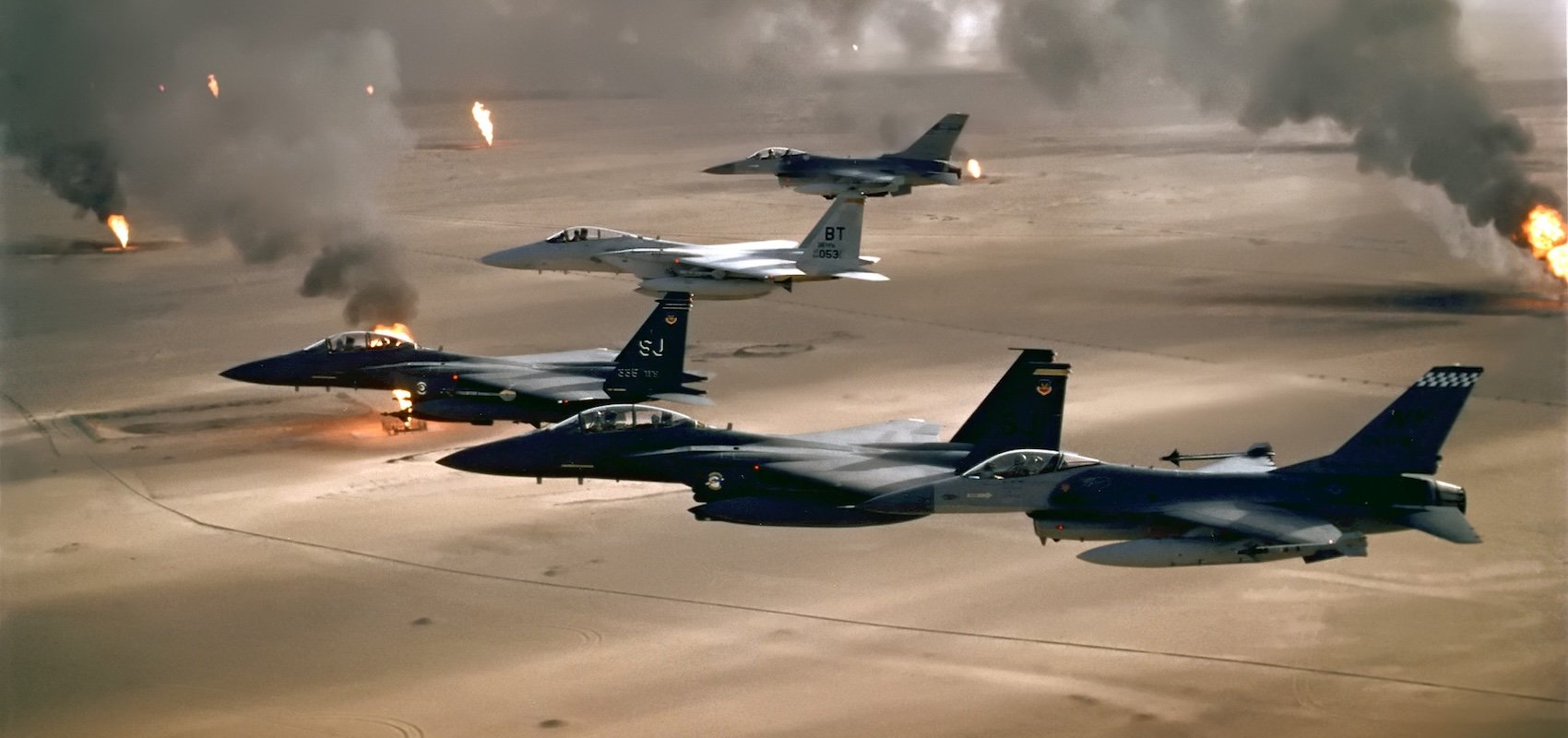
Was the First Gulf War a mistake? The historian Paul Schroeder thought the answer was “yes.” In his arresting formulation, Operation Desert Storm was “a just, unnecessary war.” He was hardly the only one to think so. Easy triumph silenced the war’s naysayers—except for Schroeder, and therein lies his distinction. He sensed that victory was no sure guide to sound judgment. At the end of the Cold War, the United States was taking a wrong turn. The country’s leaders overestimated the effectiveness of battlefield victory. As a historian of European balance of power, Schroeder saw that our elites failed to understand that preponderant military and economic power should be used to marshal allies and to marginalize enemies, not defeat and rule them.
America’s Fatal Leap collects Schroeder’s essays on U.S. foreign policy from 1991 to 2016, a few years before his death. In Schroeder’s view, the “fatal leap” involved the transition of the United States from benevolent hegemon to aspiring architect of a global empire.
The writings of such an eminent historian are rich and refreshing. The essays provide an incisive, historically informed critique of American foreign policy. For skeptics of America’s recent military adventures overseas, the collection may seem like a bracing anti-imperialist counterpunch. But on closer inspection, Schroeder’s views appear no less imperialistic than those of the neoconservatives he criticizes. He simply outlines a different kind of imperialism. It’s soft rather than hard, but it partakes of the same idealistic assertions of global responsibility that inspired America’s adventures in the Middle East. We won’t be able to resist the seductions of global empire until we have the courage to look at conflicts in far-off corners of the world and say, “That’s not our problem.”
The First Gulf War was the closest George H. W. Bush ever came to the “vision thing.” With the “New World Order,” Bush dazzled the imagination with the dream of a universally authoritative international system, ensuring global peace and prosperity. Building and defending that system meant punishing states that broke the rules; in 1991, it meant punishing Saddam Hussein’s Iraq for invading Kuwait. Many observers had theoretical and practical misgivings, since neither America nor an American ally had been attacked. Memories of Vietnam reminded some of the risks of defeat. But given the almost surreal speed of success, most agreed afterward that the war had demonstrated America’s power to build a new global system and enforce its rules—and its moral responsibility to do so. Schroeder, by contrast, saw that victory brought its own risks.
America’s actions were paradoxical. To reverse Saddam’s resort to offensive force and deter the future employment of force elsewhere required the United States to resort to offensive force, to act militarily when the nation itself was not threatened. Saddam no doubt had violated international law. But among America’s leadership class, it came to be taken for granted that responsibility fell to a country that had not been attacked—the United States—to match force with force and eject him. It was far from clear why this had to be so. Despite the dazzling victory, the First Gulf War foreshadowed later conundrums. The United States appointed itself the world’s policeman, declaring itself an exceptional nation. Leaders in Washington presumed they could bend and break the rules-based international order in order to preserve it.
This exceptionalism defines America’s post-1989 leadership class, and it fuels vaulting ambitions. The ’89ers imagined they were building a better world, as one of Condoleezza Rice’s books puts it, creating a historically unprecedented “global commonwealth.” Strivers and scholars such as Rice thought they could leap between academia and national security posts, theorizing and implementing the future of international relations, leading the world toward ever more benign destinations. In their minds, American power could be used to replicate the stability of the nineteenth-century balance of power and surpass it, building a system that enjoyed the clarity of universally applicable principles. It’s the vision thing, enhanced by academic expertise.
This conceit makes Schroeder’s critique particularly biting. A specialist in nineteenth-century European diplomatic history, Schroeder shows just how badly America’s leadership class missed its mark at the end of the Cold War. Despite America’s unchallenged supremacy, despite its immense capacity for experimentation and innovation, the country’s leaders never got anywhere near the peace secured by the balance of power orchestrated by the Concert of Europe. The ’89ers produced a more volatile, destructive arrangement in every region of the world to which they turned their attention.
The crux of Schroeder’s critique of America’s post–Cold War foreign policy lies in his distinction between hegemony and empire, and his strong preference for the former. Schroeder sees the responsible use of hegemonic power as the key to maintaining stable international relations in modern circumstances, where functioning states are presumed to have equal rights in international law. A responsible hegemon exercises power in a cooperative way, acting as first among equals and seeking to make decisions through persuasion and consensus. An empire acts by ruling over subordinates, imposing its own decisions by coercion. Hegemony exists in an international system of autonomous, independent, and juridically equal states. Empires are incompatible with that arrangement. True, empires once brought stability. But relations of domination are stable “only in premodern” settings. Today, there exists an international order, formal or informal, that is defined by autonomous and nominally equal states. For this reason, empires are obsolete; attempts to resurrect them are doomed to fail. Schroeder saw the Cold War as a contest between American hegemony in Western Europe and the Soviet empire in Eastern Europe. Because the United States acted as a responsible hegemon, and the Soviet Union as a typical empire, the writing was on the wall.
As Schroeder saw as far back as 1991, after the Soviet Union fell, the United States would have no trouble smacking down dictators or terrorist organizations in the Middle East. But each campaign pulled the country into the region even further. Each victory would “unfailingly commit us to an even more direct and intrusive hegemony than before.” This dynamic carried with it the risk of America’s metamorphosing from hegemon to empire.
Schroeder argues that America failed the test of 9/11, becoming more involved in the Middle East on more ambitious terms, aiming to crush any actor that defied it. The climax came in 2003. Concocting a dire threat from Saddam Hussein—“existential exceptionalism,” in Schroeder’s formulation—the Bush Administration launched a preventive war that would prove one of the most spectacular foreign-policy blunders in American history. According to Schroeder, the invasion of Iraq was a quintessentially imperial action, because one country, without being attacked or threatened by the other country, invaded and conquered the latter for the purposes of changing the government.
Schroeder has two lines of criticism against the Iraq war. Both reveal him to be a doppelgänger of those he criticizes. The first line of criticism is rooted in moral universalism. For Schroeder, the United States violated the international laws it purported to uphold. In one of his more creative historical analogies, he compares the Iraq War to France’s Dreyfus Affair, which exposed corrupt institutions, an opportunistic government, and a divided society—in short, “a serious deficit in intellectual and moral integrity.” The Third Republic did not live up to its ideals. Iraq showed the same about America.
One can appreciate the earnestness of Schroeder’s moral critique. Yet it is based more in liberal ideals than in actual events. Breaking international rules, in this theory, is the equivalent of violating the moral law in Kant’s universe: One’s actions cannot be translated into the universal law, and so they damage the agent’s moral credibility and legitimacy. But just as the Third Republic lasted long after the Dreyfus Affair, the exposure of corruption doesn’t bring an end to a republican empire. The deeper problem with republican-imperial hybrids is the one the Roman Republic faced. As Rome’s empire expanded, the old form of republican government could not meet the new demands. A system designed for governing a city on the Tiber was not suited to governing the Mediterranean. Schroeder perceives the threat an aggressive empire can pose to a stable international system. He is less clear-sighted about the threat imperialism poses to the republic at home.
In De Officiis, Cicero distinguished the days when Rome was patrocinium of the whole world from the days when it was an imperium. Cicero’s distinction is not unlike Schroeder’s distinction between hegemon and empire. When Rome was a patrocinium, her commanders acted to defend her provinces and allies; as an imperium, they acted to oppress and ruin others. Cicero viewed this change with dismay largely because, as Rome expanded, a despotic cycle emerged that hollowed out the institutions of republican self-government. The dictator Sulla, whose star rose in large part because of his imperial adventures, is a key figure in this shift. We might call his dictatorship the prelude to the Roman imperial security state. It demonstrated that to preserve her empire, Rome needed to become a military despotism, albeit one that would use republican edifices to dissemble this reality. “And so,” lamented Cicero, “only the walls of Rome’s houses remain standing.”
Schroeder’s second line of criticism is historically determinist. The imperial adventure may have worked in the past; now, in an age of globalization, it will inevitably end in self-destruction. New circumstances and the new supranational institutions (the EU, the UN, and NATO) combine to make “nineteenth-century-style empire structurally impossible and unthinkable in the twenty-first century.”
It’s no accident that Schroeder’s condemnation of certain actions as “nineteenth-century” echoes the Obama administration’s wailings about Russia’s annexation of Crimea. In the twenty-first century, we are told, one does not simply walk into a former Soviet oblast (though somehow it keeps happening). On closer reflection, Schroeder’s conservatism looks like the progressivism of John Kerry.
Both Kerry and Schroeder opposed the First Gulf War, the latter for far more thoughtful reasons. Unlike Kerry, Schroeder had an alternative theory of how the “new era in international relations” should develop. Rightly understood, the “New World Order” should put an end to the old resort to force, repudiating the politics of military brinkmanship. Bush Sr. (like his son) described foreign policy along the lines of a Wild West gunfight. The ultimatum to Saddam was a “line drawn in the desert.” Schroeder imagined another path. The responsible hegemon of the New World Order needed to dispense with the gunfighters and adopt the analogy of judo, whereby the goal is not to unleash maximum force but to throw your opponent off-balance, then use just enough force to disarm him. For Schroeder, military force in the Middle East was effective, but unnecessary. It would have been more efficient to pin Saddam down in Kuwait by means of worldwide economic sanctions, coordinated by the United States. The sanctions would have paralyzed Saddam, isolating him from the international community and teaching the lesson that violent solutions do not work—all without normalizing the use of force in itself.
These are the orthodox presuppositions of 1990s globalization. Economics is preeminent. Given how much states depend on mutual trade for their prosperity, war is useless. Some states, such as Saddam’s Iraq, need to be reminded of this new geopolitical reality. But for Schroeder, the way to go about it is not “compellence-deterrence” [sic]: the coercive, often violent means by which superior states enact their will. The new system should rely on “association-exclusion.” A bad actor is not invaded; he is excommunicated. He loses the benefits of economic association with others, possibly the whole world. No violence is needed: Sanctions teach that the price of exclusion is far too costly to risk violating the international consensus. The neutral and impartial rules of the international system are thereby preserved, equally enforced upon all. No actor is endowed with special emergency police powers that others do not possess.
This system has already been road-tested, Schroeder argues. In 1945, Germany and Japan were not taught to become liberal democracies by force. Instead, they were shown that adopting this regime type was the price of association with the West—markets, security, and respectability. France and Britain were encouraged to decolonize (“sometimes with brutal clarity as in the Suez Crisis of 1956”) because they were taught that they would lose the economic and political benefits of association if they did not.
This picture of a New World Order is elegant, all the way down to its legitimating appeal to the postwar moment. Closer inspection exposes its blemishes. First, Schroeder’s description of postwar America as a benevolent hegemon fits uncomfortably with the postwar reality of a shattered Europe. Even if we believe that West Germany could really have decided for a different regime after 1945 (when a foreign power was writing its constitution for it), a large part of the postwar picture involved states that were far from equal and far from autonomous. Eisenhower’s 1956 threat to provoke a run on the pound if Britain did not withdraw from Suez was not the action of a hegemonic “first among equals.” It was a credible threat to oppress and ruin the British economy. Eisenhower demonstrated that Britain had lost the capacity for independent sovereign action due to its financial reliance on the United States. The British couldn’t defend what they perceived as their interests without first getting America’s permission. Schroeder is too smart to deny what happened in 1956. But he masks the raw inequality of power. A broken Britain opted to become part of an informal American empire that dared not speak its name.
There’s another problem with Schroeder’s narrative. The American occupation of Iraq, however imperial, didn’t cascade into a great-power conflict or lead to a collapse of American power in its traditional zones of influence. One gets the impression that America’s power over its allies strengthened rather than weakened during the first two decades of the twenty-first century. Appealing to the law of nations, Germany protested that the second Iraq war was illegal, and yet the Germans allowed their country to be used as a base from which to wage it. In a gesture of Gaullist defiance, France’s threat of veto shamed the Americans at the United Nations; several years later, the country reversed de Gaulle’s bid for strategic sovereignty and rejoined NATO’s military command structure. Iraq may have exposed America’s limits in the Middle East; it also showed that Europe was willing to submit to an ever less informal American empire.
And there’s a third problem: Schroeder imagines a largely straightforward demarcation between coercion through “compellence-deterrence” on the one hand, and consensus through “association-exclusion” on the other. The latter presupposes economic and social networks to which one must belong if one is not to be left out. That’s the basis of Schroeder’s distinction between empire and hegemon. But both his hyphenated terms describe deeply ambiguous and potentially coercive relationships. A state may join an economic and social network not because it brings intrinsic benefits, but because the penalty for being left out is too steep to bear. (These coercive aspects of the modern world are outlined in David Singh Grewal’s brilliant book Network Power: The Social Dynamics of Globalization.) Schroeder, like many liberal proponents of globalization, sees economic and institutional associations—network power—as providing the impartial, neutral, and necessary rules for prosperity. Unlike more naive liberals, he sees that these associations are powerful means to enforce one particular vision of the international system. But he doesn’t see just how destabilizing this vision of soft power is.
Is “association-exclusion,” enforced by economic means, really a judo-like method of responsible, restrained statecraft? Judo presupposes a fixed set of tools and tactics that can be brought to bear on one’s opponent: hands, legs, grasps, kicks. That’s not the economic world. Technological innovation introduces new forms of economic competition and new forms of rivalry, with political and strategic implications—so that beating China in AI or shipbuilding is not just a sporting contest over GDP growth. And as long as economic exclusion from the family of nations is taken as a legitimate policy goal, technological change will create new opportunities to strike at recalcitrant actors—as well as new dangers. When one nation attempts to remove another nation’s central bank from the world’s financial system—which would have been inconceivable before the onset of digital banking—it may end up a cobelligerent in a brutal war of attrition.
Moreover, implementing targeted “association-exclusion” changes the laws of the republic. Maintaining sanctions and ensuring that a rogue nation remains excluded requires a whole new institutional, legal, and diplomatic regime, foreign and domestic. It requires clandestine measures to hide the full scope of the nation’s involvement from a skeptical public. Abroad, it’s just as intrusive—if not more so—than the occasional military operation exercised against recalcitrant dictators. Constantly reordering social and economic practice to ensure that an actor remain excluded from the international system will have the effect of expanding state pressure, power, and administrative reach.
One might argue that hegemony is not violent, at least not intentionally. But ostensible anti-imperialists should ponder the way sanctions get used. Take four examples from the Cold War to the present: Rhodesia, Slobodan Milošević’s Serbia, the Islamic Republic of Iran, and the Russian Federation. It is unclear whether sanctions against these actors were designed to punish them for specific actions—or to undertake that quintessentially imperial action, regime change.
And therein lies the greatest danger of “association-exclusion.” The excluded actor is made into an unperson, a non-state. In such an actor, as Woodrow Wilson put it in 1917, “we can never have a friend.” The excluded becomes the outlaw of humanity; as at least one commentator on Wilsonianism realized, such a monster “must not only be defeated but also utterly destroyed.” The principle of “association-exclusion” culminates in annihilation.
From this angle, Schroeder’s New World Order does not seem a workable alternative to neoconservative global imperialism. It endorses different means, suggesting that tools other than military might can work just as well (perhaps better) to marginalize deviants, change their governments, and eliminate monsters from the earth. The endgame is the same.
But, of course, Schroeder’s New World Order is not much different from the policies he imagines himself opposing. “Association-exclusion” began in the Rhodesian Civil War of the 1970s, when Washington decided that the dictates of the Cold War necessitated the use of economic power to force regime change on Rhodesia. Even if George Bush’s wars of the 2000s relied on more direct action, his successor was shrewd enough to recall that the imperial playbook left him many other options of the sort Schroeder endorses. One might argue that the real lesson of the Iraq War was that the Washingtonian imperial security state should never again be caught having to justify its actions at the ballot box. The safest way to run an empire is to hide it. Invisible economic coercion is a great way to do that.
Barack Obama was the last president able to pose as anti-war. He promised that he would not deploy hundreds of thousands of troops to topple governments; military strikes against recalcitrant actors would be “unbelievably small,” in Kerry’s phrase. For anti-imperialists, this side of Obama’s rhetoric brought solace. It masked a deeper shift.
During Obama’s presidency, America cemented itself as the world’s high priest. It pronounced ever more dogmas of exclusion and association and expected everyone around the world to adopt them. It was already enforcing those rainbow dogmas at home. The strategy for enforcing them was exactly what Schroeder prescribed in the 1990s: to use economic power to teach what one could and could not do in the twenty-first century. The pronouncements of exclusion by Obama and others cajoled and compelled haute finance to rain down economic punishments on rogue states and actors, foreign and domestic. This strategy of “association-exclusion” reached its frenzied peak in in 2022, the time of truckers debanked, of the FBI’s “Arctic Frost,” and Biden’s “this man cannot remain in power.”
Schroeder was a sharp thinker, superb historian, and careful student of foreign policy. Yet he embodied the central contradiction of so much of today’s foreign-policy commentariat. On one hand, he opposed America’s imperialist adventures and invasions. On the other, he embraced America’s universal responsibility to adjudicate and enforce “association-exclusion,” and to do so by a variety of ever more coercive tools. If he had had his way, the global American empire would be at once dead—no more forever wars!—and very much alive. It would be orchestrating, directing, and disciplining the global economy to ensure that the rogue and reactionary actors that break the norms set by America’s priestly caste are extirpated from the global system.
In these essays Schroeder, like his peers, arrives at this position because he does not question the most important post-1989 axiom: America’s world-historic, universal responsibility. Questioning that responsibility brings disaster. In his writings, the America First movement of the 1920s and ’30s is the second-greatest villain of the twentieth century, just as it is for the neoconservatives he despises.
Reading Schroeder, one has the impression of witnessing a vicious family quarrel. He loathes what the neocon cowboy branch of the household has done. But it’s a domestic dispute within the wider Wilsonian clan. None of the disputants repudiates the twenty-eighth president, nor does any repudiate his ends. The quarrel is over whether, in effecting regime change around the world, it’s better for America to act as the world’s policeman, its priest, or its pickpocket—the confiscator of foreign financial assets. It’s a typical uniparty dispute, premised on how best to bear the burden of America’s global responsibility. The family quarrel is resolved once the ’89ers settle on some amalgamation of the three. Then they can go back to bashing the isolationists.
We often hear how postwar American conservatism broke down because of irreconcilable tensions within the “fusionist” camp. The argument over the philosophical coherence of fusionism brackets two more concrete questions. Can one admit that, during the Cold War, America was already a global empire? Can one accept that, even then, Americans didn’t like that very much? Cold War conservatives, including Schroeder, helped reinforce the paradigm that distracted Americans from asking those questions.
Schroeder was a Cold War conservative because he opposed the challenge of the New Left in the 1960s, whereby every American action abroad disclosed the tentacles of vicious imperialism, and every American action at home disclosed an irrational, jingoistic mob. Schroeder protested. There was a sensible, pious patriotism in resisting the New Left. But Schroeder’s motivations for doing so are complicated.
In an early essay in this volume, Schroeder argues that America’s Cold War hegemony rested on a vote of confidence by the American people. America’s presence in Europe and South Korea and its support for Israel reflected “the public’s ability, sensibly led and instructed, to understand the central realities of international politics, gird itself for the long term, and wait patiently for results.” In the 1990s, against those who thought that America needed to withdraw from parts of the world because of public skepticism of further imperial adventures, Schroeder wanted to stay abroad. He argued that the country’s leaders could win another vote of confidence. It sounds like a republican expression of faith in the American people. But “sensibly led and instructed” isn’t that. It’s an expression of faith in their malleability. The American people will vote in the right way—after their leadership class has curated their options.
Americans have never been particularly fond of being told by their leaders how to think. In the twenty-first century, they have gotten increasingly wise to this trick. So it’s no surprise that after America’s fatal leap, Schroeder became much more pessimistic about the country and its people. He describes American history as the drama of a typical empire: a “rent-collecting state living off and profiting from capital accrued from the struggles and achievements of others” and now reckoning with reality. “In that respect, as in others, it is no longer exceptional.” The final essay of the volume reflects the conventional opinions of 2016. Schroeder made the choice of the academic and national-security establishment, preferring to keep the global American empire running rather than disrupt the status quo by supporting a garrulous outsider. Whatever anxieties the public had—about a dying republic, the cost of forever wars, the state-sponsored rainbow flag flying abroad and at home, and the kind of regime America had become—were irrelevant. Schroeder hurled his condescension on the candidate and his irrational voters. In America, he wrote, “there is a considerable rabble to rouse.”
Schroeder, like so much of the foreign-policy class, couldn’t really face the possibility that the skeptical instincts of the voters might be right. Running a global empire has kept up the edifices of the old republic but emptied the houses of their treasures. The end of the Cold War was the right time not just to question wars in the Persian Gulf, but to question the presupposition of universal responsibility. It was a time to renovate America’s dying republican homesteads. After the fall of the Berlin Wall, our elites could have redrawn the boundaries of a responsible patrocinium. Yet the ’89ers chose a different road. Their critics, Schroeder among them, were bewitched by the dreams of limitless American responsibility. They ultimately helped the ’89ers to stay the course, in Iraq and elsewhere. And so in America only the walls of her houses remain standing.

YOU MIGHT ALSO LIKE
Timothée Chalamet Is Right About Art (ft. Suzy Weiss)
In this episode, co-founder and reporter for the Free Press, Suzy Weiss, joins Virginia and Germán to…
Trump’s Civilizational Project
Secretary of State Marco Rubio spoke at the recent Munich Security Conference. Last year, Vice President JD…
The Real JD Vance (ft. Frank DeVito)
In the latest installment of the ongoing interview series with contributing editor Mark Bauerlein, Frank DeVito joins…
