
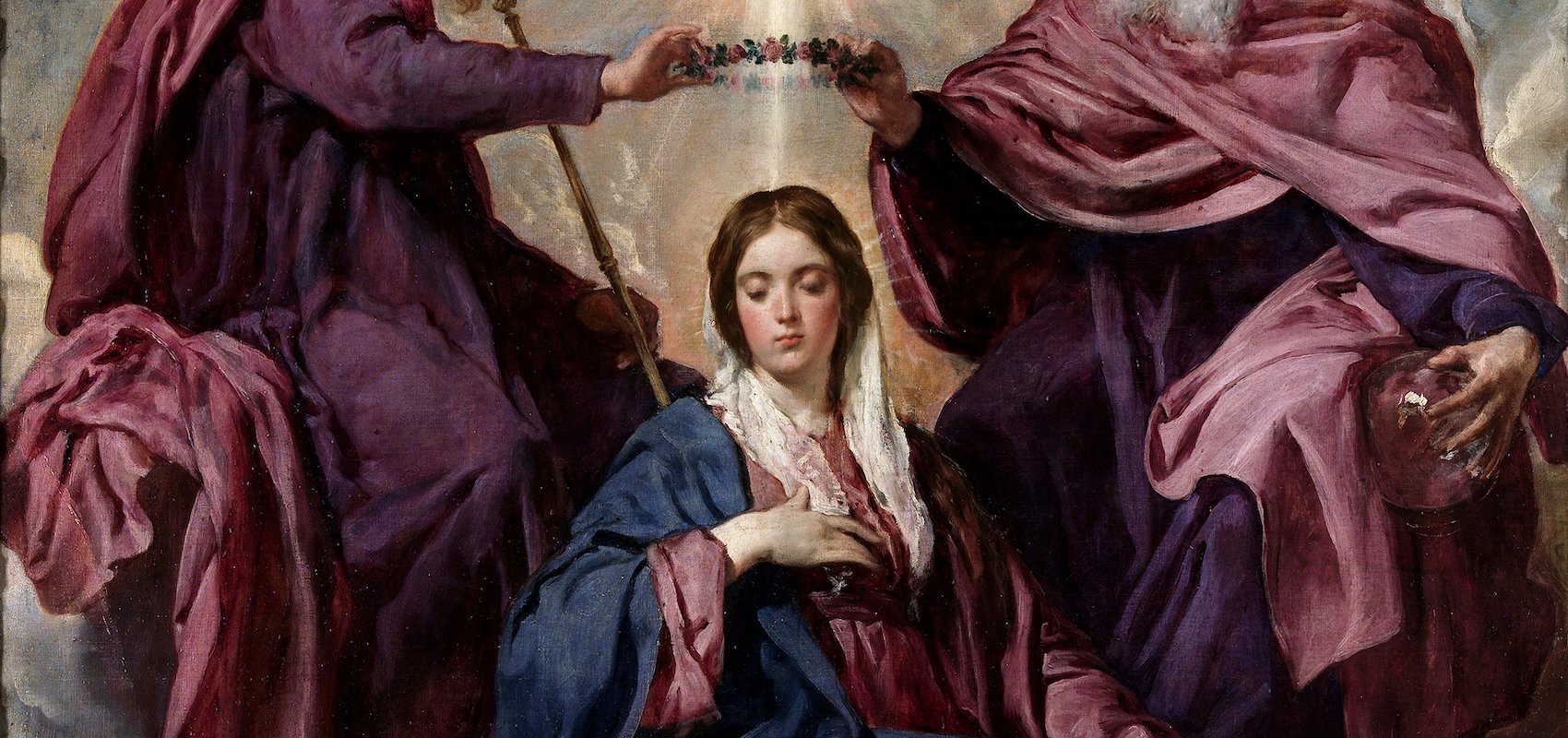
Is confusion surrounding a doctrine sufficient reason to suppress it? The Dicastery for the Doctrine of the Faith seems to think so. In the recent document Mater Populi Fidelis, the DDF states that two titles popular in Marian piety, “Co-redemptrix” and “Mediatrix,” should not be used because of the misunderstanding that often surrounds them. Some may wrongly conclude from these titles that Mary plays a role equal to Jesus in both redeeming the human race and mediating to it the grace of God the Father. Such conclusions fail to affirm that Jesus Christ is the sole and unique Redeemer and the “one mediator between God and men” (1 Tim. 2:5). The “many, repeated explanations” that these titles require make them, in the DDF’s estimation, “always inappropriate.”
The concern about potential confusion resulting from Marian titles and doctrines is nothing new. In the debates leading up to and during the Second Vatican Council, a number of bishops and theologians resisted the Council’s affirmation of Mary’s virginity in partu, the doctrine that Mary, in giving birth to Jesus, preserved her physical integrity whole and intact. Although that doctrine enjoyed a universal consensus among the Fathers of the Church and was taught without controversy by numerous popes and doctors down the centuries, it was dramatically reinterpreted in the middle of the last century to mean simply that Mary, the virgin, gave birth. The reimagining evacuates the doctrine of the virgin birth of meaning and collapses it into virginity ante partum, that is, Mary’s virginal conception of Christ. The Doctrinal Commission sought, through the timely ecumenical council, to affirm the traditional understanding and decisively reject the small but vocal band of theologians who endorsed the novel view.
Much of the resistance to the Council’s clarifying aim came from northern European bishops, heavily influenced by Karl Rahner. They were concerned that the doctrine of Mary’s perpetual virginity sows confusion about her role in the incarnation, and that the misunderstanding that easily follows makes dialogue and cooperation with Protestants more difficult. The intervention of the German-speaking bishops, spearheaded by Rahner, stated that an affirmation of the time-honored teaching would imply that natural birth is therefore corrupt and contaminated. They desired to have the specific word “integrity” replaced with the more general “virginity.” Failing to do so, they wrote, would cause “horror” among Protestants at this latest Marian accretion. The Council did ultimately affirm the traditional teaching, heeding the plea of Augustin Cardinal Bea, then-president of the Pontifical Council for Promoting Christian Unity, that only through clear and repeated explanations of the truth can difficulties with Protestants be overcome.
Other Marian dogmas and titles have faced similar obstacles, from the Theotokos controversy at the Council of Ephesus in 431 (affirming that Mary is not merely the “Mother of Christ,” but that she is and can properly be called the “Mother of God”), to the widespread misunderstanding that Mary, in her Immaculate Conception, is thus exempt from Christ’s redemption. Rare is the doctrine that has not, at some point, faced its share of controversy, from the homoousious debates surrounding the Arian crisis to, more recently, the easily misunderstood doctrine of extra ecclesiam nulla salus: When we affirm that “outside the Church there is no salvation,” we do not state that any non-Catholic is damned, but that every human person who is saved is saved through the grace of the Catholic Church.
The most important question in all of these doctrines is whether or not they are true, and then finding the best vocabulary in which to explain and defend them. Such is the constant task of the Church and her preachers and theologians. It is certainly true that Mary, with her pierced heart, shares in and cooperates with the redeeming work of her Son. It is also true that Mary mediates the grace of her Son, who first came to the human race “born of a woman” (Gal. 4:4). The Fathers understood that everything that can be said about Mary can be said about the Church, and vice versa, an equivalence that Vatican II reaffirmed in the fraught placement of the Marian schema within the Constitution on the Church. The grace of Christ comes to us through his Church, of which Mary is the mother, personification, and preeminent member.
The truth behind these doctrines, however, remains distinct from the question of whether or not their accompanying titles should be formally bestowed. Unlike other time-honored titles or defined dogmas, “Co-redemptrix” and “Mediatrix” and the reality they express are not unique to Mary. All of us are called to be co-redeemers, to “complete what is lacking in Christ’s afflictions” (Col. 1:24). To the extent that we take up our cross and follow Jesus, we participate in and cooperate with his redeeming work. Likewise, all of us are called to be mediators or instruments of his grace, a role we carry out whenever, for example, we follow through on someone’s request to pray for them. Mary’s co-redeeming and mediating roles surpass those of any other creature, but it remains a difference of degree, not of kind.
The same is not true of the Marian dogmas: She alone is Mother of God; she alone of all women is mother while remaining perpetually virgin; she is the only human person ever conceived without sin and whose soul remained united to its body at the end of its earthly life. That uniqueness obtains in each of the many titles in the Litany of Loreto: No one else can be called, even analogously, “Virgin of Virgins” or “Queen of Martyrs.” It is one thing, then, to explain and defend the truth that Mary is a co-redemptrix and a mediatrix of graces. It is another thing entirely to declare her the Co-redemptrix and the Mediatrix, implying a uniqueness and exclusivity in those roles that she does not in fact have.
There are, then, theological grounds to affirm Mary’s co-redeeming and mediating work, and also grounds to refrain from bestowing them as formal titles. The discernment of these reasons remains the task of theologians. The potential for confusion, though, ought never to impede or discourage the pursuit of theological truth. Rather, it should inspire the Church to take up the challenge these teachings present, refining and proclaiming them with the courage of her own convictions. Failure to do so would only deepen the very confusion she seeks to avoid.

YOU MIGHT ALSO LIKE
Turned Away on Palm Sunday
In politics, diplomacy, war, or pretty much any field of human interaction, one must contend not only…
A Medieval Pilgrimage in Modern Assisi
When you go to the hilltop town of Assisi, you’re immediately struck by how medieval it is:…
Via Crucis, 2026
The Way of the Cross—and the third, seventh, and ninth stations in particular—has been an especially appropriate…
