

Why Religion Went Obsolete:
The Demise of Traditional Faith in America
by christian smith
oxford university, 440 pages, $34.99
Christian Smith, a sociologist at Notre Dame, has a knack for turning academic research into books that resonate beyond the ivory tower. The concept of “moralistic therapeutic deism” (from Smith’s 2005 book Soul Searching, co-written with Melinda Lundquist Denton) has entered the lexicon. Why Religion Went Obsolete deserves to have a similar impact. Academically rigorous, yet accessible to pastors and educated lay Christians, it combines standard data sources and Smith’s own survey work with insightful cultural analysis to provide a powerful exposition of some of the most important cultural changes in post–Cold War America.
There are many ways to frame the decline of Christianity. One lens is “secularization,” an account perhaps best articulated in philosopher Charles Taylor’s A Secular Age. Taylor gives a narrative spanning more than five centuries to show how we arrived at our current moment. My own “three worlds” model (First Things, February 2022) focuses on the period since 1964, and especially the Negative World that has been upon us since 2014, a world in which elite secular culture views Christianity negatively—or at least skeptically.
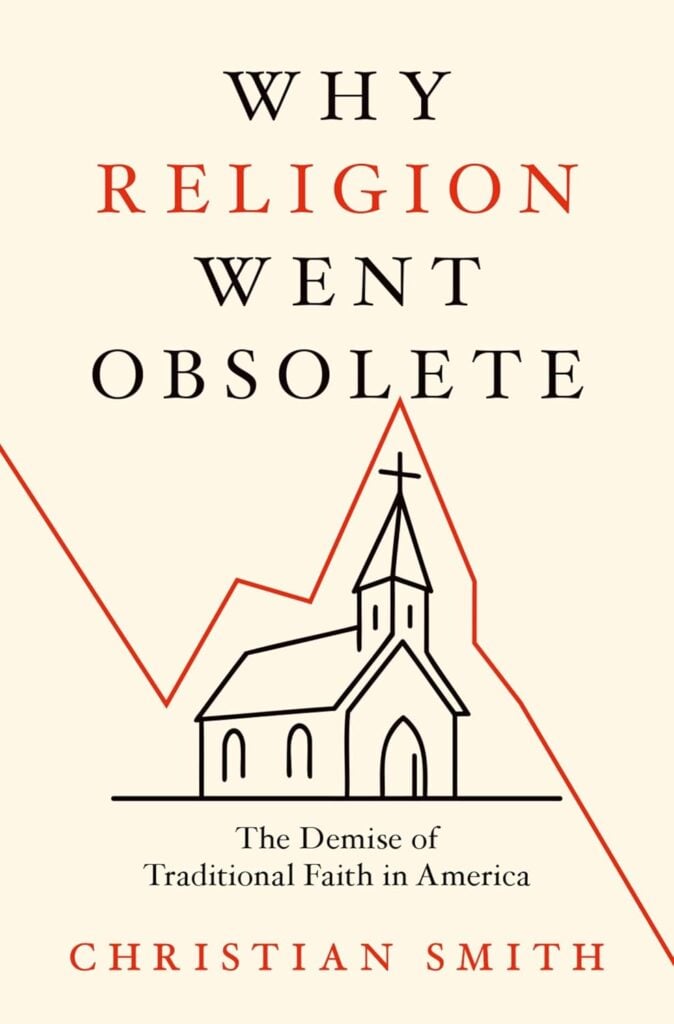
Smith offers a useful new lens: obsolescence. Religion is now obsolete—that is, “most people feel it is no longer useful or needed because something else has superseded it in function, efficiency, value, or interest.” This doesn’t mean that religion is hated or that no one is religious, merely that the world has moved on.
The book notes that in addition to spiritual goods, Americans once expected religion to provide immanent ones. An example is the inculcation of morals, especially in children. Religion is supposed to help people cope with the ups and downs of life. It is expected to foster social harmony and national identity. Far fewer people today see traditional religion as either providing these goods or necessary to provide them. And, as we’ll see, many Americans have found new forms of spirituality, which they perceive as providing the spiritual goods they might once have sought in Christianity.
As Smith writes, obsolescence doesn’t mean extinction. “Some people still can and do use obsolete items because they are familiar, less expensive, viewed with affection, or as a matter of principle.” Traditional television is becoming obsolete because people have moved to on-demand digital streaming and social media. Many people still watch TV, but as a medium it is in decline, with viewers skewing older. Print newspapers are even more obsolete. At age fifty-five, I still take the Financial Times, Wall Street Journal, and New York Times in print. But younger generations have moved on.
In the short term, nothing stops you from using an obsolete product or practice. But it is no longer relevant to most other people’s lives, and eventually, social changes will make sustaining obsolete practices difficult. Horse and buggy transportation is obsolete: The Amish continue to use it, but doing so requires them to maintain a lifestyle that is detached from mainstream American life. Print newspapers may be even less sustainable. When they are no longer produced, people like me won’t be able to buy them at all.
Smith’s framing device helps us understand certain features of today’s religious landscape. First, it can explain why there are still many millions of practicing Christians, and why Christianity may well persist indefinitely into the future in America. Obsolete doesn’t mean extinct. Second, it allows us to see that the shift in views of religion in America wasn’t driven by any anti-Christian or anti-religious animus or plot, but rather, as I outline below, by a complex matrix of social changes. As Smith writes, “very little of what caused American religion’s obsolescence was planned or intended by anti-religious agents.”
Smith also helps us understand that, over time, obsolescence is likely to make sustaining the practice of Christianity more difficult. Already, for example, youth sports leagues schedule games on Sunday mornings. These sorts of changes are a product of obsolescence, and have little conscious relationship to religion at all.
For Smith, social survey data show a break in social attitudes starting in 1991—close to what I identified as the start of the Neutral World in 1994. In fact, multiple independent analyses show that something did change in the culture of post–Cold War America. Religion had been a key weapon in the West’s moral war with the avowedly atheist Soviet empire, and its collapse was consequential because it allowed Christianity to be unbundled from what it meant to be a Western, liberal, democratic society. In Smith’s view, the shift to religious obsolescence was largely complete by 2009—a little earlier than my suggestion of 2014 for the start of the Negative World, but comparable.
The most impressive thing about Smith’s book is how many social trends and events he adduces—both inside and outside the church—in support of his thesis. By my count, he discusses forty-one different historical developments, ranging from the increasing number of women in the workforce to the rise of televangelism to global neoliberal capitalism to postmodernism. Most of these developments will be familiar to readers already, but together the effect is overwhelming.
For example, Smith discusses the impact of global neoliberal capitalism. Religion in America has implicitly been associated with settling down, rootedness, and stability. Neoliberalism, by contrast, values mobility (of goods, services, capital, ideas, and labor). It created a more competitive environment for careers, which required younger people to focus on and invest much more time in them. It imposed an ethic of dynamism and constant change—moving geographically, changing teams, learning new skills, and so on. Neoliberal values were also at odds with Christianity, Smith writes: “In a thousand and one ways, neoliberal capitalism socializes people to value autonomous individualism, continual innovation, material prosperity, market exchange relations, consumer satisfaction, endless competition, globalized cosmopolitanism, and the monetizing and marketizing of almost all aspects of life.”
As one might expect, Smith also discusses the digital revolution as a force undermining traditional religious practice. The internet has taken up large amounts of our time, created new ways of finding more flexible and less demanding community, made it easier to broadcast negative stories about religion (or religious figures behaving badly), broken the monopoly previously held by official sources of information, and given religious doubters the ability to build communities of their own and look for recruits.
On topic after topic, Smith describes not just the phenomenon itself, but also how it worked to undermine traditional religion. Obsolescence results not from any one phenomenon or even a handful of them, but from their combined force. This fact makes his analysis difficult to refute: Even if a reader were, for example, to disagree with his view on ten of these trends, that would still leave more than thirty.
Not all of the book is equally compelling. When he arrives at the 1990s and 2000s, Smith uses the term “Millennial zeitgeist,” leaving unclear what exactly he means and even whether he is referring to the Millennial generation or just the millennium. The term seems to add little, even if Smith’s remarks on the era and his own survey findings are typically insightful.
“Traditional religion”—Christianity and Judaism—may be obsolete. But there are new forms of religious sensibility that are better aligned with today’s cultural conditions. We can think of it as a form of re-enchanted spirituality: an individualized, personally customized, syncretic form of religion that is spiritual but not religious, is seen as a means of discovering and realizing one’s authentic self, and often draws on Eastern religious influences or the occult. It is the kind of spirituality Rod Dreher wrote about in his book Living in Wonder.
Smith summarizes the point: “Religion did not become obsolete because secularity won the day. Religion lost out in good measure because alternatives that are actually more like religion than secularism emerged as cultural options that proved attractive to many post-Boomers. These ideas and interests replaced religion more easily than secularism could. Traditional religion has to compete against spirituality and occulture.” Religion’s decline, he argues, “has not been due to its farfetched belief contents—as most atheists and some secularization theorists would have it—but because of its own fossilized cultural forms that it was unable to shake.”
The implications of Smith’s book are challenging for conservative American Christians whose strategies for the future have tended to involve doubling down on the very elements—the “fossilized forms”—of traditional religion that are now obsolete: rootedness, stability, family-centeredness, thick community, institutions, and historic practices and distinctives. This is the paradigm of Rod Dreher’s Benedict Option and, to some extent, of my own work.
But if Smith is right, this strategy will probably only ghettoize the Church by making it even less relevant to mainstream society. It is the “build an ark” approach, which is designed to help the Church survive cultural change but which at some level involves giving up on or disengaging from society.
An alternative, to reconstruct Christianity so that it aligns with new cultural conditions, would represent a new form of seeker sensitivity, which would come with its own downsides. It’s by no means clear whether it is possible to do this and remain fully within historic Christianity. The evangelical Emerging Church movement tried it in the 1990s by embracing the postmodernist moment, but it failed to build or sustain institutions and went into steep decline. What was left of it ended up abandoning Christian orthodoxy and merging with progressive Christianity. This is a cautionary tale about attempting to embrace social trends.
But regardless of how the Church responds to today’s world, Smith’s book represents a powerful cultural diagnostic, which American religious leaders need to read and take seriously. The implications for the future of American Christianity are profound.

