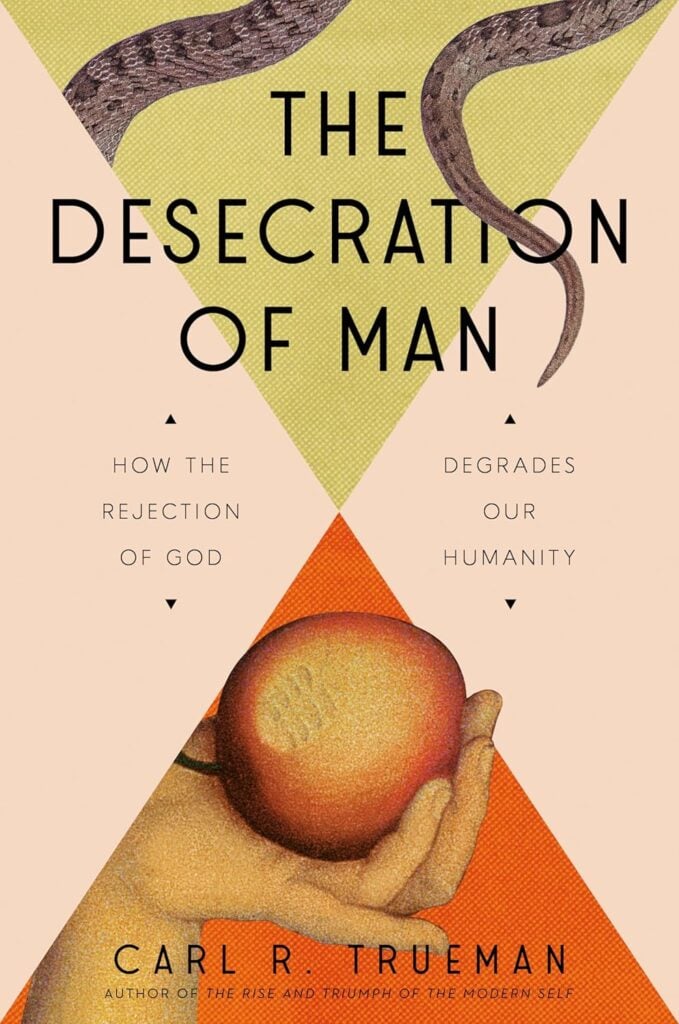
The Desecration of Man:
How the Rejection of God Degrades our Humanity
by carl r. trueman
penguin, 256 pages, $29
The 2020 publication of The Rise and Triumph of the Modern Self established Carl Trueman as one of the most incisive commentators on the pathologies of the late modern condition. Recognizing the sexual revolution as a fundamental assault on the very notion of human nature, and taking its contemporary triumph as his starting point, Trueman traced not only the transformation in modern conceptions of the self, the “expressive individualism” that underlay the revolution, but also the social and intellectual history that would lead to individualism’s peculiar expression in a form as unlikely as transgender ideology. The book came as a revelation and—appearing as it did at the very height of “wokeness”—as something of an event.
Trueman’s new book, The Desecration of Man, should further cement his authority. It supplements, focuses, and in some fundamental ways deepens the analysis of The Rise and Triumph of the Modern Self, despite being briefer and composed for a more popular audience. That many in the political class now glorying in their alleged triumph over wokeness have become champions of IVF is an indication that the fundamental question “What is man?” has not been heard, much less answered.
The book is vintage Trueman. It is clear-headed, exquisitely written, and profoundly learned, deftly deploying theology, philosophy, history, and literature in the analysis of contemporary social phenomena, binding them into an intelligible unity, and deepening our understanding of the defining pathologies of the age. Trueman’s characteristic combination of accessible thinking, eloquent prose, and erudition makes The Desecration of Man—oddly, given its subject—a real pleasure to read.
Trueman’s analysis starts from his dissatisfaction with recent lamentations over the “disenchantment” of the modern world. The disenchantment thesis does not go far enough, in Trueman’s estimation. It cannot account for the perpetual revolution against all forms of givenness that characterizes contemporary social life, nor for the pace of revolutionary change in recent years. It does not account for the unity of vision that makes ideological allies of BLM activists, LGBTQ radicals, and the terrorists of Hamas and Hezbollah. It does not account for the progressive transformation of abortion from a tragic necessity into something to be celebrated and “shouted,” or the enthusiastic embrace of biotechnology by many on the right. It does not account for the transgressor as the archetype of the moral hero or the lust with which contemporary political actors overthrow what was once considered decent or sacred, as seen in the evident delight of some on the right in terrorizing immigrant populations or the European Parliament’s celebration of the image of a queer BDSM Jesus (to note two of Trueman’s many examples). “And this has all occurred in a matter of decades; centuries of Christian cultural dominance have not simply faded away”—as they would under conditions of mere disenchantment—“but have been ecstatically torn down. How has this all happened so suddenly?”
The question is partially answered by Nietzsche in his madman’s famous announcement of the death of God, which also meant the death of the natural and moral order—the “limits, obligations, and ends” premised on God’s existence. But it is the madman’s suggestion that we must ourselves become gods to appear worthy of so great a deed, annihilating all vestiges of the created order so that we can create ourselves, that brings us closer to the heart of Trueman’s thesis. It is desecration, and not mere disenchantment, that best describes our condition.
Desecration differs from disenchantment in a couple of important respects. It implies “the intentional abuse or destruction of something holy, something of more than ordinary significance.” Not only is desecration intentional; it is also exhilarating. This fact is crucial for understanding how desecration became a moral imperative and the default project of our “culture-creating classes: artists, politicians, educators,” a project Trueman explores in great detail. The imperative of desecration requires that human exceptionalism be eliminated, lest some trace of the imago Dei remain.The inevitable result, across every sphere of life, is the belief that human beings can create their own meanings and even their own natures, a belief that terminates tragically in human objectification. Desecration also explains the glee with which the moral codes and categories shaped by Christianity are now repudiated. Ours is not a world in which “God has simply died. It is one where we have taken delight in dancing on his grave, for in doing so we have granted ourselves divine status.”
Nietzsche understood this, and indeed performatively embodied it unto his own madness (a tragic sign of his integrity, one might say). But at the time of Nietzsche’s appearance, the inertial force of a once Christian culture was still too strong. Nietzsche’s contemporaries could not apprehend the gravity of the divine murder or rise to the challenge of becoming gods. “Backdoor” philosophers such as Kant exemplified Nietzsche’s definition of nihilism by devaluing their own highest achievements. Wielding the assassin’s knife in one hand, Kant resuscitated with the other by seeking consolation in the morality that the dead God had made possible. Roger Scruton and Richard Dawkins occupy a position in Trueman’s thought analogous to the role of Kant in Nietzsche’s, as exemplars of “nihilism repackaged.” Obviously, Scruton and Dawkins are very different thinkers—indeed, the disparity between them seems to be part of the point. Trueman professes his gratitude and even his intellectual indebtedness to Scruton, whereas he is clearly impatient with Dawkins’s late appreciation for the Christianity he did so much to destroy. The point of this unlikely pairing is that any thinker who values Christianity for its social benefits rather than its truth will turn out to be a nihilist in Nietzsche’s sense.
In proclaiming the death of God, Nietzsche’s madman was less a lone assassin than a prophet, bursting into the marketplace with his lantern to shine a light on the meaning of a deed that had already been collectively done. This is Nietzsche’s role in Trueman’s thought as well: to cast fresh light on historical developments that were already long underway by Nietzsche’s time, developments that have culminated in our post-Christian and post-human present. Two factors stand out in bringing the “hour of the madman” to fruition. The first of these is the rise of the “expressive individualism” whose origin and history were traced in The Rise and Triumph of the Modern Self. The second factor was largely overlooked in the earlier book: the stunning advance of technology that transforms our relation to time, place, body, and tradition in fundamental and unprecedented ways. It is illustrated powerfully in chapter 2, where Trueman draws on Charles Taylor’s concept of the “social imaginary” to contrast our experience of these relations with the experience of a twelfth-century English peasant.
The assumptions and expectations of the social imaginary have been transformed in mutually reinforcing ways by “the liquefaction of the world via changes in technology, and the move inward to find the authentic self.” The technologization of the body detaches what’s left of the soul from any meaning inherent in the body’s form, and the identification of the self with felt identity eliminates all limits on biotechnical intervention, save that of possibility. Together they “shape a social imaginary inclined toward a kind of iconoclasm,” encouraging us “to be transgressors.”
Chapters 4 through 6 prosecute the second half of Trueman’s thesis, that we are still not “worthy” of this dark deed. The exhilaration of desecration heralded by Nietzsche has not led (and will not lead) to our becoming gods; instead, it has “plunged us into the passivity that is simply another form of nihilism.” The Promethean effort to will our super-humanity annihilates our humanity. The wages of desecration are degradation. Trueman adduces three areas of contemporary life in which the desecration of the human being, the annihilation of its given “limits, obligations, and end” through the combination of expressive individualism and technological domination, have resulted in human degradation and suffering.
Chapter 4, on “Endless Sex,” interprets the category of sexual identity as a fundamental redefinition of the human being, considering its place in our politics and the indispensable role played by technology in bringing about this primacy and realizing its consequences. Contemporary phenomena such as sexual libertinism, abortion, and pornography take on new weight as symptoms of the self-contradictions and false promises of the sexual revolution. The failure of the revolution to deliver on its promises is further exemplified by the contradictions of the #MeToo movement, the conflicted nature of contemporary feminism, and the logical conflict between “the LGB and the T and Q in the LGBTQ+ movement.” Each of these phenomena makes sexuality the locus of our self-creation while tacitly acknowledging a residuum of inherent meaning. The contradiction is evident in all sorts of ways, not least in the special gravity we accord to sexual crimes and in the way the concept of homosexuality depends for its intelligibility on normative biology. Such theoretical contradictions are not a problem, of course, for ideologues who have renounced the obligations of reason and made thought instrumental to political purpose. But the theoretical contradictions terminate in practical entanglements from which there is no escape. “Here we run into the dilemma that lies at the heart of the sexual revolution: That which promises to liberate us as individual agents, able to express ourselves and thus achieve authenticity, ends up creating a world where we are doomed to experience life as objects.”
Chapter 5 is titled “What Is Man in an Age of Mechanical Reproduction?” Here Trueman draws out a similar contradiction in the growing regime of assisted reproductive technologies such as IVF, which treat the nascent human being as an artifact, subject to “quality control procedures,” destined to be selected, commodified, and ultimately improved upon through the eugenic capacities of modern genetics. The related practice of commercial surrogacy downgrades the surrogate to a mere “service provider, her body a tool for the production of a commodity.” One wishes Trueman had explored these issues further, as there is much more to be said, but he is right to say that this brave new world entails a “comprehensive revision of what it means to be human,” a revision with dystopian consequences.
Chapter 6, “The Final Enemy,” outlines the contradictions in our attitudes toward death in the aftermath of God’s demise. Our tendency is simultaneously to deny and to trivialize it, as we seek both to avoid death through technological assaults on the body and to take it in hand through the “pre-emptive, controlled strikes” of euthanasia—which is spreading throughout the once Christian West in a final, paradoxical sign that the end result of our technological prowess is the downgrading of human lives. “Death is the final proof of the unity of soul and body, and of our own nature as dependent creatures.” As Trueman observes, “There is nothing like standing at the graveside of a loved one to make one aware that human nature is not a social construction.”
Trueman’s diagnosis is sound. By introducing the category of desecration, he identifies an inner unity to the otherwise disparate symptoms of our pathological anti-culture. Moreover, he homes in on the anthropological question—“What is man?”—and the theological question that lies behind it.
Trueman rightly notes that the anthropological question has been a longstanding preoccupation of Catholicism. Aided especially by the profound diagnosis of Henri De Lubac, the Church at the Second Vatican Council recognized that the reduction of theology to anthropology, which began with Feuerbach, terminated tragically in the reduction of man. The Church responded to this crisis by placing an anthropology rooted in Christology at the center of its deliberations, a move that became thematic during the pontificates of John Paul II and Benedict XVI. “Whoever defends God is defending man,” the latter said in the waning days of his pontificate.
I share Trueman’s dissatisfaction with the renewed emphasis on disenchantment, not least because re-enchantment always seems to mean either “Weird things are real” or “Less reason, more poetry,” neither of which quite gets to the heart of what is lost in a disenchanted world. Re-enchantment never seems to mean the rediscovery of the intrinsic unity, intelligibility, finality, and existential indivisibility that were tossed aside with the overthrow of scholastic Aristotelianism as our New Atlantis came into existence. Nevertheless, Trueman wrongly places desecration and disenchantment in opposition. The rise of Trueman’s “expressive individualism” always entailed a “naughting” of the world, both logically and historically. Trueman’s own analysis demonstrates this necessity time and again. The interminable drive toward technological control became our overwhelming preoccupation and collective raison d’être only because meaninglessness was made a transcendental attribute of being in everyorder of life—social, political, scientific, and religious—de jure as well as de facto. Nihilism is a prerequisite for technological dominion.
When we understand desecration as a corollary of disenchantment, the exhilaration Trueman attaches to desecration can be understood more fully—and in a manner that better accords with how desecration presents itself in contemporary culture. For such exhibitions are not characterized by Dionysian intoxication, much less the joyful exuberance that characterizes Nietzsche’s thought. Queer theory is not a “gay science” on the model of Die fröhliche Wissenschaft. Rather, our pervasive desecrations are marked above all by anger, and just below the surface by a quiet, or not so quiet, desperation. Acts of transgressive desecration appear less as fits of Dionysian intoxication and more as attempts to find a pulse, to discern some vitality in a meaningless universe and some form of agency in the face of the intractable systems of power in which we are enmeshed. Trueman’s penetrating reflections on death as the backdrop for our sexual libertinism come very close to this insight.
Our desperate situation has provoked a surprising new interest in religion among elite intellectuals, as Trueman observes. Yet such interest is destined to remain but a subtle form of nihilism, with the “values” of religion devaluing themselves, unless the revival is rooted not in the perceived cultural benefits of Christianity, but in the truth of Christian claims about God and man. This is the point of Trueman’s final chapter and the conclusion of the book as a whole.
Despite much profound and needed analysis, in my view the book does not do full justice to its own thesis. “The answer to desecration is consecration,” a term Trueman defines under the headings of “creed, cult, and code.” “Creed” refers to the beliefs that define a faith, “cult” to the worship practices of a church, and “code” to the moral habits and practices that define Christian life. These are doubtless necessary conditions for any hoped-for reshaping of our culture, but they are hardly sufficient. Stripped down to these essentials, Trueman’s answer reads like a “congregationalist” solution to a problem of universal—which is to say, Catholic—proportions, a problem that could be solved if Christians just tried harder. But precisely what is at stake in the problem of desecration and the crisis of modernity more generally—what was always really at stake in the question of disenchantment, however inadequate that formulation—is the meaning of the whole(kata holos). And a problem of the whole, by definition, cannot be resolved in part.
The “catholicity” of the problem emerges more clearly if we reverse Nietzsche’s declaration and ask what it would really mean to affirm that God is alive. What would be affected? And the answer is: absolutely everything. For there can be no aspect of reality that falls outside creation and thus no aspect of reality that is not interiorly affected by its being from and for God. We would have to look differently at everything: man, being, nature; knowledge, truth; the ends of politics; the meaning of history. In short, we would need to recover the cosmological scope of Christianity—a work not only of faith and morals but of metaphysics and natural philosophy, literature and art. It would mean recovering a true sense of the catholicity of the Church, indeed of its cosmological significance, not as a part within the secular whole but as the whole that contains and judges the world.
I do not mean this case for catholicity to be triumphalist. We hardly know what this Catholic solution would mean, formed as we are by the concepts that come naturally to a godforsaking world, and Lord knows the extent to which Catholics have acquiesced in atheism’s triumph. The death of God is not an event external to the Church and its self-understanding. But it defies logic to think that the life of God can be apprehended in full apart from the restoration of the catholicity—the cosmological significance and the concrete unity—of the Church.
Trueman might well agree with much of that last paragraph, though I do not wish to minimize whatever disagreements he, as an Orthodox Presbyterian, would undoubtedly have with my characterization. And in fairness, his proposal of consecration is the conclusion of the book, not its argumentative burden. But it is a conclusion that invites the impolite question that at some point must inevitably arise: whether Protestantism is an antidote to the death of God or a stage in his protracted demise. Carl Trueman’s excellent book is to be commended not only for the breadth and profundity of his insight into the meaning of our historical moment, but also for bringing us nearer to that question.
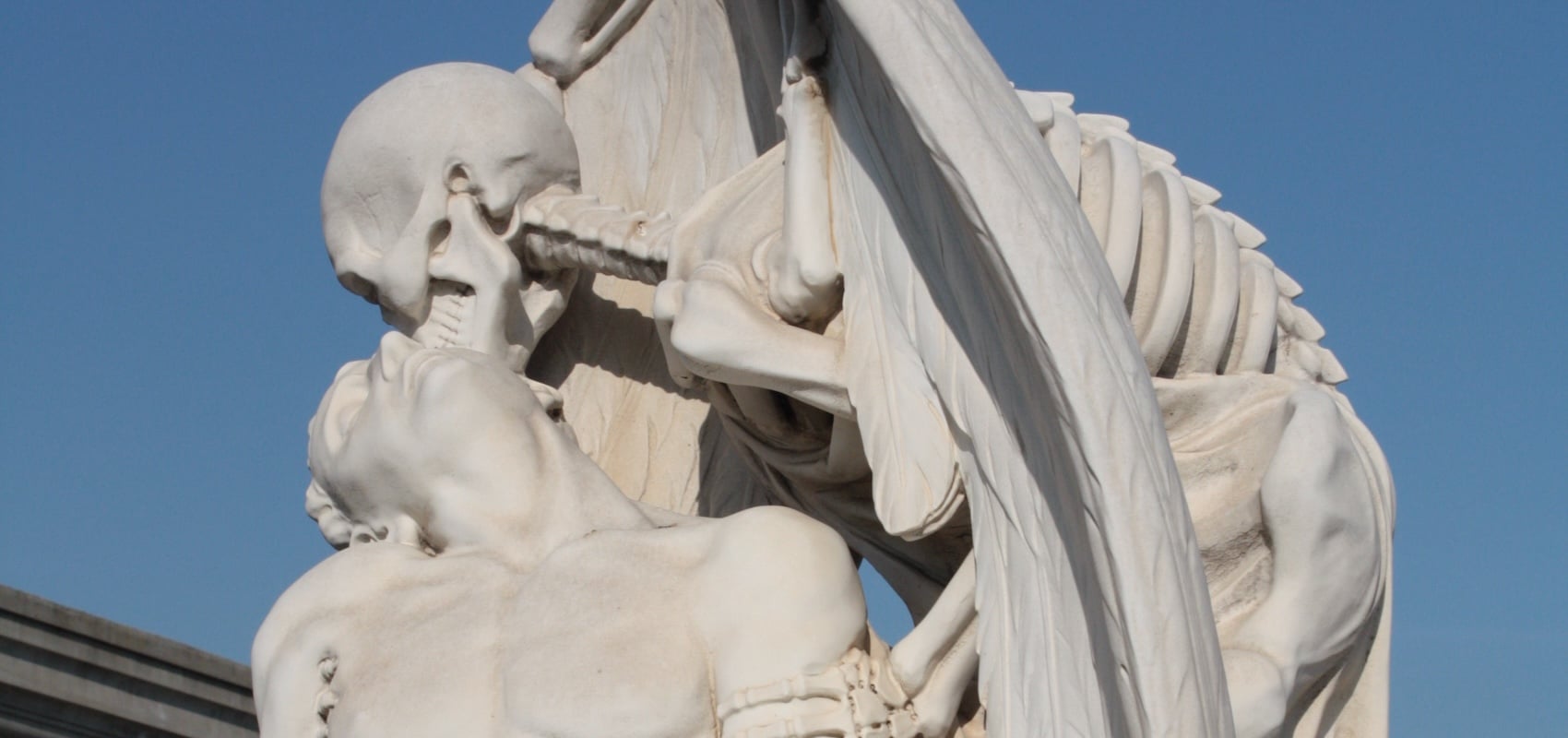
Image by Enric Juan, licensed via Creative Commons. Image cropped.