

Christianity is cropping up in unexpected places. This summer, Jordan Peterson chatted with Elon Musk. In his inimitable way, Peterson digressed into the long-dead religions of Mesopotamia, tying ancient wisdom to brain science. Musk responded with thoughtful comments about the meaning of life. The conversation was edifying, a nice change from the usual fare.
Then Peterson, who was wearing a loud dinner jacket featuring images of the Madonna and Child, took up the question of forgiveness and turning the other cheek. Musk confessed, “While I’m not particularly religious, I do believe that the teachings of Jesus are good and wise.” He allowed that he is best described as “a cultural Christian,” and he observed that Christian beliefs have done a great deal of good in the world. “I’m actually a big believer in the principles of Christianity. I think they’re very good.”
Musk was not confessing faith in Christ. Earlier in the interview, he had outlined his belief in what he calls “the religion of curiosity” or “the religion of enlightenment,” which involves asking the right questions about life. Nonetheless, Musk was staking out cultural territory for faith, expressing appreciation for the role and influence of Christianity.
Something similar had happened in the spring. While being interviewed, the famous atheist Richard Dawkins expressed his regret over Christianity’s diminished influence in British society. Like Musk, he stated that he is not a believer. He was quick to call fundamentalist Christianity pernicious nonsense and tangled with his interviewer over the credibility of Christian belief. In spite of that, he called himself a cultural Christian, and in the face of the rising influence of Islam he was keen to place himself on “Team Christian.”
It’s easy to make too much of passing comments like these. But we should not make too little of them either. Aaron Renn has observed that Christians in the United States now live in a “negative world.” In elite circles, a consensus holds that Christianity is largely a force for evil. Some see it as instilling a dangerous fanaticism, an eagerness to impose dogmas on others. Others fix on sexual morality and regard Christianity as the source of homophobia and other repressive pathologies.
Under present circumstances, therefore, it is notable when prominent and powerful figures say positive things about Christianity. What gives? Are we witnessing a revival of sorts, a cultural resurgence of Christian prestige? Yes and no—or, rather, no and yes.
The negative world that Renn documents is not abating. By some measures, it is intensifying. The New York Times and other organs of the liberal establishment eagerly stoke hysteria about “white Christian nationalism.” A coven of Bible-thumping racists is poised to take over the country! With astounding alacrity, the mainstream media turned JD Vance into a strange, alien, and vaguely threatening figure. His recent conversion to Catholicism was treated as a sign that the blue-eyed, bearded man from Ohio is “weird.”
There’s another dynamic at work, however, one that may be motivating the surge in pro-Christian statements. We live in a polarized country, which means that two sides are consolidating, opposing each other as solid blocks. In this political environment, progressives fix on Christianity as the emblem of all that is harmful to their dreams of a transformed America. As a consequence, those who dissent from progressive political and cultural dogmas, and are increasingly outspoken in their opposition, readily see themselves as members of “Team Christian.”
The full interview with Richard Dawkins makes clear that he is troubled by the consequences of Britain’s hectoring multicultural ideology. The interview took place on Easter weekend, and Dawkins was dismayed that government officials were encouraging the populace to celebrate Ramadan, not the Christian holiday. Had the multicultural commissars been less brazen, were the reigning ideology less aggressive, I doubt Dawkins would have expressed any sympathy for Christianity. He would have remained stuck in the anti-religious ruts of his 2006 book, The God Delusion. Dawkins and Alan Sokal recently penned an op-ed criticizing the politically correct conceit that sex is “assigned at birth” rather than established at conception (the obvious scientific truth). Here as well, his staunch opposition to faith notwithstanding, the realities of the political scene put him and his opposition to transgender ideology on “Team Christian.”
Jordan Peterson and Elon Musk are notorious for their violations of progressive rules and regulations about what can be said or thought. This does not make them believers in Christ as the Risen Lord but puts them on the same side as Christians who are deemed “deplorables,” often for the same reasons. Put simply, as Christianity is targeted by progressives, its cultural intransigence becomes a rallying point for those who oppose progressivism, even as they reject Christianity’s theological precepts.
Last year, Ayaan Hirsi Ali explained why she had converted to Christianity. She framed her turn to faith in terms of a “civilizational war,” one element of which rests in the necessity of resisting woke ideology, “which is eating into the moral fibre of the next generation.” The tools of science and liberal principles are insufficient to meet the challenge. She observes that if we are to renew a culture of freedom, we must return to the deepest roots of the West, the Judeo-Christian tradition.
Ali recognizes that faith is not a cultural-political position in a civilizational struggle. It’s a personal turn toward God, a giving of oneself to the Lord. I’ll wager, however, that her journey to faith began as a cultural commitment and matured into a theological one. This pathway is and will be traveled by others. I can well imagine a college student falling in with Christian peers, saying, “I’m not a believer, but with them I’m free to speak my mind.” That’s not a declaration of faith, but it points in the right direction.
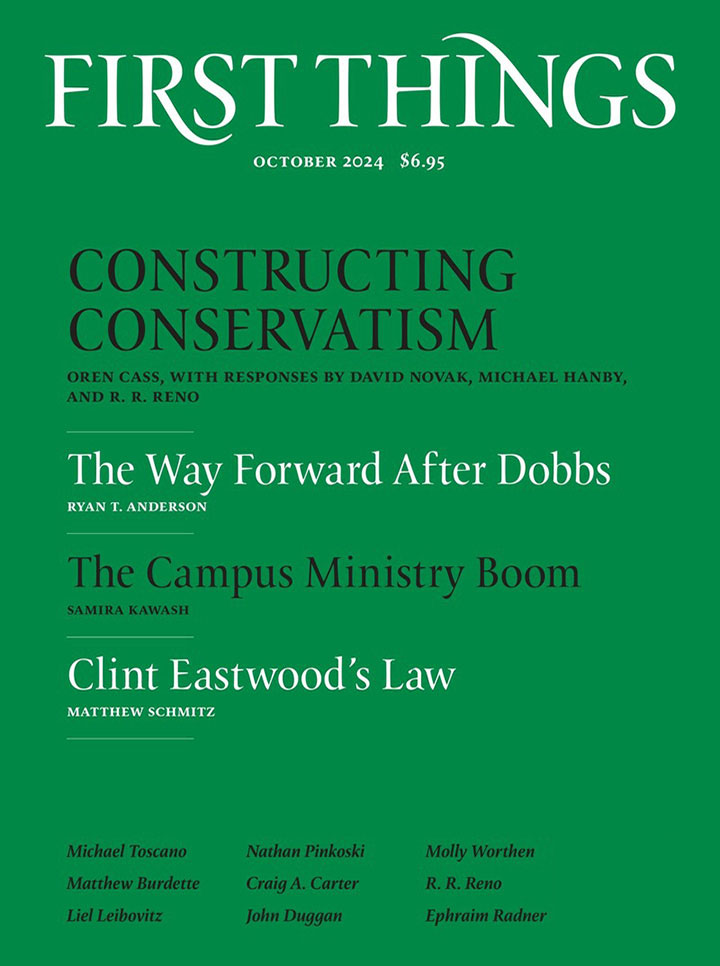
It’s common to note that many come to church for community, or because they seek the beauty found in the music and liturgy. As Samira Kawash observes in this issue (“The Campus Ministry Boom”), these natural goods often draw us to the supernatural good of God himself. The same holds for a healthy culture, a coherent moral framework, and the freedom to use one’s reason.
I had in mind Christianity’s rising prestige among rebels against woke tyranny when I composed the concluding paragraphs of a review of two recent volumes on today’s negative world (Renn’s Life in the Negative World and John Daniel Davidson’s Pagan America) for the Claremont Review of Books:
In the negative world, Christianity is not part of the dominant regime. This imposes burdens. The outsider does not get preferment, and he’s sometimes persecuted. . . . But we are living in a time when populism is on the rise. The insiders are under assault. And people know that the architects of the present, shitty regime, and the enforcers of its increasingly insane dogmas, are not evangelical pastors or Catholic bishops.
In 2016, a large body of alienated, angry Americans noticed that a brash, boastful New York developer attracted the ire of the Great and the Good. The more he was denounced, the more they loved him. Perhaps something similar will happen in the spiritual realm. The more hostile the people who brought us Drag Queen Story Hour are toward Christianity, the more obvious it will be that the churches are an alternative to our failing regime. Will people who are sick and tired of the Rainbow Reich begin to say, “The enemy of my enemy is my friend”?
It’s a hard time to be a pastor or priest. But it’s a good time. Dissent is growing. Few young people trust educational institutions, and for good reason. They’re aware that they have grown up in a cesspool of pornography, have been poisoned by social media, and were sacrificed on the altar of COVID lockdowns. Some, maybe more than a few, will turn to Christ as an anchor in the dissolving, disintegrating culture of the post-Christian West. When a house is collapsing, it’s a great advantage to be on the outside.
May the tribe of cultural Christians grow.
Dear Reader,
Can I be direct with you?
War abroad. Socialists on the rise. AI upending human life. Endless uproar online. The modern attention economy doesn’t want readers — it wants users enslaved to the tyranny of the present.
First Things is the antidote: literary excellence, timeless truths, and a fixed point of reference in a culture that has lost its bearings.
But we can’t do it without readers like you.
Our goal: Raise $150,000 by November 1 to sustain First Things in the year ahead.
Your gift anchors readers in the permanent things.
Make your Fall Campaign gift now using the button below.
If you have any questions or would like more information, please contact Giovanni Del Piero, Director of the Editor’s Circle, at gdelpiero@firstthings.com or 212-627-1985.


YOU MIGHT ALSO LIKE
The Church in the Age of Therapy
In 1966, Philip Rieff wrote in The Triumph of the Therapeutic that “Religious man was born to…
Canada’s Deadliest Blind Spot
On September 20, the Daily Mail ran a story with the provocative headline, “Our 83-year-old Christian grandmother…
The Faithful Joy of Dolly Parton and Fulton Sheen
Dolly Parton and Fulton Sheen seem to have had little in common. She favored rhinestones; he wore…
