
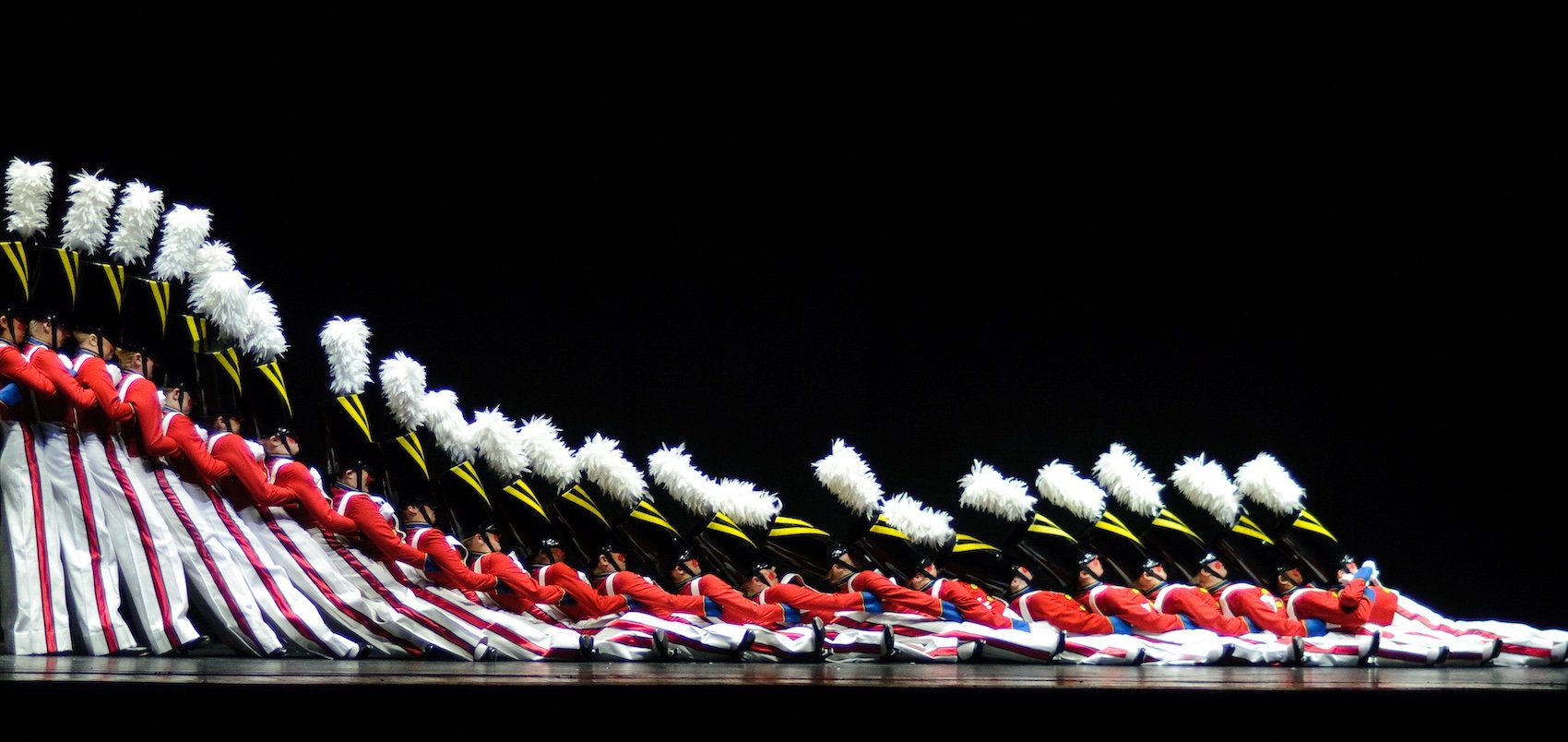
This year marks the Radio City Rockettes’ one hundredth anniversary, and the annual Christmas Spectacular at Radio City Music Hall is an aptly named feat. The century-old show has inspired big-budget iterations in evangelical circles nationwide, including in my home state of Texas. But whereas the Rockettes use spectacle to amplify the sacred foundations of Christmas, these evangelical spin-offs are often excessive and irreverent, losing sight of the reason why we celebrate Christmas in the first place.
Radio City Music Hall boasts a grandeur that amplifies the awe of immersive projections, sparkling costumes, and first-rate performers. The Rockettes’ performances blend in with one another, creating a tight, unified ensemble of bodies in which no individual’s talent soars above the others. The chorus of other dancers and singers manages to do the same with balanced harmony and synchronized movement. The stage never feels too full, however, and the set design is shockingly minimal. When the Rockettes are dancing, there is little else vying for your attention.
There are a few breakout acts, including an ice-skating duo, a young girl playing The Nutcracker’s Clara among other roles, and Santa Claus as the narrator. However, the show’s true high points and overall message convey a vision of unity in which the craft itself—rather than the individual performers—is the object of applause. The audience comes to recognize that the primary emphasis lies not on individual egos, but on the collective effort to advance the story they are constructing together.
The Rockettes’ show famously ends with a living nativity. No longer dressed as reindeers, toy soldiers, frost fairies, elves, rag dolls, or New Yorkers, the performers process across the stage en route to seeing the birth of baby Jesus. With camels, donkeys, and sheep in tow, everyone in the audience hears the Christmas story narrated. The performers, and much of the audience, sing “Hark the Herald Angels Sing,” giving glory to the newborn king as the Holy Family is elevated and venerated by the performers on bended knee. It’s an arresting display of public Christianity.
Many on social media have expressed annoyance at having to watch “the Jesus bit.” One TikToker even said: “I guess I just forget that Christmas is a religious holiday for some people.” Hardened hearts are bound to reject the resonance of such a scene. But there are some Christmas performances that warrant backlash.
The Bible Belt has its own renditions of the Christmas Spectacular that often provoke the ire of online commentators. Typically, the show, or at least the version with which I’m familiar, largely follows the same format as the Rockettes’: beginning with more secular Christmas imagery, song, and dance, and ending with a living nativity. These shows take place in megachurches that can seat thousands, and run for about a week. A description of the Christmas Spectacular in Houston, Texas, states that the show is meant to capture “the wonder and the true meaning of Christmas.”
“Wonder” indeed. Performers dressed as angels soar over the audience belting out “Gloria in excelsis Deo,” and one cannot help but wonder why the church has a flying rig in the first place. A live elephant stands at the edge of the stage during the living nativity, and I truly can’t imagine anyone is wondering at Jesus so much as wondering how they got a real elephant inside the church. Blinding laser light shows rip through the stage during “Winter Wonderland,” and again when Jesus is visited by the wise men. There is no thematic unity.
Videos of these performances circulate online to the glee of those who live for anti-religious discourse, and the commenters don’t seem to understand that most of the performers are children. They are dancing and singing and being a part of something that feels big and technically impressive. They are being elevated by technical theater in a manner I understand very well from my years of community theater performances. But because so many elements compete simultaneously for the audience’s attention, all designed to “stand out,” the effect ultimately collapses into a kind of undifferentiated sensory overload. In attempting to evoke wonder, the people in charge of these shows have seemingly forgotten the simplicity of the manger and the raw power of the story they’re telling.
Clearly, as the Rockettes have demonstrated, spectacle is not at odds with the religious. There are ways to platform the Christmas story, even amidst reindeer and Santa and elves, that allow the virtue and foundations of the Christian faith to resonate. Christians ought to remember that we are the keepers of the story and animating ethos that shape the spirit of Christmas in a way that secular culture cannot escape, whether it acknowledges it disdainfully or not. The best, most enduring Christmas stories—whether they are staged by the religiously unaffiliated or put on by the expressly evangelical—manage to bleed outside of the church’s walls during this season, and they are wonderfully spectacular all on their own.
Image by Bob Jagendorf, licensed via Creative Commons. Image cropped.

YOU MIGHT ALSO LIKE
James Talarico’s Backward Christianity
James Talarico wants to “reclaim Christianity for the left.” That’s the title of the New York Times…
A New Purity Culture
I grew up in evangelical purity culture. Well-thumbed copies of I Kissed Dating Goodbye, Every Young Man’s…
Dimes Square: An Oral History (ft. Nick Allen)
In this episode, Sovereign House and Reign founder Nick Allen joins Virginia and Germán to discuss Dimes…
