
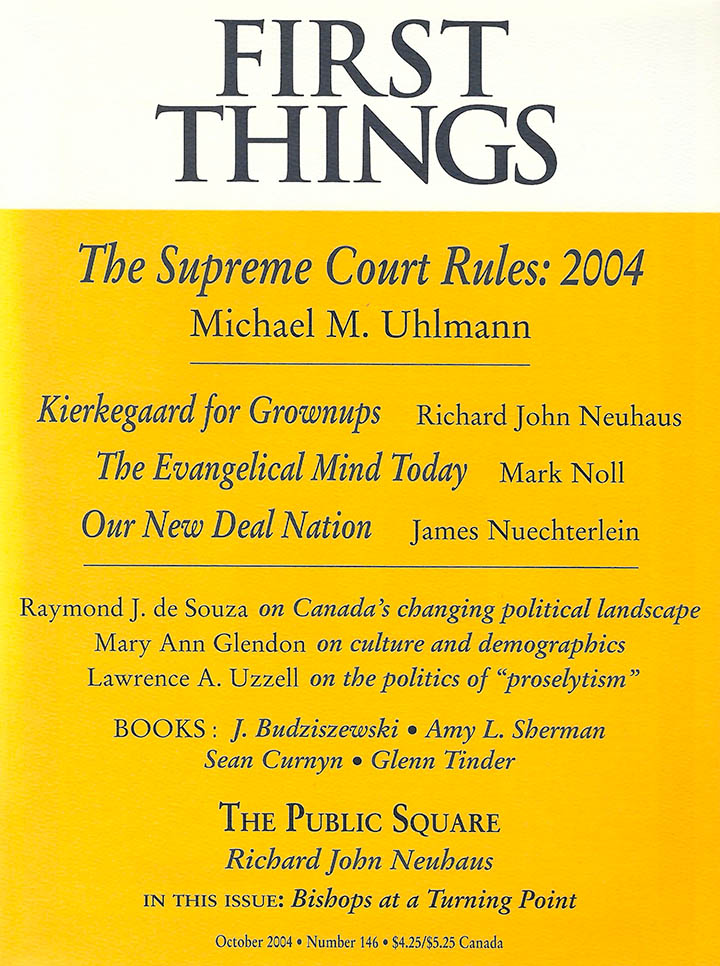
In the nineteen years he has been attending these meetings, says one archbishop, this was unquestionably the best. The sentiment seems to be widespread among the bishops who participated in the semi-annual meeting, held this past June in Englewood, a few miles from Denver, Colorado. The sentiment is hardly universal, however. For some who are more closely bound to an older way of doing things, the meeting had its rough patches. But, for those who loved it, several reasons are offered. There was no press. The bishops were meeting among themselves and had a chance to work through problems without the glare of publicity. They were able to engage in fraternal argument and disagreement without worrying about the next day’s headline, “Major Rift in Bishops Conference.” Equally important, it is said, there was minimum participation by the staff of the national conference, the U.S. Council of Catholic Bishops (USCCB). There are 281 active bishops (active, in this case, means they are not retired) and more than 350 staff members of the USCCB. While the USCCB is the creation of the bishops, and the staff is there to serve the bishops, a common complaint has been that meetings of the bishops are consumed by processing the predetermined agenda of an endless array of committees, subcommittees, departments, and related offices. As the title of a book on the episcopacy has put it, the bishops have become “a flock of shepherds.” In sum, substance was subsumed by process and the bishops have found themselves, willy-nilly, subordinated to those who are supposed to be serving them. That, it is said, did not happen at the Denver meeting.
At Denver there was real discussion and deliberation, and a readiness to engage rather than deny disagreements. Not that the meeting was confrontational, although there were tense moments; but the bishops spoke out as bishops, as shepherds and teachers of the Church, and not as managers of local franchises of Catholicism U.S.A. The most important difference, several bishops say, is that the meeting was intensely prayerful. The homilies at Masses were spiritually and intellectually substantive, there were periods devoted to prayer and reflection before the Blessed Sacrament, and confessors were kept busy. The sense was that, after years of scandal and unremitting attack, they had, by the grace of God, come through a dark night together; wounded and chastened, to be sure, but newly resolved to be more fully the bishops they were ordained to be. Of course, minds were powerfully concentrated by a question that most of the bishops knew could not be evaded or postponed: how to deal with Catholic public figures, meaning mainly politicians, who act in public and persistent defiance of the Church’s teaching, notably on the protection of innocent human beings at the beginning and end of life.
Before turning to that great question and what the bishops did about it, however, a word is in order on what Denver may portend for the future of the American bishops as a body. It is said that Denver may be, just possibly, a turning point in how the bishops deliberate and decide, and how they define their fraternal responsibilities to one another and to the body. As discussed previously in this space, there has been much thought over the last two years about how the bishops might more effectively exercise their leadership. Apparently nobody is suggesting that the USCCB be dismantled, but there is a general sense that something else is needed. The idea of a plenary council for the Church in the U.S. has been widely bruited, but a plenary council has not been held since the nineteenth century and nobody quite knows what it would entail. Some experts say that the pertinent canons prescribe the participation of well over a thousand people, both clerical and lay, thus making it unwieldy, in addition to being ineffective as a forum for deliberation among the bishops. It would also be, some note, forbiddingly expensive.
Alternatively, there could be a special U.S. synod of bishops, but synods of bishops are ordinarily held in Rome and are composed of representatives from the region involved. That would not achieve the goal of enhancing effective collegiality among all the American bishops. So it seems the plenary council and synod proposals have been put on a back burner. They may be moved to the front again, but right now bishops who are looking for a better way are saying, “Let’s do the June meeting again for another two or three years and then see where we are.” In other words, if at least once a year they meet as bishops with no press, minimal staff, a limited and sharply focused agenda, and a generous openness to what the Spirit might do as they engage one another on questions of consequence, perhaps a plenary council or synod will not be necessary after all.
A New Generation
Another reason for talking about a possible turning point is that there seems to be something like a generational change underway. It is not necessarily age specific, being more a matter of when one was admitted to the episcopal club. There is, I am told, a different spirit among many of those who were made bishop from, say, 1995 on. They were not present at the creation of the USCCB system. The last of the founding fathers who knew how to make the machinery work and enjoyed making it work was Joseph Cardinal Bernardin of Chicago, who died in 1996. No other cardinal archbishop has taken over the organizational controls. The late Cardinal O’Connor of New York believed he had more important things to do than to get distracted by national episcopal politics, and his successor, Edward Cardinal Egan, has concentrated on putting New York on a sound financial basis. Cardinal Bevilacqua of Philadelphia, now retired, is an assertively orthodox and independent soul who is impatient with bureaucratic restrictions. His successor, Justin Cardinal Rigali, evidences no ambition to be king of the conference. William Cardinal Keeler of Baltimore steadily attends to organizational duties and has served as president of the conference but has apparently never aspired to run the machine in the tradition of Cardinal Bernardin. The energies of Cardinal Law, formerly of Boston, were applied to curial business in Rome and international troubleshooting. As for Roger Cardinal Mahony of Los Angeles, he is viewed as being off in a world of his own. There was for years the monumental preoccupation with building that cathedral, and now he and his batteries of lawyers have their hands full with abuse charges that will likely see him through retirement. Also monumentally preoccupied has been Adam Cardinal Maida of Detroit, who raised some seventy million dollars for the John Paul II Cultural Center in Washington, D.C., which has turned out to be a cropper in terms of both popular interest and scholarly contribution. So nobody has taken on, or seems likely to take on, the role of conference ringmaster played by Cardinal Bernardin. Some think that Theodore Cardinal McCarrick, moved from Newark to Washington in 2001, may aspire to that role, but after the June meeting that seems unlikely, for reasons we will come to.
If one asks around among knowledgeable bishops, there seems to be near unanimity that the intellectual leader of the conference is Francis Cardinal George of Chicago. Nobody is listened to more carefully and respectfully by the other bishops. It is not simply that he is very bright. He seems to embody a sense of urgency and expectation about the possibilities of Catholic renewal in the U.S. That is joined to a dour—I think excessively dour—assessment of the problems intrinsic to America’s Protestant (he says Calvinist) culture, and he has no illusions about the culturally accommodationist “reforms” of Catholicism over the past four decades. He is strongly, albeit critically, sympathetic to what some describe as a need for a “reform of the reforms.” But he, too, has no ambition to succeed Bernardin in presiding at the master control panel of the USCCB.
A while back, we invited Cardinal George to give a lecture at the celebration of Cardinal (then Father) Avery Dulles’ eightieth birthday, and he took the occasion to present a dramatically different vision of the bishops conference. In contrast to the present apparatus of departments, committees, and subcommittees issuing endless memoranda and position papers on every issue that pops up on the public radar screen, he suggested that bishops should see themselves as part of a deliberative body that participates in the magisterium or teaching ministry of the Church. Close conversation and coordination with Rome, he believes, is not an unwelcome restriction but is crucial to the credibility of the bishops’ leadership. Unlike some critics of the bishops conference, he does not want to downgrade the conference but to upgrade it into a more ecclesial and less institutional-bureaucratic instrument of leadership. Maybe into something more along the lines of what began to happen this June in Denver.
Not surprisingly, Cardinal George’s star is high also in Rome. John Allen, the best of American reporters in Rome, says that when he mentions Francis George in Vatican circles he frequently gets the response, Peccato che lui è un americano. Perchè sarebbe un bel papa. (Too bad he’s an American. Otherwise he would make a great pope.) Because of this country’s dominance in almost everything else, it is assumed that no American should be elected pope. One also has reason to believe that Cardinal George, very sensibly and very definitively, does not want or expect to be pope. He has no ambition other than to be the very best archbishop of Chicago that he can be, and it is the singularity of his devotion to the episcopal task that makes his leadership crucial to what some sense as a turning point in the episcopal conference. In short, he is greatly respected by those who are sometimes called the “new generation” of bishops, the men who are likely to shape the conference of the future.
“JP II Bishops”
These are men who palpably understand their office in ecclesial and spiritual, rather than managerial and career, terms. They evince a serious practice of prayer and are not inhibited in talking about the devotional life. They give top priority to evangelization, and to the re-evangelization of Catholics who seem not to know what it means to be Catholic. They are active in encouraging vocations to the priesthood, proposing it to young men as a course of high adventure and costly discipleship. Very often, they are simply called “JP II bishops.” The term is not meant to suggest that not all bishops respect the Pope. Of course they do. Admittedly, there are still some who are inclined to the view that this Pope has slowed down or stopped the liberal progress that they thought was mandated by the Second Vatican Council. Others are well past that ideological hump, respect the authority of his office, and admire him personally. The JP II bishops, however, have internalized the dramatic teaching initiatives of this pontificate and have demonstrated a zeal in communicating them. They share the Pope’s discernment of the third millennium as a potential “springtime” of evangelization and authentic Catholic reform.
Very importantly, they are men who do not hesitate to speak up and speak well in the company of their fellow bishops. Until recently, the protocol was that those recently made bishop deferred to their seniors and remained silent in conference meetings for several years. That is changing. Another change is noted. Rome is no longer limiting itself to the conventional sequence of episcopal “promotion.” Younger auxiliary bishops are being appointed directly to archiepiscopal sees. The Catholic Church, as one is regularly reminded, is like a very big ship that turns slowly, and, in the gradualness of the turning, “turning points” are hard to specify, but there is a sense that change is underway. The future of the bishops conference, in particular, will be significantly affected by a number of bishops whose names repeatedly crop up in these discussions. Mind you, this is not to be taken as my list of favorite bishops. Some of them I do not even know. No bishop should have his influence crippled by appearing on a First Things roll of honor, so that is not what this is. But in a very unscientific survey of people who pay attention to such matters, there are bishops who are mentioned again and again.
Not in any particular order, the list includes: Bishop William Lori of Bridgeport, Connecticut; Archbishop Charles Chaput of Denver, Colorado; Bishop Allen Vigneron of Oakland, California; Bishop Thomas Olmstead of Phoenix, Arizona; Bishop Samuel Aquila of Fargo, North Dakota; Bishop Peter Sartain of Little Rock, Arkansas; Auxiliary Bishop José Gomez of Denver; Archbishop Sean O’Malley of Boston, Massachusetts; Bishop Leonard Blair of Toledo, Ohio; Archbishop John Myers of Newark, New Jersey; Bishop Robert J. McManus of Worcester, Massachusetts; Archbishop Timothy Dolan of Milwaukee, Wisconsin; and Archbishop Joseph Naumann of Kansas City, Kansas. They are, along with Cardinal George, the emerging leadership of the American bishops, or so I am told by people whose judgment I respect. No doubt, to the extent their leadership is effective, there are many others who will come to the fore in the years ahead. But, if there is to be a vibrantly collegial reception of the deep reforms—spiritual, catechetical, evangelistic, pastoral—proposed by this pontificate, these are the bishops who are notably eager to let the Spirit make it happen.
Catholics in Political Life
Aspects of the new leadership were evident in the way the bishops addressed the question of Catholic politicians who defiantly reject the Church’s teaching, notably on abortion. Cardinal McCarrick had earlier been appointed to head up a task force on the question, and it was scheduled to issue its report to the bishops after the November elections. At the June meeting, he arranged for Cardinal Keeler and Archbishop William Levada of San Francisco to make presentations, after which he would speak. Keeler reported on consultations that had been held months earlier with bishops, theologians, canonists, and sundry lay leaders, all suggesting that it would be a big mistake to publicly sanction offending politicians. By the time of the June meeting, however, Cardinal Keeler’s report seemed very dated. Levada offered an extended pastoral-theological reflection, asking the question, “Who is to judge the state of a Catholic communicant’s soul?” He warned that penalties imposed on politicians or voters might be viewed as “an interference in the constitutional rights to political freedom.” Moreover, he said, bishops should act together, since “the application of restrictive practices regarding the reception of Holy Communion in one diocese necessarily has implications for all.”
The last observation was understood to refer to a few bishops, most notably Archbishop Raymond Burke of St. Louis, who had taken the pastoral initiative in cautioning offending politicians that they should refrain from communing or run the risk of being refused at the altar. At the meeting, there were some who wanted Burke put on notice that he had violated the protocols of episcopal fraternity by acting as he did. First in his diocese in La Crosse, Wisconsin, and then shortly after his move to St. Louis, Burke stood firm on the necessary connection between communing and being in communio with the Church, which includes not publicly rejecting her solemn teaching on the dignity of human life. Some canon lawyers argued that Burke had exceeded his canonical authority, but they apparently did not know their man. For five years Burke was on the Apostolic Signatura in Rome, the Church’s highest court, and he has mastered canon law in all of its sometimes befuddling intricacies. It soon became evident at Denver that the overwhelming majority of bishops, while they may not follow Burke’s precise course of action, were in no mood to reproach him or distance themselves from him. To the contrary, the final Denver statement, “Catholics in Political Life,” was approved 183 to 6 and provided ample room for the approach taken by Burke and others.
A Beleaguered Cardinal
After the speeches by Cardinal Keeler and Archbishop Levada, Cardinal McCarrick spoke to the assembly. It had become obvious that the bishops were not prepared to wait until after the elections for his task-force report. The question, which had in prior weeks and months become publicly entangled with the John Kerry campaign, had to be addressed now and addressed clearly. McCarrick told the bishops that “the battles for human life and dignity and for the weak and vulnerable should be fought not at the communion rail but in the public square.” (One conservative wag indicated his surprise and pleasure that there are still communion rails in Washington.) McCarrick declared that, while “life comes first,” there are other issues that “demand our attention and action as well,” such as “faith and family, education and work, housing and health care.” He continued, “We must not allow ourselves to become used in partisan politics either by those who dispute our teaching on life and dignity or those who reduce our teaching to a particular issue or partisan cause.” The reference to “our” teaching—as distinct from the teaching of moral reason, natural law, and the Church’s magisterium—struck an odd note. As did the suggestion that those who concentrate on protecting the unborn are somehow “reducing” the Church’s teaching to a partisan cause, while pro-abortion Catholics are innocent of partisan politics.
The unhappy and beleaguered Cardinal went on in this vein, bringing to mind familiar liberal abuses of the metaphor of a “seamless garment” of moral urgencies. “The fundamental issue is human life and dignity,” he asserted, “which is threatened in so many ways—preeminently by abortion, but also by euthanasia, cloning, widespread hunger and lack of health care, by war and violence, and by crime and the death penalty.” The list can be readily extended in emptying “preeminently” of preeminence. “Our task is not winning elections,” he said, but, with an eye to elections, he noted that attempts to impose penalties on Catholic politicians “have often been counterproductive.” Things took an interesting twist when he told the bishops that he had been in contact with Joseph Cardinal Ratzinger, head of the Congregation for the Doctrine of the Faith, by letter and telephone. “He has offered some observations for our work,” Cardinal McCarrick said, “which he specifically asked not to be published, but which I wish to share with you.” According to McCarrick, the burden of Ratzinger’s message was that he has complete confidence that the American bishops know best how to deal with these questions, that the proper approach is one of dialogue and persuasion, not discipline, and that, not to put too fine a point on it, Cardinal Ratzinger agrees with Cardinal McCarrick. He did allow that Ratzinger recognizes that, “as in the case of a person in an invalid marriage, there are circumstances in which Holy Communion may be denied.”
The Ratzinger letter and how McCarrick used it is the subject of lively discussion. No bishop wanted to say that McCarrick “misrepresented” Ratzinger’s message but, as one put it, “The charitable thing to say is that he did not tell us the whole truth.” It appears, although it is not certain, that the letter was sent only to McCarrick and the papal nuncio, Archbishop Gabriel Montalvo, who was, of course, present at the meeting. At least a few bishops, however, were apprised of the full text and were less than pleased with McCarrick’s presentation of what Ratzinger had to say. When the full text was later made public, first in an Italian newspaper, McCarrick suggested to the press that there were other communications with Ratzinger that put the letter in context, justifying the interpretation he had offered the bishops. Back at the June meeting, the bishops had, despite McCarrick’s resistance, made up their minds. There needed to be a clear and firm statement that unmistakably underscored the utterly distinctive status of abortion and euthanasia in Catholic teaching, and that approved, but did not mandate, specific pastoral approaches, including the denial of Communion to the obdurate.
The drafting of the statement was assigned to Cardinal McCarrick’s task force, but not before the bishops took the precaution of adding Cardinal George and Archbishop Chaput to the drafting team. McCarrick was manifestly unhappy with the turn of events, but the others stitched together a statement that, while hardly seamless, managed to take into account appropriate cautions while affirming an assertive course in dealing with offending public figures, including the denial of Communion when other measures have failed. One can only speculate on how the statement would have been different had Cardinal McCarrick more accurately communicated Cardinal Ratzinger’s message.
Striking Differences
The Ratzinger letter speaks decisively to those who misleadingly weave a “seamless garment” of Catholic concerns:
Not all moral issues have the same moral weight as abortion and euthanasia. For example, if a Catholic were to be at odds with the Holy Father on the application of capital punishment or on the decision to wage war, he would not for that reason be considered unworthy to present himself to receive Holy Communion. While the Church exhorts civil authorities to seek peace, not war, and to exercise discretion and mercy in imposing punishment on criminals, it may still be permissible to take up arms to repel an aggressor or to have recourse to capital punishment. There may be a legitimate diversity of opinion even among Catholics about waging war and applying the death penalty, but not with regard to abortion and euthanasia….
Regarding the grave sin of abortion or euthanasia, when a person’s formal cooperation [i.e. knowing, free, and deliberate cooperation] becomes manifest (understood in the case of a Catholic politician, as his consistently campaigning and voting for permissive abortion and euthanasia laws), his pastor should meet with him, instructing him about the Church’s teaching, informing him that he is not to present himself for Holy Communion until he brings to an end the objective situation of sin, and warning him he will otherwise be denied the Eucharist [emphasis added].
Citing an earlier statement of the Holy See, Cardinal Ratzinger continues:
When “these precautionary measures have not had their effect or in which they were not possible,” and the person in question, with obstinate persistence, still presents himself to receive the Holy Eucharist, “the minister of Holy Communion must refuse to distribute it.” This decision, properly speaking, is not a sanction or a penalty. Nor is the minister of Holy Communion passing judgment on the person’s subjective guilt, but rather is reacting to the person’s public unworthiness to receive Holy Communion due to an objective situation of sin [emphasis added].
In view of the striking differences between Ratzinger’s letter and what he had told the bishops on June 15, Cardinal McCarrick was in an awkward position. He did later elicit and make public a letter from Ratzinger, dated July 9, referring not to McCarrick’s position but to the statement actually adopted by the bishops. “That statement is very much in harmony with the general principles” set forth in his earlier letter which, writes Ratzinger, was “sent as a fraternal service—to clarify the doctrine of the Church on this specific issue—in order to assist the American bishops in their related discussion and determinations.” This is a classic instance of observing what in the Vatican is called bella figura—in this case, reproaching by subtle indirection. How could Ratzinger’s earlier letter have assisted the bishops in their discussion and deliberations if it was not shared with them? Which is precisely what McCarrick did not do and claimed he was instructed not to do. There is also a nicety in the phrase “very much in harmony.” If I ask whether you agree with something I have said, you might answer, “Yes, very much.” Or you might answer, “Well, very much”—meaning to a large extent—and then you might go on to qualify that by referring to agreement in “general principles.”
In fact, there are obvious differences between the bishops’ statement, “Catholics in Political Life,” and Cardinal Ratzinger’s articulation of “the doctrine of the Church on this specific issue.” Most notably, what is optional in the former is mandated in the latter. Nonetheless, the June statement is to be welcomed. It acknowledged the worries of the timid while affirming the course decided upon by the likes of Archbishop Burke and Archbishop Myers and emboldening others to follow their example. There is every reason to believe that the statement would have been more firm and coherent if, as Cardinal Ratzinger intended, the bishops had had the benefit of his letter. As several have pointed out, the connection between Communion and communio, which is addressed by the statement, involves much more than the current and necessary concern about errant Catholic politicians. In recent decades the practice has become widespread that everyone attending Mass receives Communion. The consistent Catholic teaching, however, is that only those who are in a state of grace and are rightly disposed spiritually should receive. Practice to the contrary has resulted in, among other things, a dramatic decline in recourse to the Sacrament of Reconciliation, a decline approaching desuetude in some parts of the Church. It is hoped that the clarification precipitated by the controversy about Catholic politicians might turn into a “teaching moment” with respect to the sacramental order of Catholic Christianity.
And so one may see the June meeting as a possible turning point in the leadership of the American bishops. As Cardinal George has underscored, it is not a turn against the bishops conference but a turn toward reconceptualizing the purpose of the conference and its supporting institution, the USCCB. The key to the turning is the readiness of bishops to be the teachers and shepherds they are ordained to be. After a few more meetings like that of Denver, there may be substantial reason to believe that a new generation of bishops is prepared to lead.
Spelling errors have been emended.

YOU MIGHT ALSO LIKE
The Politics of Judas
In this Easter season, we naturally reflect on the passion of Christ, his resurrection, and all that…
Via Crucis, 2026
The Way of the Cross—and the third, seventh, and ninth stations in particular—has been an especially appropriate…
Trump’s Civilizational Project
Secretary of State Marco Rubio spoke at the recent Munich Security Conference. Last year, Vice President JD…
