
When it comes to papal matters in Rhode Island, I am often interviewed on the local news. Thus, I get my “fifteen minutes of fame” whenever a pope dies or is about to be elected. I am called upon to make predictions about the next pope. My record is not great. I predicted Bergoglio to succeed St. John Paul II, but said he was too old to follow Benedict XVI. With respect to our present pope, I confidently ruled out an American being elected. My reasoning was that it would give the United States too much power in the world, throne as well as altar. In my defense, Robert Prevost is an unusual American prelate, having been a bishop in Peru. Once elected, I predicted that he would stay out of American politics or at least avoid fighting with Donald Trump. I was wrong on this as well and spectacularly so.
Over the past months, Pope Leo has become a harsh critic of the policies of the Trump administration. The first salvo concerned immigration. Leo’s statements were finely balanced, acknowledging, on the one hand, that every nation has a right to regulate its borders and, on the other, insisting that immigrants, regardless of their legal status, must be treated with dignity and fairness. Not much to see here. Things took a drastic turn, however, when the pope objected to the attacks on Iran by the militaries of Israel and the United States. The problem was not, of course, that the pope opposed the war and, once it started, urged an immediate cessation of violence in favor of dialogue. Wars are always accompanied by great evils and are never permissible when a peaceful alternative is available. Papal statements against this or that war go back, at least, to Benedict XV’s impassioned but ultimately fruitless efforts to stop World War I, a conflict he described as “useless slaughter” and the “suicide of civilized Europe.” St. John Paul II, at the end of his life, spoke out forcefully against the Iraq War.
What is new, at least to my ears, is the harshness of Leo’s rhetoric. He seems to have determined that Trump’s actions stem from a lust for domination and nothing more. The president’s stated reason to ensure that the radical government of Iran never procures a nuclear weapon is wholly ignored. Moreover, some of the pope’s statements veer toward pacifism. For example, the pope stated the following in his homily for Palm Sunday: “Brothers and sisters, this is our God: Jesus, King of Peace, who rejects war, whom no one can use to justify war. He does not listen to the prayers of those who wage war, but rejects them, saying: ‘Even though you make many prayers, I will not listen: your hands are full of blood’ (Is. 1:15).”
Whether or not he was countering Defense Secretary Pete Hegseth’s questionable use of Psalm 144:1 in support of the military operations against Iran, it is presumptuous for any human being, even a pope, to pronounce on whose prayers God attends. Moreover, is the pope referring to those who wage unjust wars or any war? In other words, is Pope Leo signaling an abandonment of the just war tradition, despite its connection to St. Augustine, the patron of his religious order? Given his predecessor’s alteration of the Church’s teaching on the death penalty, this possibility is not far-fetched.
Whatever is the case, the recent fireworks can be traced to a series of events beginning with Leo’s denunciation of Trump’s threat against Iran that “a whole civilization will die tonight, never to be brought back again.” The pope was as right as rain to condemn such language but took the extra step of encouraging Americans to contact their congressmen to end the war. Leo is here going beyond the application of Catholic moral principles and entering into the political fray of his native country. Even if other popes have done this, no American pope, for obvious reasons, has. We are in uncharted territory. The next extra step was an April 9 meeting between the pope and David Axelrod, the Chicago Democratic operative and fierce critic of Trump. Three days later, a trio of American cardinals, Blase Cupich, Joseph Tobin, and Robert McElroy, were interviewed by the partisan journalist Norah O’Donnell on 60 Minutes. They trashed the president with the vigor of politicians.
It is at this point that Trump attacked the pope in a Truth Social post and in subsequent comments made to reporters. The language was, as it often is with Trump, over the top and gross. It is an undeniable aspect of our current president that he often speaks in ways that bring shame to the country he leads. Like Bishop Barron, I think he should apologize. In Trumpian fashion, the president responded to Barron’s request by doubling down on his criticism. So it terribly goes. What strikes me about Trump’s comments is that he treats the pope like any other politician. “Pope Leo is WEAK on Crime, and terrible for Foreign Policy” and only got elected “because he was an American, and they thought that would be the best way to deal with President Donald J. Trump.”
Be offended if you like (I am), but do not miss the sheer novelty and perils of the moment. As the leader of the Catholic Church, Pope Leo must be free to speak out on events anywhere in the world. As an American, however, he would be wise to avoid getting too involved in a back and forth with any American politician, especially an unrestrained pugilist like Trump. He is surely correct to say that he does not “fear” the president or any other worldly leader. He should fear, however, being entangled in his country’s dysfunctional politics. It is safe to say that Leo is learning about what it means to be an American pope in the present context.
For more from James Keating, subscribe to his twice monthly newsletter, the Fourth Watch, a project of First Things and the John Templeton Foundation.
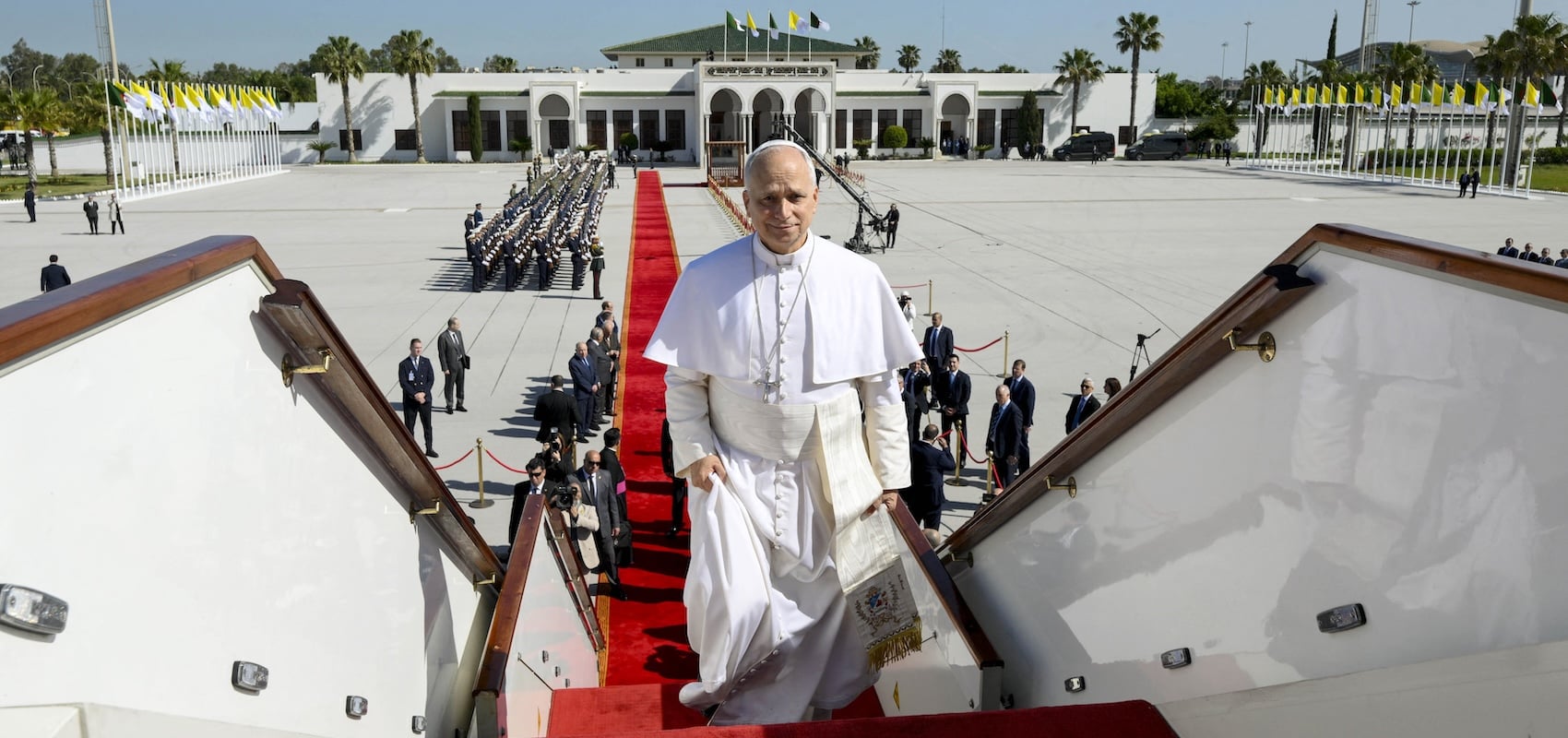
Photo by (EV) Simone Risoluti/Vatican Media/Abaca/Sipa USA(Sipa via AP Images)
Dear Reader,
Can I be direct with you?
War abroad. Socialists on the rise. AI upending human life. Endless uproar online. The modern attention economy doesn’t want readers — it wants users enslaved to the tyranny of the present.
First Things is the antidote: literary excellence, timeless truths, and a fixed point of reference in a culture that has lost its bearings.
But we can’t do it without readers like you.
Our goal: Raise $150,000 by November 1 to sustain First Things in the year ahead.
Your gift anchors readers in the permanent things.
Make your Fall Campaign gift now using the button below.
If you have any questions or would like more information, please contact Giovanni Del Piero, Director of the Editor’s Circle, at gdelpiero@firstthings.com or 212-627-1985.

YOU MIGHT ALSO LIKE
Why the Death Penalty Is a Sore Point for Papal Authority
Pope Leo XIV marked World Day Against the Death Penalty, observed on October 10, with the following…
Forget Odysseus. Aeneas Is the True American Hero.
Who is our Odysseus? Or more precisely, who is the most Odyssean hero of American film? Matt…
Foucault’s Idol of Nothingness
Today marks the 100th anniversary of the birth of Michel Foucault. He was influential in his lifetime,…
