
For Instance
by rhina p. espaillat
wiseblood books, 126 pages, $18
Dominican-American poet and translator Rhina Espaillat, at ninety-four, has spent decades examining life and then, graciously and modestly, punching us in the gut with her findings. In her newest book, For Instance, Espaillat finds herself very close to the end—looking backward, yes, but also looking forward, staring at her own death.
The nonce sonnet “Night Falling Early” introduces an older speaker recalling her younger self, her “rough / and greedy youth spent wanting—deep in those / never-long-enough days.” Now, the speaker realizes her days don’t need to be any longer. She enjoys the lights of evening, but the real reason is starker still:
like a man who goes
home after his day’s labor full of gruff
gratitude for the lights that one by one
rise up in welcome; glad of what he’s done,
but gladder still it’s done with, and enough.
Espaillat’s finely crafted iambic pentameter underscores the meaning. The iamb/trochee line breaks of “who goes / home” and “of gruff / gratitude” build tension that starts to release in the next line’s iamb/iamb line break, “by one / rise up.” Espaillat has lectured that it’s not enough to just rhyme. The words should play off each other, connect in meaning as well as sound. She rhymes the monosyllabic, brusque “rough” and “gruff” with the final disyllabic sigh of relief of “enough.”
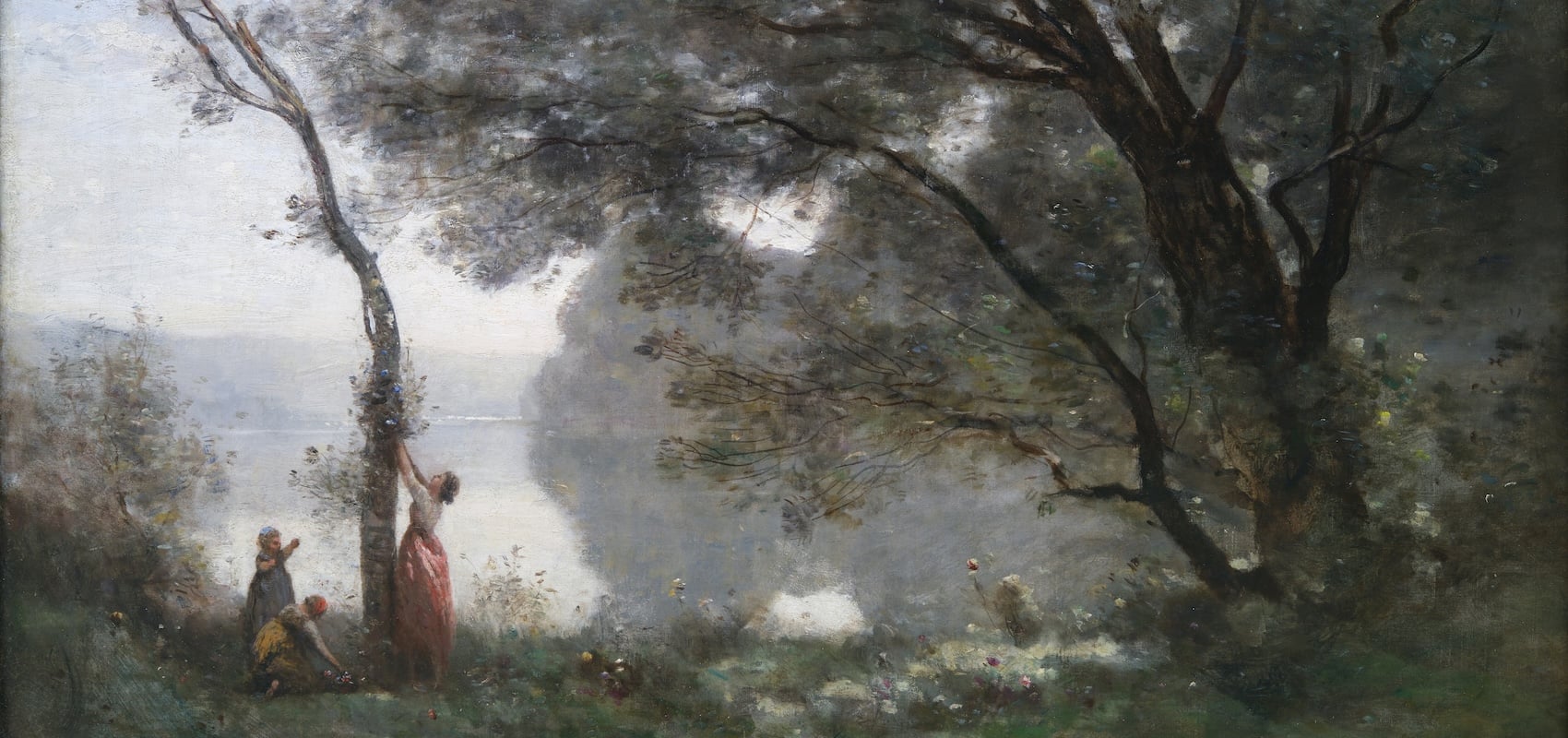
“Corot’s Meadow” continues this contemplation of death. An ekphrastic poem about a painting by French artist Jean-Baptiste-Camille Corot, it evokes the peace of death, lovely and enticing: “Death is like that—I promise myself so— / a gray-green lapping at the shores of sight / soft as night’s velvet whispering.” The physical painting itself also becomes a metaphor for death’s limits: “But oh, / the frame’s enclosure, the muting of the light.” Whether the speaker fears or embraces those boundaries, I leave to the reader to decide.
Espaillat, exiled as a child with her family during the dictatorship of Rafael Trujillo, has lost many things throughout her life—homeland, family, friends, and her beloved husband Alfred Moskowitz, who died ten years ago. She explored that fresh grief in her 2019 collection And after All. But grief doesn’t end; it evolves. In “Where Nectar Was,” the widow still thinks about her husband, but in
a calm state of mind,
no longer desolate—in fact, inclined
to hum while dicing onions—absently
I turn to you, old friend and only lover . . .
She takes his presence so much for granted that she is “confused over your absence, like a bee / whose shallow habit or lifelong intent / draws it where nectar was.”
But Espaillat also explores grief with a hard honesty. In “Bedside,” she recounts one of the last things a dying husband said
to cheer his almost widow. Silly joke—
“I love you more than you love me”—well meant
as a last spicy, teasing argument
to be remembered by.
But all these years later, the words are “now echoing, ambiguous, obscure: / unanswerable charges from the dead.” What does it feel like to remember something a loved one said or did that you can never clarify or reconcile? Like this, Espaillat says.
Espaillat has translated countless poems into English and Spanish, including Sor Juana Inés de la Cruz, San Juan de la Cruz, Marko Marulić, Robert Frost, and Richard Wilbur. Two poems in For Instance feel like translations, but not in the usual sense of the word. In “At the Next Table,” two people seated nearby at a restaurant converse in sign language. “They sing / with their four hands.” The poem becomes a metaphor for translation; the translator’s job is “eavesdropping on their silence from our own.” The poet, trusted by her reader but afraid of getting it wrong, has to convey the underlying meaning of the poem: “Homebound through sleet, hands clasped—afraid to fall!— / you and I will repeat, without a word, / the eloquent exchange we more than heard.”
In “Reconciliation,” Espaillat translates her younger self to herself now. In many of her older poems about God, doubt and disappointment battle with joy and humor. But in “Reconciliation,” Espaillat questions this decades-old battle: “God, you and I have quarreled long. / But to what purpose who can say. / Your rigor made me twice as strong.” She still does not condone “the stern impassiveness you wear / when man and sparrow fall to ground.” But, since God is the one who “gave your child / her human flaw,” she wonders if they might finally make up, if God might “Now be at last / Forgiving, if not reconciled.”
The poem “Lesson,” Espaillat’s ars poetica, starts as both instruction and incantation: “Wind, let me teach you / to make a winter evening.” She uses short dimeter-trimeter-dimeter stanzas to distill her process for creating a poem into simple steps the wind can follow. She starts with a blank page—“First wash the sky”—upon which she writes her first ideas: “secure it with early stars.” For Espaillat, each poem is an act of communication with others, a “humming wire / clotted with sparrows” that the wind must hang. The wind learns that grief, the “tatters of rain,” and fear, “the shivering of / wild cherry trees” are part of the work. Finally, the poet and the wind complete their creations in the same way: “Rubbing their fingers; / Gather the last light there, and / Hang up the moon.”
Espaillat ends this moving volume of poetry with the villanelle “Guidelines,” first published in 2008. I wondered why it was included here but then realized its significance. Having explored the boundaries of life, Espaillat leaves us with the one thing she knows is true:
Here’s what you need to do, since time began:
Find something—diamond-rare or carbon-cheap,
It’s all the same—and love it all you can.
Dear Reader,
Can I be direct with you?
War abroad. Socialists on the rise. AI upending human life. Endless uproar online. The modern attention economy doesn’t want readers — it wants users enslaved to the tyranny of the present.
First Things is the antidote: literary excellence, timeless truths, and a fixed point of reference in a culture that has lost its bearings.
But we can’t do it without readers like you.
Our goal: Raise $150,000 by November 1 to sustain First Things in the year ahead.
Your gift anchors readers in the permanent things.
Make your Fall Campaign gift now using the button below.
If you have any questions or would like more information, please contact Giovanni Del Piero, Director of the Editor’s Circle, at gdelpiero@firstthings.com or 212-627-1985.

YOU MIGHT ALSO LIKE
A Culture of Parricide
I learned a new word the other day: déploration. It’s the French, directly from the Latin, for “lament.”…
The Chariot Burials
Wheeling through the clotted earth, / Bronze, bone, and leather clumped in clay...
William of St. Thierry
“Where love and understanding join, hearts are tranquil, / They rise above the turmoil of this world…
