Something Wicked:
Why Feminism Can’t Be Fused with Christianity
by carrie gress
sophia institute, 256 pages, $21.95
In the musical Wicked, the familiar story of The Wizard of Oz is retold from the perspective of its supposed villain. When Elphaba, the green-skinned, talented young woman who will later be remembered as the “Wicked Witch of the West,” discovers that the Wizard’s regime is systematically persecuting sentient animals in order to consolidate power, she refuses to participate. Threatened by Elphaba’s effectiveness and determined to thwart her mission to expose the Wizard’s cruelty, Madame Morrible teams up with him to discredit her by branding her “wicked,” hence the musical’s ironic title.
Pick an enemy, flatten their motivations, cast them as the just-so villain in a story of how everything is going sour, and watch as your rival goes up in flames. The story of the scapegoat is a tale as old as time, one René Girard identified as the motivational impetus at the heart of human culture. When communities experience disorder—moral, political, or social—they relieve the pressure by locating the cause of their unease in a single person or group. The scapegoat absorbs the blame while the crowd achieves a fleeting sense of clarity and relief. If you can condense the entire moral drama into a single word—Wicked!—you’ve done your job.
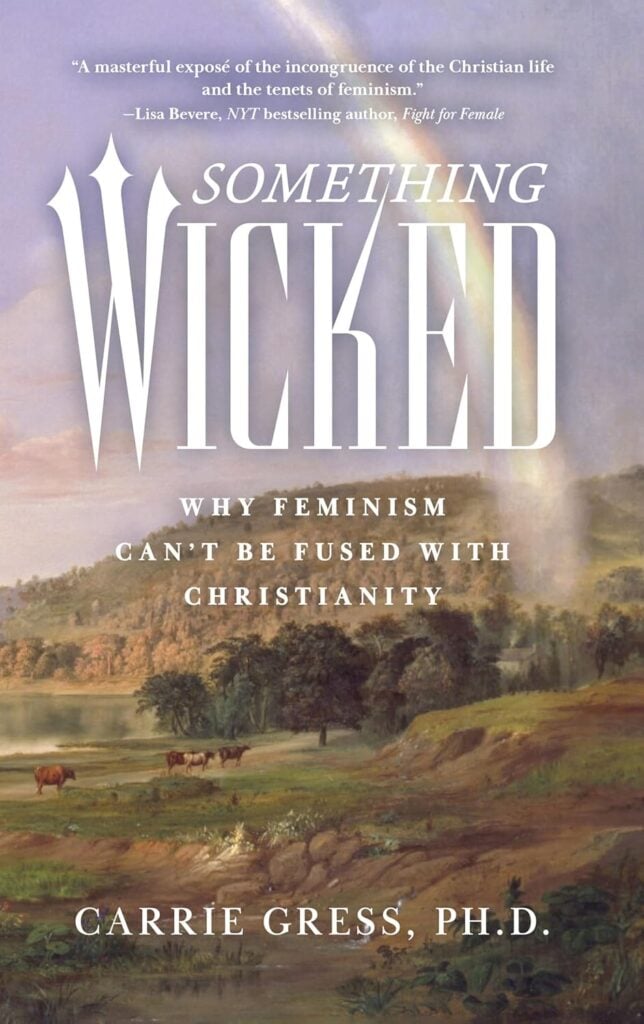
Carrie Gress’s latest book, Something Wicked: Why Feminism Can’t Be Fused with Christianity, neatly coincides with the expansive promotional tour of Wicked: For Good, the finale of the musical’s popular cinematic adaptation. The book, written from a Catholic perspective, leans heavily into the imagery of the greater Oz universe to make its argument: that every wave and version of feminism is poisoned, root and branch, by occultism. Feminism tout court must be excised completely in order to save the Christian West from imminent destruction.
In an information ecosystem shaped by algorithms that privilege emotional intensity over nuance and clarity, authors are incentivized to package their work in whatever way will cut through the noise. That much is at least understandable. Unfortunately, the content of Something Wicked proceeds in the same mode as the packaging, ratcheting up emotion at the cost of clarity while simultaneously profiting from the achievements and insights of the very feminism it purports to reject in toto (no pun intended).
The problem begins with definitions—or, rather, with the refusal to settle on a definition that conforms to common sense. From the outset, Gress dismisses all attempts to define feminism as it is generally understood, as a women’s rights movement. Any basic definition—such as “the pursuit of civil rights on behalf of women”—only works to obscure feminism’s true, sinister motives, Gress insists: “These kinds of definitions aren’t what the feminists (of any wave) meant by feminism. . . . The movement has become an intellectual behemoth by simply failing to define itself beyond a few empty tropes.”
For any intellectual tradition so old and so internally diverse, one would be hard pressed to find anything more specific than “the pursuit of civil rights for women” that circumscribes the movement without erroneously excluding critical elements. In order to achieve clarity—to provide answers for the begged questions of what rights are and what women are—serious scholars typically add qualifiers. Liberal feminist, trans-exclusionary radical feminist, carceral feminist, Marxist feminist, ecofeminist, reactionary feminist, pro-life feminist, sex-realist feminist, Catholic feminist: These are all substantive, distinctly different elements of a tradition united, however tenuously, by its basic concern for the civil rights of women. The claim that the movement fails to define itself beyond “tropes” doesn’t hold up against the real history of intra-movement debate. Is it that feminists do not want to define “feminism” with any specificity, or that Gress doesn’t?
Most scholars can agree on an a similarly observable reality of conservatism, too, as “the political inclination to preserve what is established,” provided that the positions of neoconservatives, constitutional conservatives, paleoconservatives, social conservatives, and fiscal conservatives, who can indeed be diametrically opposed to one another, are properly differentiated. The same goes for liberalism, as “the political philosophy that emphasizes the primacy of liberty.” We have classical liberals, social liberals, economic liberals, and libertarians, all with different emphases and different notions of humanity’s telos.
The same goes again for the history of civil rights as the pursuit of racial equality, which most people can recognize without holding the abolitionists responsible for the Black Panthers. Though different strains may emerge from a shared origin, they vary profoundly in thought and deed. Why not settle on a basic definition and then parse the various iterations, with all their different anthropological assumptions and internal contradictions, as needed? In Something Wicked, “feminism” becomes a rhetorical instrument that is never allowed to mean anything but what Gress says it does, rather than an analytical category that traces real things. This verges on nominalism.
Civil rights for women, Gress insists, “aren’t what the feminists (of any wave) meant by feminism”—including Pope St. John Paul II, who called for a “new feminism” to combat the culture of death and sexual permissiveness of the 1980s and ’90s. Here, the author grants herself exclusive interpretive access to figures whose words she sets aside in favor of her own. On John Paul II: “He was using feminist ideas without being a feminist.” It simply does not matter to Gress how many feminists of history would have adhered to the commonsense definition and declined hers. Gress insists that a commitment, conscious or not, to a Satanic inversion principle constitutes the invariable, “anti-Christian roots of organized feminism,” in an unbroken chain from the beginning. Gress goes on to detail the Unitarianism of several of the early feminists, and the spiritualism and theosophy of some, in order to demonstrate that “freethinking, rationalism, and scientism were supposed to be feminism’s guiding stars, not a trinitarian God.” The “true” definition of feminism is actually an occultic “shadow church,” complete with “its own list of canonized names, its own set of consecrated and therefore untouchable terms, its own rituals and sacred gatherings. . . . Feminism is its own megachurch.”
When you look past the provocative language, it becomes clear that Gress is actually just describing every successful political movement in American history. Culture of any kind mimics religion by requiring shared objects of reverence, shared language, and shared idols. I have several family members proudly buried in our highly ritualized, sacred-but-secular national cemeteries. Concerning abolitionism and civil rights: I am writing this review on Martin Luther King Jr. Day. As for “untouchable terms,” I am fine with the fact that it’s not socially acceptable to use certain slurs or to burn the flag. I do not see a problem with honoring any of these traditions per se, and I doubt the author would, either, even though Martin Luther King Jr. engaged in degenerate sexual behavior and rejected the orthodox Trinitarian understanding of Christ—as did some of the Founding Fathers, many of whom engaged in occultic practices such as freemasonry. Does the immoral behavior of some of the Framers of the American project make that project unworthy of preservation? Should we blind ourselves to their virtues because of their vices? Should we also abandon the wisdom of the ancient Greeks on account of their devotion to the pantheon or their pederasty? Thomas Aquinas didn’t think so. Better, surely, to understand these things in context, try to account for the historical forces to which they responded, and engage the ideas on their own terms with a basic sense of charity for the human frailty of our forebears.
The charity that the book withholds from women’s-rights activists is doled out liberally to those who use the word “patriarchy.” Gress states that “patriarchy, then, as understood by the Church, Scripture, and Tradition, . . . does not suggest tyrannical abuse, but love, order, and the possibility of sanctity. Certainly, there are plenty of ready examples of men acting badly, but human sinfulness doesn’t erase the divine order established by God.” Notwithstanding the passing acknowledgment of perennial male violence against women, Gress advises her readers to embrace patriarchy as interchangeable with ecclesial hierarchy, the same way she advises them to reject feminism as interchangeable with the occult.
Quoting Dominican Friar Gregory Santy’s essay “Embracing Hierarchy,” Gress writes: “‘the whole reason God established our ecclesial hierarchy was for our sanctification.’ The Church hierarchy or patriarchy is then the order by which we and the world are made holy.” But there is a crucial distinction to be made here. Patriarchy (or matriarchy, for that matter), insofar as it describes a form of human social organization rooted in parental authority, manifests the mixture of good and evil that is found in any natural reality. Ecclesial hierarchy, by contrast, belongs to the supernatural order, deriving its authority—according to Catholic teaching—from Christ’s institution of the Church.
Gress objects to contemporary critics of “patriarchy,” such as Catholic philosopher Nathan Schlueter, concluding that they “rely on a distorted and inauthentic vision of patriarchy,” thereby rejecting the goodness of Catholic hierarchy. This is an unfair reading of Schlueter’s plain words. What Schlueter objects to is not ecclesial hierarchy, but, as John Paul II put it, the historical abuse and mistreatment of women. Again, conflating patriarchy per se with ecclesial hierarchy is a rhetorical sleight of hand that shields the former from moral scrutiny by cloaking it in the authority of the latter.
The real historical injustices against women and girls, and the feminists who fought to end those injustices, demand more attention and respect. In early American culture, it was taken for granted that women, whether as wives under coverture or the enslaved, had no legal right to refuse sex. For centuries, slave women endured violent sexual abuse, often resulting in pregnancy, a fact that modern genetic testing bears out. If a slave woman attempted to defend herself against such abuse, she was beaten severely and with no legal recourse. It was not until 1861 that a black woman could even file rape charges against a white man, thanks to the efforts of Christian feminist Maria Stewart. In 1885, the age at which unwed girls could “consent” to (and be held responsible for) sexual intercourse was, legally, twelve or younger in all thirty-eight states. In Delaware, it was seven. In 1895, women’s rights advocate Carrie Clyde Holly introduced the first bill in national history to raise the age of sexual consent to adulthood. Marital rape was legal in all fifty states until the late 1970s, when contemporary feminists, elaborating on the first wave’s plain language about women’s right to refuse sex (especially courageous given Victorian norms of speech), petitioned the courts to reconsider.
These historical tragedies, and the real moral victories over them, simply cannot be dismissed out of hand or deemed something other than what they were: feminist moral victories.
Words have meaning. They also have consequences. An uncritical embrace of “patriarchy,” especially in the age of an ascendant and outright misogyny that claims the term enthusiastically, leaves female readers vulnerable to predation. The internet discourses that bubble up around the signifier “patriarchy” encourage the adoption of flat, prescriptive roles that not only are silly and un-Christian but may be personally devastating, especially because of the real physical and dispositional differences between men and women.
Gress devotes a section to the manosphere, casting its ascendant, violent misogyny as an “unfortunate development” that is “simply a self-defensive cover in the battle of the sexes.” This equivocation is incongruous with the lines that follow, in which Gress favorably quotes Edith Stein: “The relationship of the sexes since the Fall has become a brutal relationship of master and slave.” Earlier in the book, Gress castigates early feminists for seeking common cause between abolitionism and the women’s rights movement, diminishing this relationship to the “piggybacking” of an illegitimate cause on a legitimate one. She unfavorably cites Mary Wollstonecraft, who “added her own comparison of women’s lot to slavery. ‘Was not the world a vast prison, and women born slaves?’ Wollstonecraft asked.” Gress and I agree that the authentic, mutual affection of the sexes provides a clear path to freedom from mutually debasing animosity. But sentiment is not enough; formal justice and equality, what Gress writes off as “feminism,” is still necessary to protect the particular frailty of women from the particular frailty of men.
Gress’s soundbite-friendly framing guarantees engagement on the podcast circuit, especially in the conservative Catholic media market, where the stories of celebrity exorcists reliably dominate. Something Wicked makes a play to be its own exorcist literature, taking on feminism, which is always and everywhere demonic. This habit of literally demonizing one’s enemies is of a piece with the wider clickbaitification of everything, including religion, and we are the worse for it.
The attention economy collapses plausible grievances into monocausal metanarratives that demonize particular groups and lead to real-life bigotry. When we foreclose curiosity, complexity, and the possibility of common ground or redemption, we replace truth-seeking with the comfort of reflexive blame. Discernment demands that we dispense with these false dichotomies and conspiratorial Theories of Everything that increasingly define our public discourse, however psychologically satisfying they may be.
Aleksandr Solzhenitsyn said it best:
The line separating good and evil passes not through states, nor between classes, nor between political parties either—but right through every human heart—and through all human hearts. This line shifts. Inside us, it oscillates with the years. And even within hearts overwhelmed by evil, one small bridgehead of good is retained. And even in the best of all hearts, there remains . . . an unuprooted small corner of evil.
One may reasonably conclude that the word “feminism” has become too compromised to salvage, that it now obscures more than it illuminates. People of goodwill can disagree about whether the label is worth retaining in our present moment. What is indefensible is to arrive at that conclusion by flattening history, imputing guilt by association, or caricaturing contemporaries whose work is explicitly ordered toward defending human dignity, resisting sexual nihilism, and articulating a genuinely Christian anthropology with women in particular as their focus.
The danger of Something Wicked is not merely that it is rhetorically overheated, but also that it trains readers to think in totalizing binaries that are alien to sound moral reasoning. When feminism is defined as simply evil, and patriarchy as simply good, discernment becomes impossible. Everything is reduced to loyalty tests and symbolic affiliations. The result is not clarity but credulity—precisely the condition that makes witch hunts possible.
The Catholic tradition is capacious enough to hold complexity, nuance, and authentic development. It does not require us to scapegoat our own intellectual ancestors—or present allies—in order to defend it.
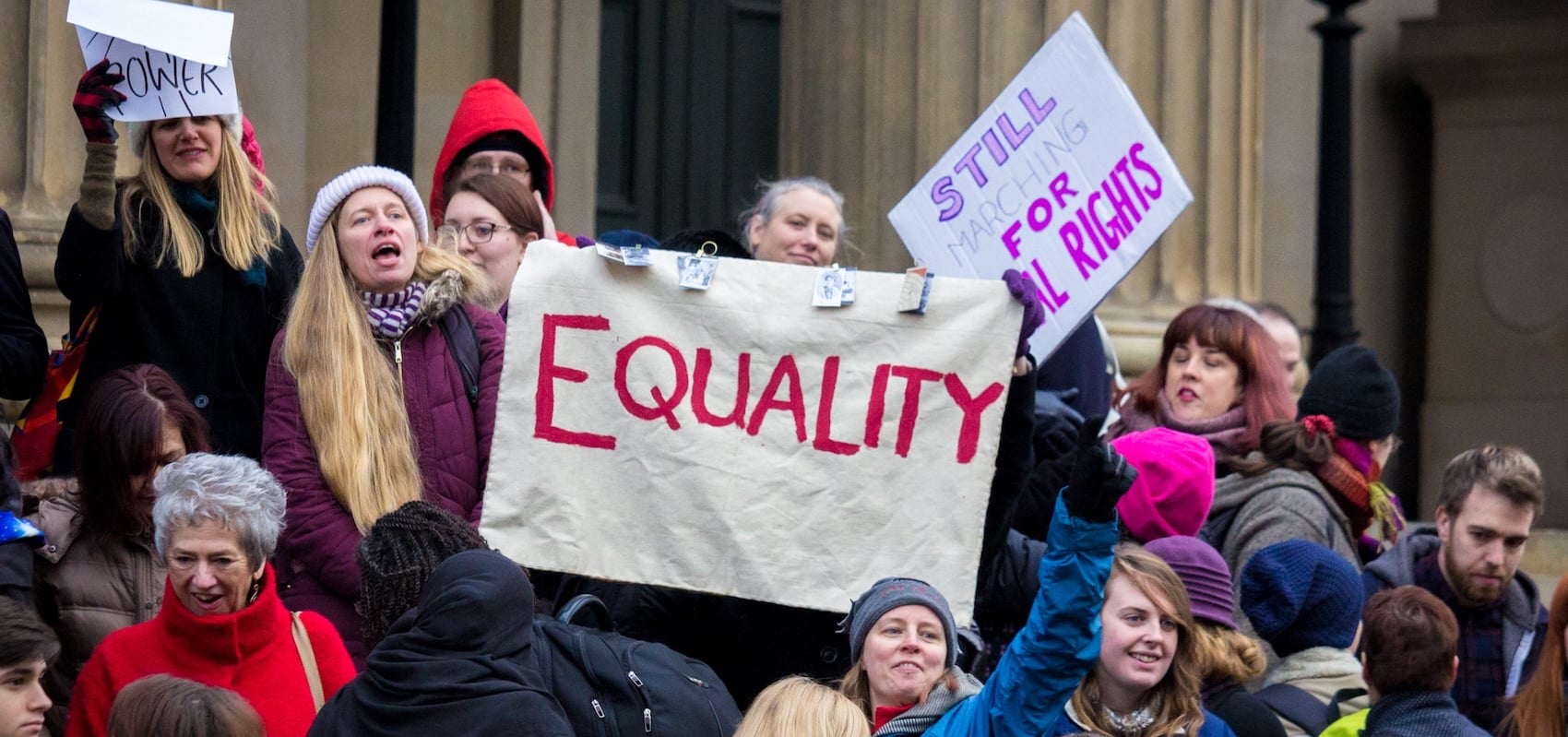
Image by Samwalton9, licensed via Creative Commons. Image cropped.