
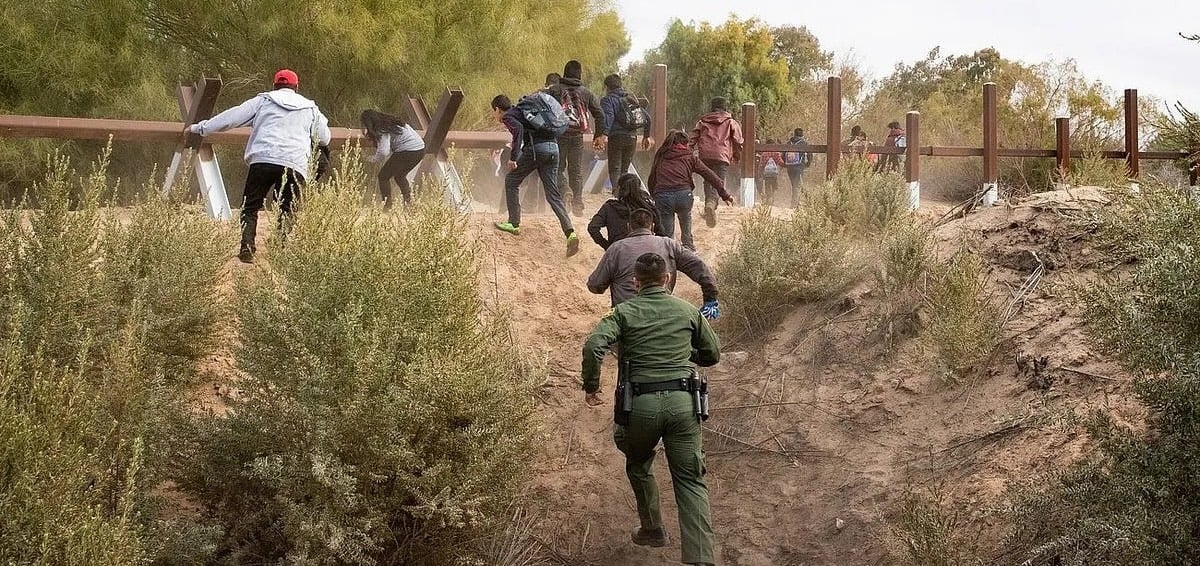
Catholic discussions of immigration frequently omit salient facts, most prominently the legal status of the “migrant.” I criticized this curious neglect in Pope Leo XIV’s apostolic exhortation Dilexi Te. In that document, the discussion of “migrants” ignores the question of their legal status. Since then, Pope Leo has acknowledged state sovereignty while saying it must be “balanced” with the duty to provide “refuge”—telling us neither how such balance is achieved nor assuring that the Church won’t always fault nations for addressing a migration crisis. Chicago Cardinal Blase Cupich’s latest video insisting the “Church stands with migrants” likewise evades the question of legality.
An honest discussion would not circumvent the issue of legal status, which is why growing numbers of people are beginning to ask whether the Church is a good-faith interlocutor on questions of mass migration. Glossing over the distinction between legal and illegal residency cannot be ecclesial oversight; too many critics have pointed out that the Church regularly sidesteps this issue. Church leaders at times formally acknowledge state sovereignty over immigration, but in practice the rhetoric (“undocumented”) suggests otherwise. Which makes one think the Church is dodging the question of illegal status, a posture more befitting a lobbyist pushing an agenda than an honest broker addressing a question that affects the common good.
The Church seeks to frame the discussion of illegal immigration through the lens of “human dignity.” This is a fitting concept with which to begin. But the Church’s selective use of this framing neglects to address the way in which illegal immigration offends human dignity.
Free will is an essential aspect of human dignity. Man is alteri incommunicabilis: Nobody can will for me. Nobody can ultimately make me want something. I can be influenced, pressured, and even physically forced, but I cannot be made to will something. Even God does not interfere with free will; in the end, he respects what we have chosen, even if we damn ourselves in the process.
Willing is not limited to individuals. Political sovereignty is also an act of will. It is a decision of a community, exercised by its designated leaders. In Catholic thought, sovereign decisions are accorded deference, because the one charged with attending to the common good is supposed to employ an objective overview of the common good—which individual parties with individual interests might not see—when making a decision. It’s why distributive justice belongs to the one responsible for the community and not its individual members.
In modern political structures, the sovereign will is expressed by the democratic choice of a majority, adopted through processes established by rule of law. In our constitutional order, this is done through passing legislation in accord with proper procedures. These laws are entitled to the presumption that they serve the common good, which means that they are not subject to veto by parties outside of the legislative process. There is a profound moral reason for the presumptive respect for validly enacted laws: They express the rightly adopted will—an essential aspect of human dignity—of the organized political community on a question. The Immigration and Nationality Act of 1965 fits that requirement.
Thus, if we recognize human dignity to be expressed through free choices, individual as well as collective, and that the latter deserve our deference as decisions made for the common good by those responsible for that common good, then validly enacted laws also deserve recognition as expressions of human dignity. A political community’s free choice of a morally legitimate option (no one has claimed immigration restrictions are intrinsically evil) by a collective decision in the name of the common good cannot be dismissed on the ground that it affects the human dignity of an individual, as if the individual is the only party that has a dignity claim.
The Church’s unartful dodges on the migrant question have especially disturbing consequences. It practically canonizes the isolated individual’s decision to judge laws, find them wanting, and justify disobeying them. This undermines the coherence of Catholic teaching. It makes an unjustified exception to a Catholic’s responsibility to obey legitimate laws, suggesting an anthropology that asserts that the only dignity at stake is the individual’s. This marks a departure from Catholic tradition, which accords dignity to the valid expression of a collective community will embodied in duly adopted laws.
When churchmen speak about the human dignity of migrants, they are drawing attention to an important principle, one that rightly governs law enforcement’s treatment of any person who is suspected of breaking the law. But it is baffling to think that the mere assertion of the human dignity of an individual can serve as justification in practice for ignoring immigration law. Does “dignity” immunize somebody against enforcement of a valid law? Does “dignity” nullify a state’s right to enforce a valid law against a violator?
In sum, migrants are not the only parties with a dignity stake in questions of illegal immigration. Communities and the common good their laws seek to incarnate also have dignity rights.
St. Thomas teaches that an unjust law is not a law. Unless churchmen are willing to tell us directly why they think America’s immigration laws are unjust in se—something difficult to do without endorsing open borders—it seems fair to ask whether the ecclesial “dialogue partners” with the Trump administration are engaging in mauvaise foi.
