I visited a friend of mine a few years ago. He was a deeply faithful theologian, but without much success in his profession. Deeply devoted to each other, he and his wife had yearned for children but were unable to have any. When his wife died unexpectedly, my friend was distraught. We talked, and the accumulated humiliations, disappointments, and losses of his adulthood were recounted with increasing anguish. At one point he blurted out, with a startling passion and anger, “Why me?!”
His question, to be honest, surprised me. It did not seem to fit his Christian faith—not that he should have meekly adopted an Augustinian sense of being part of the great massa damnata, for whom all ills are well-deserved and any smidgeon of good is an unmerited grace. Anyway, plenty of Christians, myself included, have asked the question. Still, “Why me?” expresses a misunderstanding of human identity and its relation to suffering that sits uneasily with a Christian spirit. To be a “me” is to live far beyond the constraints of individual feeling, and to suffer is just what it means to transcend the great burdens of our misconceived and solitary selves. “Why me?” is, alas, uttered from a place outside a true sense of God’s life.
When the self is viewed and felt as solitary, it is hard to live. For this reason, suffering has become the great question of our individualist age. Charles Taylor has famously stressed the modern “moral imperative to reduce suffering.” That imperative now defines our culture’s vision of human life. My seminary students have often noted that their generation thirsts for a true “theology of suffering.” Every generation worries about suffering. But in our age, it is the suffering of the self that is so hard to tolerate. When all of life is bound up with just one person, with just our own being, who can endure it? There have always been selves; there has always been suffering. But when the two are chained together as mutually defining, the world implodes.
“Why me?” is a very modern question. It first emerged in the seventeenth century as an exclamation of wonder from the lips of the redeemed sinner, contemplating the marvel that he should be plucked from the fire he otherwise so richly deserved. Sometimes the notion was built on Psalm 8:4, taking the human collective and turning it into an individual: “What is man that thou art mindful of him?” “Who and what am I, that thou shouldst be mindful of me?” as a late eighteenth-century devotional explicates the verse. The Reformed tradition’s stress on election drove this sense of amazement. As a nineteenth-century writer put it: “Do we see our eternal election of God? This brings us on our knees before the Lord with, ‘Why me, why me, O blessed God; Why such a wretch as me?’”
The predestinarian framework, of course, logically entails the same question uttered by the damned from the depths of hell. More skeptical writers were quick to note this troubling parallel: As “poor reprobated creatures . . . sink into the bottomless pit,” they, too, cry out, “Why me! . . . A dreadful why me this!” Too dreadful. As the religious universe contracted during the nineteenth century, a fixation on individual souls and their destiny unsurprisingly shifted to utilitarian worries over the individual body. By the twentieth century, “Why me?” was completely focused upon physical pain, illness, mental anguish, and personal loss. The last hundred years are littered with book after book—Jewish, Christian, therapeutic—concerned with, or even titled, “Why Me?” It is our era’s strangled moral sobriquet.
We need to gauge suffering anew. The words “suffering,” “passion,” and “toleration” all share a common semantic base, one that indicates the act of “bearing” and “enduring.” The relationship of all this to “pain” is not immediately obvious. In fact, pain is a relative latecomer as the explicit object of suffering. For a long time, one suffered circumstances, challenges, and especially people. We still hold on to this sense with our usage of “patience,” which has become a mostly personal disposition of enduring difficult colleagues. The point is that suffering is above all about our location within a web of relations: living there, with them.There is nothing to suffer if one is all alone. There is nothing to feel, nothing to touch or be touched by. This is a matter of basic metaphysics. To be alive is, by definition, to suffer, to “bear” with the world that is ours. They are one and the same thing, seen from different aspects.
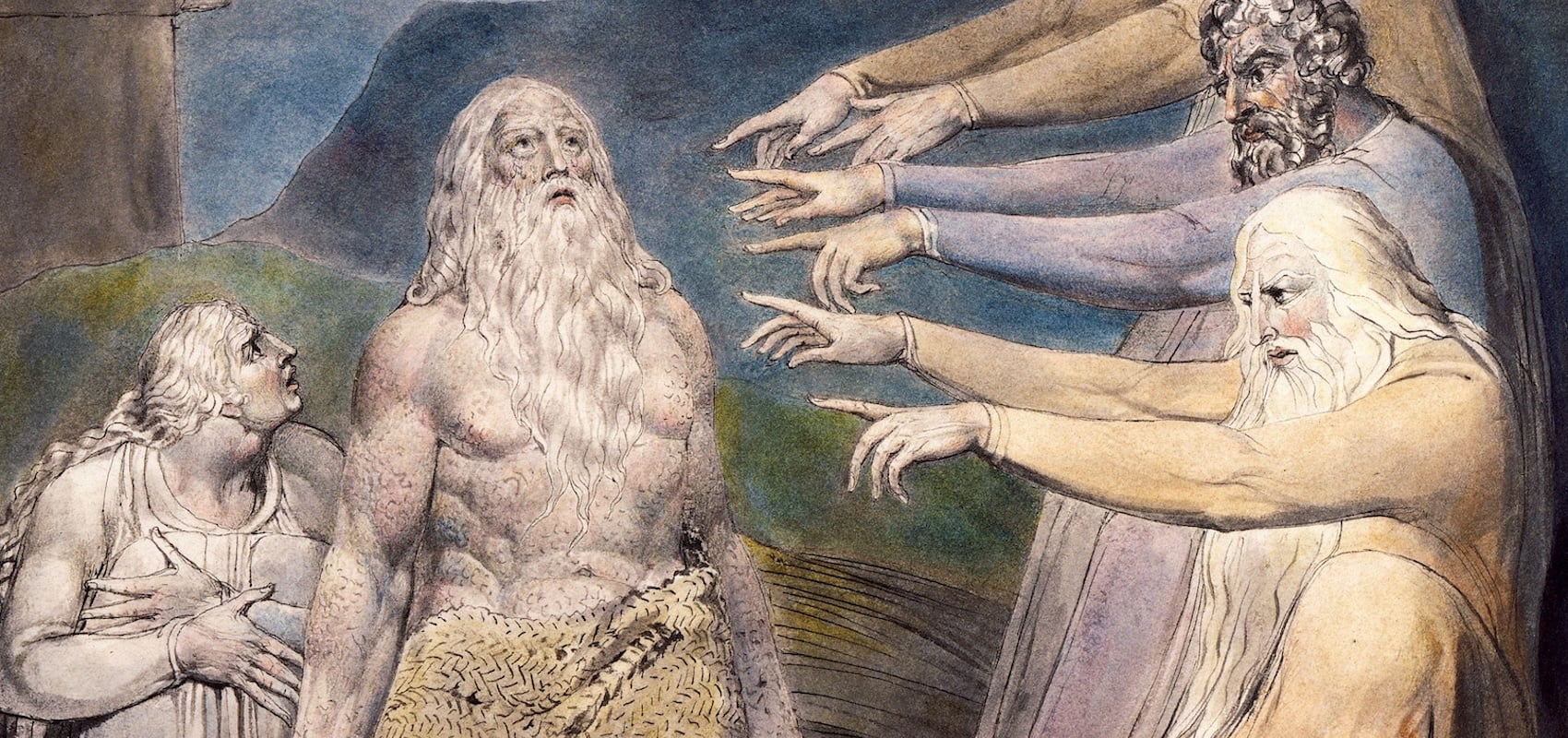
Job, the paradigm of one who suffers, is instructive here. “Why me?” has often, as a phrase, been linked with the exclamation of Job: “Why hast thou set me as a mark against thee, so that I am a burden to myself?” (7:20). This is not a solitary word, however: It is spoken to another, to God. As the book unfolds, we discover God laying out a vast creation of which Job’s singular existence is a vital part. God’s creation is wide, fearsome yet beautiful, replete with animals, peoples, oceans, stars, wisdom, questions, glory. It is true that central to Job’s distress is the loss of his human relations: family, children, servants, and, with the destruction of his wealth, that skein of ties to neighbors and colleagues. Yet Job’s friends—too often denigrated by readers for their purported narrow moralism—come up beside him, lifted out of that mass of relations Job’s plight seems to have suffocated. There they are, and the book is one of conversations with them as much as with God. When all is said and done, his eyes opened, though his heart surely still broken, Job prays for these misguided companions. At this point, we recognize the unveiling of true suffering: the riches that other people constitute (42:10).
Gregory the Great, in his marvelous work Moralia in Job, explains the “Why me?” verse in this way: God uses the suffering of Job—of the righteous individual—to “manifest” the life of virtue in front of “others.” Job is now “exposed to open trial” before the eyes and hearts of those near and far. Gregory will go further, placing Job within the full panorama of divine order: “The life of the righteous is set as a spectacle to men and angels; for while they are smitten with scourges, they are made known to all.” We rarely hear this said about those who suffer (let alone dare to believe it of ourselves), but well we might: “He touched the lives of angels.” There are always others who are somehow bound up with the “me” I’m tempted to think, desolately, is “only me.”
“Why have you singled me out?” turns out to be the entryway into a realm in which Job recognizes not his lack of individuality, but that individuality’s intricately woven place within a panoply of wonder, wrought by God’s own self. To “endure” this life, to suffer it, is to live within the sphere of God’s brimming and enveloping creative gifts. To accept suffering—to bear the shape of a life, mine or another’s—is to manifest before the heavens the breadth of divine beauty, the creases and folds of my own existence stretching out into the manifold webs and tendrils of many. That may sound falsely cheery—or sullenly grim. But it will only seem so to the ears of an era that has so trampled down the character of life to its stunted solitary experience that something like legal “assisted” suicide could seem to express the modern virtue of “universal benevolence.”
My friend’s sorry life, as he saw it, was never anything but a life with others—family, spouse, colleagues, students, supermarket workers, people in line, doctors, booksellers, priests, silent partners in prayer. So then: A “sorry” life? Or plenteous? “Why me?” would, I suppose, be more appropriately posed, if posed at all, as “Why us?” That question is hard enough. But it is Israel’s question, not the lone Israelite’s. David’s psalms, with all their seeming personal complaint, are written for his people, and the Christ who takes these hymns as his own is the one who “suffers,” not primarily his own bodily pain, but his nation’s—and indeed the whole race of Adam’s—agonies. With-ness, not me-ness, defines the question of suffering. Once raised in these terms, the individual calculus must shift seismically. Suffering is always with and for others; in this sense suffering always pries our bodies open to the reality of God’s gift of creation itself. It is the purest form of natural theology that exists.
John Donne’s famous meditation begins, “No man is an island, / Entire of itself. / Each is a piece of the continent, / A part of the main.” Here, Donne uses the terrestrial metaphor of a land, of which each of us is a “clod,” or a “promontory.” To lose a life is to “diminish” the whole. True enough. But this is a quantitative analogy, and the character of suffering isn’t measurable. It is better viewed in terms of livingbeings, not bits of earth. Suffering, in other words, is “vital.” We live, and thereby suffer, as the “body of Christ,” in the Church most intensely and intimately, but reaching out into all the limbs of Adam’s progeny. This is truly an unmerited grace. But grace it is.