
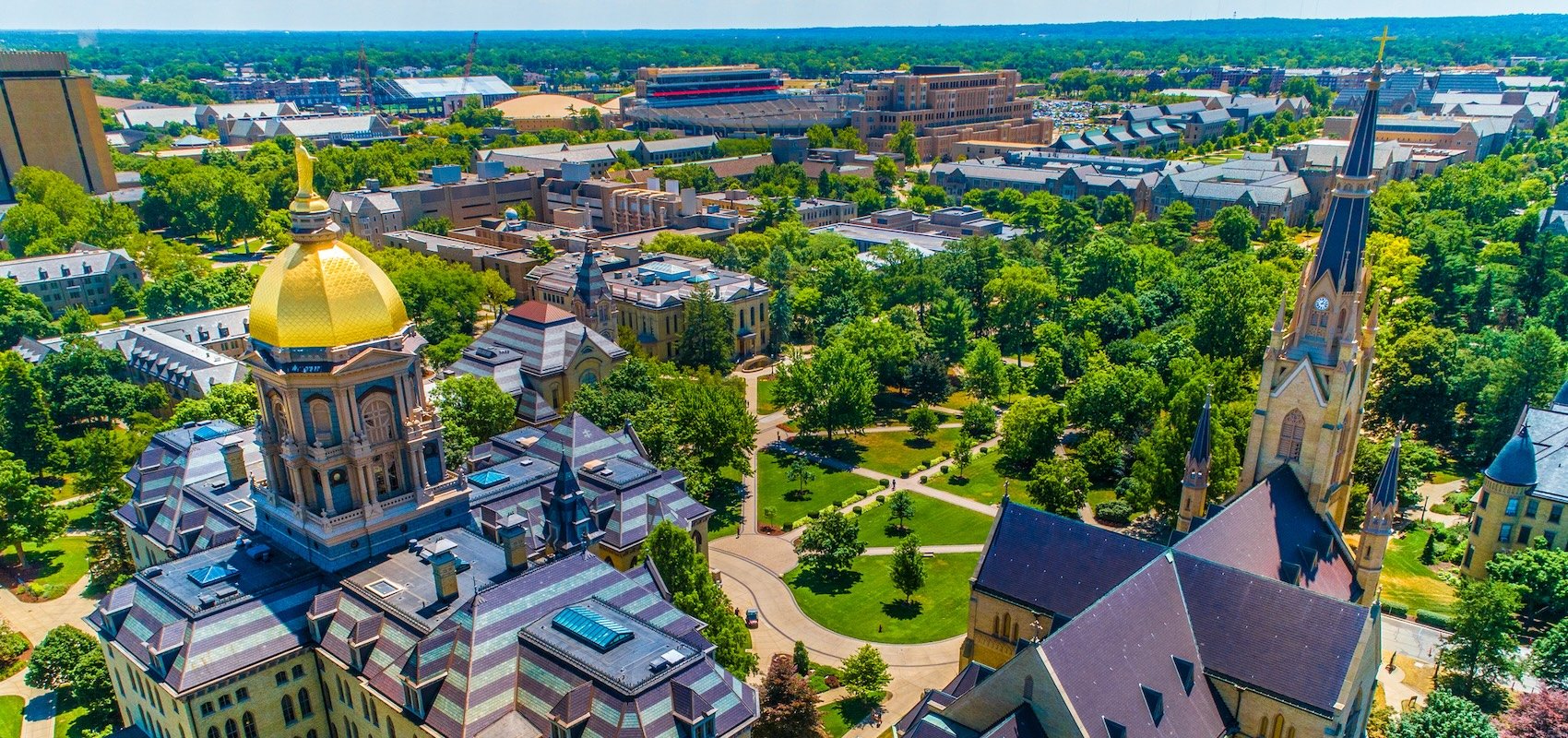
I have been associated with the University of Notre Dame since 1984, first as a graduate student in mathematics and then in philosophy. In 2003, I became a tenured member of the philosophy faculty. All but the first three years of my elementary school education have been spent in institutions of Catholic learning. So perhaps I have an overly narrow view of the possibilities of Catholic culture and intellectual life at a place like Notre Dame, not having enough comparative experience at places like Harvard, Yale, Duke, Northwestern, Stanford, the University of North Carolina, and so on. However, for years, when asked by friends or parents of prospective undergraduate students what it is like at Notre Dame, I have responded: “In my experience, one way in which the University of Notre Dame is unique as a Catholic community is that it is truly a microcosm of the Catholic Church.” Look at the universal Church—everything one sees in it can be seen here at Notre Dame. That characterization is true in terms of sect, ethnicity, race, gender, but also politics, culture, and history.
All the things one doesn’t like—perhaps, in one’s more sinful moments, even hates—about the Church can be found here. Walker Percy once told family members who were criticizing him for converting to Roman Catholicism, calling it a church full of sinners, that “The Catholic Church is a very good place for sinners to be, which is why there are so many in it.” I count myself among those sinners. Do people make mistakes in the Church and at Notre Dame? Yes. Does one become exasperated at the Church and at Notre Dame? Yes. Do people do good work in the Church and at Notre Dame? Yes. Does one find laughter and joy in the Church and at Notre Dame? Yes. Are there decent, good, and holy men and women in the Church and at Notre Dame? Yes. I have never met as many anywhere else but here. But I have also met decent, good, and holy men and women here at Notre Dame who are not Catholic, who are Protestants, Jews, Muslims, Buddhists, and, yes, even atheists, not to mention every race and ethnicity one can imagine. I have colleagues and friends here whose unjustified anger at the Church and Notre Dame pains me, but whose justified anger prompts my compassion. Amidst all this symmetry between the Church and Notre Dame, there is this deep asymmetry as well—while the Catholic Church is everywhere on Earth, everywhere on Earth is at Notre Dame.
Now, one might think I’m describing the broad social and cultural aspects of the Notre Dame community, apart from its distinctive essential feature of being a Catholic institution of higher learning. But one would be mistaken. I can only speak for myself. I have spent my entire adult life pursuing an intellectual life as my vocation, grounded in the intellectual life of the Catholic Church and, like the Church, engaging the culture that exists beyond it. Specifically, I am a Thomist, someone who seeks to engage secular philosophy by bringing the thought of Thomas Aquinas into conversation with it. Given what one might call my narrow academic specialization, there is no better place for me to be than at the University of Notre Dame. Only at Notre Dame would I be hired among the top twenty or so philosophy departments in the country, precisely because I work on the thought of Aquinas. There is no better place for me to be. In my department, I encounter at a very high level all those different streams of contemporary philosophy that I seek to engage and that enrich the depth of my own thought.
Looking beyond my own narrow academic specialization, Notre Dame offers a wealth of intellectual stimulation and growth to those who take the time to listen. I smoke cigars and drink bourbon with an Old Testament scholar who helps me understand the narratives of the Old Testament. From another theologian, a good and holy person, I have come to appreciate the aesthetics of poetry, particularly the religious aesthetics of poetry that would otherwise be thought by many to be not particularly religious. From historian friends, I have learned more about Reformation history, the American Founding, and boxing. I have had the opportunity to engage at length with constitutional scholars, those who work on contracts, housing, bioethics, and international human rights. I have learned from an engineer friend about how far one could power a car simply by unlocking the carbon energy contained in one Oreo cookie. I have sparred with scientist friends about the nature of facts and theories. I have argued with social science friends about the character of human motivation in action, and enjoyed conversations between urbanist and classicist architects about how to build livable and beautiful communities. The list goes on. I thank God for them all.
I know every particular aspect of the intellectual life I have enjoyed and just described can be found elsewhere, since there are philosophers, theologians, historians, lawyers, scientists, social scientists, and architects in other universities, particularly the “great” secular universities. From lack of experience, I cannot say and will not judge whether the broad and sustained wealth of engagement with those intellectual resources at other universities is possible. But from a wealth of experience, I will say that it is available at Notre Dame for those who are “lost, all lost in wonder.”
Is Notre Dame perfect? No, just like the pilgrim Church on Earth. Does Notre Dame have problems? Yes, just like the pilgrim Church on Earth. Does Notre Dame make mistakes? Yes, just like the pilgrim Church on Earth. Can the pursuit of wealth at Notre Dame appear at times to obscure its intellectual and social gifts? Yes, just like the pilgrim Church on Earth. Can we do better? Yes, just like the pilgrim Church on Earth. Does the wealth of Notre Dame serve the intellectual life of its members? Yes, just like the pilgrim Church on Earth. If one doesn’t like Notre Dame, then one shouldn’t like the pilgrim Church on Earth. But if, despite all its faults and mistakes, one loves the pilgrim Church on Earth and prays for it, then one should love Notre Dame and pray for it, as I do. Not everyone needs to be at Notre Dame. One can seek to live out one’s Catholic faith in many places. But this is why I stay.

YOU MIGHT ALSO LIKE
Turned Away on Palm Sunday
In politics, diplomacy, war, or pretty much any field of human interaction, one must contend not only…
A Medieval Pilgrimage in Modern Assisi
When you go to the hilltop town of Assisi, you’re immediately struck by how medieval it is:…
Via Crucis, 2026
The Way of the Cross—and the third, seventh, and ninth stations in particular—has been an especially appropriate…
