
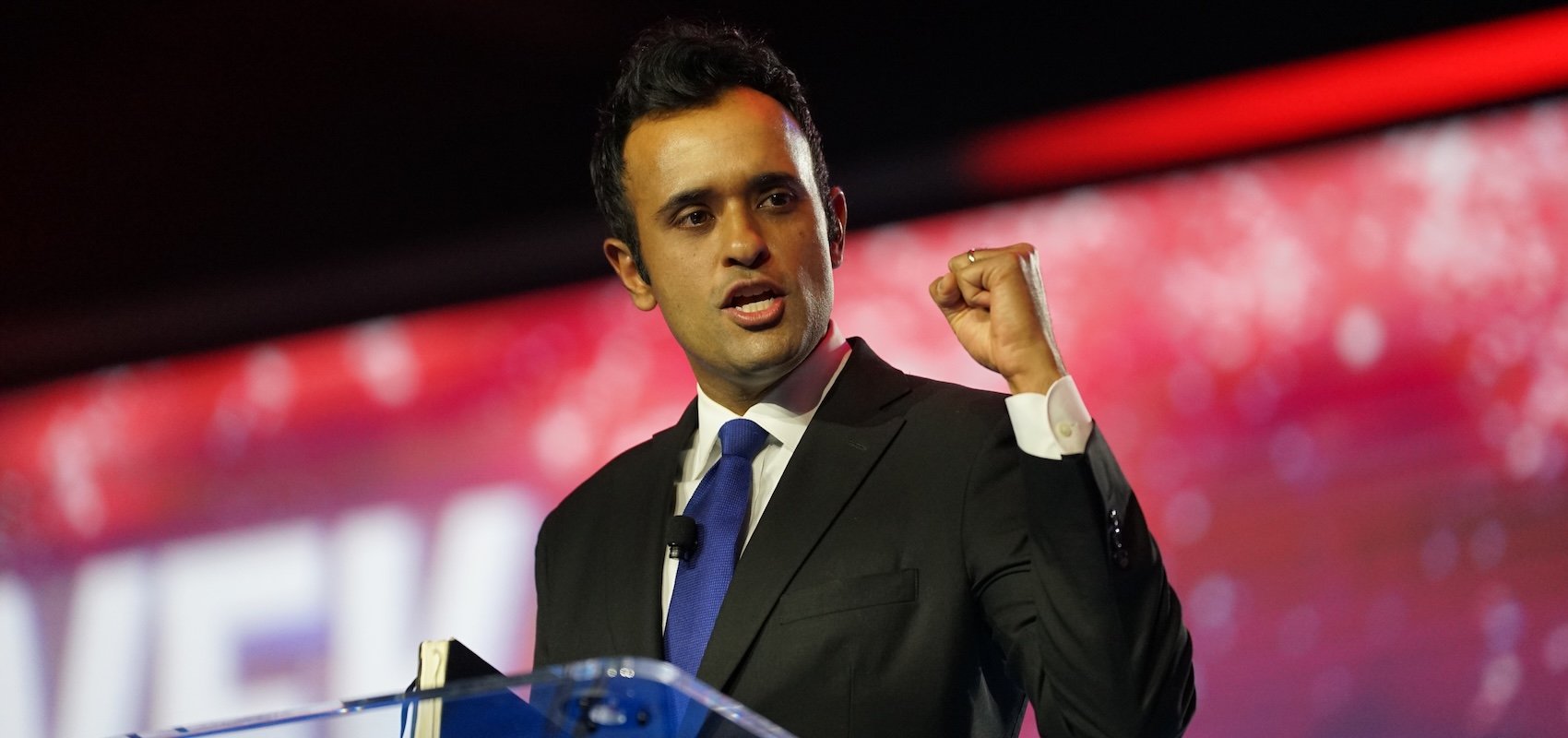
December is here. The air is chill, the leaves have fallen, and children are preparing for school break, looking forward to wrapping presents in the glow of a decorous tree. It’s time for Vivek Ramaswamy to explain what is wrong with America. America, Vivek writes in the New York Times, is filled with racists. The initial title of his op-ed asked, “What Is an American?” His answer: “No matter your ancestry, if you wait your turn and obtain citizenship, you are every bit as American as a Mayflower descendant.” If you disagree, you’re a “blood-and-soil” racialist.
This is a childish oversimplification. America does have a creed, but we also have a common culture and a common stock, as do all other nations. Immigration is only healthy when it leads to integration, when the “other” qualities of the immigrant culture fade into the background and normal American customs dominate family life.
Vivek spends over half the essay hand-wringing about racism. Young people engage in dissident discourse, testing boundaries and violating long-held taboos. But this is not happening in a vacuum. They are responding to the material conditions and political forces thrust upon them. It is those conditions that must be addressed, not their epiphenomena.
Instead of spending Christmas lecturing us about what makes Americans Americans, Vivek should sit down and do the reading. A recent essay in Compact, “The Lost Generation,” went viral around the time Vivek’s article was published. It describes in detail how affirmative action, and the legal and cultural conditions it fostered, went into overdrive about a decade ago, dramatically decreasing opportunities for white American men. This is a third rail issue, in part because white men traditionally avoid framing themselves as victims or playing identity politics. Moreover, the antiracist ideological structure calls anyone who questions it a racist beyond the pale of acceptable society.
This catch-22 has consequences. “For about a decade, under woke and racial-reckoning conditions,” writes Ross Douthat, “certain important American institutions appeared to systematically disfavor younger white men for employment, preferment and advancement. In the process, these institutions forged a cohort that had concrete, economic, material reasons to regard the existing system and its values as a racially motivated conspiracy against their interests.” While DEI was militating against the people Vivek is now smearing, it was helping people like him.
Vivek’s success and that of his family rely on existing immigration and identity politics regulations. His family entered the country through the precursor programs to the H-1B. They were the tip of the spear of modern mass migration. Should we be shocked that he defends the system that birthed his citizenship? If immigration law were radically revised to prioritize American citizens, would he intervene out of familial loyalty?
We do not know comprehensively the ways in which DEI helped him and his family rise to elite status. But given what we know now about higher education and the DEI machine, it would be far more surprising to learn that he had suffered setbacks because of his race. In 2011, Vivek received a scholarship from the Soros family. This money was not available for what Vivek calls “heritage Americans.” He accepted the scholarship despite being far wealthier than the average American at the time. And as recently as 2020, Vivek established Roivant Social Ventures to support pro-DEI initiatives like increasing racial and gender diversity in biopharmaceutical leadership.
Tell me again about those pernicious identity politics, Vivek!
Last December, on the second day of Christmas, Vivek denigrated Americans for not revering hard work enough, unlike immigrants. The context was a fight about H-1B visas. His long X post included gems such as:
Our American culture has venerated mediocrity over excellence for way too long (at least since the 90s and likely longer). That doesn’t start in college, it starts YOUNG.
A culture that celebrates the prom queen over the math olympiad champ, or the jock over the valedictorian, will not produce the best engineers . . .
“Normalcy” doesn’t cut it in a hyper-competitive global market for technical talent.
I argued in First Things at the time that just as children need a stable home, families need a stable homeland. And a stable homeland is built on more than efficient allocation of capital (human or otherwise).
The Preamble to the Constitution states: “We the People of the United States, in Order to form a more perfect Union, establish Justice, insure domestic Tranquility, provide for the common defence, promote the general Welfare, and secure the Blessings of Liberty to ourselves and our Posterity, do ordain and establish this Constitution for the United States of America.”
The Constitution does not establish a universal good for all mankind, but a common good for a particular people and their posterity. At the time, “posterity” meant the offspring of one progenitor to the furthest generation; not, as some modern legal scholars argue, “whoever comes after us.” The founders were building a world for their children and their children’s children. Like many Americans, I have ancestors who were present at our country’s founding; it is clear that the founders intended this more perfect Union for us. They of course anticipated immigration and integration, the grafting of new branches onto the tree of liberty. But it is the tree and its roots that make grafting possible.
The founders took it as common sense that America’s originating culture must be given primacy. Consider Federalist No. 2:
Providence has been pleased to give this one connected country to one united people—a people descended from the same ancestors, speaking the same language, professing the same religion, attached to the same principles of government, very similar in their manners and customs, and who, by their joint counsels, arms, and efforts, fighting side by side throughout a long and bloody war, have nobly established general liberty and independence.
Americans are those who, as Vivek notes, honor the principles of the U.S. government. But an American is more than that. Americans speak English and honor the legacy of English literature and law. We have particular manners and customs that anyone seeking to be an American should embrace. Americans are proud of our athletic abilities, our jocks, and we are equally proud that the jock can be a scholar-athlete. We are proud of our prom queens, and love to celebrate female beauty and social prowess. Primordially Sabbatarian, we are rightly proud of our leisure and reject the idea that work is an end in itself. Work, for Americans, is vocational, a calling placed on us by God and from which God will relieve us one day. But in the meantime, we are in fact very good at working hard, which goes a long way in explaining why we are the richest people in the world. Americans are Christians, even if often secularized; more specifically, as Charlie Kirk so well articulated, America is Protestant. Americans are those whose families have fought side by side, whose sacrifices we remember on Memorial Day.
We are a people largely descended from the same ancestors, and if a family immigrates to the U.S. we should expect them to drop their former customs and take up ours. They drop their often unpronounceable names to take on American ones. Aleksandr becomes Alex, Jorge becomes George, 康 becomes Lawrence. Over time they will integrate and intermarry and become Americans, but this is not accomplished at the moment of their naturalization oath. That oath grants full legal status of citizenship, but the citizenship is that of an American, and it assumes in the heart of the new citizen a firm desire to emulate the founders of the country, its culture and customs.
We, the American people, have maintained this land as a free and ordered republic for 250 years. Vivek and some of his family have joined themselves to our common project. But as new arrivals, they do not get to tell us what that common project is, nor shame us when we correct them for misunderstanding it.
Image by Xuthoria, licensed via Creative Commons. Image cropped.
