
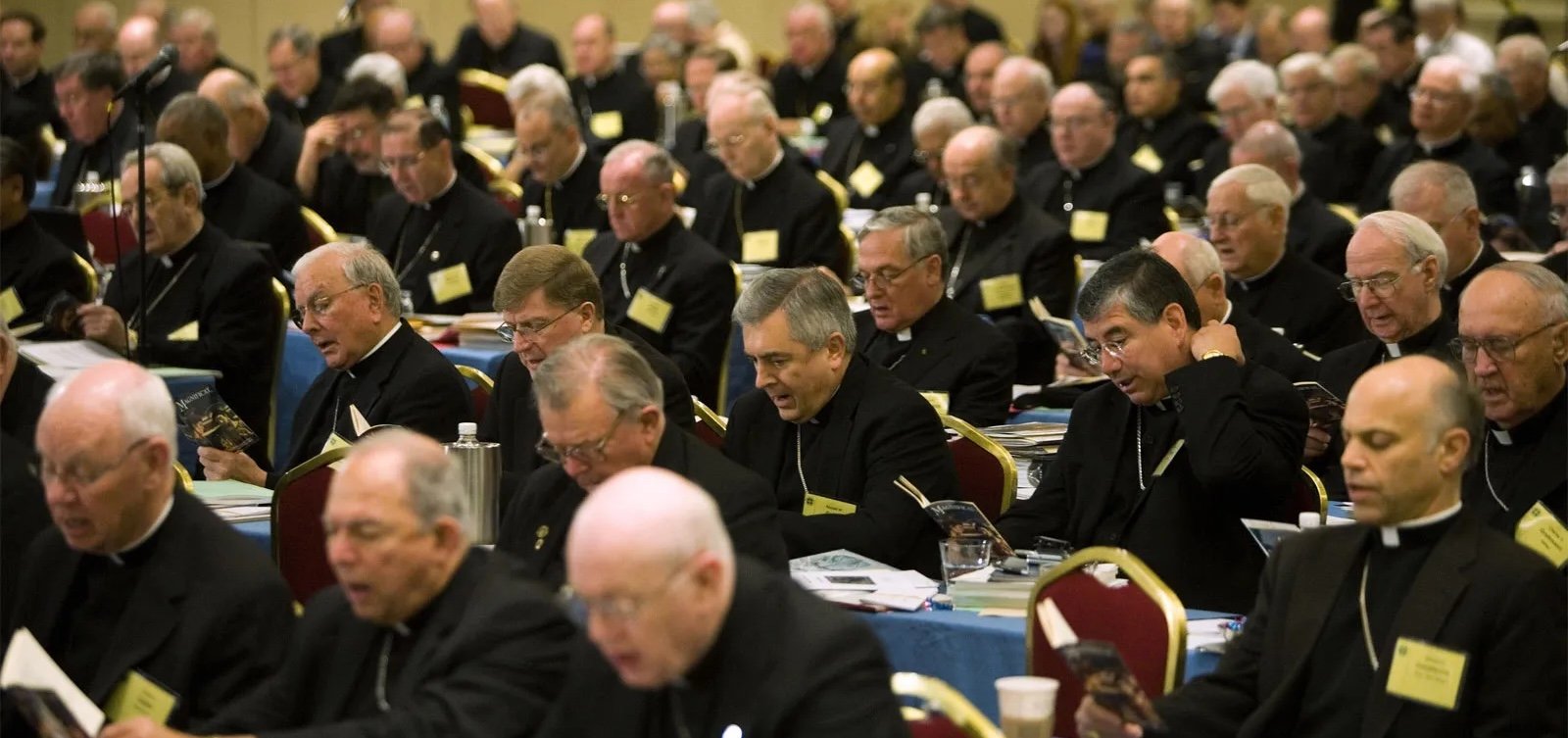
In the wake of the 2007 Supreme Court decision to uphold Kansas’s ban on partial birth abortion, University of Chicago law professor Geoffrey Stone notoriously asked and answered, “What, then, explains this decision? Here is a painfully awkward observation: All five justices in the majority in Gonzales are Catholic.” He reasoned that their judgment only made sense if they failed “to respect the fundamental difference between religious belief and morality.” The insinuation that the Catholic justices rendered decisions based on their religious views reportedly incensed Justice Antonin Scalia at the time. It’s context that makes all the more shocking a recent amicus brief by the United States Conference of Catholic Bishops (USCCB) on birthright citizenship. The brief literally tells the Supreme Court that it should adopt Catholic theology in its constitutional adjudication.
That the USCCB came out against President Trump’s efforts to restrict birthright citizenship should come as no surprise. The USCCB is notoriously left-wing when it comes to immigration and the border. For example, in 2024 they opposed the Border Act, a bill I helped negotiate alongside Democrats Chris Murphy and Chuck Schumer, for being too severe. When you come down to the left of those two on immigration, you’re well outside the mainstream.
In legislative cases like the Border Act, though, the USCCB is simply expressing a policy position to elected representatives, and there’s nothing necessarily wrong with that. One may disagree with the prudential application of their theological principles, but no one should begrudge them their religious witness in the legislative process. We shouldn’t want a “naked public square.”
Birthright citizenship is different. This is a legal case about the proper interpretation of the Constitution’s Fourteenth Amendment. In other words, whether President Trump’s executive order should stand is a legal question to be resolved through legal analysis. It’s not policy advocacy.
What does that legal analysis look like? What was the original public meaning of the Fourteenth Amendment at the time of ratification? What did contemporary and analogous citizenship regimes look like? What is the role of Congress in applying the terms of the Fourteenth Amendment? What role does Supreme Court precedent play in answering these questions? These questions and others aren’t especially easy if confronted honestly, and the Supreme Court has its work cut out for it.
What the Court neither will nor should ask is whether birthright citizenship is moral or compelled by the teachings of the Roman Catholic Church. The USCCB seems to disagree. Just take some of the arguments the USCCB advances: “Western tradition, the Constitution, and the teachings of the Catholic Church support birthright citizenship because it recognizes the equal dignity of every human person”; “Birthright citizenship is consistent with the Church’s fundamental teaching regarding every human person’s inherent dignity”; “Birthright citizenship is consistent with the Catholic teaching of subsidiarity”; “The executive order is immoral.” Okay, for the sake of argument, sure—why not? But also, who cares? None of that has anything to do with the original public meaning of the Fourteenth Amendment or the role of precedent.
This problem persists in their cited authorities. They cite only five legal cases and two constitutional provisions. At the same time, they have eleven entries for “Sacred Scripture” and citations to Aquinas and Augustine. There are references to the Code of Canon Law, a pontifical council, and nine different popes. Interpreting the Fourteenth Amendment through the lens of Pope Francis is nothing if not novel. Call it Critical Catholic Theory.
When you dig into the body of the brief it fares no better: “Birthright citizenship aligns with the Church’s teaching that humans were created as social beings and that political authority is morally bound to affirm and protect the inherent dignity of every human person in the community.” This is a falsifiable non-sequitur. The social nature of humanity and our inherent dignity are universal and unalienable. So does that mean every country needs birthright citizenship? If so, perhaps we should start by changing the laws of the Holy See.
The brief goes on: “In turn, birthright citizenship reflects the Catholic principle of subsidiarity by recognizing persons as members of the community from birth, thereby enabling their participation in civic life and ensuring that state power serves the human person as a social being.” What the principle of subsidiarity—or the view that decisions should be made at the lowest unit of responsibility—has to do with birthright citizenship is a riddle wrapped in an enigma. Apparently it involves birthright citizenship “recognizing children as members of a particular political community” that “acknowledges the intrinsic value of every human person.” But the whole nature of the dispute is whether those children are legally part of the American political community. It has nothing to do with subsidiarity—which itself has no real bearing on constitutional interpretation.
The brief’s conclusion leaves no doubt about its intentions: “At its core, this case is not solely a question about citizenship status or the Fourteenth Amendment. It is a question of whether the law will affirm or deny the equal worth of those born within our common community—whether the law will protect the human dignity of all God’s children.” It’s incoherent theology in the explicit service of Catholic judicial activism.
Apart from being an abysmal approach to the law, this perhaps more importantly squanders the Church’s legal goodwill. There are cases where authoritative opinions of Catholic theology can be material, such as those involving religious liberty or church autonomy. At the Supreme Court in particular, credibility is the coin of the realm. It’s unfortunate to see the USCCB throw theirs away with a theocratic Brandeis brief.

YOU MIGHT ALSO LIKE
Turned Away on Palm Sunday
In politics, diplomacy, war, or pretty much any field of human interaction, one must contend not only…
A Medieval Pilgrimage in Modern Assisi
When you go to the hilltop town of Assisi, you’re immediately struck by how medieval it is:…
Trump’s Civilizational Project
Secretary of State Marco Rubio spoke at the recent Munich Security Conference. Last year, Vice President JD…
