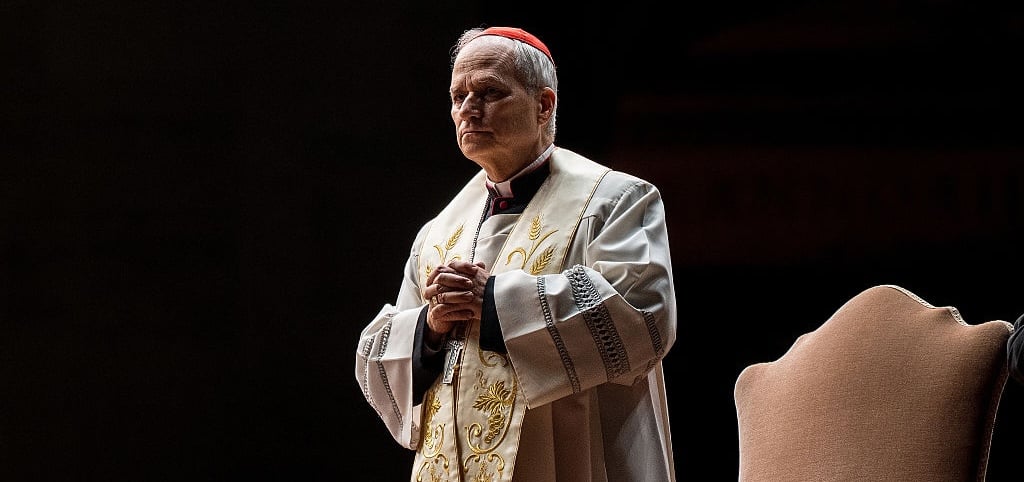
In a recent in-flight interview, Pope Leo mentioned that Brother Lawrence’s The Practice of the Presence of God was one of the great influences on his spiritual life. Lawrence was a lay brother in a Carmelite monastery in seventeenth-century Paris, whose sayings and letters were collected and published by a local priest, Joseph de Beaufort, who knew Lawrence. “It’s a very simple book by someone who doesn’t even give his last name,” the pope said. “I read it many years ago, but it describes a type of prayer and spirituality where one simply gives his life to the Lord and allows the Lord to lead. . . . And if you want to know something about me, that’s been my spirituality for many years, in midst of great challenges—living in Peru, during years of terrorism, being called to service in places where I never thought I would be called to serve to—I trust in God, and that message is something that I share with all people.”
Pope Leo’s remarks have already prompted reflections on Brother Lawrence’s significance for understanding the Holy Father’s spiritual vision and interior life. But how revelatory is this reading from “many years ago”? Not much, I would guess. Trusting in God’s leading, while a helpful personal attitude in hard times, as the pope notes, is hardly indicative of a particular “way” in which a—let alone “the”—vicar of Christ will shepherd his flock. In fact, to speak of “the way of Christ” in the manner of John 14:6—the way of the Son of God through the world, from Bethlehem to Jerusalem to Heaven; the way of the Word uttered before Israel and the Nations; the way of the disciple who follows; the way of the Church that is Christ’s body—is to speak about something on which Brother Lawrence is completely silent.
Lawrence’s concerns, as they are transcribed for us, are articulated within a Christian culture deeply caught up in the search for devotional access to God. This defined seventeenth-century France’s “culture wars” (how different from today!), pitting Jesuits against Jansenists, Oratorian incarnationalists against Benedictine contemplatives, parish priests against monastics. One can get a sense of this through the sprawling multi-volume religious history of the period by Henri Brémond. Brémond characterizes Lawrence as a minor figure in the “panmystical” movement of the era, an example of a simple and unadorned search for God apart from the complex theologies, philosophies, and ecclesiastical struggles that had come to define “prayer” for many. God is good, God controls all things, seek to love him at every moment, detach yourself from concerns and anxieties over daily life, and resign yourself to his providence: This was Lawrence’s basic attitude. Practically, this meant a constant “conversation” with God, expressing need, love, and trust in the midst of the day’s demands. This could be done in simple phrases or with “practice,” through a kind of continuous sensibility. It also meant that daily tasks, and human relationships, were not that important—just do the best you can. Friends die, you get new ones; just don’t attach yourselves too much to them. The liturgy is fine, but no better than daily communion with God.
How might any of this touch upon the life of a pope? Interestingly, de Beaufort’s early editions of Lawrence’s sayings—including the editor’s own lengthy hagiography and theological discussions—were little read among French Catholics after the early eighteenth century. Lawrence’s unlucky commendation by Archbishop François Fénelon associated his work with Quietism, a mystical movement that emphasized total passivity before God; Pope Innocent XI condemned it as heresy in 1687. (Fénelon was closely associated with the movement and became embroiled in controversy because of his mystical writings.)
Instead, Practice of the Presence of God was picked up by the Protestant Pierre Poiret and anthologized within his spiritualist canon. Poiret’s editions were the basis for a widening English and then American Protestant embrace of Lawrence. The book was republished countless times and entered the evangelical stream of anti-institutional and individualist “heart religion” that has flowed into the present.
The early eighteenth-century English translator notes that Lawrence’s “principal view was to teach men how to converse with God at the same Time they were employed in their ordinary business.” This has continued to be the popular understanding of Lawrence’s teaching: Be with God even in the kitchen (where Lawrence spent years in the monastery), peeling potatoes, washing dishes. There is today a host of books about the “divine in the ordinary,” aimed mostly at mothers cleaning up, changing diapers, cooking, ironing. Brother Lawrence fits into this genre: He performed and celebrated “women’s work,” as a recent translator, Carmen Acevedo Butcher, puts it. He’s on the “margins,” and imbues women with divine value. “Imagine Mr. Rogers was a mystic. That will give you a sense of the warm spiritual heart of Brother Lawrence,” writes the theologian James K. A. Smith.
But there’s an awful lot missing in Brother Lawrence. Both de Beaufort and his first English translator take pains to fill out Lawrence’s teachings with explicit Christian elements: scriptural citations, Christological details, ecclesial doctrine—none of which actually appear in his quoted sayings and letters. De Beaufort tells us that Lawrence favored reading the Gospels for their simple depiction of Jesus. But Lawrence himself does not mention this as part of the simple “method” of knowing God and gives no indication of what he found compelling in Scripture. He was immersed in it within the monastery, but one would never know. The few times he mentions the name of Jesus in the conversations and letters is in reference to the sacrifice for sin, a passing instrumental indication of God’s supreme grace. When it comes to personal suffering, which Lawrence discusses frequently, none of this is associated with Jesus, let alone Israel, but with resignation to God’s providence, and the need to detach oneself from worldly concerns. Don’t fret too much. Things will be okay. God will take care of you. Enjoy him.
This is a good message. I need it, as do most of us. I assume that Pope Leo was providing a winsome pastoral encouragement—“I share [it] with all people”—rather than signaling a theologically substantive direction with his remark. We need the latter too, though, and desperately. But for that direction to emerge, it seems we will have to wait.
Image by Christopher Furlong via Getty Images.