
Anyone paying attention to low and declining fertility today knows that it is a problem. Fewer children automatically produces an aging society. Fertility rates well below the level of replacement—levels currently experienced by nearly every high-income and even most middle-income societies—produce rapid aging, which in turn lowers economic growth, raises the cost of the welfare state, causes depopulation, and places human society on a reinforcing doom loop.
Public conversation about low fertility tends to focus on its material costs, but the spiritual costs are also clear. Families decay or are never formed in the first place. Loneliness grows. AI, robots, and pets replace human beings. Collective purpose is strained. Hope for the future fades.
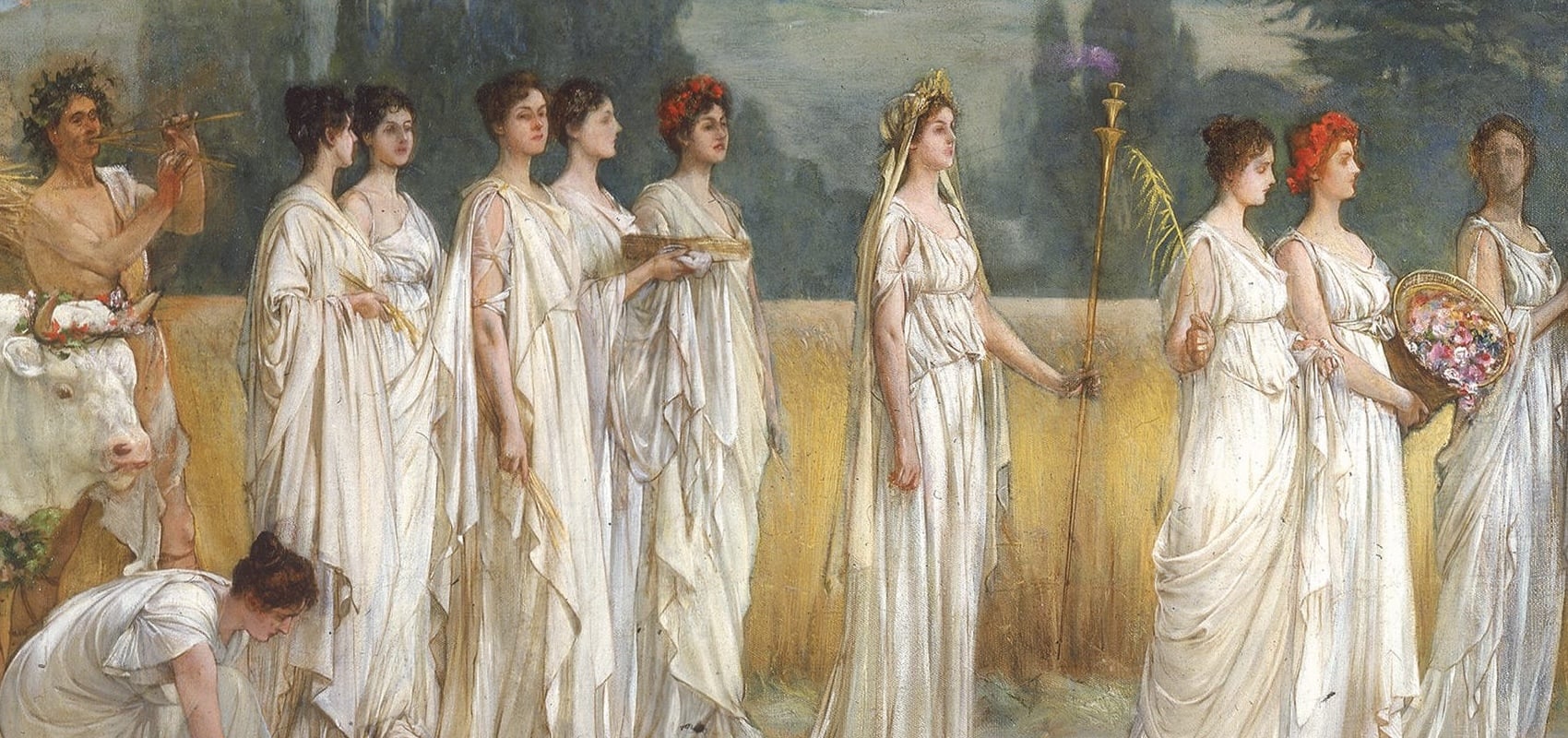
While low fertility certainly has spiritual costs, does it also have spiritual causes? Right-wing internet personality Costin Alamariu, better known as Bronze Age Pervert (BAP), certainly believes so. In a recent viral essay at the British “Zoomer Doomer” online publication J’accuse, BAP claims to have plumbed the depths of our civilization’s spiritual despair. As a true Nietzschean, he has unsurprisingly landed on the discovery that “the utterly prosaic, medicalized, optimistic-rational and utilitarian nothing” of decadent liberal progressivism and decadent conservative religiosity has strangled the life force. Out of his Nietzschean concern for cultivating the Übermensch, BAP offers a “modest proposal” to stimulate the fertility of extremely-high-IQ women and men. Through financial incentives (up to $500,000 bounties) and a cultural project emphasizing the “glamorization of male youth,” the right kind of women will overcome their anxiety and hesitation, open themselves to “sexual delirium,” and embrace fertility. With the revival of a pagan fertility cult, we could be saved.
Of course, BAP doesn’t really believe any of this in the practical sense. Like most internet personalities, he is a provocateur and an ideologue. His main goal is not to analyze data or recommend policy but to insult Christianity and apply his worldview to whatever contemporary concern happens to capture his attention. Taking cues on fertility from a childless Nietzschean vitalist is as sensible as taking an infertile brown-haired vegetarian to be the pinnacle of Aryan manhood. Yet there are reasons to take BAP’s essay seriously.
The first reason is negative. It is important to dismantle the eugenicist frame that informs BAP’s worldview. According to his perspective, human beings are divided into two basic groups, the functional and the dysfunctional. Low fertility is only a problem at the “upper registers” of human society among “women of high quality.” BAP draws the line of high quality very high indeed: an IQ of 130; membership in elite special forces; or exceptional athletic achievement. To put some numbers on these categories, an IQ of 130 is two standard deviations above the mean. About 2 percent of the population has an IQ that high. Membership in special operations forces is less than 0.1 percent of the total population of Americans aged twenty to thirty-nine. The number of professional athletes and Olympians is even smaller. With a population of interest this microscopic, it is the height of nonsense to believe that BAP has anything serious to contribute at a policy level. Moreover, BAP’s most inflammatory dysgenic claims about the distribution of fertility are also just wrong. Both obesity and mental health disorders decrease fertility. Especially among men, fertility has long been positively associated with income, intelligence, and even height up to a point. The marked declines in fertility across all Western countries over the past fifteen years have been concentrated at the lower, not the upper, end of the socioeconomic ladder.
The second reason to take BAP seriously, however, is a positive one. His theory of fertility is worth pausing over. BAP’s expectation that “a huge intensification of sexuality” would stimulate fertility is embarrassingly foolish. Pornified cultures, like those of Ancient Rome and our own, drive down fertility. Besides, a society with universal access to near-100 percent effective contraception subjects the formerly necessary biological relationship between sexual congress and fertility to the whim of human choice. That being said, BAP is nonetheless asking an important and interesting question: Why is low fertility a society’s aggregate choice? In particular, why is low fertility the aggregate choice of women, the sex for whom fertility is the most consequential?
Most economic and demographic research simply assumes without any reflection that women just want children. BAP challenges this assumption. He takes the costs of pregnancy and child-raising to women seriously. He takes these costs as particularly significant for women with ample life alternatives to motherhood. He notices the existence of low-fertility societies in the past, as well as the prevalence from West Africa to Greece to Pakistan of fertility rituals that venerated youth, sexual potency, and fecundity. Under civilization, BAP insists, human fertility is not given but must be made.
This is an important insight, especially for a contraceptive society like ours, where female fertility defaults to “off” and must be consciously switched “on.” Thus BAP asks in his indelicate manner: What “can overcome women’s rational reluctance at being impregnated and taking a pregnancy to term”?
BAP’s short answer is irrationality. He uses words like “magic,” “enthusiasm,” “frenzy,” even “delirium” to describe the psychological force needed to overcome a woman’s eminently rational opposition to personal fertility. BAP sexualizes this force in an exaggeratedly juvenile direction, with all manner of talk of phallic totems and the fetishization of the pregnant belly. But he is right to observe that strategies of reason—he calls it “hectoring or lecturing”—have no hope of overcoming individual resistance.
Surprisingly, BAP’s theory of fertility is not so very different from the most mainstream diagnosis of low fertility in Western countries. There is an enormous literature in economics, sociology, and pop commentary on the dearth of “marriageable men” able to offer an attractive package of personal and financial qualities that would encourage women to fertility. In short, both agree that the primary cause of low fertility today is women’s perfectly rational resistance to pregnancy and the declining ability of men to overcome it. The main difference between the mainstream and BAP is that the mainstream imagines women’s acceptance of fertility to be a rational choice deduced from a prior series of rational choices—”being ready” for motherhood today as the end of a long path of successful personal development, job market experience, dating, cohabitation, house purchase, and (perhaps) marriage. BAP, on the other hand, conceives the female acceptance of fertility to be a fundamentally irrational act requiring an irrational motive.
Dare I suggest that BAP is not completely wrong here? The “choice” of pregnancy, childbearing, and child-raising is never a fully rational one. Both marriage and parenthood are fundamental leaps of faith into an unknown world we can only dimly perceive before we enter it. BAP observes quite infelicitously that “in the state of nature the female’s aversion to pregnancy can only be overcome by a sexual delirium or ‘fetishization’ of the male who impregnates her, for mad enthusiasm for the issue of their union, and for carelessness regarding material and social consequences.” Shorn of its Nietzschean overtones, isn’t this the observation that being open to pregnancy, conceiving and bringing a pregnancy to term, and sharing that child with someone else for the rest of his or her life is ultimately dependent on something irrational? Something deeply self-sacrificial not only in this moment but for infinite moments to come? Something beyond ourselves that can neither be controlled nor measured lest it be destroyed?
BAP is convinced that this force is sexual desire, but only because he doesn’t know the name of sexual desire directed toward and inextricably bound to fertility. Its name is Love. If a society has affordable housing and good jobs and gender equality but has not love, it is nothing. If a society gives away baby boxes and child tax credits and free daycare but has not love, it gains nothing. Love is the true magic that produces people. Would that we had a public cult around that.
