
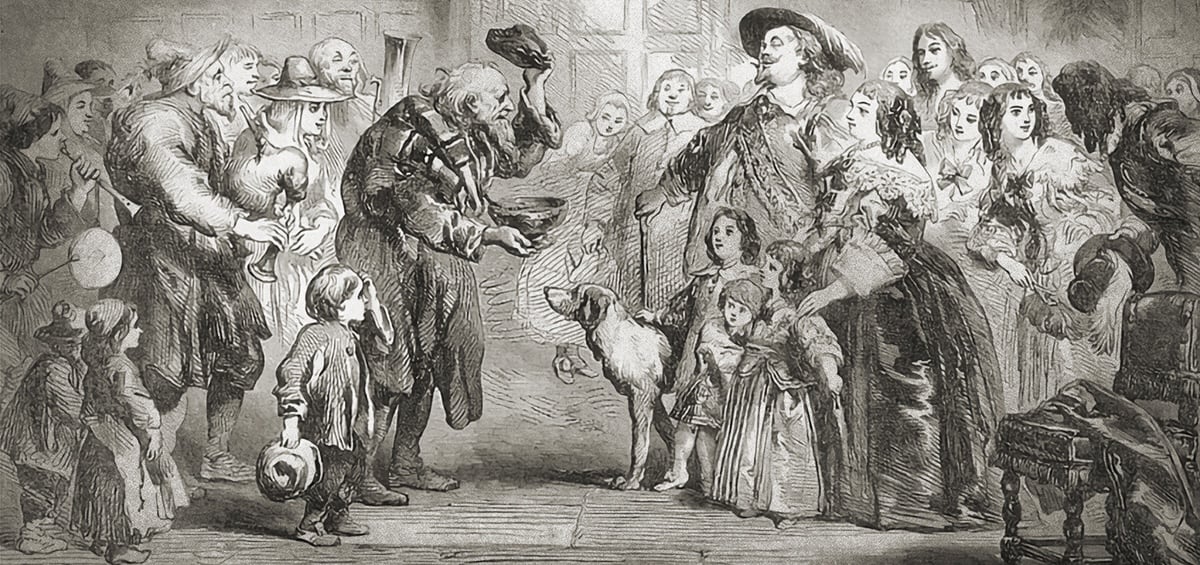
Wassail! wassail! all over the town,
Our toast it is white and our ale it is brown;
Our bowl it is made of the white maple tree;
With the wassailing bowl, we’ll drink to thee.—“The Gloucestershire Wassail”
Every year on January 17, revelers gather in an orchard near the Butcher’s Arms in the Somerset village of Carhampton, in the Brendon Hills. There, “wassailers” walk between the trees, splashing them with cider, while portions of bread soaked with ale and cider are placed in their branches; wassailing songs are sung and guns discharged over the trees to “wake” them from their winter slumber. As the songs bear witness, the intention of this strange custom is to encourage (and, in some versions of the tradition, to threaten) the apple trees to bear fruit the following autumn in this heartland of England’s cider-making country.
Perhaps understandably, many folklorists have seized on wassailing as a survival of a purely pagan rite; after all, it involves humans talking and singing to trees, seemingly making libations to nature, while singing songs named for an Anglo-Saxon greeting (Wæs þu hæl, “be thou in good health,” corrupted to “wassail”).
Wassailing is indeed an old custom, and a custom that has little directly to do with Christianity; but it is not pagan, and understanding it takes us into the paradoxical heart of English folk culture’s response to the Reformation. Wassailing orchards certainly sounds like the sort of thing the Anglo-Saxons ought to have done, but in fact agricultural charms are one of the genres of Old English literature most richly represented in what has come down to us from pre-Conquest literature. We find no charms for fruit trees among them. But the Anglo-Saxons did indeed wassail, and this original wassailing involved people rather than trees. The Old English greeting Wæs þu hæl, to which the reply was drinc hæl (“drink health!”) was recorded by Geoffrey of Monmouth as popular among the English in the twelfth century, and was effectively a form of toast; you drank to someone’s good health from a wassailing bowl, which was then shared between you. There is no reason to think such a convivial custom could not have pre-dated Christianity, but there was nothing specifically religious about it—so it makes little sense to describe it as “pagan.”
The first mention of this ancient English custom of greeting being extended to fruit trees and orchards dates from 1585, when men and boys in Fordwich, Kent, were going to orchards to “howl” at the trees on Twelfth Night (January 5) in hope of monetary reward. Ritualized begging of this kind at important moments of the festive year was very common; at Christmas people might seek money by mumming, guising, or (in some regions) parading around the locality with various kinds of hobbyhorses.
The date at which wassailing orchards was first recorded is significant, for this was after the Reformation but still within the lifetime of people who would have remembered the ritual life of Catholic England. Whereas we have no record of the Anglo-Saxons (pagan or otherwise) charming or blessing fruit trees, we do know that such blessings took place in the medieval Church. One such blessing wove fruit trees into the history of salvation, referencing the Garden of Eden:
We beseech you Almighty God, to bless the fruit from the new trees so that we who are wounded by the just sentence of death from our First Parents who ate the fruit from the Tree of Death may be made holy and be blessed in all things through the light of your only begotten Son, our Saviour Jesus Christ.
Sacramentals such as agricultural blessings and exorcisms (to drive away pests) were central to rural life in medieval Catholic England, and the abolition of all such rituals at the Reformation left communities to their own devices to find replacements. People came up with creative solutions, such as the West Country practice of sprinkling crops with graveyard earth instead of holy water—since holy water no longer existed, but churchyards were still consecrated after the Reformation and so their earth was a source of sanctification. Cunning-folk (practitioners of popular magic) moved into the space vacated by the Church, offering people various kinds of spoken or written charms and exorcisms that were often closely based on the half-remembered prayers and sacramentals of the medieval Church.
In the context of Elizabethan England, it made perfect sense for growers anxious that their apple trees no longer received the appropriate blessing to modify a purely secular custom of toasting and greeting (wassailing) into a quasi-ritual act of tree-blessing. In all likelihood, wassailing orchards developed as a response to the cultural trauma of “de-ritualization” in Reformation England, where people used to living according to the rituals of the Church found themselves bereft of reassurance of this kind. The kind of ritual improvisation that followed the Reformation resulted in ceremonies that, to modern imaginations trained on the anthropological speculations of Sir James Frazer, seem obviously “pagan.” Thus at Ross-on-Wye in Herefordshire, a straw effigy called “the Maiden” is set alight in orchards as part of a distinctive wassailing custom, which might evoke images from 1970s horror movies. Yet on closer inspection we find that “the Maiden” was originally called “the Mary,” and other flaming piles of straw represented the Twelve Apostles. Our own contemporary cultural prejudices inflect what we choose to see as “pagan” or “Christian.”
In truth, orchard wassailing is neither pagan nor Christian; it is a non-religious folk custom that, in some measure, replaced the ritual reassurance once provided by the blessings of the Church. At the same time, however, it draws upon a distinctively English and genuinely ancient festive custom of drinking to a friend’s good health—and, as such, it rather effectively expresses the friendship between man and nature essential to all agriculture and husbandry.

YOU MIGHT ALSO LIKE
How the State Failed Noelia Castillo
On March 26, Noelia Castillo, a twenty-five-year-old Spanish woman, was killed by her doctors at her own…
The Mind’s Profane and Sacred Loves
The teachers you have make all the difference in your life. That they happened to come into…
History’s Pro Tips on Iran
Nothing in human experience compares to the wars of the last 120 years. Their scope has grown…
